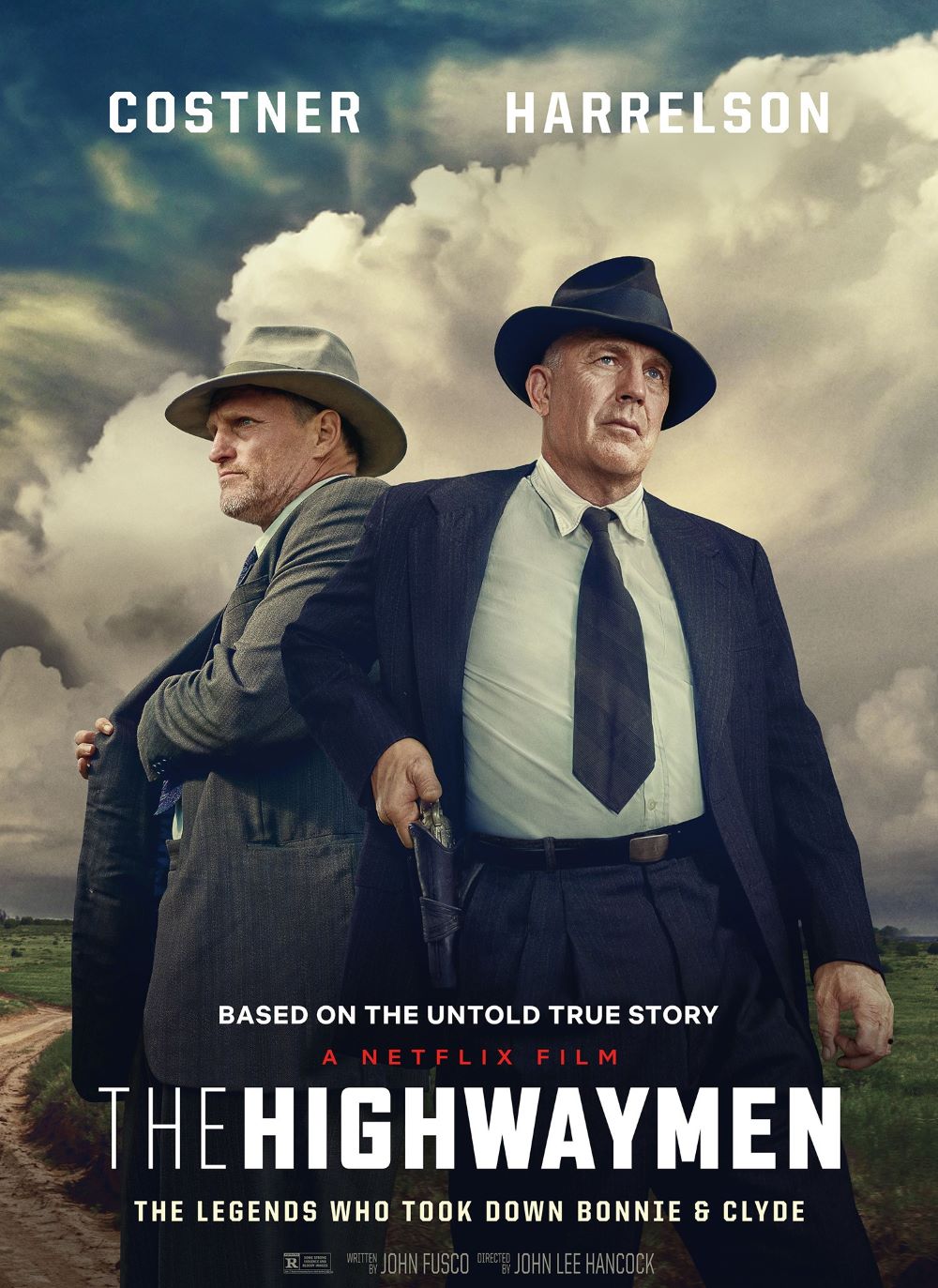
Review: The Highwaymen (dir. by John Lee Hancock)


“People don’t always know who they are… ’til it’s too late.” — Frank Hamer

The Highwaymen, as directed by John Lee Hancock, delivers a character-driven, period crime drama that refreshes a story so often mythologized in American pop culture. Instead of glamorizing Bonnie and Clyde, the film spotlights the two former Texas Rangers tasked with ending their crime spree: Frank Hamer (played by Kevin Costner) and Maney Gault (played by Woody Harrelson). Set against the bleak dustbowl landscape of 1934, the film opens with the criminal duo breaking their associates out of Eastham Prison, setting the state of Texas into a panic. In desperation, Governor “Ma” Ferguson authorizes the return of Hamer, a seasoned lawman whose old-school methods have largely been left behind in modern policing.

From the start, The Highwaymen takes its time, inviting viewers into a slower, more contemplative chase rather than the kinetic action often associated with outlaw stories. Hamer, long retired and resistant to rejoining the fight, is persuaded both by the severity of Bonnie and Clyde’s violence and the humiliation his state faces in failing to catch them. Gault, for his part, is recruited despite his own personal struggles, adding a layer of regret and weariness to their partnership. Their pursuit is marked by straightforward detective work—staking out small towns, following trails, and confronting a public that is strangely captivated by the criminals they hunt. The film repeatedly draws attention to the way crowds and the press elevate Bonnie and Clyde, reflecting on an early version of true crime celebrity culture.

The dynamic between Hamer and Gault forms the emotional core of the movie. Their bond is shaped by years of experience, mistakes, and a real sense of being out of place in a society that now doubts their relevance. There’s plenty of banter and friction, but also reflective moments that dig into the costs of life spent in pursuit of justice. Throughout the investigation, the film uses the Texas and Louisiana landscape as a powerful backdrop—the vast, windswept highways underscore the isolation and existential gravity faced by these lawmen. The cinematography favors wide shots and muted colors, giving the chase a feeling of endlessness and melancholy.

Instead of showcasing Bonnie and Clyde as glamorous anti-heroes, the film keeps them at a distance, rarely granting much screen time or dialogue. Violence is handled abruptly and unsentimentally. When it finally arrives, most notably in the climactic ambush, it is portrayed as brutal and inevitable, reminding the viewer that myths are built on blood and public spectacle. The lawmen’s final confrontation results in the infamous shootout, depicted with documentary-like restraint. The aftermath involves a bullet-riddled car towed through throngs of onlookers—an eerie scene that highlights how tragedy becomes spectacle.

One of the film’s greatest strengths is in its portrayal of moral ambiguity. Both Hamer and Gault operate by principles shaped in a different era. Their methods can be rough and unorthodox; they clash with younger law enforcement and the FBI, whose approaches are more bureaucratic, less personal. The film hints at the toll violence and a lifetime in law enforcement has taken on them, including a poignant story from Gault about a tragic accident in his past. These reflections draw out the muted sadness underlying their pursuit, exploring themes of justice, changing times, and what remains after one’s era passes.

Performance-wise, Costner and Harrelson bring authenticity and gravity to their roles. Their chemistry is quiet and real, developed largely through understated scenes—silent drives, awkward motel breakfasts, and occasional arguments broken up by mutual respect. Supporting roles, like Kathy Bates’s steely governor and John Carroll Lynch’s earnest corrections chief, flesh out the historical setting and institutional pressures.

The film doesn’t always dig as deep as it could into the complexities of Depression-era justice, but its restraint and focus on character make up for that. Rather than indulging in nostalgia or sensationalizing violence, it keeps its lens on the human cost—the consequences for the victims, the weariness of the men trying to restore order, and the strange cultural fascination with outlaws. If you’re looking for a grounded historical drama that trades fast action for thoughtful pacing, and puts working-class grit front and center, The Highwaymen is worth the ride.

Playing Catch Up With The Films of 2017: The Glass Castle (dir by Destin Daniel Cretton)


The Glass Castle, which some people expected to be an Oscar contender until they actually sat through the damn thing, is a film that nearly inspired me to throw a shoe at my television.

Seriously, I was curled up on the couch and watching the movie on TV.  On the screen, Woody Harrelson was playing an obnoxious, selfish alcoholic who resented both his daughter’s success and her boyfriend.  According to the alcoholic who was living in a trash-strewn hovel with his wife, success meant selling out and money was the root of all evil and blah blah blah.  Anyway, the drunk ended up punching his son-in-law.  The very next scene featured the son-in-law whining about getting punched and that’s when I realized that the film somehow expected us to be on the side of the drunken asshole.

I reached down and picked a shoe up from the floor.  I was just about to throw it at the television when my sister Erin reached out from behind me and grabbed my hand.

“Lisa Marie,” she said, “you are not throwing your shoe at the TV.”

“But Errrrrrrrin,” I whined, “this movie really sucks!”

“Well, then write a review about how much it sucks.  But you’re not going to throw another shoe at the TV.”

Reluctantly, I dropped the shoe.  Though I may have been annoyed at the time, I see Erin’s point.  The Glass Castle is not worth losing a shoe over.

The Glass Castle is based on a powerful memoir by Jeannette Wells.  It tells the story of how she and her siblings were raised by an alcoholic father and an artist mother.  It’s a story that’s full of adventure and pathos and everything else that you could hope for from a family memoir.  It’s also a memoir that works because Walls refuses to idealize her life.  Though she writes about how her childhood seemed like a grand adventure when she was actually living it, she’s also very honest about the fact that it really wasn’t.  Though her love for her family comes through on every page, she never shies away from the darker aspects of growing up as American vagabonds.

The film largely takes the opposite approach to the material.  As played by Woody Harrelson and Naomi Watts, Walls’s parents are portrayed as being somewhat lovable eccentrics.  Early on, when her mother’s carelessness leads to young Jeannette being burned and permanently scarred in a fire, there’s a scene where Harrelson compares it to the fire that burns inside of the entire family.  When I realized that we were supposed to be moved by this asinine comparison, I ended up rolling my eyes so hard that the world literally looked like it was upside down for five minutes.  “ARE YOU FUCKING KIDDING ME!?” I yelled at the movie.

This was followed by another scene where, at a public pool, Harrelson attempts to teach Jeanette to swim by repeatedly tossing her into the deep end and nearly drowning her.  And while the film acknowledged that this wasn’t exactly the best parenting technique, it was hard not to feel that we were supposed to think that Harrelson had a point when he said that he was preparing Jeannette to be a strong and independent person who would be able to survive being plunged into the deep end of existence.  “NO!”  I shouted at the TV, “YOU JUST NEARLY DROWNED YOUR DAUGHTER, YOU PRICK!”

(Full disclosure: My Dad once tried the same thing with me.  Fortunately, he only nearly drowned me once — as opposed to Jeannette’s father who just keeps dunking her in the deep end.  Still, it was frightening enough to not only leave me with with an obsessive fear of drowning but it also kept me from ever really learning how to swim.)

When Jeannette grows up, she’s played by Brie Larson, who does a passable Virginia accent and gives about as good a performance as anyone could, considering the script and the direction.  Her husband, David, is played by Max Greenfield.  David is a good, responsible person who doesn’t drink much and who makes a lot of money.  Jeannette’s father looks down on him for those two reasons and the film seems to expect us to do so as well.  But why?  David hasn’t done anything wrong.  He’s certainly not the one who tried to drown his own daughter or who came up with some bullshit explanation about why it was a good thing that she was allowed to burst into flame.  But, if we accept that David’s not a bad guy then we also have to accept that Jeannette’s father is being an asshole.  The film’s not sure how to handle that so instead, we’re just supposed to laugh at David because he gets the worst lines in the script.

It’s a very dishonest film.  Unlike the memoir on which it’s based, it has no interest in honestly examining what it’s like to grow up with an alcoholic.  Instead, it’s too busy giving us Woody Harrelson playing yet another redneck with a drinking problem.  Harrelson does a good enough job but fuck it.  If I want to spend time watching a drunk Woody Harrelson, I’ve got The Hunger Games on Blu-ray.

The Glass Castle ends with footage and pictures of Jeannette’s actual family and, as I watched them, it occurred to me that I would happily watch a documentary about the Walls family.  That would presumably have the honesty that is so lacking in The Glass Castle.