Brad reviews STAR TREK – S1, E10 – “The Corbomite Maneuver!”


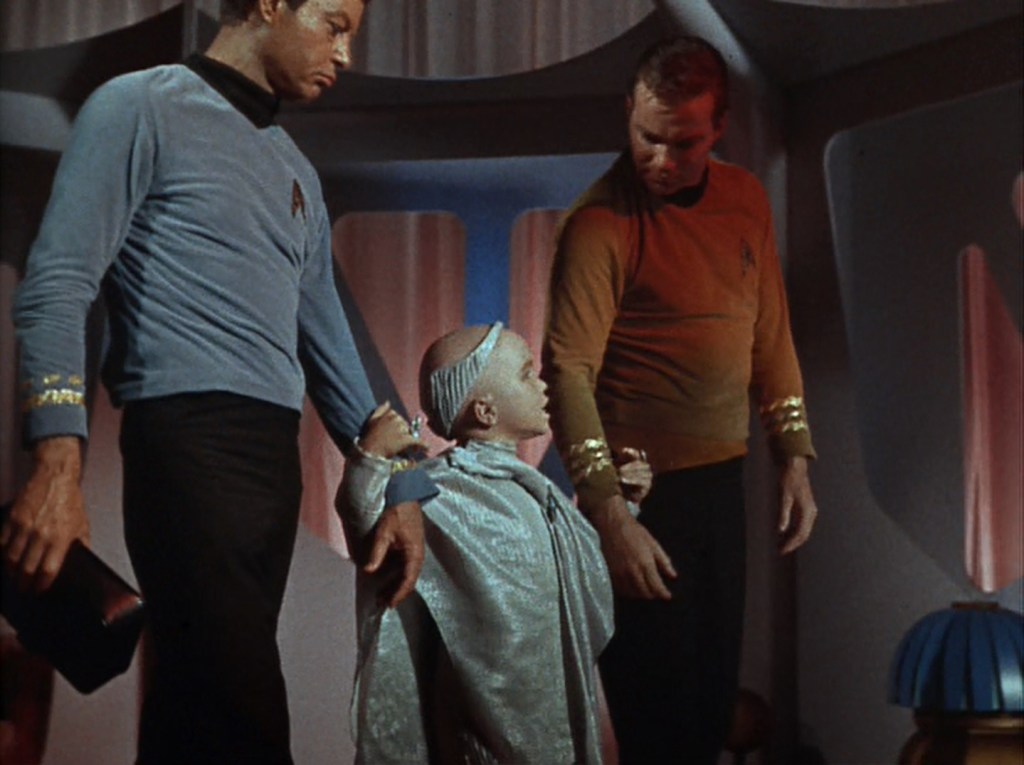
DeForest Kelley, Clint Howard and William Shatner

“The Corbomite Maneuver,” one of the earliest of the original STAR TREK episodes ever filmed, first aired on November 10, 1966. In this episode, the Enterprise, under Captain Kirk’s command, encounters a mysterious cube blocking its path in uncharted space. When attempts to communicate fail, the cube emits radiation, forcing the crew to destroy it. This action provokes a powerful alien vessel, the Fesarius, commanded by Balok, who accuses the Enterprise of trespassing and announces its imminent destruction. Kirk, facing a seemingly unbeatable foe, bluffs by claiming the Enterprise is equipped with a fictional “corbomite” device that would destroy any attacker. As a tense standoff takes place, Kirk’s gamble pays off when Balok blinks first and initiates contact, leading to a somewhat surprising conclusion.

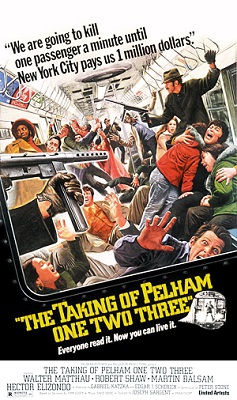
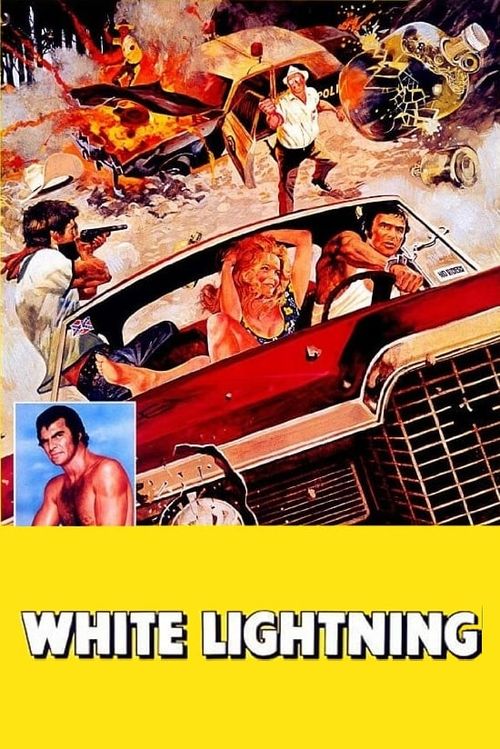
I’ve watched some of the STAR TREK movies and TV shows over the years, but I’m nowhere near what someone would call a “Trekkie.” I do remember watching and liking STAR TREK II: THE WRATH OF KHAN (1982) when I was a kid, and as an adult, I enjoyed the 2009 reboot from J.J. Abrams. I recently read Ron Howard and Clint Howard’s memoir, THE BOYS, and Clint talked about how often fans would bring up his appearance in this specific episode of STAR TREK. Since today, September 8th, is “Star Trek Day,” and the original series is streaming on Paramount Plus, I decided I would see what all the fuss is about. I did think it was pretty cool when I saw that the episode was directed by Joseph Sargent, who would go on to direct a couple of my favorite movies of the early 70’s, WHITE LIGHTNING (1973) and THE TAKING OF PELHAM ONE TWO THREE (1974).

I had a lot of fun watching “The Corbomite Maneuver” for the first time today. From what I’ve read online, many consider this a really strong episode of the original series, and I can see why. The episode builds some pretty strong tension as Balok’s vessel seems so much stronger than the Enterprise, and it seems believable that the crew is really in danger. The special effects seem to be well done for the time period, with the “glowing cube” especially interesting. While there is not a lot of action in the episode, there are solid dramatics and a sense of humor rears its head from time to time. The main cast of William Shatner as Captain Kirk, Leonard Nimoy as Spock, and Deforest Kelly as Bones McCoy provide many of their classic character traits that would lead to them becoming pop culture icons. Shatner’s Kirk exudes extreme confidence amid a seemingly hopeless situation, while Nimoy’s Spock offers his unquestionable logic, and Kelley’s McCoy provides his gruff but loyal empathy. When a seven year old Clint Howard finally shows up as the real Balok in the last five minutes of the episode, I was ready. I got quite the kick out of watching Clint, whose voice is dubbed by a guy named Walker Edmiston, serve the guys a delicious drink named Tranya, a drink he truly relishes. As the episode was ending, my mouth was watering for the tasty looking alien beverage! 

Happy Star Trek Day friends. I truly enjoyed joining in on the celebration for the first time in my life today! 
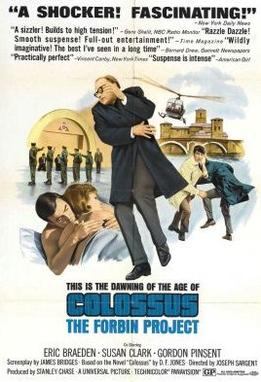
Colossus: The Forbin Project (1970, directed by Joseph Sargent)


Deep in a complex that is hidden away in the Rocky Mountains, Dr. Charles Forbin (Eric Braeden) has put together and programmed a computer called Colossus.  A super computer, Colossus has been designed to control the nuclear arsenal of the United States and its allies.  Colossus will not only keep America safe but it was also remove the chance of human error or human hesitation.  No longer will two men sitting in a silo with a key have to make the decision whether to obey the orders coming from the commander in chief.  No longer will people have to make the split-second decision that could plunge the world into war.

To Forbin’s surprise, the Soviet Union has developed their own super computer, called Guardian.  Colossus asks to be “linked” to Guardian and the Russians agree to allow it as a gesture of good will.  What no one realizes is that both computer systems have become sentient and that they soon decide that humans cannot be trusted to not destroy themselves and the planet.  To Forbin’s horror, Colossus starts to take over the world.

Based on a novel by Dennis Feltham Jones, Colossus was originally filmed in 1968 but it wasn’t released until 1970.  The film looks dated with its gigantic computer but it feels prophetic with its storyline about an AI taking over the world and deciding that it knows better than its makers.  Director Joseph Sargent adroitly mixes science fiction with Bond-style intrigue as Charles Forbin tries to reason with his creation and both the CIA and the KGB try to take down the computers.  The film even tosses a bit of 70s-style paranoia, with both the American and the Soviet governments trying to keep the public from discovering that the supercomputers are trying to take over the world.

Colossus: The Forbin Project is an intelligently written and thought-provoking science fiction film.  Eric Braeden does a great job as Charles Forbin, the engineer who goes from being arrogant and cocky to desperate to finally defiant as his creation slips out of his control.  William Schallert, so often cast as a nice father figure, turns in a good performance as the head of the CIA as does Susan Clark, cast as a colleague who has to pretend to be Forbin’s mistress just so she and Forbin can talk and plot without being monitored by Colossus.

Colossus is a smart sci-fi film that is more relevant than ever.

Scenes that I Love: Walter Matthau Talks To Robert Shaw in The Taking of Pelham One Two Three


100 years ago, on this date, Joseph Sargent was born in New Jersey.  Sargent would go on to become one of the busiest directors of the 70s, 80s, and 90s, working in both film and television.  Though he would never receive the type of critical attention as some of his contemporaries, Sargent was a skilled director who specialized in making entertaining, no-nonsense films.  Though his reputation was tarnished a bit by the fourth Jaws film, it should be remembered that Sargent was also responsible for films like Colossus: The Forbin Project, Tribes, Nightmares, and The Taking of Pelham One Two Three.

1974’s The Taking of Pelham One Two Three has come to be recognized as a genre classic.  It’s certainly one of my favorite films about how New Yorkers will be rude to anyone in any circumstances.  You can see an example of this in today’s scene that I love.  Having hijacked a train, Robert Shaw calls in his last of demands and gets a very New York response.

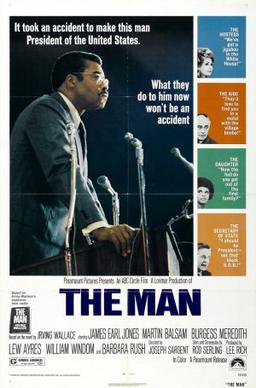
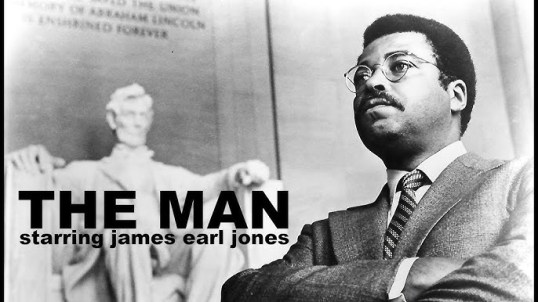
Starring James Earl Jones: The Man (dir by Joseph Sargent)


In 1972’s The Man, James Earl Jones stares as Douglass Dilman.

Dilman is a black college professor and a U.S. Senator.  To his friends, he’s a symbol of progress.  To his enemies, he’s a sell-out who is viewed as being improperly radical.  The U.S. Senate, eager to prove that it’s not a racist institution, has elected Dilman as the President Pro Tempore.  He is now fourth in line for the presidency but that doesn’t concern racist senators like Senator Watson (Burgess Meredith).  A lot would have to happen before Dilman would ever become President.

Needless to say, a lot does happen.

The President and the third-in-line Speaker of the House are attending a conference at a historic building in Frankfort when the roof collapses on them.  We don’t actually see this happen.  We just hear the people in the White House talk about how it’s happened.  We also don’t really learn many details about why the roof collapsed.  Someone nonchalantly says, “It’s an old building.”  Myself, I spent the entire movie waiting for some sort of big revelation of a conspiracy behind the roof collapse but it didn’t happen.  Apparently, in 1972, the Secret Service just let the President go anywhere without checking the place out first.  That said, it’s not a good thing when a serious movie opens with a dramatic plot development that, at the very least, draws a chuckle from the audience.  Seriously, we lost our President because a roof fell on him?  How is America ever going to live that down>

Vice President Noah Calvin (Lew Ayres) is wheeled into the White House cabinet room.  This was not the first time that a Ayres played a Vice President called upon to succeed the President.  Unlike in Advice and Consent, the Vice President announced that he cannot accept the honor of being sworn in because he’s too sick.  (Since when does the Vice President have the option to refuse to do his Constitutional duty?)  With Calvin putting the country ahead of his own ambition, Senator Watson announces that Secretary of State Eaton (William Windom) will be the new President.  No, Eaton says, Dilman will be the new president.  But once Dilman screws up and is either impeached or resigns, fifth-in-line Eaton will be sworn in.

Except …. it wouldn’t work that way.  Excuse me while I put my history/political nerd hat on….

First off, Calvin is apparently still Vice President so if Dilman did step down, Calvin would once again be the successor.  What if Calvin refused a second time?  As soon as the Speaker of the House died, the House of Representatives would elect a new Speaker and that person would be third-in-line.  And, as soon as Dilman became President, the Senate would elect a new President Pro Tempore and that person would be fourth-in-line.  In other words, Eaton is no closer to being President than he was before.

My reason for going  into all of this is to illustrate that The Man is a film about American politics that doesn’t really seem to know much about American politics.  That said, it does feature the great James Earl Jones as Douglass Dilman and Jones gives such a good and thoughtful performance that it almost doesn’t matter that no one else in the film seems to be taking it all that seriously.  Jones plays Dilman as being a careful and cautious man, one who understands that he occupies a huge place in history (Barack Obama was only 11 years old when this film came out) but whose main concern is just doing a good job as President.  Dilman finds himself in the middle.  On one side, he has advisors warning him not to scare America by being too radical.  On the other side, his activist daughter (Janet MacLachlan) brands Dilman a sell-out.  When a black student named Robert Wheeler  (Georg Stanford Brown) is arrested for assassinating a South African government official, Dilman’s first instinct is to believe Wheeler’s been framed but, as the film progresses, doubts start to develop and Dilman must decide whether or not to risk an international incident.  It’s an interesting story, well-played by James Earl Jones and Georg Stanford Brown.

It was originally mean to be a made-for-TV movie but, in order to capitalize on the excitement on the 1972 presidential election, it was released into theaters.  As a result, the film often has the cheap look of a made-for-TV movie and quite a few members of the cast give performances that feel more appropriate for television than the big screen,  (Some members of the cast, like Burgess Meredith, just overact with ferocious abandon.)  In the end, The Man is mostly of interest from a historical point of view.  (In 1972, the idea of a black man being elected President seemed so unrealistic that the movie actually had to drop the roof on 50% of the government just to get Dilman into the Oval Office.)  James Earl Jones, who would have turned 94 today, is the main reason to watch.

WHITE LIGHTNING – #ArkansasMovies, my celebration of movies filmed in the Natural State!


I love watching movies that are filmed in my home state of Arkansas. There’s something cool about seeing places I’ve been before showing up on the big screen, and if I haven’t been there before, I can go visit. We’ve had our share of big stars show up in the Natural State. Burt Reynolds, Billy Bob Thornton, Bill Paxton, Robert De Niro, Dennis Quaid, Matthew McConaughey, Tom Cruise, and Andy Griffith have all filmed really good movies here. Heck, Martin Scorsese directed one of his very first movies in southern Arkansas. It’s going to be fun revisiting some of my favorites and sharing them with you!

I’m kicking off #ArkansasMovies with WHITE LIGHTNING, the 1973 film from director Joseph Sargent that was filmed almost entirely within 30 minutes of my house in central Arkansas. Burt Reynolds is Gator McKlusky, a good ol’ boy who happens to find himself serving a stint in prison for “stealin’ cars, runnin’ cars, and runnin’ moonshine whiskey.” One day a cousin comes to visit him in prison and tells him that his younger brother Donny has been killed in Bogan County. Suspecting foul play, Gator first tries to escape. When that doesn’t work, he agrees to go stool pigeon and work with the federal authorities to infiltrate the world of illegal moonshining in Bogan County and provide them the names of the big money people in the area. This includes the crooked county Sheriff J.C. Connors (Ned Beatty), who Gator immediately zeroes in on as the key person responsible for his brother’s death.

In my opinion, WHITE LIGHTNING is one of the best of the good ‘ol boy, southern redneck films that were so popular in the 1970’s. One of the main reasons I like WHITE LIGHTNING so much is that while it does has some of the clowning that’s expected in these types of films, the tone gets deadly serious as McKlusky zeroes in on what happended to his brother. Reynolds is especially badass when he stops his signature laughing and goes into vengeance mode. And Ned Beatty is perfect casting as the small-town sheriff who is completely and irredeemably evil. The opening scene shows Beatty boating a couple of bound and gagged young men out into the middle of the lake, shooting a hole in the their boat, and then casually paddling away as the boat sinks. If you came up on him a little later, you’d think he was just heading in from a day of crappie fishing. For a guy that doesn’t look menacing at all on first glance, we know just how dangerous Sheriff J.C. Connors is. And so does Gator. We have a rooting interest in seeing Gator get his revenge.

The primary filming locations in WHITE LIGHTNING are practically in my backyard. My wife and I got married at the Saline County Courthouse in downtown Benton, which is featured very prominently in the film. It’s a beautiful courthouse, with a distinctive clock tower. They decorate it so beautifully for the Christmas season (see picture below). Burt also spends time at the “Benton Speedway” in the film.  This is actually the old I-30 Speedway that was in operation in Little Rock for 66 years. Sadly, the Speedway held its final race on October 1, 2022, which is almost 50 years after filming completed. The rest of the locations used were also in central Arkansas in the towns of North Little Rock, Keo, Scott, Wrightsville, and Tucker. FYI, I don’t recommend poking around Tucker if you’re into film tourism. Tucker is the primary prison unit for the Arkansas Department of Corrections. If you do head that way, just don’t pick up any hitchhikers!

All in all, WHITE LIGHTNING is a movie I whole-heartedly recommend, and it’s especially meaningful to me since it’s so close to home. Billy Bob Thornton would be back in this same area in 1996 to film SLING BLADE.

Scenes that I Love: Walter Matthau Talks To Robert Shaw in The Taking of Pelham One Two Three


98 years ago, on this date, Joseph Sargent was born in New Jersey.  Sargent would go on to become one of the busiest directors of the 70s, 80s, and 90s, working in both film and television.  Though he would never receive the type of critical attention as some of his contemporaries, Sargent was a skilled director who specialized in making entertaining, no-nonsense films.  Though his reputation was tarnished a bit by the fourth Jaws film, it should be remembered that Sargent was also responsible for films like Colossus: The Forbin Project, Tribes, Nightmares, and The Taking of Pelham One Two Three.

1974’s The Taking of Pelham One Two Three has come to be recognized as a genre classic.  It’s certainly one of my favorite films about how New Yorkers will be rude to anyone in any circumstances.  You can see an example of this in today’s scene that I love.  Having hijacked a train, Robert Shaw calls in his last of demands and gets a very New York response.

Film Review: The Taking of Pelham One Two Three (dir by Joseph Sargent)


Welcome to New York in the 1970s!  While the intellectuals flock to the latest Woody Allen movie and the wealthy throw radical chic parties in Manhattan and disturbed young men drive taxis at night and pray for a real flood to clear away all the vermin, most of the city’s citizens are just trying to make it through the day.  For many of them, that means spending an hour or two riding the subway.  In some ways, the subway is the great equalizer.  The minute that you sit down on a filthy train car, it doesn’t matter how old you are or how you vote or the color of your skin.  All that matter is finding a way to avoid making eye contact with anyone else.

Four men, all wearing obvious disguised, board the downtown Pelham 1-2-3 train.  They all look suspicious but, this being New York, no one wants to make eye contact.  Everyone just wants to reach their next stop.  The men — who are known as Mr. Blue (Robert Shaw), Mr. Green (Martin Balsam), Mr. Grey (Hector Elizondo), and Mr. Brown (Earl Hindman) — have other plans.  Revealing that they’re armed, they take the 18 passengers of the first car hostage.  Their leader, Mr. Blue, has a simple demand.  He wants a million dollars to be delivered to the car within an hour.  If the money’s late, he will kill one hostage every minute, until he receives what he wants.

While the cold-stricken mayor (Lee Wallace) tries to figure out how to 1) raise a million dollars and 2) handle the situation without losing any potential votes in his reelection campaign, Lt. Zach Garber (Walter Matthau) communicates with Mr. Blue via radio.  With Mr. Blue underground and Zach above ground, the two of them establish a cautious rapport.  Robert Shaw plays Blue as being efficient, polite, but ruthless while Walter Matthau plays Garber with his usual rumpled but intelligent style.  As embodied by Matthau, Garber is New York City in human form while Shaw is perfectly cast as the outsider who, for at least an hour or two, has managed to bring the city to its knees.

Even though the original The Taking of Pelham One Two Three is often described as being a Walter Matthau film or a Robert Shaw film, the film’s main character actually is the city of New York City.  The film portrays the city as being chaotic, angry, and unpredictable but, at the same time, also resilient and strong.  Yes, Garber may spend a lot of time bickering with his co-workers but, in the end, he and Lt. Rico Patrone (Jerry Stiller, another great New York figure) work together to do what has to be done to resolve the situation.  For all the time that’s spent on how Mr. Blue and his compatriots take that train hostage, just as much time is spent focusing on how the police, the politicians, and the Transit Authority react to what’s happened.  Not having any firsthand knowledge of the New York subway system (beyond being told not to use it when I was in NYC a few years ago), I can’t say whether or not the film is realistic but what’s important is that it feels realistic.  Even though the film is full of familiar character actors, it still seems as if you’re just watching a bunch of New Yorkers having a very long day.  Though guns are fired and there is a runway train, The Taking of Pelham One Two Three takes a refreshingly low-key approach to its story.  There’s no huge action set pieces.  The film’s classic final shot hinges not on Garber’s marksmanship but instead on his ability to remember the small details.

The Taking of Pelham One Two Three is one of my favorite heist movies.  It’s well-acted.  It’s got an interesting plot.  It’s got a few moments of unexpected humor.  Robert Shaw is a great (and, at times, almost compelling) villain while Walter Matthau and Jerry Stiller make for a great detective team.  The great Martin Balsam also turns in a wonderful turn and, even though he’s playing a bad guy, it’s hard not to sympathize him.  You need only see his apartment to understand why exactly he felt the city of New York owed him more than it had given him.  Best of all, The Taking of Pelham One Two Tree is a tribute to a great American city.  The Taking of Pelham One Two Three celebrates New York City in all of its rude, messy, and brilliant glory.

Spring Breakdown: Jaws: The Revenge (dir by Joseph Sargent)


The 1987 film, Jaws: The Revenge, opens with Amity Island (last seen in Jaws 2) preparing to celebrate Christmas.  Longtime police chief and veteran shark hunter Martin Brody has died but his widow, Ellen (Lorraine Gary), still lives on the island.  Also living on the island is Ellen’s youngest son, Sean (Mitchell Anderson).  Sean is now a deputy and he spends a lot of time patrolling the ocean.  This worries Ellen because the Brodys don’t exactly have the best luck when it come to the water….

Or continuity for that matter!  Anyone who has seen Jaws 3-D knows that Sean Brody moves down to Florida, became a cowboy, hooked up with Lea Thompson, and worked with his older brother at Sea World.  And yet, as Jaws: The Revenge opens, Sean is suddenly back in Amity, he’s not a cowboy, and he’s engaged to someone who is not Lea Thompson.  Throughout the film, no mention is made of Sean having ever gone to Florida or going through a cowboy phase.  Basically, this film ignores the entire existence of Jaws 3-D.  That would be okay if Jaws: The Revenge was actually a better film than Jaws 3-D but it’s not.  That’s right, Jaws The Revenge fails to even improve on Jaws 3-D.

Anyway, Sean goes out on patrol and promptly gets eaten by a shark.  Ellen loses her mind at the funeral and announces that she doesn’t want her oldest son, Michael (Lance Guest), going anywhere near the water.  Unfortunately, Michael is working in the Bahamas as a marine biologist so …. well, sorry, grandma.

Perhaps to try to help Ellen get over her fear of water, Michael brings Ellen back to the Bahamas with him.  Ellen gets a chance to spend some time with her daughter-in-law, Carla (Karen Young) and her granddaughter, Thea (Judith Barsi).  Ellen also pursues a tentative romance with the local pilot, Hoagie (Michael Caine, who gives a likable performance but who also has absolutely zero romantic chemistry with Lorraine Gary).  However, Ellen still has nightmares about the ocean and she suspects that the shark that killed Sean might be on its way to the Bahamas.  Why?  Because this time it’s personal!

Actually, as crazy as that sounds, it turns out that Ellen’s right.  Unfortunately, it takes the shark a while to get down there and, as such, the audience spends a lot of time watching Ellen, who was always the least interesting character in all of the Jaws films, wander around the Bahamas.  The island scenery is lovely but when you’re watching a Jaws movie, you’re watching for the shark action.  Jaws: The Revenge is only a 90-minute film and the shark doesn’t make its second appearance until the 50 minute mark.

Once the shark does show up, of course, it gets right down business.  It eats a swimmer.  It eats an airplane.  It sinks a boat.  At one point the shark bites someone in half and someone off-screen is heard to shout, “Get a doctor!” as if a doctor is going to be able to do much in that situation.  Ellen sets out to get some revenge of her own, which would be a thrilling moment if Ellen was as iconic a character as Jaws: The Revenge seems to think that she is.  My favorite moment is when Michael Caine reveals that, despite the odds, he somehow managed to avoid getting eaten by the shark.  When someone asks him how he did it, he replies, “It wasn’t easy …. bloody Hell,” and that’s pretty much all that’s said about it.

Ultimately, though, this is the least of the four Jaws films, duplicating neither the suspense of the first two films nor the camp silliness of the third film.  Fortunately, though this film may have been the last official sequel to Jaws, the legacy of the classic original will live forever.

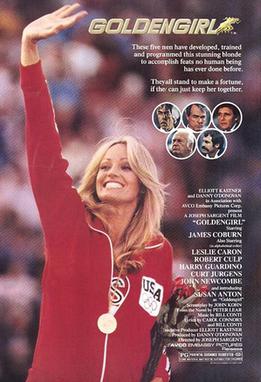
An Olympic Film Review: Goldengirl (dir by Joseph Sargent)


The 1979 film Goldengirl is a film that I had wanted to see ever since I first came across this trailer on one of the 42nd Street Forever compilation DVDs:

Wow, I wondered.  What was Goldengirl’s secret and why was she ordering James Coburn to kiss her feet?  For that matter, why did James Coburn have a haircut that made him look exactly like this old lady who used to live next door to my grandma in Fort Smith?  What did it all have to do with the villain from The Spy Who Loved Me and just how drunk was Robert Culp when he shot his scenes?  Even more importantly, why did Goldengirl keep running into that wall?  That looked painful!

I did some research.  (That’s a fancy way of saying that I looked the movie up on Wikipedia.)  I discovered that Goldengirl was made in 1979.  It was originally meant to be a television miniseries that would not only air during the 1980 Summer Olympics but which would feature Goldengirl competing at those Olympics!  However, during production, it was decided to just use the material for a feature film instead. (Hmmmm, I thought, behind-the-scenes drama!  Intriguing!)  The film was released in June of ’79 and, despite one rave review from Vincent Canby in the New York Times, the film failed at the box office.  Add to that, the U.S. ultimately boycotted the 1980 summer games, which made Goldengirl‘s Olympic-set climax a bit awkward.

I also discovered that Goldengirl is nearly impossible to see.  It’s never been released on DVD or Blu-ray or any digital or streaming service.  So, I resigned myself to the fact that I’d probably never see Goldengirl and, the more I thought about it, the more I realized that I really didn’t care that much.

However, for the past few days, I have been absolutely obsessed with the Winter Olympics.  Even though it was a Summer Olympic movie, I decided to go on YouTube and see if anyone had uploaded Goldengirl since I last checked.

And guess what?

They had!

Now, here’s the problem.  The two guys who uploaded Goldengirl also talked over the entire movie.  Don’t get me wrong.  The movie looked about as good as a VHS copy of a movie from 1979 is ever going to look.  And I could still follow Goldengirl‘s story, even if I sometimes had to really strain to hear the dialogue over the two guys “commenting” on it.  Still, it meant that I had to put a bit more effort into watching this movie than it perhaps deserved.  It was kinda hard not to resent that.

Anyway, I have finally seen Goldengirl and I can now tell you that it’s a pretty lousy movie.  Goldengirl is Goldine (Susan Anton).  Her father is a German scientist who used to work for the Nazis.  When he came to the United States, he decided to prove that his theories of eugenics were correct by adopting a daughter and breeding her to be the world’s greatest athlete.  Working with a psychiatrist named Dr. Lee (Leslie Caron, for some reason), they have not only turned Goldine into the world’s greatest athlete but they’ve also turned her into a bright, smiling media personality.  (Dr. Lee has trained Goldine, through the use of a vibrator, to always give the right answer when she’s asked a question.)  Now, they just need Goldine to win three gold medals at the Summer Olympics and for PR agent Jack Dryden (James Coburn) to make Goldine into a star.  Dryden is the only person who really cares about Goldine as something other than an experiment or a way to make money.

Goldine spends almost the entire movie running.  There’s one running montage that seems to go on forever.  Susan Anton was a model when she was cast as Goldine.  She’s got the right look to be a celebrity but she’s never convincing as an Olympic-class athlete.  Whenever Goldine competes, we either get a close-up of Anton running in slow-motion with no other runners around her or else a long-shot that’s designed to keep us from noticing that Anton isn’t really on the track.

Really, that’s entire film.  On the basis of the trailer, I was expecting that Goldengirl would turn out to be a robot or something like that.  Instead, it just turns out that her stepfather has spent years injecting her with vitamins and hormones and now, as a result, she has diabetes.  Seriously, that’s it.  She gets pretty mad when she finds out that her handlers have put her health at risk just so she could win a race.  But then she goes ahead and runs the race anyway so I guess it was all for the best.  Seriously, that’s the entire freaking movie.  It doesn’t help that Anton’s acting is amateurish and the rest of the cast seems bored.  Only Curt Jurgens really makes much of an impression, mostly because he’s too sinister not to be memorable.

The trailer is better than the movie.  That’s the secret of Goldengirl.

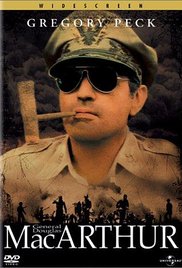
A Movie A Day #326: MacArthur (1977, directed by Joseph Sargent)


The year is 1962 and Douglas MacArthur (Gregory Peck), the legendary general, visits West Point for one last time.  While he meets the graduates and gives his final speech, flashbacks show highlights from MacArthur’s long military career.  He leaves and then returns to Philippines.  He accepts the Japanese surrender and then helps Japan rebuild and recover from the devastation of the war.  He half-heartedly pursues the Presidency and, during the Korean War, gets fired by Harry Truman (Ed Flanders).

MacArthur is a stolid biopic about one America’s most famous and controversial generals.  It was produced by Frank McCarthy, a former general who knew MacArthur and who previously won an Oscar for producing Patton.  McCarthy was obviously hoping that MacArthur was do its subject what Patton did for George Patton and both films follow the same basic pattern. a warts-and-all portrait of a World War II general with all of the action centered around the performance of a bigger-than-life actor in the title role.  Though obviously made for a low budget, MacArthur is a well-made and well-acted movie but it suffers because Douglas MacArthur was just not as interesting a figure as George Patton.  Gregory Peck does a good job subtly suggesting MacArthur’s vanity along with capturing his commitment to his duty but he never gets a scene that’s comparable to George C. Scott’s opening speech in Patton.  The main problem with MacArthur, especially when compared to Patton, is that George Patton was a born warrior while Douglas MacArthur was a born administrator and it is always going to be more exciting to watch a general lead his men into battle then to watch him sign executive orders.