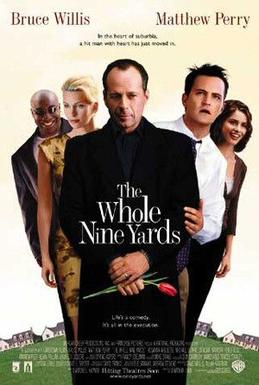
Oz (Matthew Perry) is an unhappily married dentist who discovers that his new neighbor, Jimmy (Bruce Willis), is a notorious contract killer who has a bounty on his head. Oz’s wife, Sophie (Rosanna Arquette), wants Oz to rat Jimmy out to the local mob boss (Kevin Pollack) and collect the bounty. Oz is deeply in debt and has a hard time saying no to his wife but he and Jimmy have actually become friends. Also, Oz is falling in love with his dental assistant, Jill (Amanda Peet) despite the fact that Jill is also a contract killer, though she’s still a “virgin” because she’s falling in love with the man that she was hired to kill.
The Whole Nine Yards is an amusing comedy that works because of the chemistry between Matthew Perry and Bruce Willis. When it came to his movie career, Perry was always Chandler Bing no matter who he was playing but that didn’t matter because everyone loved Chandler. I know I loved Chandler, even if Joey would have been the Friend that I probably would have ended up flirting with. Perry was a naturally funny actor and he and Willis made for a good team in The Whole Nine Yards. I also really liked Amanda Peet’s energetic performance as Jill and Kevin Pollack as the crime boss. The Whole Nine Yards is basically a violent sitcom. It may not be a great movie but Perry and Willis will make you laugh.
It’s a little hard to rewatch now. Matthew Perry is gone. Bruce Willis is retired for health reasons. They’re both having so much fun in this movie and are so entertaining to watch that it’s impossible not feel a little sad watching them. But the movie also shows what Perry and Willis could do, even with so-so material. Watching the movie made me laugh and it made me sad but mostly it just made me appreciate their talent. We can mourn what we’ve lost while still appreciating what we had.
4 (or more) Shots From 4 (or more) Films is just what it says it is, 4 (or more) shots from 4 (or more) of our favorite films. As opposed to the reviews and recaps that we usually post, 4 (or more) Shots From 4 (or more) Films lets the visuals do the talking.
Today, we wish a happy birthday to the great actor, Joe Pesci! It’s time for….
4 Shots From 4 Joe Pesci Films
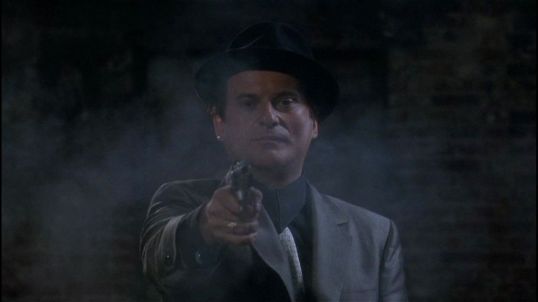
Goodfellas (1990, dir by Martin Scorsese, DP: Michael Ballhaus)
JFK (1991, dir by Oliver Stone, DP: Robert Richardson)
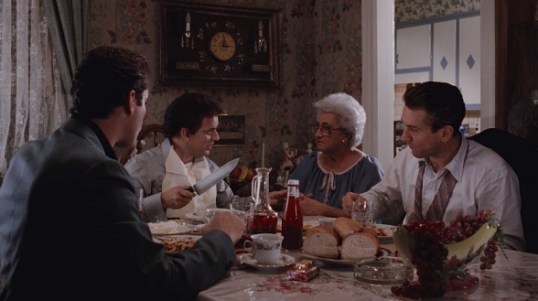
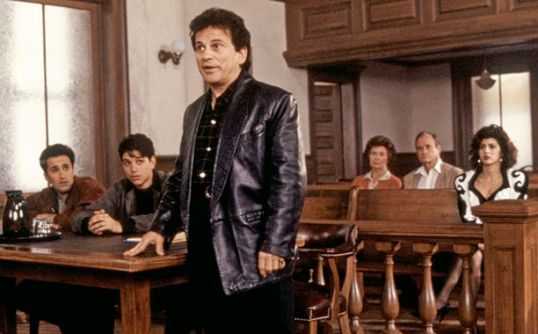
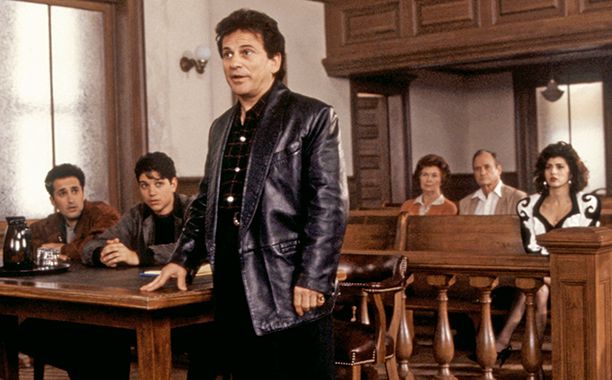
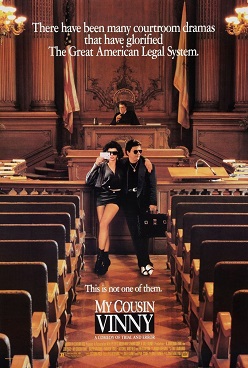
My Cousin Vinny (1992, dir by Jonathan Lynn, DP: Peter Deming)
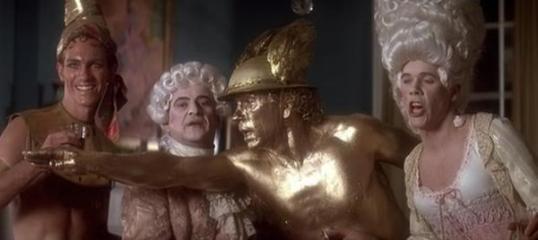
Casino (1995, dir by Martin Scorsese, DP: Robert Richardson)
There are certain movies in my life that I consider “comfort movies.” These are the movies that I love so much that they always help me relax because I feel better just by watching them. I often turn on a comfort movie when I really need to fall asleep. Examples in my life include most of Charles Bronson’s filmography, RIO BRAVO, the ZATOICHI films, THE OTHER GUYS, and pretty much anything directed by Alex Kendrick. MY COUSIN VINNY fits comfortably under my categorization of a comfort movie.
The movie opens with friends Bill Gambini (Ralph Macchio) and Stanley Rothenstein (Mitchell Whitfield) taking the scenic route down south as part of a cross-country trip to attend college at UCLA. Unfortunately, while in Alabama, the two are arrested soon after leaving a convenience store. Thinking they are being charged for accidentally shoplifting a can of tuna, it turns out the actual charges are robbery and murder as the place was robbed and the clerk killed soon after they left. Knowing they are in big trouble, Bill calls his cousin Vinny Gambini (Joe Pesci), who’s pretty much the only lawyer that he knows. The problem, Vinny has never actually tried a murder case. Vinny heads down south with his fiance Mona Lisa Vito (Marisa Tomei) where he must contend with a judge (Fred Gwynne) who doesn’t like him, a prosecutor (Lane Smith) who has way more experience than him, and a mountain of circumstantial evidence that he has almost no hope of contradicting. Will Vinny be able to prove his cousin’s innocence before they end up with life in prison, or even worse?
There are many reasons that I love MY COUSIN VINNY. The cast consists of a couple of my personal favorite actors in Joe Pesci and Ralph Macchio. GOODFELLAS is certainly one of the best movies ever made, and Joe Pesci gives an unbelievably powerful performance, a performance that would win him the Academy Award. Pesci took a short break from filming MY COUSIN VINNY to attend the Acadamy Award ceremony and pick up the gold. He even took the statue to the set to show the cast and crew. Maybe that helped inspire Marisa Tomei to give her own Academy Award winning performance in this film. My favorite scene of the entire movie is when Vinny is treating Mona Lisa as a hostile witness on the stand, just before she proceeds to prove that nobody knows more about cars than she does. It’s such a satisfying scene as she makes the prosecutor’s “expert” look like a novice. As for Ralph Macchio, many times in my life I’ve made the statement that I wanted to be the karate kid when I was growing up. I think I was in the fifth grade when I saw the film for the very first time. I’ve been a fan of Ralph Macchio, and in love with Elisabeth Shue, ever since. It’s the kind of movie I’d just sit around thinking about when I was a kid. I even wanted to learn karate, but being just a little over 4 feet tall at the time, I didn’t need to be getting into any fights. I also like that MY COUSIN VINNY was partially filmed in the town of Covington, GA. My wife and I were driving from Arkansas to Myrtle Beach back in 2020 and we stayed the night in Covington. I had done a little research while I was looking for a place to stop for the night, and I found out that Covington is sometimes referred to the “Hollywood of the South” due to the large number of movies and TV shows that are filmed there. We snapped a couple of shots of the downtown before heading on down the road. But I think the thing I love most about MY COUSIN VINNY is also the reason I love movies like THE KARATE KID and ROCKY so much. I love movies where a person is completely underestimated, and rightfully so. But then, through some combination of intelligence, hard work, heart, and will, that same person is able to rise to the occasion and prevail against those very same people who underestimated them. Vinny has no business in the courtroom, but somehow, he’s able to win the case, and he does it in a smart, funny and exciting way. I love an underdog, and MY COUSIN VINNY just makes me feel good!
In the 1992 film, My Cousin Vinny, two college students from New York City, Bill Gambini (Ralph Macchio) and Stan Rothstein (Mitchell Whitfield), make the mistake of driving through Alabama. The two students stop off at a convenience store. When the clerk is subsequently shot dead during a robbery, Bill and Stan are arrested for the crime. The viewers know they’re innocent. Bill and Stan know they’re innocent. But the entire state of Alabama seems to be determined to send Bill and Stan to prison for life.
Fortunately, Bill’s cousin, Vinny (Joe Pesci, star of Half Nelson), is a lawyer. Unfortunately, he just recently passed the bar exam and he has yet to actually try a case. Still, Vinny and his fiancée, Mona Lisa Vito (Marisa Tomei), come down to Alabama. Vinny takes the case, lying to the judge (Fred Gwynne) about his qualification as a trial attorney. Vinny is momentarily impressed when the prosecutor (Lane Smith) shares with him all of the files about the case. “It’s called disclosure, dickhead!” Lisa snaps at him, revealing that she actually has more common sense than Vinny. That becomes increasingly important as Vinny tries to keep Bill and Stan from spending the rest of their lives in prison.
To be honest, considering how much I complain about stereotypical portrayals of the South, I really shouldn’t like My CousinVinny as much as I do. Almost every character in the film is a stereotype to some extent or another, from the farmers and rednecks who take the witness stand to Fred Gwynne’s no-nonsense judge who rules that Vinny is in contempt of court because he’s wearing a leather jacket. Fortunately, though, the Southern stereotypes don’t bother me because both Vinny and Lisa are New York stereotypes. Just as the judge and the townspeople seem to confirm every prejudice that someone like Vinny would have against the South, Vinny seems to be the epitome of everything that people in the South dislike about the North. When Vinny first shows up on the scene, he’s loud and brash and obnoxious. But, as the film progresses, Vinny reveals himself to not only be a better attorney than anyone was expecting but he also calms down and adjusts to the more relaxed pace of life in the country. Just as Vinny reveals himself to be not as bad as everyone originally assumed, both the Judge and the prosecutor are also allowed to reveal some hidden depths. Neither one is the cardboard authority figure that viewers might expect. The Judge does sincerely want justice to be done and the prosecutor sincerely wants to keep the county safe, even if he is prosecuting two innocent men. Just as Vinny learns not to be too quick to judge them, they learn not to be too quick to judge Vinny. The end message is that everyone is innocent until proven guilty and deserves a fair hearing, whether in a court of law or just in the courts of public and private opinion. It’s not a bad message. In fact, it’s one that more than a few people could still stand to learn today.
Of course, the best thing about the film is Marisa Tomei, who not brings a lot of energy to the film but whose hair is amazing and whose clothes are to die for. Tomei won an Oscar for her performance in My Cousin Vinny, a victory that was so controversial that there were unfounded rumors that presenter Jack Palance had read the wrong name by mistake. (As we all learned a few years ago when Warren Beatty and Faye Dunaway actually did read the wrong winner, the accountants aren’t going to let anyone get away with that.) Watching the film last night, it was obvious to me that Tomei deserved that Oscar because Lisa is the heart of the film. Pesci, Gwynne, and Lane Smith are all give good performances but, without Marisa Tomei’s performance, My Cousin Vinny would ultimately just be another culture clash comedy. A lesser actress would have just played Lisa as being a stereotype. But Tomei turned Lisa into the most believable and sincere character in the film. While Lisa won the case, Tomei saved the movie.
(And needless to say, I’m a fan of any movie that features a Lisa saving the day.)
My Cousin Vinny holds up as an enjoyable film. Watch it the next time you’re losing faith in humanity.
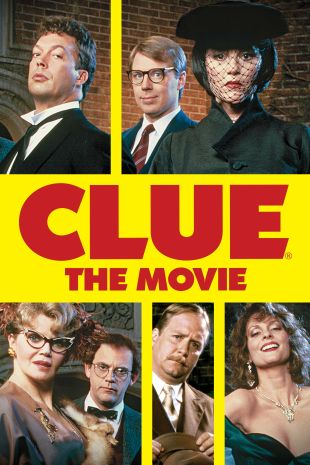
The 1985 comedy, Clue, opens with a set of six strangers arriving at an ominous mansion in New England. They’re meet by Wadsworth (Tim Curry), an oddly charismatic butler who explains that all six of the strangers have a few things in common. They all work in Washington D.C. They are all, in some way, involved with the government. And they’re all being blackmailed by Mr. Boddy (Lee Ving), the owner of the house.
The six strangers have all been assigned nicknames for the night.
Miss White (Madeleine Khan) is the enigmatic widow of a nuclear physicist who may have had communist sympathies. Actually, Miss White is a widow several times over. All of her husbands died in circumstances that were a bit odd. Is Miss White a black widow or is she just unlucky? And what about the flames of jealousy that she occasionally mentions?
Professor Plum (Christopher Lloyd) is a psychiatrist who once worked for the World Health Organization and who has an unfortunate habit of sleeping with his patients.
Mr. Green (Michaele McKean) explains that he works for the State Department and that he is also secretly gay. If his secret got it, he would be deemed a security risk or perhaps even a communist agent.
Mrs. Peacock (Eileen Brennan) is the wife of a U.S. Senator who forced to resign after getting caught up in a bribery scandal.
Colonel Mustard (Martin Mull) is a somewhat stuffy war hero-turned-arms dealer.
And finally, Miss Scarlet (Lesley Ann Warren) is Washington D.C.’s most powerful and most witty madam.
Once everyone is in the house, Wadsworth explains that the police have been called and will arrive in 45 minutes, at which point Mr. Boddy will be arrested and everyone’s secrets will be exposed. Mr. Boddy’s solution is to suggest that one of the six kills Wadsworth. After tossing everyone a weapon, Mr. Boddy turns out the lights. When the lights come back on, Wadsworth is still alive but Mr. Boddy is not. But who murdered Mr. Boddy? And in what room? And with what weapon? And what to make of the other people who were either in the house or show up at the front door, like the maid, Yvette (Collen Camp), or the motorist (Jeffrey Kramer) who shows up to use the phone or the traveling evangelist (Howard Hesseman)? Can the mystery be solved before the police show up and presumably arrest everyone?
Based on the old board game, Clue is a hilariously exhausting film, one that mixes smart wordplay and broad physical comedy to wonderful effect. It’s not often that you see a film that gets equal laughs from two people colliding in a hallway and from characters accusing each other of being communists. In fact, it’s so easy to marvel at the physical comedy (especially the lengthy scene where Tim Curry runs from room to room while explaining his theory about who committed the murders) that it’s easy to forget that the film is also a sharp satire on political corruption, national paranoia, 50s morals, and the McCarthy era in general. Since all of the characters are already convinced that they’re either surrounded by subversives or in danger of being accused of being a subversive themselves, it’s not a great leap for them to then assume that any one of them could be a murderer. I mean, if you’re willing to betray your country than who knows what you might be willing do in the study with a candlestick?
The cast is full of comedy veterans, all of whom know how to get a laugh out of even the mildest of lines and none of whom hold back. Madeline Kahn, in particular, is hilarious as Miss White though my favorite suspect, in both the game and the movie, has always been Miss Scarlet. Not only is she usually portrayed as being a redhead in the game but, in the movie, her dress is to die for. In the end, though, it’s perhaps not a surprise that the film is stolen by Tim Curry’s energetic performance. The film’s final 15 minutes are essentially a masterclass in physical comedy from Tim Curry but he’s just as funny when he’s delivering his frequently snarky dialogue. Both Wadsworth the character and Tim Curry the actor appear to be having a blast, running from room to room and shouting out accusations.
When Clue was originally released, it was released with three different endings. Apparently, the audience wouldn’t know which ending they were going to get before the movie started. I guess that the idea was to get people to go the movie three times to see each ending but I imagine few filmgoers had the patience to do that and who knows how many viewers went to multiple showings just to discover that the randomly selected ending was one that they had already seen. I’m surprised that I haven’t come across any reports of riots breaking out. Fortunately, the version of Clue that is now available for viewing features all three endings. Of course, none of the endings make much sense. Hercule Poirot would demand a do-over, especially if he was being played by Kenneth Branagh. But the fact that it’s all so ludicrous just adds to the comedy. I watched Clue two Fridays ago with a group of friends and we had a blast. It’s definitely a movie that’s more fun when you watch it with other people.
(That said, as far as incoherent solutions are concerned, the third one was my favorite and I think Poirot would agree.)
As for the board game itself, I used to enjoy playing it when I was a kid. We had really old version from the 60s and I always used to imagine what all of the suspects were like when they weren’t being accused of murder. I always imagined that Mr. Green and Miss Scarlet probably had something going on. Today, I’ve got a special Hitchcock edition of the game. It’s all good fun, this never-ending murder mystery.
So, you want to be a rock and roll star? Then listen now to what I say: just get an electric guitar and take some time and learn how to play. And when your hair’s combed right and your pants fit tight, it’s gonna be all right.
If you need any more help, try watching these four films:
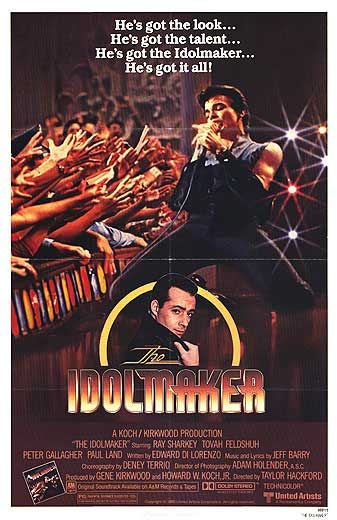
The Idolmaker (1980, directed by Taylor Hackford)
The Idolmaker is a movie that asks the question, “What does it take to be a star? Who is more interesting, the Svengalis or the Trilbys?” The year is 1959 and Vinny Vacari (Ray Sharkey, who won a Golden Globe for his performance but don’t let that dissuade you from seeing the movie) is a local kid from New Jersey who dreams of being a star. He has got the talent. He has got the ambition and he has got the media savvy. He also has a receding hairline and a face like a porcupine.
Realizing that someone who looks like him is never going to make hundreds of teenage girls all scream at once, Vinny instead becomes a starmaker. With the help of his girlfriend, teen mag editor Brenda (Tovah Feldshuh) and a little payola, he turns saxophone player Tomaso DeLorussa into teen idol Tommy Dee. When Tommy Dee becomes a star and leaves his mentor, Vinny takes a shy waiter named Guido (Peter Gallagher) and turns him into a Neil Diamond-style crooner named Cesare. Destined to always be abandoned by the stars that he creates, Vinny continually ends up back in the same Jersey dive, performing his own songs with piano accompaniment.
The Idolmaker is a nostalgic look at rock and roll in the years between Elvis’s induction into the Army and the British invasion. The Idolmaker has some slow spots but Ray Sharkey is great in the role of Vinny and the film’s look at what goes on behind the scenes of stardom is always interesting. In the movie’s best scene, Tommy performs in front of an audience of screaming teenagers while Vinny mimics his exact moments backstage.
Vinny was based on real-life rock promoter and manager, Bob Marcucci. Marcucci was responsible for launching the careers of both Frankie Avalon and Fabian Forte. Marcucci served as an executive producer on The Idolmaker, which probably explains why this is the rare rock film in which the manager is more sympathetic than the musicians.
Breaking Glass (1980, directed by Brian Gibson)
At the same time that TheIdolmaker was providing American audiences with a look at life behind-the-scenes of music stardom, Breaking Glass was doing the same thing for British audiences.
In Breaking Glass, the idolmaker is Danny (Phil Daniels, who also starred in Quadrophenia) and his star is an angry New Wave singer named Kate (Hazel O’Connor). Danny first spots Kate while she is putting up flyers promoting herself and her band and talks her into allowing him to mange her. At first, Kate refuses to compromise either her beliefs or her lyrics but that is before she starts to get famous. The bigger a star she becomes, the more distant she becomes from Danny and her old life and the less control she has over what her music says. While her new fans scare her by all trying to dress and look like her, Kate’s old fans accuse her of selling out.
As a performer, Hazel O’Connor can be an acquired taste and how you feel about Breaking Glass will depend on how much tolerance you have for her and her music. (She wrote and composed all of the songs here.) Breaking Glass does provide an interesting look at post-punk London and Jonathan Pryce gives a good performance as a sax player with a heroin addiction.
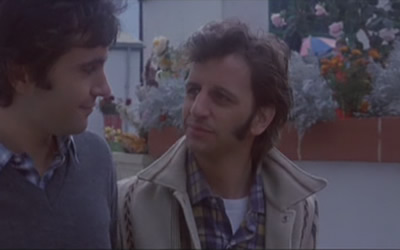
That’ll Be The Day (1973, directed by Claude Whatham)
Real-life teen idol David Essex plays Jim MacClaine, a teenager in 1958 who blows off his university exams and runs away to the Isle of Wright. He goes from renting deckchairs at a resort to being a barman to working as a carny. He lives in squalor, has lots of sex, and constantly listens to rock and roll. Eventually, when he has no other choice, he does return home and works in his mother’s shop. He gets married and has a son but still finds himself tempted to abandon his family (just as his father previously abandoned him) and pursue his dreams of stardom.
Based loosely on the early life of John Lennon, the tough and gritty That’ll Be The Day is more of a British kitchen sink character study than a traditional rock and roll film but rock fans will still find the film interesting because of its great soundtrack of late 50s rock and roll and a cast that is full of musical luminaries who actually lived through and survived the era. Billy Fury and the Who’s Keith Moon both appear in small roles. Mike, Jim’s mentor and best friend, is played by Ringo Starr who, of all the Beatles, was always the best actor.
That’ll Be The Day ends on a downbeat note but it does leave the story open for a sequel.
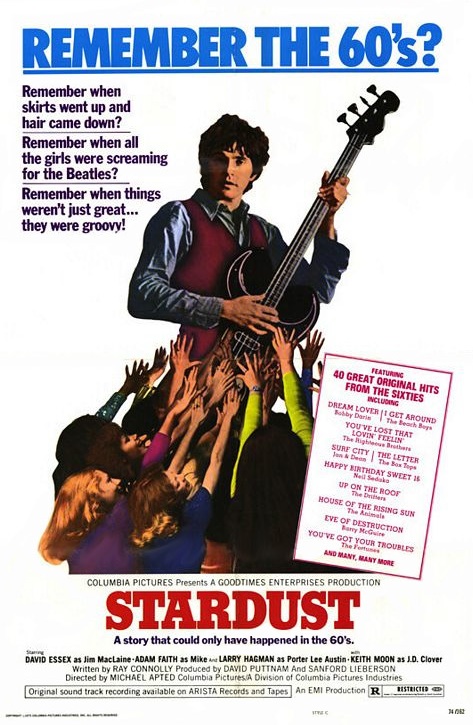
Stardust (1974, directed by Michael Apted)
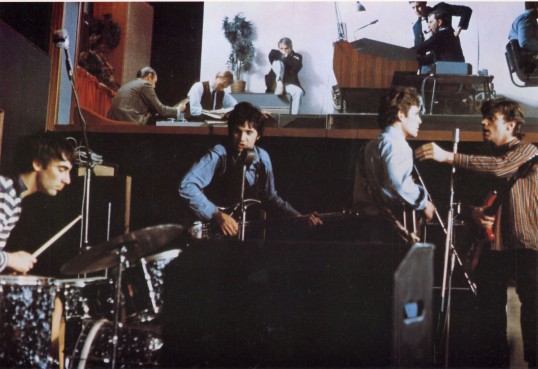
Stardust continues the story of Jim MacClaine. Jim hires his old friend Mike (Adam Faith, replacing Ringo Starr) to manage a band that he is in, The Straycats (which includes Keith Moon, playing a far more prominent role here than in That’ll Be the Day). With the help of Mike’s business savvy, The Stray Cats find early success and are signed to a record deal by eccentric Texas millionaire, Porter Lee Austin (Larry Hagman, playing an early version of J.R. Ewing).
When he becomes the breakout star of the group, Jim starts to overindulge in drugs, groupies, and everything that goes with being a superstar. Having alienated both Mike and the rest of the group, Jim ends up as a recluse living in a Spanish castle. Even worse, he gives into his own ego and writes a rock opera, Dea Sancta, which is reminiscent of the absolute worst of progressive rock. Watching Jim perform Dea Sancta, you understand why, just a few years later, Johnny Rotten would be wearing a homemade “Pink Floyd Sucks” t-shirt.
Stardust works best as a sad-eyed look back at the lost promise of the 1960s and its music. Watch the movie and then ask yourself, “So, do you really want to be a rock and roll star?”



 Through the Shattered Lens