Deputy Marshal Ed Garry (Jon Hall) is pursuing two bank robbers in Wyoming when he comes across a wounded man. Harley Masters (Wheaton Chambers) has been shot in the gut but his main concern is holding onto his hat. Ed takes Harley into town. They go into the local saloon, where Harley reveals a map hidden in his hat. He slips the map to Ed before an unseen gunman shoots him a second time. This time, Harley does not survive.
With the current sheriff “laid up,” Ed decides to stay in town and not only catch the bank robbers but also solve Harley’s murder. Ed soon finds himself in the middle of a conflict between two rival women (Frances Langford and Julie Bishop) who own ranches and stand to make a lot of money when the railroad comes through.
Deputy Marshal is one of the B-westerns that was produced by Robert Lippert and directed by William Berke in the 40s and 50s. This one is a step above the usual Lippert production because it combines a murder mystery with the standard western action and there are enough suspects to keep the story interesting. Jon Hall was best-known for appearing in exotic adventure films, often playing islanders. His career was in decline when he starred in Deputy Marshal but he makes for a surprisingly believable western hero. It helps that Hall was older than the typical B-western hero. His weathered looks make him convincing as an experienced lawman who understood the ways of the west.
Frances Langford, who plays the nicer of the two ranchers, was married to Jon Hall when she appeared in this film. She gets to sing two songs because this is a Lippert production and Robert Lippert believed that every western should open with a horse chase and should feature at least one song.
While it obviously never won any awards for originality, Deputy Marshal is a better-than-average B-western with an interesting mystery story and a convincing hero.
1944’s The Invisible Man’s Revenge opens with Robert Griffin (Jon Hall) arriving in England.
Despite his last name and the fact that he’s played by the star of Invisible Agent, this Robert Griffin would not appear to be in any way related to the previous invisible men. Instead, he is someone who has just escaped from a mental institution in South Africa. He has already murdered two orderlies and now, he’s come to England to take vengeance on Sir Jasper Herrick (Lester Matthews) and his wife, Lady Irene (Gale Sondergaard), two old friends who the paranoid Robert thinks tried to kill him in Africa so that they could steal his money. When Robert sees Sir Jasper and Lady Irene, he informs them that they can either give him half of their fortune or they can allow him to marry their daughter, Julie (Evelyn Ankers). Lady Irene responds by drugging Robert and having him kicked out of the house.
Dejected, Robert eventually comes across the cottage of Dr. Peter Drury (John Carradine, giving a surprisingly low-key performance in the mad scientist role). Dr. Drury reveals to Robert that he has developed a serum that can turn living things invisible. Drury goes on to “show” Robert all of the invisible pets that he has hanging out around the cottage, from an invisible dog to an invisible parrot. When Robert asks how long the invisibility lasts, Drury says that it will last until the invisible person dies. That sounds pretty good to Robert so he volunteers to be Drury’s latest test subject.
Soon, Robert is invisible and going out of his way to haunt that Herrick family. Some of Robert’s antics are merely playful. He helps a cobbler (Leon Errol) win a game of darts and later turns the man into his personal servant. Robert’s other actions are a bit more destructive. Robert, after all, was a murderer to begin with and using a serum that cause additional insanity is definitely not helping him with his temper. When Robert decides that he wants to be visible again, he discovers that there’s only one temporary way to do it and it involves a lot of blood.
After being portrayed as being a hero in Invisible Agent, The Invisible Man is once again a villain in The Invisible Man’s Revenge and it just feels right. There’s just something inherently sinister about the idea of someone being invisible. Jon Hall, who was so boring in Invisible Agent, is far more compelling here, playing Robert as a paranoid megalomaniac who has so convinced himself of his own cleverness that he can’t even understand that he’s writing the script for his own downfall. This is a good, solid Universal horror movie. The true hero of the movie is Drury’s dog, played by a talented canine actor named Grey Shadow. It takes more than invisibility to fool that dog!
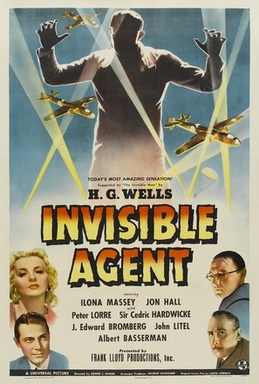
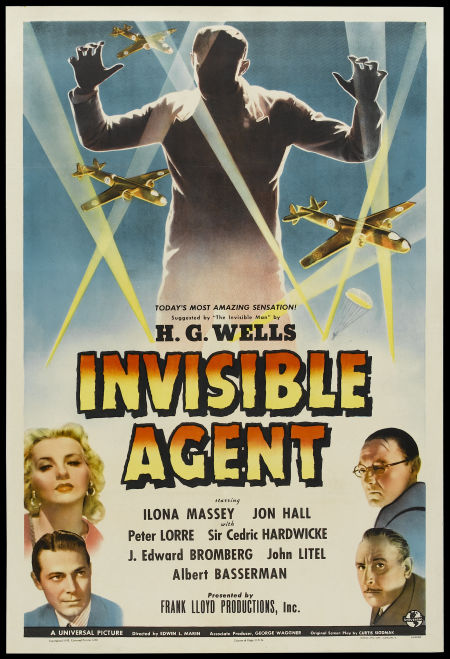
In 1942, the world was at war and everyone, whether a soldier or a civilian, was expected to do their part for the war effort. That included the best and the brightest of Hollywood. Stars like Jimmy Stewart, Clark Gable, and Henry Fonda enlisted in army. Others sold war bonds and narrated patriotic news reels. Even the Universal monsters did their part for the war effort, with the Invisible Man becoming the Invisible Agent in the 1942 film of the same name.
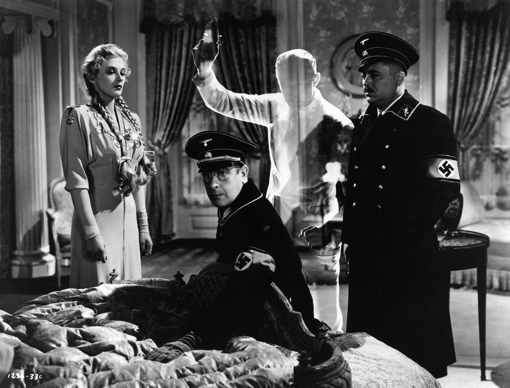
Invisible Agent opens in 1940, with Frank Griffin, Jr. (Jon Hall), the grandson of the original Invisible Man, being confronted by a Nazi (Sir Cedric Hardwicke) and a Japanese spymaster (Peter Lorre) at his print shop in Manhattan. They want his grandfather’s invisibility formula. At first, they offer to pay him for it. Then, when Frank refuses, they threaten to chop off his fingers. Frank manages to escape with both his fingers and the formula. As Frank later tells the Americans, he’s not willing to give the formula to anyone because he knows how dangerous it can be if not used properly. As far as Frank is concerned, the formula must never be used again. Frank does say that he might change his mind under extraordinary circumstances.
The film cuts to a series of headlines announcing that the Japanese have bombed Pearl Harbor. The circumstances are now extraordinary and Frank agrees that it is time to use the formula for the war effort. But he agrees to do so on the condition that only he be allowed to take the formula. Frank becomes the Invisible Agent, taking the formula and then parachuting into Nazi Germany. Unseen, Frank searches for information about Nazi spies in the U.S. and the details of Germany’s plan to bomb New York. Along the way, he meets Maria Sorenson (Ilona Massey), a wealthy German woman who is lusted after by the members of the German high command but who is actually working for the Resistance. Frank also finds himself, once again, coming across the two men who previously threatened him in New York.
Here are the positive things about this film. Invisible Agent has an intriguing premise. The Nazis are such monsters that even the once fearsome Universal monsters are joining the effort to take them down. The film also features two intelligent performances from Cedric Hardwicke and Peter Lorre, both of whom bring some unexpected shadings to their villainous roles. The opening scene in Manhattan plays out like an intense film noir and, once the action moves to Germany, director Edwin L. Marin keeps things moving at a steady pace.
Unfortunately, Invisible Agent has one huge problem that it cannot overcome. Jon Hall gives a remarkably charmless performance in the title role, flatly delivering his lines and showing very little in the way of personality. When you’re not seen for the majority of the film, it’s important to have a voice that’s full of personality. That’s one reason why the previous Invisible Man films benefitted from the casting of actors like Claude Rains and Vincent Prince. Jon Hall, on the other hand, just comes across as being dull. He gives a boring performance, whether visible or not and, as a result, Invisible Agent falls flat in a way that the previous Invisible films did not. There’s no real stakes in his turning invisible because there really wasn’t much to him to begin with.
Still, I thank the Invisible Agent for his service.
When the invention of the telegraph puts the Pony Express out of business, two veteran riders — John Blair (John Wayne) and Larry Adams (Lane Chandler) — decide to start their own stagecoach line. The richest man in Buchanan City, “Honest” Cal Drake (Douglas Cosgrove), sells them the line to nearby Crescent City. Though initially grateful, Blair and Larry soon discover that Crescent City is now a ghost town that serves as home to exactly two inhabitants. Rather than give up, Blair and Larry set up their stagecoach and they suddenly get lucky as settlers start to find themselves in Crescent City. Blair is even able to convince the local telegraph company to run the wire though Crescent City, which leads to an influx of even more people. Now, Blair just needs to land the contract delivering mail for the area. To do that, he’ll have to win a stagecoach race against Drake, who turns out to not be very honest at all.
Winds of the Wastelands is one of John Wayne’s better pre-Stagecoach programmers. While it has the western action that most people would expect from a B-western, it also has a lot more comedy than some of Wayne’s other poverty row productions. For instance, a skunk tries to turn the stagecoach into his home and, of course, shows up at a key moment during the big race. When one of bad guys tries to convince Blair to take his donkey to Crescent City in the stagecoach, Blair asks if there are any other “jackasses” who want a ride while casting a look at Drake’s men. The movie takes a more serious turn when Drake goes to extreme methods to try to stop Blair and, as a result, Larry is wounded in a gunfight. Doc Forsythe (Sam Flint), the founder of Crescent City, has to rediscover his confidence to perform the operation that can save Larry’s life. Fortunately, the doctor’s daughter (Phyllis Fraser) is there to both help him out and to fall in love with John Blair.
This 55-minute programmer featured John Wayne playing the type of character for which he best known, the level-headed westerner who wasn’t going to let anyone push him around but who still fought fair. Watching this movie, it’s easy to see why, just three years later, John Ford used him in Stagecoach.
Spring Break is one of the things that I really miss about high school and college. Despite the fact that I don’t drink, I don’t swim, and I generally hate crowds, I always made it a point to celebrate Spring Break by going to the beach. Spring Break was more than just a week’s vacation from “preparing for the future” and everything else that I occasionally pretended college was about. Spring Break was a ritual. It was a tradition. Celebrating Spring Break was as much a required activity as dressing up for Halloween or going to fireworks on the 4th.
For the next two weeks, we’re going to celebrate Spring Break on the Shattered Lens. I know that some people are saying that no one should be celebrating the Spring Break this year. To be honest, there were people saying that before the pandemic broke out and there were be people saying that once the pandemic is under control. Wear your mask indoors. Social distance. Do whatever needs to be done and yes, definitely make sure that you know what’s going on in the world. But don’t ever let the professional killjoys tell you that you don’t have a right to enjoy your life.
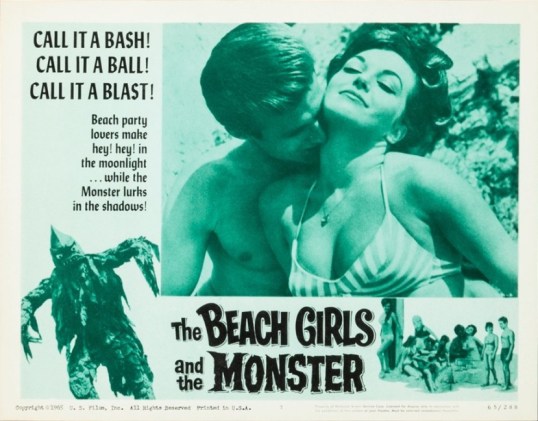
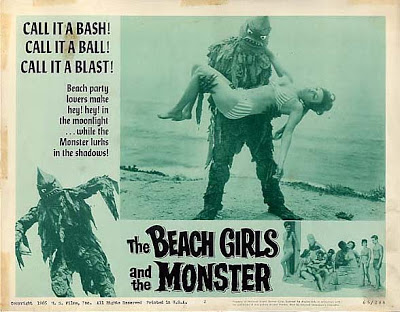
If you want to check out a professional killjoy, just check out the scientist who is at the heart of the 1965 film, The Beach Girls and the Monster. Dr. Otto Lindsay (Jon Hall, who also directed) is an oceanographer who totally resents the fact that teenagers are partying on the beach. I mean, he’s even more obnoxious than that jackass lawyer who spent last year wandering around the beach of Florida while dressed up as the Grim Reaper. Obviously, some of Otto’s bad attitude can be explained by the fact that he’s old but it’s hard not to feel that there’s something bigger fueling his resentment. Maybe he’s angry that his young wife, Vicky (Sue Casey), doesn’t seem to be particularly happy with their marriage. Maybe he’s annoyed that there’s a sculptor named Mark (Waler Edmonston) living in his house. Mark is a friend of Otto’s son, Richard (Arnold Lessing). Richard was planning on following his father into the field of oceanography but then he discovered surfing. Now, the only thing that Richard wants to do is surf and hang out on the beach.
It’s a popular beach, though perhaps a little bit less popular now that people are being randomly killed on the sand. Who is killing off of all of the surfers and the beach girls? Richard thinks that it’s a maniac but Otto believes that it’s a prehistoric sea creature, come back to life and seeking revenge on all of the irresponsible young people who ruining the beach. Judging from the fact that the killer looks like some sort of humanoid-fish hybrid, we can only assume that Otto is right. But is he?
You’ll have to watch the film to find out and, fortunately, it’ll be pretty easy for you to do just that. The Beach Girls and The Monster is in the public domain and it’s been uploaded to YouTube about a dozen times. And you know what? You should watch it because this is an entertainingly dumb little movie. It’s not exactly a good movie, of course. The acting is …. not impressive. The killer fish is …. less impressive. But so what? This is a fast-paced and fun movie with a silly monster, a lot of beach parties, and just enough dancing to hold my attention. It’s nonsense but, in the best tradition of Spring Break, it’s entertaining nonsense.
Jon Hall is back as The Invisible Man, but not the same one he played in INVISIBLE AGENT . Like all the Invisible Man movies, THE INVISIBLE MAN’S REVENGE features a new protagonist, as Hall plays Robert Griffin, an escaped mental hospital patient who comes to London seeking his share of a diamond mine after being left for dead in the African jungle by partners Sir Jasper and Irene Herrick. Griffin has returned to get what’s coming to him, and he does… Irene dopes him, and the couple throw the rascal out. Disoriented, Griffin stumbles into a nearby river, where he’s saved from drowning by shady Cockney Herbert Higgins.
Higgins and his disreputable attorney pal try to shake down Jasper, but are confronted by the local chief constable. Griffin’s left to fend for himself, when he stumbles upon the home of Dr. Drury, a scientist experimenting with invisibility on animals…
4 Shots From 4 Films is just what it says it is, 4 shots from 4 of our favorite films. As opposed to the reviews and recaps that we usually post, 4 Shots From 4 Films lets the visuals do the talking.
Today, we celebrate horror on the beach with….
4 Shots From 4 Beach Horror Films
The Horror of Party Beach (1964, dir by Del Tenney)
The Beach Girls and the Monster (1966, dir by Jon Hall)
For today’s horror on the lens, we offer up 1965’s The Beach Girls and the Monster. In this one, a monster that might be a mutated barracuda is hiding out on the beach and killing teenagers. Can Dr. Otto Lindsay (played by the film’s director, Jon Hall) figure out how to defeat the monster? Will Otto’s son Richard (Arnold Lessing) ever stop surfing long enough to get back to studying science? Will Otto’s much younger wife Vicky (Sue Casey) seduce the troubled and crippled sculptor Mark (Walker Edmiston)? And will it ever occur to anyone to just go to a different beach?
Complete with a ludicrous monster, a great soundtrack, tons of dancing, melodramatic acting, and a twist ending that will surprise no one, The Beach Girls and the Monster is low-budget favorite of mine. It’s also, I think, a perfect movie to watch on a rainy October Saturday.
INVISIBLE AGENT could very well have been subtitled “The Invisible Man vs The Nazis”! This is the only Universal Horror that addresses the topic of the war in Europe (despite the fact most of them take place in Europe!), and though there aren’t many scares going on, Curt Siodmak’s sci-fi flavored screenplay, John P. Fulton’s fantastic special effects, and a cast featuring Peter Lorre in his only Universal Horror appearance make this one of the most enjoyable movies of the whole bunch!
Frank Griffin, grandson of the original Invisible Man, is living in London under the assumed name Frank Raymond and running a small printing shop. A gang of Axis creeps led by Gestapo spymaster Stauffer and Japanese Baron Ikito pay him a call, demanding his grandfather’s secret of invisibility, which of course they want to use for their own nefarious purposes. Frank manages to escape their clutches, and goes…
For today’s horror on the lens, we offer up 1965’s The Beach Girls and the Monster. In this one, a monster that might be a mutated barracuda is hiding out on the beach and killing teenagers. Can Dr. Otto Lindsay (played by the film’s director, Jon Hall) figure out how to defeat the monster? Will Otto’s son Richard (Arnold Lessing) ever stop surfing long enough to get back to studying science? Will Otto’s much younger wife Vicky (Sue Casey) seduce the troubled and crippled sculptor Mark (Walker Edmiston)? And will it ever occur to anyone to just go to a different beach?
Complete with a ludicrous monster, a great soundtrack, tons of dancing, melodramatic acting, and a twist ending that will surprise no one, The Beach Girls and the Monster is low-budget favorite of mine. It’s also, I think, a perfect movie to watch on the 3rd of October.
 Deputy Marshal Ed Garry (Jon Hall) is pursuing two bank robbers in Wyoming when he comes across a wounded man. Harley Masters (Wheaton Chambers) has been shot in the gut but his main concern is holding onto his hat. Ed takes Harley into town. They go into the local saloon, where Harley reveals a map hidden in his hat. He slips the map to Ed before an unseen gunman shoots him a second time. This time, Harley does not survive.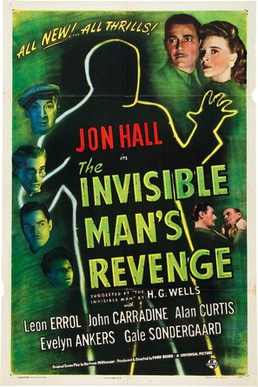



 Through the Shattered Lens