Released in 1958, How To Make A Monster is a clever little horror satire from American International Pictures in which the stars of Teenage Werewolf and Teenage Frankenstein are hypnotized into believing that they actually are the monsters that they played! The main culprit is a movie makeup artist (Robert H. Harris) who has been deemed obsolete by the new bosses at AIP.
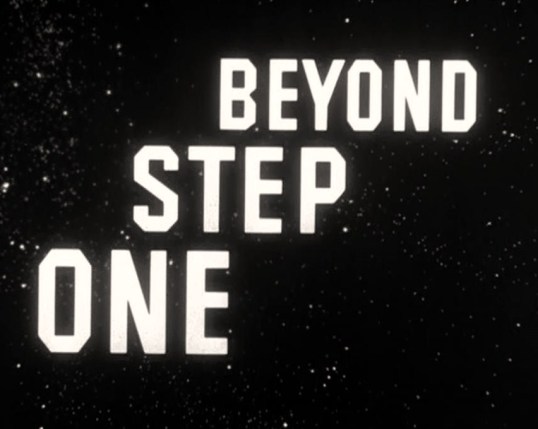
For this year’s horrorthon’s final episode of One Step Beyond, we have the …. final episode of One Step Beyond!
In this, the series’s very last episode, a Boston newspaper reporter in 1883 somehow manages to write a firsthand account of one of the greatest natural disasters in human history, the volcanic eruption of Krakatoa. Making his accomplishment all the more amazing is that he not only filed the story the day before it happened but he also says that he has no memory of writing it! What’s going on? Take one step beyond and find out!
Released in 1958, How To Make A Monster is a clever little horror satire from American International Pictures in which the stars of Teenage Werewolf and Teenage Frankenstein are hypnotized into believing that they actually are the monsters that they played! The main culprit is a movie makeup artist (Robert H. Harris) who has been deemed obsolete by the new bosses at AIP.
Released in 1958, How To Make A Monster is a clever little horror satire from American International Pictures in which the stars of Teenage Werewolf and Teenage Frankenstein are hypnotized into believing that they actually are the monsters that they played! The main culprit is a movie makeup artist (Robert H. Harris) who has been deemed obsolete by the new bosses at AIP.
Having watched Cocktail earlier tonight with Lisa and the FridayNightFlix crew, Kokomo seemed like an obvious choice for today’s music video of the day. Kokomo started out as an unreleased song by John Phillips. When The Beach Boys were commissioned to provide a theme song for Cocktail, Phillips sent the song over. The Beach Boys, of course, put their own spin on the material and the end result was a surprise hit for the band.
The video was shot at the Grand Floridian Resort at Walt Disney World in Florida, with the band performing in front of an audience that included several cheerleaders from the University of Nevada. This is the only Beach Boys video to not feature Brian Wilson. It does, however, feature actor John Stamos playing the conga. (Stamos, apparently, is a long time friend of the band.)
While I couldn’t find a credited director for this video, it does contain several scenes from Cocktail, which was directed by Roger Donaldson.
Incidentally, at the time this song was recorded, there were no resorts called Kokomo. After the song became a hit, however, several island resorts borrowed the name.
Released in 1958, How To Make A Monster is a clever little horror satire from American International Pictures in which the stars of Teenage Werewolf and Teenage Frankenstein are hypnotized into believing that they actually are the monsters that they played! The main culprit is a movie makeup artist (Robert H. Harris) who has been deemed obsolete by the new bosses at AIP.
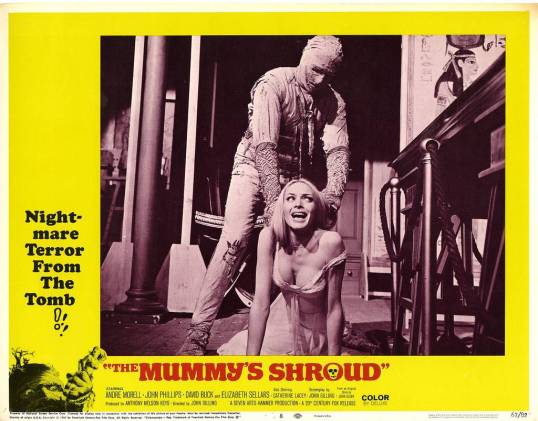
In this underrated horror film from the legendary Hammer Studios, a British archaeological expedition travels to Egypt and makes the mistake of entering a mummy’s tomb. As often happens, it turns out that the tomb is cursed and everyone who sets foot inside of it is destined to be tracked down and murdered by a mummy!
That’s pretty bad news for some of members of the expedition. Among those who are now on the Mummy’s list, there’s Sir Basil Waldron (Andre Morrell) who, in the film’s most effective moment, finds himself talking to a toothless fortune teller who cackles as she tells him, “You are going to die!” (Needless to say, a 7 foot tall Mummy is soon standing behind him). And then there’s Claire (Maggie Kimberly), the linguist who translated the curse. And there’s the expedition’s hilariously pompous financial backer, Stanley Preston (John Phillips), along with Stanley’s son, Paul (David Buck). And finally, there’s poor Mr. Longbarrow (Michael Ripper), Stanley’s press agent. If you’ve seen any other Hammer films from the late 60s, you’ll recognize the majority of the cast and you will probably be able to guess everyone’s fate from the minute they first appear on screen.
That, of course, is part of the fun!
First released in 1967 and often dismissed as being one of the lesser horror films to come out of Hammer Studios, The Mummy’s Shroud is actually a pretty effective film. I watched it late last night, with lights out and the sound of rain pounding on the windows outside and I have to admit that, even if nothing about the film surprised me, it still had enough eerie moments that I found myself watching for sudden shadows and the sound of heavily wrapped feet.
And why not? Mummy’s are scary! Even if you don’t know all of the grotesque details that go into the mummification process, Mummy’s just look frightening. It’s the bandages, to be honest. The bandages keep you from knowing exactly who is doing the stalking but, at the same time, you know that if those bandages were unwrapped, you wouldn’t want to see what’s hiding underneath them. By their very existence, Mummies are proof of the finality of death.
And The Mummy in The Mummy’s Shroud is frightening! He towers over all of the “human” actors in the film and when he attacks, he does it with a sudden and savage cruelty. Perhaps the death that disturbed me the most was the death of poor Mr. Longbarrow, who is literally lifted up off of his feet and tossed out of a window. He crashes to the street below and, briefly, the screen is awash with Hammer’s trademark red blood. It’s a disturbing scene, both because Longbarrow is one of the few likable characters in the film and also because the Mummy could have just as easily and much more efficiently strangled him. Instead, the Mummy had to be mean about it.
Seriously, there’s nothing more frightening than a sadistic mummy.
The Mummy’s Shroud may not be one of Hammer’s best films but still, it’s an efficient little horror film and one that, I think, many other horror critics have been a bit too quick to dismiss.

 Through the Shattered Lens