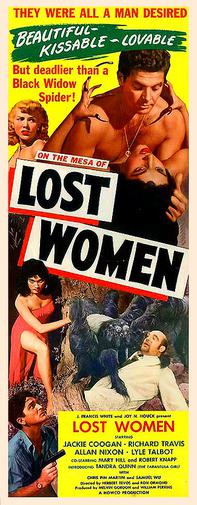
Horror Film Review: Mesa of Lost Women (dir by Herbert Tevos and Ron Ormond)


“Have you ever been kissed by a girl like this?” a disembodied voice asks at the start of 1953’s Mesa For Lost Women as a pair hands with claw-like fingernails caresses the face of someone who is later identified as being “Doc” Tucker (Allan Nixon).

Things get stranger from there.  A couple is found lost and dehydrated in the Mexican desert.  Grant Phillips (Robert Knapp) rambles about “super bugs” out in the desert and how they have to be destroyed.  American land surveyor Frank (John Martin) assumes that Grant must be delirious but Frank’s assistant, Pepe (Chris Pin Martin), knows differently.  We know that Pepe knows differently because the narrator tells us that Pepe had heard all about the monsters in the desert but Pepe keeps that information to himself….

Who is this narrator and why is he so condescending?  (For the record, he’s actor Lyle Talbot, who split his career between major, Oscar-winning productions and stuff like this.)  Have you ever noticed that a narrator usually just leaves you feeling even more confused by what you just watched?  There’s a trailer playing right now for a film called Ella McCay that opens with Julie Kavner saying, “Hi, I’m the narrator!” and whenever I hear that line, I’m just like, “Oh, this film is going to be so bad!”

I think it’s because most narrators are added after the fact, in an attempt to give some sort of uniformity to a badly constructed movie.  The narrator is there to tell us stuff that a good movie would be able to show us.  For instance, in the trailer for Ella McCay, Julie Kavner tells us that “I’m nuts about her,” as a way to assure us that Ella McCay is someone worth making a movie about.  Now, ideally, you wouldn’t have to have someone tell you that.  You would just watch the movie and say, “Hey, Ella McCay!  She deserves all the happiness in the world!”  But when your trailer is a bunch of scenes of Ella McCay acting a bit immature for someone who is destined to become “governor of the state you were born and raised in,” you need that narrator to say, “No, she’s likable, I promise!”

By that same logic, Mesa of Lost Women was apparently a mash-up of several different films, none of which had a complete script.  Narrator Lyle Talbot is here to tell us that, despite what we’re seeing, Mesa of Lost Women is an actual movie with an actual story as opposed to just a bunch of random scenes that were haphazardly crammed together.  We get a flashback of a scientist named Masterson (Harmon Stevens) traveling to the laboratory of Dr. Aranya (Jackie Coogan) and discovering that Aranya is creating giant tarantulas and transforming human women into mind-controlled slaves with the instincts of a spider.  Masterson doesn’t think that’s ethical so Aranya’s assistant, Tarantella (Tandra Quinn), gives him an injection that turns him into a simpleton.  Masterson ends up in a mental hospital, though he later escapes.  Meanwhile, an American businessman and his girlfriend (Mary Hill) come to Mexico and witness Tarantella dancing in a bar.  Masterson shows up and shoots Tarantella and then takes everyone hostage so that he can force Grant, who we now discover is a pilot, to fly him to the mesa of lost women …. or something.

Despite the best efforts of the narrator, the film is impossible to follow.  A big problem is that Dr. Aarnya’s plan never makes much sense.  How is creating a giant spider and a bunch of women who think that they’re spiders going to help him conquer the world?  The other problem is that the film had two directors, one of whom was an enigmatic German named Herbert Tevos who got the job by claiming to have directed Josef von Sternberg’s The Blue Angel.  Tevos’s footage of Dr. Aranya, the giant tarantula, and the “lost women” was not enough to secure the film distribution so a second director, Ron Ormond, was brought in to shoot a bunch of new footage to make the film more commercial.  Tevos’s film became an extended flashback in the middle of Ormond’s film and the whole thing is a big mess.

In fact, the film is such a mess that some people insist Ed Wood must have been involved.  It is true that narrator Lyle Talbot also appeared in Plan 9 From Outer Space and Glen or GlendaPlan 9‘s Mona McKinnon appears as a spider woman.  So does Dolores Fuller, who was Wood’s girlfriend at the time.  Wood later “borrowed” Mesa of Lost Women‘s score for Jail BaitMesa of Lost Women was definitely Wood-adjacent but, by all accounts, Wood didn’t actually do any work on the film.  This mess of a film belongs to Tevos and Ormond.

And it is a mess.  It’s a watchable mess, in much the same way that a nuclear meltdown would probably be watchable.  But, nonetheless, it’s still a mess and the incoherence of the plot really does get on one’s nerves, despite the best efforts of Lyle Talbot.  Talbot can’t sell the viewer on Mesa of Lost Women.  Maybe he would have had better luck with Ella McCay.
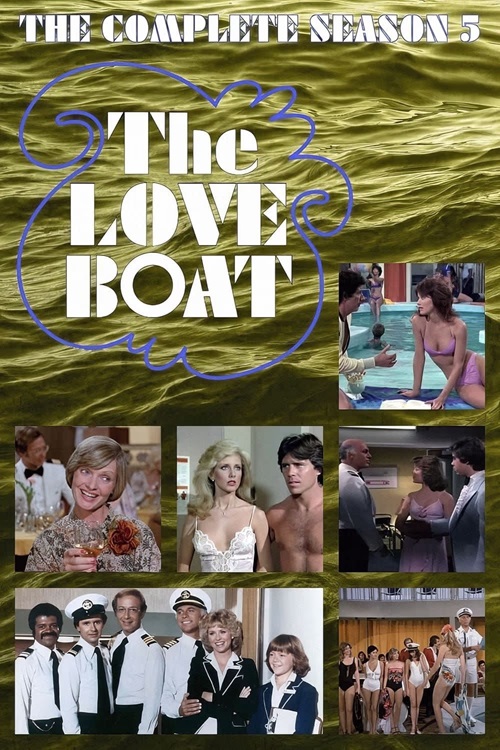
Retro Television Review: The Love Boat 5.28 “A Dress To Remember”


Welcome to Retro Television Reviews, a feature where we review some of our favorite and least favorite shows of the past!  On Wednesdays, I will be reviewing the original Love Boat, which aired on ABC from 1977 to 1986!  The series can be streamed on Paramount Plus!

It’s time set sail for adventure!

Episode 5.28 “A Dress To Remember”

(Dir by Robert Scheerer, originally aired on May 8th, 1982)

This week’s episode features three stories and one dress.

The dress, a lovely blue gown, is brought on board by diet doctor Dr. Alfred Farney (Kelly Monteith), who claims that his “muskmullet” diet will lead to Donna Baker (Markie Post) losing 10 pound by the end of the cruise.  The proof will be that Donna will be able to fit into the dress.  Alfred’s former partner-turned-rival Dr. Tucker Martin (Lyle Waggoner) is also on the ship and his plan is to tempt Donna into eating so much that she’ll instead gain 11 pounds and the dress will rip.  Boooo!  Shame on both of those doctors!  Seriously, Donna looks miserable for the entire cruise.  That said, despite the efforts of Dr. Martin, Donna still loses the weight …. in fact, she loses even more than 10 pounds.  She loses 11!  Doctors Farney and Martin agree to partner up again and Donna, who looks like she’s about to faint, suggests that they celebrate over pizza.  The doctors make some money and Donna gets an eating disorder but at least the dress looks good.

That dress goes through a lot over the course of one episode.  For some reason, Gopher and Isaac have been tasked with keeping it safe.  Why would you trust those two with something important?  Actually, Isaac is usually pretty smart and Gopher’s actually been behaving a bit more like a professional than usual this season so I guess they were just having an off-cruise.

Norman Lomax (Bob Denver) wears the dress (and a wig) to keep his ex-father-in-law, Tom (Forrest Tucker), from recognizing him.  Tom must be an idiot because Bob Denver in a wig and dress still looks and sounds like Bob Denver.  Norman’s ex-wife, Nancy (Brianne Leary), is also on the cruise.  Norman tries to win her back.

Finally, Tom falls for Rosie Strickland (Eleanor Parker), who makes her living selling flowers to people boarding the cruise.  When Rosie’s daughter (Catherine Parkes,) shows up, Rosie doesn’t want her to know that Rosie isn’t rich.  So, the Captain gives her the dress to wear and helps Rosie pretend to be a rich woman.  Fortunately, it turns out that Rosie’s daughter loves her regardless of whether or not she’s rich.  And so does Tom!

Myself, I’m a little bit concerned by the fact that the Captain just gave away a piece of clothing that belonged to one of the passengers.  That doesn’t really seem very professional and it kind of goes against everything that we know about Captain Stubing.  He’s a good man but he’s not exactly a rule-breaker.  That said, everything works out in the end.  Stubing even gets to perform a triple wedding.

The third story, I actually liked it.  It’s heart was in the right place, even if it was basically just a remake of Lady For a Day.  Eleanor Parker actually gave a really good performance, finding some much needed reality in Rosie’s character.  The other two stories were pretty forgettable (or, in Bob Denver’s case, annoying) but Eleanor Parker’s story made up for both of them, making this a very nice and ultimately rather touching cruise.

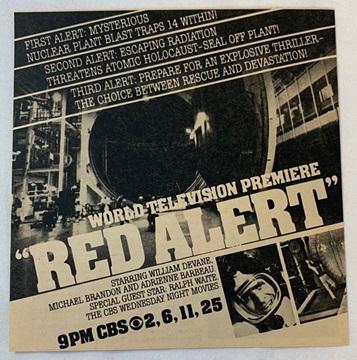
Made-For-Television Movie Review: Red Alert (dir by William Hale)


The 1977 made-for-television movie, Red Alert, opens with a man walking through a cemetery on a rainy day.  As we watch Howard Ives (Jim Siedow) move amongst the tombstones, we hear his thoughts.  He’s a sad and bitter man, wondering why he’s wasted so many years of his life at work.  He thinks about someone close to him who has died.  He’s obviously very troubled.

(Of course, any horror fans in the audience will immediately recognize Jim Siedow from his role as the Drayton Sawyer in the the original Texas Chainsaw Massacre.  He was troubled in that film as well!)

Howard works at the local nuclear power plant.  Ominously, when the film cuts to the plant, the first thing we see is a leak of very hot water.  I don’t know much about nuclear power plants but I imagine any type of leak is not a good thing.  The water leak causes the computer that runs the plant assuming that a nuclear disaster is minutes away from happening.  The compound is automatically sealed off, trapping fourteen men (including Howard), inside the reactor.  As Commander Stone (Ralph Waite) tries to keep a possible nuclear disaster from occurring, two investigators (played by William Devane and Michael Brandon) try to determined whether the accident was the result of a malfunction or of deliberate sabotage.  When the local sheriff (M. Emmet Walsh) informs them that Howard Ives’s wife has committed suicide, the investigators look into the troubled man’s history.  Eventually, the two investigators realize that the only way to prevent a nuclear disaster is by risking their lives by entering the sealed-off power plant.  The two investigators attempt to do their work under the cover of night and without causing a panic.  Needless to say, it doesn’t work.  One of them calls his wife (Adrienne Barbeau) and tells her that she needs to leave the area.  She tells her mother, who then tells her neighbor and soon the airport is crowded with people looking to get out of town.

Red Alert contrasts the intuitive approach of the two inspector with Commander Stone’s insistence that every bit of a data be fed to his computer before any decisions are made.  Stone’s hands are so tied by protocol and red tape that he stands by while the fourteen men who are trapped in the nuclear power plant die.  Wisely, though, the film doesn’t turn Stone into a cardboard villain.  He’s very much aware of what will happen if the plant suffers a core meltdown.  When one of his assistants mentions that he hasn’t been given any instructions on how to evacuate the town in case the plant does explode, Stone tells him that no plans have ever been drawn up because the plans would be useless.  There would be no way to evacuate everyone in time.

In the end, Red Alert is scary not because it deals with nuclear power but because it presents us with a world where no one — not even Devane and Brandon’s heroic investigators — seems to know what to do.  Everyone is slowed down by a combination of red tape and their own personal angst.  Devane is a strong investigator because, as a widower whose only son died in Vietnam, he has no family to worry about.  Unlike everyone else in Red Alert, he has nothing left to lose.  In the end, the film suggests that the only way to save the world is to cut yourself off from it.

Red Alert is a compelling and intelligent thriller, one that is well-acted by the entire cast and which builds up to strong conclusion.  The film’s anti-nuclear message is a bit heavy-handed but I imagine it was an accurate reflection of the fears that people were feeling at the time.  Today, the film works best as a warning about bureaucracy and depending too much on AI to make important, life-or-death decisions.  In the end, it’s human ingenuity that saves the day and that message is timeless.

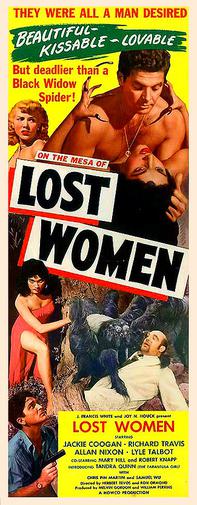
Horror on the Lens: Mesa of Lost Women (dir by Herbert Tevos and Ron Ormond)


Today’s Horror on the Lens is the infamous 1953 film, Mesa of Lost Women.  Off in the middle of the desert, Dr. Aranya (Jackie Coogan) is conducting dangerous experiments that are resulting not only in giant spiders but also a master race of superwomen who Aranya is planning to use to conquer the world or something.

Mesa of Lost Women is a bit of a disjointed film.  It was originally filmed by a German director named Herbert Tevos, who claimed to be an associate of Erich Von Stroheim’s and a former collaborator of Marlene Dietrich’s.  However, despite his claims of being well-connected, no one was particularly impressed with Tevos’s first cut of the film so Ron Ormond was brought in to film additional scenes, the majority of them featuring Jackie Coogan as the insane Dr. Aranya.  Jackie Coogan was, at the time, still best-known for playing The Kid in the Charlie Chaplin film of the same name.  After Mesa, he would go on to play Uncle Fester on the original Addams Family.

Anyway, Mesa of Lost Women is one of those B-movies that simply has to be seen and heard to be believed.  (Lyle Talbot provides the narration, which is judgmental even by the standards of the 1950s.)  Enjoy Mesa of Lost Women!