Horror Film Review: An American Werewolf in London (dir. by John Landis)


I resisted seeing An American Werewolf in London for quite some time because 1) I kept mixing the film up with its “sequel,” An American Werewolf in Paris (which is seriously one of the worst films ever made) and 2) werewolves scare me in a way that vampires and zombies don’t.  Seriously, what is a werewolf other than a really big pit bull and to say that I’m not a dog person is an understatement.  However, this Halloween season, several people on twitter suggested that I give the film a chance so, reluctantly, I watched it and I’m glad that I did.  Good call, twitter.

Originally released way back in 1981, An American Werewolf in London starts with two nice guys from New York (played by David Naughton and Griffin Dunne) backpacking across England.  They stop in one of those proverbial, fog-drenched English villages where they are told, by the secretive town folk, to stay off the moors.  Naughton and Dunne promptly wander into the moors.  “Whoops,” they literally say as the full moon shines behind them.  Suddenly, they are attacked by some sort of wild animal.  Dunne is killed and a severely wounded Naughton wakes up days later in a London hospital.

While recovering in the hospital, Naughton meets and starts up a tentative romance with his nurse (Jenny Agutter) even as he finds himself haunted by disturbing graphic nightmares in which he sees his family being massacred by humanoid wolves dressed up like storm troopers.  (Seriously, these genuinely disturbing nightmares were so seamlessly worked into film that they took me totally by surprise.)  Even worse, Dunne’s progressively decaying corpse keeps popping up in his hospital room and telling him that 1) they were attacked by a werewolf, 2) Dunne’s spirit is trapped on Earth until the werewolf’s bloodline is extinguished, and 3) that bloodline is currently being carried on by Naughton.  Fearing for his sanity, Naughton moves into Agutter’s flat after he’s released from the hospital and, for a brief moment, it actually seems like he might actually be okay.

And then, inevitably, a full moon rises and soon, there’s an American werewolf in London…

An American Werewolf in London is an oddly succesful hybrid of genres that don’t always mix well: it’s scarier than Paranormal Activity, funnier than Scream, and ultimately more romantic than any of the Twilight films.  David Naughton and Jenny Agutter are both so appealing in this film that you actually get invested in their relationship and, as a result, the inevitably of the film’s conclusion becomes all the more tragic.  As this film was pre-CGI, Naughton actually had to act out the process of transforming into a werewolf and, as a result, An American Werewolf in London feels real in a way that most werewolf films do not.

Director John Landis manages to maintain a perfect balance between the horror and the comedy and, as a result, I found myself both laughing out loud and hiding my eyes throughout this entire film.  For me, the scariest scene in the film comes when an unfortunate commuter finds himself being tracked through a nearly deserted tube station by our werewolf.  Landis  wisely draws the sequence out, with the camera taking on the point-of-view of the prowling werewolf.  Seriously, this growls heard during this whole sequence reminded me of why I’m so scared of big dogs.  The other stand-out sequence comes towards the end of the film, in which Naughton takes refuge in a filthy porno theater and talks to Dunne (who, by this point, is just a skeleton).  Dunne, it turns out, has brought with him the spirits of all the people who Naughton killed during the last full moon.  So, while Dunne and his new friends encourage Naughton to commit suicide and Naughton starts to painfully transform into a werewolf, the worst porno film ever made is playing in front of them.  The scene — with its perfect mix of tragedy, comedy, and horror — epitomizes everything that makes An American Werewolf in London work as a film.

One final note: one of the problems that I have with a whole lot of horror films is that they rarely make good use of their setting.  Whether it’s that old deserted building or that piece of wilderness that’s not on anyone’s map, horror locations often feel as a generic as horror plots.  However, Landis makes good use of both London and the English countryside here and this is a film that really should serve as a lesson for aspiring horror filmmakers todays.  Of course, it helps that the location in question happens to be London with all of its gothic traditions and old school horror heritage.  Let’s face it — An American Werewolf in St. Louis* just doesn’t carry the same punch. 

—-

* Or, God Forbid, Vermont.

Quickie Horror Review: Masters of Horror – Deer Woman (dir. by John Landis)


It is hard to categorize John Landis’ contribution to the Showtime horror anthology series, The Masters of Horror. Landis made a name for himself in the horror genre as the director of the classic early 80’s werewolf film, An American Werewolf In London, and the cult classic vampire-noir film, Innocent Blood. With his “Deer Woman” episode, John Landis reaches back to his past work and comes up with an episode that mixes horror, absurd situations and a healthy dose of black comedy.

“Deer Woman” has something in common with An American Werewolf In London in that this episode deals with a creature born out of folklore and myth. This time around its a creature from Native American folklore. The creature in question is the Deer Woman. A legendary creature who takes the form of a beautiful woman from the waist up and that of a deer from the waist down. The Deer Woman will then go on a spree of seducing random men then trampling them to mincemeat. In this respect she has a bit of the mythical succubus mixed in with the shapeshifting. It is during the aftermath of one of her killings that we’re introduced to the main player in this horrifically absurd little tale. Detective Faraday (masterfully played with a dry wit and comedic timing by Brian Benben) gets called in to the scene thinking it is an animal attack, but the crime scene leaves him confused, perplexed and a tad more than intrigued by the case after it’s unceremoniously taken away from him.

We learn through the length of the hour-long episode that Faraday is a disgraced cop due to an incident in the past that’s made him a pariah in his own department. Faraday’s sidekick in his hunt to solving the murders and thus finding the Deer Woman is a beat cop played by Anthony Griffin. Former Brazilian, and still smoking hot and stunning, Cinthia Moura does duty as the abovementioned Deer Woman. She goes through the entire episode without uttering one line. Her eyes, expressions and body language conveying whatever motivations and thoughts may be in her head. She did pretty well and it didn’t hurt she looked very natural baring it all on the screen.

The dialogue in the episode was where the absurdity of the moments in the story shone through to give “Deer Woman” its black-comedy. The characters in the film react to murders and the clues leading to what might be their only suspect with incredulity, denial and dismissal. Yet, no matter how much the characters of Faraday and his partner try to deny what they know in their mind is the real killer, they inevitably see the truth of the matter dangerously up close and personal. The teleplay for the episode was primarily written by Max Landis (the director’s son) with some brief rewrites and treatments by John himself. They both run with a very absurd situation and run with it fult-tilt and non-stop. They both know how silly the story sounds and its that silliness that makes this episode memorable. In fact, if I really had to categorize this episode I would call it a comedy with small bits of horror slipped in (horror and gore effectively done — once again — by the master effects people from KNB EFX.

Despite “Deer Woman” being closer to a comedy-horror than a straight-up horror tale, I found the episode to be very entertaining and worth the viewing. John Landis stuck to his guns in crafting an absurd tale and making it believable to his audience. With shades and hints of An American Werewolf In London, Landis’ contribution to The Masters of Horror marks a bright spot in the an uneven series, so far. Landis’ has once again shown that horror and comedy are more intertwined than most people would think.

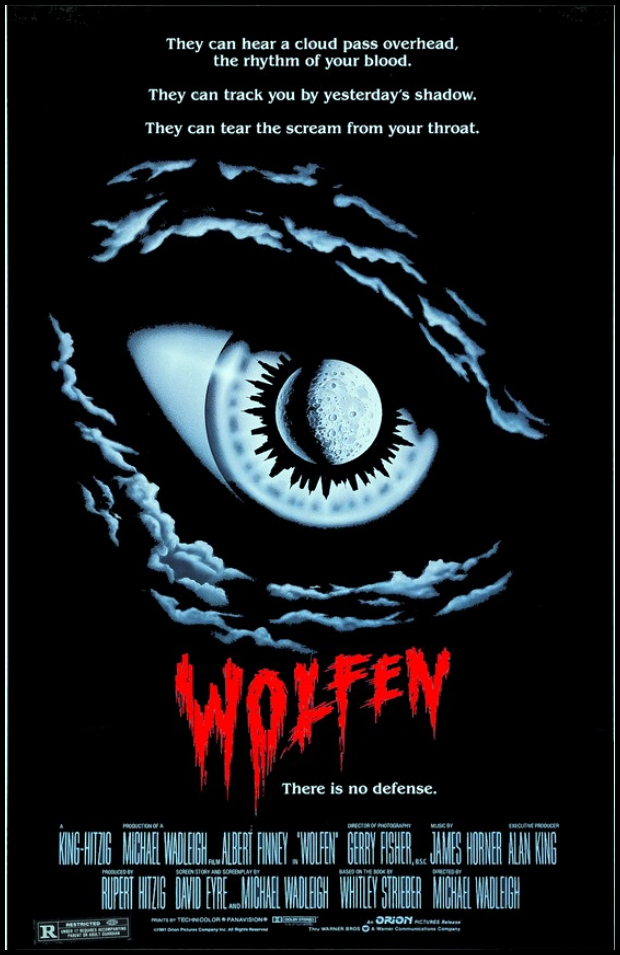
Quickie Review: Wolfen (dir. by Michael Wadleigh)


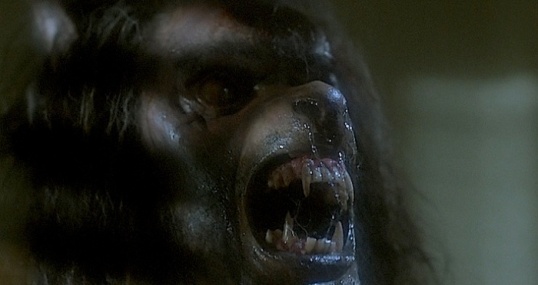
1981 was a great year for wolf movies. There was the excellent An American Werewolf in London by John Landis and Joe Dante’s equally creepy The Howling. To finish off the trifecta of werewolf films for the year there’s Michael Wadleigh’s Wolfen. Wadleigh’s film was a very good werewolf tale that added a bit of Native American folklore to the typical lycanthrope story, but it’s slightly overlong running time keeps it from being as great as Landis’ and Dante’ contributions.

Wolfen takes place in the city of New York and its growing urban jungle of decaying and condemned buildings in the city’s ghettos. One has to remember that the late 70’s and through on the mid-80’s the inner-cities of most of the major metropolitan cities in the US have turned into rundown ghettos rife with drug problems, high-crime rates and unemployment. It is in this setting that Wolfen takes place in. The film used the screenplay co-written by horror veteran novelist Whitley Strieber and his quirky style heavily influences this werewolf story. Strieber’s screenplay mixes together a police procedural, political intrigue, business corruption, race and class relations, Native American lycanthrope folklore and horror. Wolfen tries to combine all these different elements together as well as possible and it mostly succeeds, but there’s times when the film gets dragged down a bit trying to accomplish this.

The cast was made up of mostly new actors (well young and new at that time) with a few veteran actors holding things together. Albert Finney gets the choice role of NYPD Detective Dewey Wilson who begins investigating a series of brutal murders of three individuals whose race, class and personal status brings no discernible clues that ties them together. Joining him in his investigation — which Wilson gradually suspects has some sort of supernatural angle to it — were the very young Diane Venora and Gregory Hines. Edward James Olmos plays a Native American whose knowledge ties to who or what was involved in the killings might be closer than everyone thinks. The performances from all involved were pretty good though Hines comic relief performance was a bit too blackface in its tone and execution. 1981 Hollywood was still not ready to discount such racial stereotypes and it gives Wolfen a certain sense of creepiness and insensitivity. Maybe the screenplay was written just that way to highlight one of the film’s themes of racial and class inequality. If it was then Strieber sure did an excellent job of hammering home the point.

There’s a point in the film where we find out the nature of these wolfen and it does stretch the usual definition of the typical werewolf story. But looking back on it now this version told by Strieber and Wadleigh does lend credence to native folklore about wolves who were cunning as men and who preyed not just on the animals in their territory but hunted men as well. Whether they’re wolves or men in the shape of wolves really is left to the audience’s imagination even after the brief explanation of the wolfen and it’s role in the legends and myths of Native Americans.

The film had very creepy moments whenever the story switches over to be told through the viewpoint of the wolfen. The skewed perspective the camera takes on to signify that we were seeing things through the eyes of the wolfen was disorienting and creepily well-done. Wolfen never really has pure horror moments in the film though in the hands of a director like Carpenter these sequences definitely would’ve raised the level of dread and horror. Wadleigh does a good enough job, but it seemed like he was treating the horror aspect of the story with less attention than it was its due.

Wolfen marks the weakest of the werewolf trilogy of 1981, but thats not to say that it was a bad film. The finished product was a well-done film and its attempt to be very ambitious in its storytelling has to be commended. The fact that the filmmakers and all involved were able to keep all the different themes and genres together without having the film spiral into utter confusion makes it a worthwhile werewolf film. It may have been the weakest of the three films mentioned but it wasn’t by much.