Horror On The Lens: The Invasion of Carol Enders (dir by Dan Curtis)


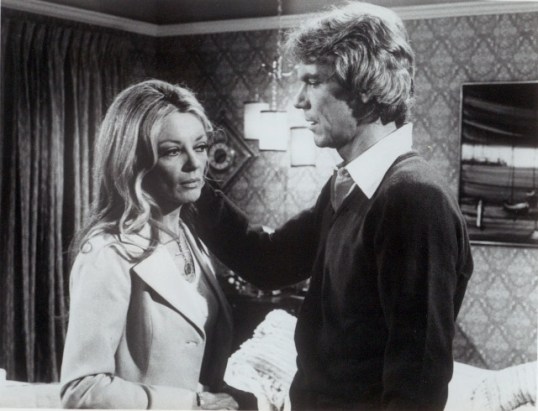
In 1973’s The Invasion of Carol Enders (Meredith Baxter) is attacked while walking in the park with her boyfriend (Christopher Connelly) and strikes her head.  At the same time, Diana Bernard (Sally Kemp) crashes her car while driving home in the rain.  Both women end up at the hospital at the same time.  Both die but Carol is brought back to life.  Except now, there’s someone else in Carol’s head….

This is a bit of an odd made-for-TV movie, even by the standards of the 70s.  It’s only 69 minutes long and it was shot on video tape, giving the whole thing the look of an old daytime drama.  It’s easy to watch this movie and imagine that it’s just a supernaturally-tinged episode of General Hospital or Days Of Our Lives.  Both the acting and the plot add to the daytime drama feel of the production.  This is a movie that fully embraces the melodrama.

I think the most interesting thing about this film is that everyone is very quick to accept that Diana has somehow willed her spirit into Carol’s body.  There’s very little hesitation about accepting Diana/Carol at her word and no one even thinks to suggest that maybe Carol is having some sort of mental episode as a result of the attack.  Adam hears that his girlfriend has been possessed and he immediately gets to work helping out the woman who has possessed her.  I mean, good for Adam.  I like a man who is willing to do whatever has to be done.  Still, everyone acts as if possession happens every day.

This is kind of a silly movie, which is probably why I enjoyed it.  It’s short, it’s simple, and it embraces the melodrama.  What’s not to enjoy?

Horror On TV: The Cloning of Clifford Swimmer (dir by Lela Swift)


Tonight’s televised horror is The Cloning of Clifford Swimmer.  Peter Haskell stars as Clifford Swimmer, an angry jerk who is unhappy with his marriage.  He’s come up with a plan, though.  He’s going to have himself cloned and then, after leaving his clone with his family, he’ll be free to live his life.  However, Swimmer discovers that things never work that simply when it comes to creating a clone.  This is a clever story with a great twist at the end.

It originally aired on November 1st, 1974 as a part of ABC’s The Wide World of Mystery.  Unfortunately, whoever uploaded this film to YouTube has disabled playback so you’ll have to click on the link to watch it!

Horror Film Review: Trilogy of Terror (dir by Dan Curtis)


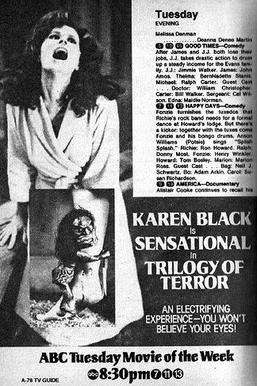
1975’s Trilogy of Terror is a true classic, a rare made-for-television horror film that could have just as easily and effectively been released in theaters.

As one can surmise from the title, it features three stories.  Each story is directed by Dan Curtis and written by Richard Matheson.  Each story also features Karen Black in the lead role, giving Black a chance to play not just one but four very different characters over the course of one film.  One of the things that makes this film work so well is Karen Black’s totally committed performance.  Sadly, Karen Black later expressed some regret about having appeared in the film because it led to her being typecast as a horror actress, which she definitely hadn’t been before.  (One need only watch Karen Black in Five Easy Pieces, Nashville, or Family Plot to see what a good actress she was.  Even in something like Easy Rider, where she had only a small role and very few lines, her talent is obvious.)  As a result, Black was no longer considered for the big studio films that she had appeared in previously and instead, she spent the remained of her career appearing in low-budget horror films.  That’s a shame because Trilogy of Terror really does show what a strong actress Black was.

The first segment features Black as Julie, a seemingly uptight teacher who somewhat surprisingly agrees to go out on a date with Chad (Robert Burton), a sleazy college student.  Chad drugs Julie’s drink during their date and later undresses her and takes pictures which he then uses in an attempt to blackmail Julie into basically being his sex slave.  Julie, however, turns out to have a big secret of her own and Chad discovers too late that he was the one who was being manipulated.  This segment was the least interesting of the three stories but the ending was very satisfying.  Anyone who has ever dated a “nice guy” who turned out to actually be a jerk will enjoy Julie’s revenge.

The second segment is enjoyably sordid, an over-the-top soap opera that I can’t talk too much about without spoiling the plot.  Black plays Millicent, a repressed brunette, who is hatefully obsessed with her twin sister, blonde Theresa (Black again).  Millicent fears that Therese is planning to corrupt and destroy her boyfriend, Thomas (John Karlen).  Millicent explains to her therapist (George Gaynes) all of the terrible things that Therese has done.  Of course, the truth turns out to be much more complicated.  This story was entertaining and featured a surprisingly effective twist.

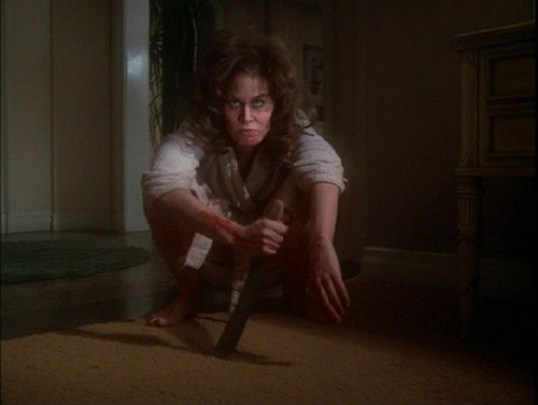
The third segment is the one that everyone remembers.  Amelia (Karen Black) lives alone in a high-rise apartment and has recently purchased, as a present for her anthropologist boyfriend, a wooden fetish doll in the form of a misshapen aboriginal warrior with pointed teeth and a spear.  The doll comes with a scroll that explains that the doll is inhabited by the spirit of a Zuni hunter and that the only thing keeping the doll from coming to life is the gold chain adorning the doll.  Of course, the chain eventually falls off and Amelia finds herself being pursued through her apartment by a viscous doll that is obsessed with killing her.  This is the simplest and the scariest of the Trilogy of Terror’s three stories.  It’s easy to say that it’s just a doll until it pops out of nowhere and stabs Amelia in the ankle.  This story ends on a properly dark note and that final image of Karen Black is haunting.

For a fifty year-old film, Trilogy of Terror holds up remarkably well.  Watch it and witness just how good an actress Karen Black truly was.

Trilogy of Terror (1975, dir by Dan Curtis. DP: Paul Lohmann)

Icarus File No. 24: Express to Terror (dir by Dan Curtis)


The year was 1979 and Fred Silverman, the president of NBC, had an idea.

How about a television series in which each week’s episode would depict a different group of passengers going on a trip?  The passengers would all be dealing with their own stories, some of which would be dramatic and some of which would be humorous.  With any luck, some of them might even fall in love over the course of their journey!

To keep the audience interested, the show would also feature a cast of regular characters, the crew.  Edward Andrews would play the captain, a sensible and by-the-book type.  Robert Alda played Doc, the doctor who was also a bon vivant.  Patrick Collins was the goofy purser.  Nita Talbot played Rose, the perky director of entertainment.  Michael DeLano was the bartender who always had the best advice for the passengers….

Does this sound familiar?

If you think that it sounds like Fred Silverman just ripped off The Love Boat …. well, you’re wrong.  The Love Boat took place on a boat.  Supertrain took place on a train.

At the time that Supertrain went into production, it was the most expensive television production of all time.  Before the pilot film was even shot, NBC had spent ten million dollars on the Supertrain sets.  Not only was a fake train built but two models were also constructed for the shots of the train moving through the countryside.  At the time, the assumption was that the costs would be easily covered by the money that NBC stood to make from broadcasting the 1980 Summer Olympics.  Unfortunately, Jimmy Carter decided that the U.S. would be boycotting the Olympics as a way to protest Russia’s invasion of Afghanistan.  The only thing that kept NBC from going bankrupt was that the BBC was apparently run by someone even more incompetent than Fred Silverman.  The BBC paid $25,oo per episode for the rights to air Supertrain in the UK.  Supertrain proved to be such a disaster that the BBC never actually aired the episodes that they had purchased.

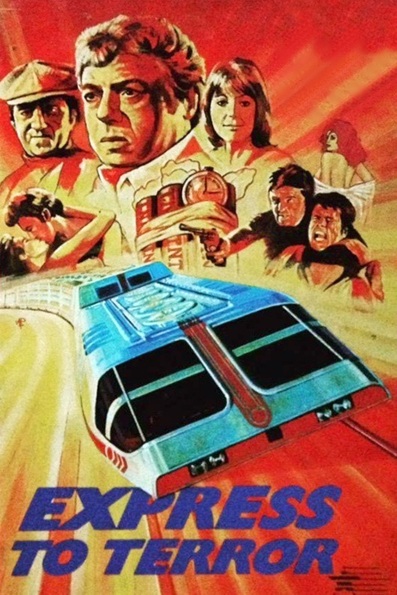
1979’s Express to Terror was the pilot to Supertrain.  (It was later released in some territories as a stand-alone film.)  Directed by horror impresario Dan Curtis (who was also brought in to produce the series), Express to Terror opens with an apparently drunk Keenan Wynn playing the role of railway baron Winfield Root.   Winfield loudly announces to a group of nervous investors that he has created ” an atom-powered steam turbine machine capable of crossing this country in 36 hours!”  A few months later, Supertrain sets off from New York to Los Angeles.

The main thing that one notices about the train is that it’s incredibly tacky.  For all the money that Winfield Root (not to mention NBC) poured into the thing, it looks awful.  The cabins are bland and also seem to be constantly shaking as the train rumbles over its tracks.  Whereas The Love Boat featured glorious shots of passengers enjoying themselves on an open-air deck, Express to Terror features a lot of shots of passengers trying to squeeze their way through narrow and crowded hallways.  There’s a disco car, which sounds like fun but actually looks like a prom being held in a locker room.  There’s a swimming pool but you can’t really lay out by it because it’s on a train.  Winfield is among the passengers and he continually refers to the train as being “Supertrain” in conversation, which just sounds dumb.  “The next person who stops Supertrain,” he announces “will be walking to L.A!”

The main drama features Steve Lawrence as Mike Post, a Hollywood agent with a gambling problem who thinks that someone on the train is trying to kill him.  Actually, the assassin is after a different Mike Post (Don Stroud) but that Mike Post is a criminal who, after entering the witness protection program, changed his name to Jack Fisk.  The criminal Post is hoping that the agent Post will be killed by mistake.  The criminal Mike Post has a girlfriend named Cindy (Char Fontane) who falls in love with the agent Mike Post.  Fred Williamson appears as a football player-turned-assassin.  George Hamilton plays a Hollywood executive.  Don Meredith is the alcoholic best friend of the agent Mike Post.  Stella Stevens is on the train as a diva.  So is Vicki Lawrence, playing a naive innocent.

Express to Terror tries to mix comedy and drama but it doesn’t really work because the “Good” Mike Post doesn’t really seem to be worth all the trouble.  Steve Lawrence gives a mind-numbingly bad performance in the role and, as a result, “Good” Mike Post really isn’t any more sympathetic than “Bad” Mike Post.  The main problem is that “Good” Mike Post comes across as being a coward and there’s only so much time that you can watch a coward act cowardly before you lose sympathy for him.  Being scared is one thing.  Being so dumb that accidentally gets your fingerprints on a knife that’s just been used to kill a man is another thing.

As for the members of the crew — the captain, the doctor, the bartender, and such, they take a back seat to the drama of the two Mike Posts.  It’s a bit odd because no one on the train — not even Winfield Root — seems to be that upset by the fact that one of their passengers is murdered while the train is going through a tunnel.  You would think that everyone would be worried about the future of Supertrain at that point.  A murder is not good for publicity but Winfield Root is oddly unconcerned about it.  I swear, light rail people are almost as heartless as bicyclists!

Of course, the worst thing about Express to Terror is that it promises terror but it doesn’t deliver.  When I see a the word “terror” in a film directed by Dan Curtis, I expect a little terror!  Other than Steve Lawrence’s overacting, there really wasn’t anything particularly terrifying about Express to Terror.

As for Supertrain, it ran for nine episodes and was promptly canceled.  Fred Silverman left NBC and spent the rest of his career as an independent producer.  Supertrain’s tracks got too close to the sun and they nearly took down a network.

Previous Icarus Files:

  1. Cloud Atlas
  2. Maximum Overdrive
  3. Glass
  4. Captive State
  5. Mother!
  6. The Man Who Killed Don Quixote
  7. Last Days
  8. Plan 9 From Outer Space
  9. The Last Movie
  10. 88
  11. The Bonfire of the Vanities
  12. Birdemic
  13. Birdemic 2: The Resurrection 
  14. Last Exit To Brooklyn
  15. Glen or Glenda
  16. The Assassination of Trotsky
  17. Che!
  18. Brewster McCloud
  19. American Traitor: The Trial of Axis Sally
  20. Tough Guys Don’t Dance
  21. Reach Me
  22. Revolution
  23. The Last Tycoon

Horror Film Review: The Invasion of Carol Enders (dir by Dan Curtis)


The Invasion of Carol Enders….

AGCK!  That’s a scary title that just brings to mind all sorts of disturbing images.  And this 1973 made-for-television film does get off to a rather disturbing start, with Carol Enders (Meredith Baxter) and her boyfriend, Adam Reston (Christopher Connelly), getting attacked in the park by a random criminal.  Carol falls and strikes her head.  She is rushed to the hospital in a coma and is not expected to survive.

Meanwhile, Diana Bernard (Sally Kemp) has an argument with her former lover (John Karlen) and then goes for a drive in the rain.  When the car crashes, Diana is rushed to the same hospital as Carol.  Ironically, it’s the same hospital where her husband, Peter (Charles Aidman), works.  Like Carol, Diana is not expected to survive.

Diana and Carol both appear to die at the same time.  Except Carol doesn’t actually die.  Instead, she has a miraculous recovery.  She comes out of her coma and she is remarkably articulate for someone who has just suffered serious brain damage.  However, there is one problem.  Carol swears that she’s never seen Adam before, that she’s married to Peter, and that her name is Diana!

That’s the invasion of Carol Enders.  When Diana died, her spirit moved into Carol’s body and took control.  Diana is convinced that her car accident was not actually an accident.  She thinks that she was set up by her ex and she sets out to try to prove that the accident was actually attempted murder.  (Actually, it’s only attempted from Diana’s point of view.  As far as the rest of the world is concerned, Diana is dead.)  While Adam tries to help Diana solve her murder out of a hope that she’ll go away and allow Carol to once again be in control of her own body, Diana runs off to her husband.  However, it turns out that there’s a lot more going on than even Diana realizes.

This is a bit of an odd made-for-TV movie, even by the standards of the 70s.  It’s only 69 minutes long and it was shot on video tape, giving the whole thing the look of an old daytime drama.  It’s easy to watch this movie and imagine that it’s just a supernaturally-tinged episode of General Hospital or Days Of Our Lives.  Both the acting and the plot add to the daytime drama feel of the production.  This is a movie that fully embraces the melodrama.

I think the most interesting thing about this film is that everyone is very quick to accept that Diana has somehow willed her spirit into Carol’s body.  There’s very little hesitation about accepting Diana/Carol at her word and no one even thinks to suggest that maybe Carol is having some sort of mental episode as a result of the attack.  Adam hears that his girlfriend has been possessed and he immediately gets to work helping out the woman who has possessed her.  I mean, good for Adam.  I like a man who is willing to do whatever has to be done.  Still, everyone acts as if possession happens every day.

This is kind of a silly movie, which is probably why I enjoyed it.  It’s short, it’s simple, and it embraces the melodrama.  What’s not to enjoy?

October True Crime: Killer’s Delight (dir by Jeremy Hoenack)


The 1978 film, Killer’s Delight, opens with the usual beautiful shots of San Francisco in the 70s.  It’s a lovely city, full of attractive people with their entire lives ahead of them.  The camera lingers on the Golden Gate Bridge.  If your movie doesn’t feature the Golden Gate Bridge, is it really set in San Francisco?

A van drives through the city and into the countryside.  My first instinct was to think, “Oh, that’s definitely a rape van,” and yes, it is.  (Seriously, don’t ever accept a ride from someone with a van.  Actually, you shouldn’t be hitchhiking to begin with!  Shame on you!)  The owner of the van, Danny (John Karlen), pulls over to the side of the road and tosses a naked woman’s body over the side of a cliff.

AGCK!

Now, I have to admit that Killer’s Delight (which is known by about a dozen other titles, including The Dark Ride) is a film that I’ve tried to watch several times but I’ve always struggled to make it all the way through.  That’s not because of the subject matter, though as a woman who once thought of herself as being invincible, I could certainly relate to many of the women who appeared in this film and made the fatal mistake of getting in that van.  No, the reason why I’ve always struggled with Killer’s Delight is because it’s a slow movie.  It’s not necessarily a bad film but it’s not one to watch if your eyelids are already starting to feel heavy.

This is an early serial killer film, made before it was decided that every killer should be portrayed as being an erudite and witty anti-hero.  Instead, the film’s killer is a loser named Danny (John Karlen) who has never gotten over his childhood and who, when he’s not killing, is busy sobbing.  It’s certainly a more realistic portrayal of a serial killer than anything that one might find in any of the films or books about Hannibal Lecter.  Danny has two skills.  He’s good at disguising himself and he’s fairly good at getting rid of bodies whenever there’s no one else around to see him.  Otherwise, he’s a total loser.  This realistic portrayal actually makes Danny into a very scary character.  You’re never going to meet Hannibal Lecter in real life.  That’s one reason why it’s so easy for some people to accept his crimes.  However, there are hundreds of people just like Danny out there.  There’s probably at least a few in your city right now.

The majority of the film is taken up with Sgt. Vince De Carlo (James Luisi) and his attempts to prove that Danny is the killer.  Vince is married and very protective of his daughters.  He’s also having an affair with a psychiatrist (Susan Sullivan) who runs the potential of becoming one of Danny’s victims.  Vince becomes obsessed with Danny but, much like Charles Bronson in Ten To Midnight, he knows that the justice system does not know what to do with a monster like Danny.

As I said, it’s a slow film but it is well-acted and, if you stick with it, it does cast an ever-growing atmosphere of doom.  It’s the type of film that will make you double-check the locks before you go to bed.

As for why this is a true crime film, it’s loosely based on the crimes of Edmund Kemper and Ted Bundy.  At the time the film was made, Bundy was still at large.  Killer’s Delight was the first film to be based on Bundy’s crimes, though Danny ultimately has more in common with Kemper than with Bundy.

Horror on the Lens: Trilogy of Terror (dir by Dan Curtis)


For today’s horror on the Lens we have a made-for-TV movie that was produced and directed by Dan Curtis.

Trilogy of Terror, which aired in 1975, is an anthology film, featuring three segments that were each based on a short story from Richard Matheson.  What makes this particular film special is that each segment features Karen Black playing a radically different character from the previous segment.  The film really is a showcase for this underrated actress, though Black herself later said that the film ruined her career because it typecast her as a horror actress.

The third segment is the one that gets all the attention.  That’s the one with the killer doll.  I like all of the segments, though.  The first one is often considered to be the weakest but anyone who has ever been through a similar situation will appreciate it as tale of revenge.  The second segment has a playful vibe that I liked.  And yes, the third segment is genuinely frightening.

From 1975, here is Trilogy of Terror:

Horror Film Review: Night of Dark Shadows (dir by Dan Curtis)


Since I just reviewed House of Dark Shadows, it only makes sense to now take a look at 1971’s Night of Dark Shadows today!

While Night of Dark Shadows is not a direct sequel to the first film, it is still definitely a part of the same cinematic universe.  There may not be any vampires in this film but it does take place in the same house and it features two members of the family that was decimated over the course of the previous film.  At one point, it’s mentioned that Joan Bennett’s character from House of Dark Shadows died after the first film but no one goes into any details.  I guess a vampire in the family is something that’s simply not discussed amongst polite company.

Night of Dark Shadows deals with Quentin (David Selby) and Tracy Collins (Kate Jackson).  Quentin is an artist who confesses that he wasn’t particularly nice before he married Tracy.  When they move into the Collins mansion, they bring two friends with them, Alex (John Karlen) and Claire (Nancy Barrett.)  Interestingly enough, Karlen and Barrett both played different characters in House of Dark Shadows.  Grayson Hall, who played Dr. Hoffman in House of Dark Shadows, also returns for Night of Dark Shadows.  This time Hall is playing Carlotta Drake, the creepy housekeeper.  (Needless to say, all mansions comes with a creepy housekeeper.)

Soon after everyone moves in, Quentin starts acting strangely.  He becomes obsessed with the painting of a beautiful woman who was named Angelique (Lara Parker) and with the story that Angelique was hanged when it was discovered that she was having an affair with Quentin’s ancestor, Charles.  (For his part, Charles was apparently walled up in the mansion.  That sounds a bit extreme to me but I guess that’s the way they did things in the 19th century.)  Quentin starts to have visions and nightmares involving his ancestor who, it turns out, looked exactly like him!  Meanwhile, Carlotta and the groundskeeper, Gerard (Jim Storm), seem to be determined to make sure that Tracy doesn’t feel welcome in her new home.  It’s almost as if they’re trying to drive everyone but Quentin away from the house.

Night of Dark Shadows is a much more polished film than House of Dark Shadows but it also unfolds at a far more leisurely pace.  It lacks the relentless energy that distinguished House of Dark Shadows.  This wouldn’t be as much of a problem if the plot itself wasn’t so totally predictable.  From the minute that Quentin first sees that portrait of Angelique, you know that he’s going to get possessed and start acting strangely.  There are a few atmospheric scenes but, for the most part, the film just doesn’t grab the viewer’s attention the way that House of Dark Shadows did.

On the plus side, David Selby is properly intense and brooding in the dual roles of Quentin and Charles Collins while Lara Parker does an equally good job as the wonderfully evil Angelique.  Grayson Hall, who tended to go overboard in House of Dark Shadows, gives a much better and far more menacing performance here.  Night of Dark Shadows isn’t a bad film.  It’s just not a particularly memorable one.

Horror Film Review: House of Dark Shadows (dir by Dan Curtis)


There’s a lot that you can say about this vampire film from 1970 but I think it can all be summed up with one word: relentless.

A lot of this is because House of Dark Shadows is a film adaptation of a daytime drama.  Over the course of six sesons, Dark Shadows ran for a total of 1,220 episodes.  That’s a lot of story to cram into a 97-minute film but director Dan Curtis does just that.  The end result is an incredibly busy film and I mean that in the best way possible.

Seriously, there are so many twists and turns in this film’s plot that it’s difficult to even know where to begin.  This is one of the most incident-filled horror films that I’ve ever seen.  No sooner does one plotline resolve itself than another begins.  Meanwhile, a surprisingly large cast wanders through the shadows and tries not to get transformed into a vampire.  Most of them do not succeed.

See if you can keep all of this straight:

In Maine, a lowlife handyman named Willie (John Karlen, giving the film’s best performance) breaks into a mausoleum and approaches a coffin that’s covered with chains.  Willie thinks that there’s a treasure hidden in the coffin but, after he removes the chains, he instead discovers that he’s stumbled across the home of a vampire!  Barnabas Collin (Jonathan Frid, who perfectly combines old world manners with thinly veiled menace) has spent 175 years trapped in that coffin and now that he’s been released, he’s not in a very good mood.

Soon, Barnabas has introduced himself to his descendants (including Joan Bennett, as Elizabeth, the family matriarch) as a cousin from England.  Everyone is impressed with Barnabas’s charm and courtly style.  Of course, some people are a little bit skeptical.  Prof. Stokes (Thayer David) notices that Barnabas doesn’t seem to know much about London while Dr. Hoffman (Grayson Hall) flat out accuses Barnabas of being a vampire.  Barnabas admits that this is true but fear not!  Dr. Hoffman’s fallen in love with him and wants to help cure him.

Meanwhile, everyone in town is growing concerned about all of the bloodless bodies that are showing up.  They especially get worried after Elizabeth’s daughter, Carolyn (Nancy Barrett), dies and then promptly comes back to life, complete with her own set of fangs….

While the town concerns itself with what to do about Carolyn, Barnabas has fallen in love with a nanny named Maggie (Kathryn Leigh Scott), who he thinks is the reincarnation of his former lover.  Unfortunately, Maggie already has a boyfriend named Jeff (Roger Davis) but when has the ever been a problem for a vampire?  Far more of a problem than Jeff is the fact that Willie is also in love with Maggie and Dr. Hoffman is so jealous of Barnabas’s love for Maggie that she’s willing to inject him with a formula that causes him to transform into an elderly man….

And all that’s just in the first hour!

Needless to say, it all leads to one final, gore-filled confrontation.  When I say that this film is gory, I mean just that.  Blood isn’t just spilled in House of Dark Shadows.  Instead, it flows like water busting out of a cracked dam.  When Barnabas bites a victim, he doesn’t just leave two neat little puncture marks.  Instead, he literally rips their neck to shreds.  Just how savage Barnabas and Carolyn get in this film is one of the things that sets House of Dark Shadows apart from other vampire films.  As opposed to the type of tragic figure who shows up in so many vampire films, Barnabas is ruthless, cruel, and unforgiving.  He’s a genuinely frightening creation.

House of Dark Shadows is a chaotic movie but it’s also a lot of fun.  This is one of those films that you watch in amazement as it just keeps going and going, piling on one incident after another.  Does the film always make sense?  No, but it doesn’t have to.  Quickly paced and featuring nonstop gore and fog, the film has a dream-like feel to it.  Curtis and the cast attack the material with such unbridled enthusiasm that it doesn’t matter if the plot occasionally doesn’t always add up or if the dialogue is occasionally a bit clumsy.  It’s impossible not to get swept along with the film’s insanity.

Probably because of its television roots, House of Dark Shadows is often dismissed by critics.  (I’ve never seen any old episodes of the show so I can’t say how the movie compares to it.)  Well, those dismissive critics are wrong.  House of Dark Shadows is one of my favorite vampire films and it’s definitely one that deserves to be rediscovered.

(And yes, it’s a helluva lot better than that movie that Tim Burton made with Johnny Depp….)
Great Moments In Television History #23: Barnabas Collins Is Freed From His Coffin


The year was 1967 and, in Collinsport, Maine, a petty criminal named Willie Loomis was about to make television history.  Convinced that a fortune in jewelry was hidden in the Collins family’s mausoleum, Willie broke in and opened a coffin that, strangely, was covered in chains.  Willie expected to find a fortune.  Instead, he found Barnabas Collins, a 200 year-old vampire who transformed Willie into his servant and proceeded to spend the next five years masquerading as a cousin from Britain while searching for both a cure to his condition and for the reincarnation of the love of his life, Josette.

Played by stage actor Jonathan Frid, Barnabas Collins made his first appearance on the April 18th, 1967 episode of Dark Shadows.  Though Barnabas was originally only meant to be a temporary addition to the show’s roster of characters, Frid proved to be popular with viewers, like my mother who not only watched the show when it first aired but also when reruns were broadcast in syndication many years later.  The show soon came to center on the ruthless vampire.

In fact, Frid and Barnabas became some identified with the show that many are still shocked to learn that Dark Shadows had run for a full year before Barnabas was introduced as a character.  When the show airs in syndication, it usually starts with Willie (played by John Karlen) opening Barnabas’s coffin and not with the earlier episodes in which the show’s nominal lead character, Victoria Winters, first arrived at Collinwood and met the members of the family.

Many future horror directors and writers have stated that their interest in the genre began with watching Jonathan Frid on Dark Shadows.  And it all began with that one great moment when Willie Loomis opened the coffin and set Barnabas free.

Previous Moments In Television History:

  1. Planet of the Apes The TV Series
  2. Lonely Water
  3. Ghostwatch Traumatizes The UK
  4. Frasier Meets The Candidate
  5. The Autons Terrify The UK
  6. Freedom’s Last Stand
  7. Bing Crosby and David Bowie Share A Duet
  8. Apaches Traumatizes the UK
  9. Doctor Who Begins Its 100th Serial
  10. First Night 2013 With Jamie Kennedy
  11. Elvis Sings With Sinatra
  12. NBC Airs Their First Football Game
  13. The A-Team Premieres
  14. The Birth of Dr. Johnny Fever
  15. The Second NFL Pro Bowl Is Broadcast
  16. Maude Flanders Gets Hit By A T-Shirt Cannon
  17. Charles Rocket Nearly Ends SNL
  18. Frank Sinatra Wins An Oscar
  19. CHiPs Skates With The Stars
  20. Eisenhower In Color
  21. The Origin of Spider-Man
  22. Steve Martin’s Saturday Night Live Holiday Wish List