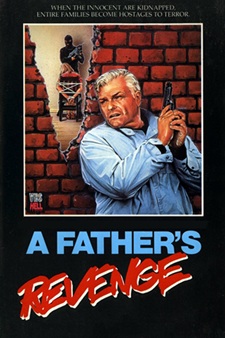
A Father’s Revenge (1988, directed by John Herzfeld)


After his flight attendant daughter is taken hostage by a group of German terrorists, basketball coach Paul Hobart (Brian Dennehy) grows frustrated with government red tape and heads to Germany to track her down and save her himself.  Realizing that he doesn’t have the experience necessary to do it all on his own, Paul hires Vickers (Anthony Valentine), a shady and ruthless former SAS man who will do whatever is necessary to get the job done.  Joanna Cassidy plays Paul’s wife.  Ron Silver plays the journalist who sees the opportunity to break a great story as Paul searches for his daughter.

A Father’s Revenge is a slow-moving thriller.  I was surprised to discover that it was actually given a theatrical release because everything about it feels like a made-for-television movie.  It’s a predictable movie.  At first, Paul is reluctant to embrace Vickers’s more extreme methods but then he sees that those methods are the only ones that work when dealing with terrorists.  As usual, Dennehy is ideally cast as a beer-drinking, blue collar American and the underused Joanna Cassidy has a few good emotional scenes as his wife.  The movie is stolen by Anthony Valentine, who brings a note of ambiguity to Vickers’s motivations.  The main problem with the movie is that it spends too much time on scenes of people debating what they should do and not enough time showing them actually doing it.  The finale is exciting but it takes too long to get there.

Icarus File No. 21: Reach Me (dir by John Herzfeld)


The 2011 film, Reach Me, opens with a rapper named E-Ruption (Nelly) appearing on a morning show and talking about how, while he was serving a prison sentence, he read a self-help book called Reach Me.  It asked him to consider whether or not his childhood self would be happy with his adult self.  The book was written by a mysterious man named Teddy Raymond.  No one knows who this Teddy Raymond is.  He’s never appeared in public.  People film themselves reading the book online and then upload to YouTube as a way of sharing Teddy’s wisdom.  I honestly can think of nothing more annoying and boring than watching someone else read a self-help book but whatever.  I live in Texas.  The movie takes place in California.

Tabloid editor Gerald (Sylvester Stallone) takes a break from action painting to order one of his reporters, Roger King (Kevin Connolly), to track down Teddy Raymond.  Roger wants to write the great American novel.  He doesn’t care about self-help.  He meets Teddy’s associates, Wilson (Terry Crews) and Kate (Lauren Cohan) and Wilson talks about how Teddy magically cured Kate’s stutter.  Roger then wanders around the beach, asking random people, “Teddy Raymond?  Are you Teddy Raymond?”  Oh look!  There’s a guy named Teddy (Tom Berenger) who reluctantly cures Roger of his smoking addiction by ordering Roger to yell at the ocean …. over and over and over again.

Collette (Kyra Segdwick) has just been released from prison.  Reading Teddy’s book has inspired her to try to become a fashion designer.  Collette’s daughter, Eve (Elizabeth Henstridge), is an aspiring actress who was earlier groped by a sleazy star named Keating (Cary Elwes).  Collette and Eve literally crash their car into a car being driven by Wolfie (Thomas Jane), a sociopathic undercover cop who enjoys killing people and who goes to confession after every shooting.  (At the start of the movie, he guns down Danny Trejo.)  The alcoholic priest, Father Paul (Danny Aiello), refuses to hear any more of his confessions.

Meanwhile, wannabe mob boss Frank (Tom Sizemore) is upset because another mob boss, Aldo (Kelsey Grammer), doesn’t treat him with any respect.  Frank sends two of his hitmen, Thumper (David O’Hara) and Dominic (Omari Hardwick), to kill a man who owes him money and to also shoot the man’s dog.  Thumper has been reading Teddy Raymond’s book and doesn’t want to shoot the dog.  Dominic realizes that his heart isn’t into the mob life so, taking the book’s message to heart, he calls Frank and says, “My heart’s not in it.”

(Don’t try that with any real mobsters.)

Eventually, all of the characters do come together.  They don’t exactly come together in a plausible manner but they do all end up at the same location so let’s give the film credit for that.  Let’s also give this film credit for leaving me seriously confused.  I have no idea whether this film was meant to a parody or a celebration of the self-help industry.  At first, I suspected that it meant to be a parody because all of Teddy Raymond’s advice was painfully shallow and the type of basic crap that anyone could come up with.  I actually found myself losing respect for the people who claimed that Teddy had changed their lives.  But at the movie progressed, I realized that I was supposed to take Teddy and his advice seriously.  This was a film that I guess was meant to have something to say but who knows what exactly that was.

That said — hey, everyone’s in this movie!  Director John Herzfeld was a former college roommate of Sylvester Stallone’s and, once Stallone agreed to appear, that apparently convinced a lot of other “name” actors to take the risk as well.  There’s a lot of talent in this film but little of it is used correctly.  Kelsey Grammer as an Italian mobster instead of the editor?  Sylvester Stallone as the editor instead of the Italian mobster?  Thomas Jane as a sociopath who has a girlfriend by the end of the movie, one who smiles and tells him, “Try not to shoot anyone?”  Kyra Sedgwick as an ex-con?  These are all good actors but just about everyone, with the exception of the much-missed Danny Aiello, is miscast.

It’s a true Icarus File.  It was a just a little more self-aware, this would have been a Guilty Pleasure.  But, in the end, self-help cannot help itself.

Previous Icarus Files:

  1. Cloud Atlas
  2. Maximum Overdrive
  3. Glass
  4. Captive State
  5. Mother!
  6. The Man Who Killed Don Quixote
  7. Last Days
  8. Plan 9 From Outer Space
  9. The Last Movie
  10. 88
  11. The Bonfire of the Vanities
  12. Birdemic
  13. Birdemic 2: The Resurrection 
  14. Last Exit To Brooklyn
  15. Glen or Glenda
  16. The Assassination of Trotsky
  17. Che!
  18. Brewster McCloud
  19. American Traitor: The Trial of Axis Sally
  20. Tough Guys Don’t Dance

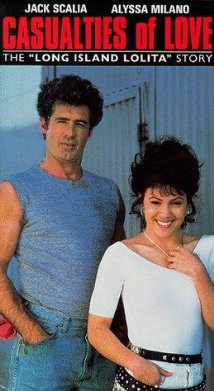
Love On The Lens: Casualties of Love: The Long Island Lolita Story (dir by John Herzfeld)


Poor Joey Buttafuoco!

As seen in the 1993 made-for-TV movie Casualties of Love, Joey is a saintly, salt-of-the-Earth blue collar guy who works as an auto mechanic on Long Island.  He’s also an aspiring drummer, one who struggles with a major cocaine addiction.  When his loving wife, Mary Jo (Phyllis Lyons), threatens to leave him and take the kids unless he cleans up his act, Joey checks into rehab.  Six months later, he leaves rehab clean and sober and dedicated to his family.  All of the other patients lean out of their windows and wish Joey well.  Everyone loves Joey!

Joey, the most handsome and sweetest auto mechanic in the state of New York, does have a problem, though.  A sociopathic teenager named Amy Fisher (Alyssa Milano) has grown obsessed with him and keeps intentionally damaging her car so that she can come hang out at the garage.  When the other mechanics say that Amy is hot, Joey agrees but that’s all he does.  Joey loves his wife.  When Amy tries to kiss him at a carnival, he shoves her away and then kisses his wife to make sure that everyone understand that Joey Buttafuoco is the best guy ever.  When Amy accuses Joey of giving her a STD, everyone realizes she’s lying because Joey would never have an STD in the first place.

And when Amy shoots Mary Jo in the face, the media and the police try to make it seem like Joey is somehow to blame but again, we know that he’s not.  Joey Buttafuoco is a name that means honor and respect.

Uhmm …. yeah.

So, this is story is very loosely based on a true story and by that, I mean that there was a teenager named Amy Fisher who shot a woman named Mary Jo in the face and later said that she was having an affair with her husband, Joey.  Apparently, there were three made-for-TV movies made about the case, all of which premiered in the same month.  Casualties of Love is told from the point of view of Joey and Mary Jo and it fully supports Joey’s initial claim that he never slept with Amy and she was just some obsessed psycho.

While watching this film, I got bored enough to look up the case on Wikipedia and I learned that, after this movie aired, Joey admitted that he did have an affair with 16 year-old Amy Fisher and he subsequently went to jail for statutory rape.  After getting out of jail, Joey divorced his wife and has subsequently been in and out of trouble with the law.  He also become a regular on TV court shows, where he would sue people who failed to pay him for fixing their cars.  My point is, Joey Buttafuoco sounds like a bit of a sleaze in real life.  That makes this film’s portrayal of him as being some sort of Saint of Long Island feel rather dumb.

Actually, it would feel dumb even if the real Joey Buttafuoco was a solid citizen.  Casualties of Love is one of the silliest films that I’ve ever seen, portraying Joey as being a streetwise former cocaine addict who was somehow too naive to realize that it would look bad to spend time in his office alone with Amy.  As Joey, Jack Scalia is very handsome and very sincere and he feels totally miscast as someone who spends hours working underneath the hood of other people’s cars.  Leo Rossi and Lawrence Tierney both show up, mostly so they can say, “Oh, what were you thinking!?” to Joey.  As Amy Fisher, Alyssa Milano gives an amazingly lifeless performance.  Occasionally she talk fast and plays with her hair.  This is the film’s way of letting us know that she’s supposed to be unhinged.  I mean, I do the same thing.  If you’ve got long hair, you’re going to play with it whenever you got bored.  It doesn’t make you crazy.

Unfortunately, though the film may be silly, it’s not much fun.  The direction is workmanlike and the film’s portrayal of Joey and Mary Jo’s marriage is so earnestly bland that the film never even rises to the level of camp.  The film ends with a warning that Amy would soon be eligible for parole.  (Oddly, it also points out that Amy could take college courses in jail, as if that was a bad thing.)  Meanwhile, “Mary Jo is taking it one day at a time.”  Fortunately, Mary Jo eventually took herself out of Joey’s life and filed for divorce.  That’s the happy ending this film lacks.
Documentary Review: Sly (dir by Thom Zimmy)


Now streaming on Netflix, Sly is a documentary about the life and career of Sylvester Stallone.

The documentary opens with Stallone watching as all of his belongings in his Hollywood mansion are packed in boxes so they can be shipped to his new home in New York.  As I listened to Stallone talk about how you sometimes have to return to your roots to discover who you truly are, it occurred to me that Stallone is one of those people who is never not playing a role.  Even when he’s not Rocky Balboa or John Rambo or any of the other characters that he’s played in the movies (or, less frequently on television), he’s still playing Sylvester Stallone, the bigger-than-life movie star who has been an inescapable part of the American pop cultural landscape for longer than I’ve been alive.  Watching Stallone talk about what it’s like to go, overnight, from being an unknown to being a celebrity, I never doubted his sincerity but I was always aware of how carefully chosen his words seemed to be.  Sylvester Stallone lets the audience in but he’s still careful about how much he reveals about himself.

The same can be said of the documentary, which largely focuses on Rocky, Rambo, and The Expendables, with a little Lords of Flatbush, F.I.S.T., Paradise Alley, and Cop Land trivia tossed in as well.  Stallone admits that he’s not proud of all of the films that he’s made, citing Stop!  Or My Mom Will Shoot! as his biggest regret.  (Arnold Schwarzenegger pops up to brag about how he was smart enough to turn down the script when it was originally sent to him.)  That said, there’s not much attention given to Stallone’s films with Roger Corman or for the films that he did for Cannon.  Sorry, there’s no Over The Top trivia.  There are a few clips from Cobra and Rhinestone but not much more.  If you’re looking for a documentary about the B-movies of Sylvester Stallone, this is not it.  (Interestingly enough, even films like Demolition Man — which was one of Stallone’s better non-Rocky and non-Rambo films — are also glossed over.)  Beyond talking his troubled relationship with his father, mentioning his love for daughters, and a moment where he gets noticeably emotional while talking about his late son, there’s not much information here about Stallone’s private life.  And again, it’s not that Stallone owes anyone any of that information.  At one point, Stallone says that he hasn’t had a moment of privacy since the release of Rocky and he’s probably right.  He’s earned the right to keep some things private.

Also interviewed in the documentary are Frank Stallone, Quentin Tarantino, film critic Wesley Morris, director John Herzfeld, and Talia Shire.  Frank comes across as a lot more genuine here than he did in his own documentary while Talia does the best job of understanding the appeal of Rocky.

This is a documentary that will probably best be appreciated by people who are already fans of Stallone.  Stallone doesn’t attempt to win over his doubters but, having been a star for nearly 50 years, Stallone can definitely argue that his doesn’t owe his doubters any effort.  Watching the documentary, it became clear to me that Stallone is one of those pop cultural figures who it is impossible not to love.  Everything about him, from the rough Hell’s Kitchen childhood to his decision to write a movie for himself to his decision to move into the director’s chair, is pure Americana.  There’s a reason why Rocky Balboa often appears with an American flag.

(That said, I still think that Stallone’s best performance was in First Blood and, in this documentary, Stallone gets genuinely emotional as he discusses when he discusses why he felt it was important for Rambo to survive the end of the film.)

He’s a survivor and he’s confident enough to admit that he got a bit arrogant after the success of Rocky.  Stallone still has that confidence that borders on arrogance but he’s aging well and it’s hard not to feel that he’s earned the right to brag on himself.  (It helps, of course, that he’s become a better actor as he’s aged.)  Stallone may not totally open up but he still has his movie star charisma.  When he talks, you listen.  When he moves, you watch.  We’ll miss him when he’s gone.


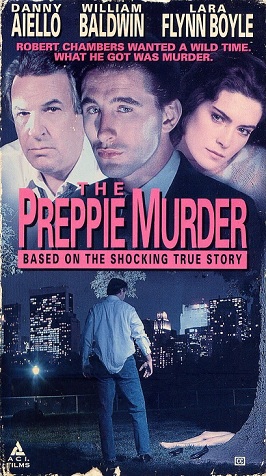
October True Crime: The Preppie Murder (dir by John Herzfield)


The 1989 film, The Preppie Murder, tells the story of the murder of Jennifer Levin (played by Lara Flynn Boyle), an 18 year-old teenager from an affluent family, who was found dead in Central Park on August 26,1986.

The man who was accused of murdering her was Robert Chambers (played by William Baldwin).  Tall, handsome, and popular, Robert Chambers was a former prep school student who had spent one semester at Boston University before being asked to leave because of a series of petty crimes.  Though Chambers and Levin were both a part of the same social circle, Chambers did not come from a wealthy family.  Instead, his background was working class.  (That said, his mother did once serve as a private nurse to John F. Kennedy, Jr. and Robert Chambers even met the presidential scion once.)  Chambers supported himself through stealing his girlfriend’s jewelry and selling drugs.  At the time that he started dating Jennifer Levin, he had just gotten out of rehab.  As shown in the early part of the film, Jennifer’s friends warned her that Chambers had a bad reputation but Jennifer felt that he was just someone who had made mistakes and who was trying to take advantage of his second chance.  To be honest, it’s a sentiment to which I could relate.  I think every woman has had at least one Robert Chambers in their life, the bad boy who could melt hearts with calculated moments of vulnerability but who, in the end, turned out to be an empty shell of a human being.

In the film, the murder occurs off-screen.  We watch as Robert and Jennifer leave a bar together and then we cut to the next morning, with Robert watching from a distance as a homicide detective (Danny Aiello, bringing his trademark, no-nonsense New York style to the role) investigates the scene of Jennifer’s murder.  When the police learn that Robert was the last person to see Jennifer alive, Robert is brought in for questioning.  The cocky Robert attempts to explain away the scratches on his face and body by saying that his cat scratched him.  (“Do you own a tiger?” Aiello’s detective asks him.)  When Robert finally confesses to having killed Jennifer, he claims that he Jennifer was assaulting him and that he only struck her in self-defense.  It’s a ridiculous and offensive story but it’s one that the press loves.  Robert may be the one charged with a crime but it soon becomes clear that, despite not being able to defend herself, Jennifer is the one being put on trial.

It’s an infuriating film, all the more so because it was based on a true story and stuck close to the facts of both the case and the trial.  William Baldwin is well-cast as Robert Chambers, playing him as a handsome and superficially charming man who secretly knows that he’s empty on the inside.  William Devane plays Chambers’s high-priced attorney, who puts Jennifer on trial and only briefly allows himself any feelings of guilt about his actions.  Lara Flynn Boyle wins the viewer’s sympathy in her limited screen time and Danny Aiello is, of course, the perfect New York cop.

What was particularly disturbing about the film was its portrayal of Jennifer and Robert’s friends, many of whom chose to support Robert even though they knew he had murdered Jennifer.  The film ends with clips of Robert at a party that was thrown by his friends after he got out on bail.  While Robert pretends to twist off a doll’s heads, his friends laugh in the background, either unaware or unconcerned that Robert is recreating his murder of Jennifer while they watch.

The real-life Robert Chambers eventually pled guilty to manslaughter and spent 15 years in prison.  He was released in 2003 and promptly returned to his old life of petty crime and drug dealing.  He was sent back in prison, convicted of selling $2800 worth of heroin to an undercover cop.  He was released in July of this year.

A Blast From The Past: Stoned (dir by John Herzfeld)


In 1980’s Stoned, Scott Baio plays Jack Melon, a teenager with a problem.

Jack is shy, awkward, and can’t escape the shadow of his older brother, Mike (Vincent Bufano).  Mike is champion swimmer.  Jack is someone who can barely walk down a hallway without walking into a wall.  But then Teddy (Jack Finch) gets Teddy hooked on marijuana, the so-called weed with roots in Hell!  Soon, Jack is acting weird, making strange jokes, and getting all of the attention in the world.  Unfortunately, Jack is also alienating those closest to him and his newfound habit leads to a near-tragedy.

Stoned was aired as an ABC Afterschool Special and, while it’s not quite Reefer Madness, it does adhere to the general anti-drug formula.  In record time, Jack goes from being shy and dorky to being goofy and potentially dangerous.  We get all the expected scenes of Jack devouring ice cream, Jack wandering around in a daze, Jack realizing that the girl he likes what’s nothing to do with the new Jack, Jack’s well-meaning teacher (played by the show’s writer and director, John Herzfeld) confronting his students about their drug use, and Jack accidentally hitting his brother with an oar.  Jack thinks that marijuana is opening his brain because, while stoned, he suddenly realizes that a tree looks like “Old Man Eber.”  Stoned goes on to show Jack ruining his life but I have to admit that I spent most of the running time wondering who Old Man Eber was.  (Seriously, Old Man Eber sounds like some sort of Lovecraftian ghoul, waiting in the shadows to drag one to an Arkham cemetery.)  Of course, someone nearly dies as a result of Jack’s marijuana use.  What’s interesting is Jack is able to save the person’s life, even though he’s stoned.  Would non-stoned Jack have been able to do it?

From the fashion choices to the cast to the message that marijuana is the most dangerous thing on the planet, Stoned is one of those TV specials that epitomizes its time.  This was a film that was made at a time when it was inconceivable that there would some day be commercials for edible gummies and it shows.  Watching Stoned is like stepping into a time machine.

Today, of course, Scott Baio is better known for his politics than his acting.  Whenever I see a headline that reads, “This veteran Hollywood star is calling out his industry for not understanding America,” I know the story is inevitably going to be about Scott Baio complaining about his taxes.  That said, Scott Baio is convincing when he’s playing Jack as being awkward and insecure but he definitely goes a bit overboard once Jack starts smoking.  While that probably dilutes the effectiveness of the film’s message (because, let’s be honest, real stoners are going to watch this and easily recognize the fact that Jack is trying way too hard to convince everyone that he’s stoned), it does give this film a certain entertainment value.

Here is Stoned, complete with the commercials that aired when the show was original broadcast on November 12th, 1980:

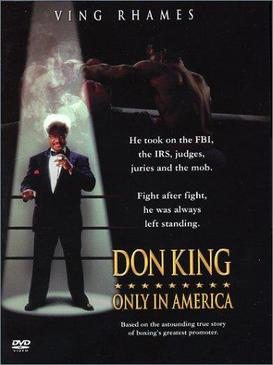
Don King: Only In America (1997, directed by John Herzfeld)


Don King: Only In America is an HBO biopic of the controversial boxing promoter, Don King.  It’s a good movie but it will probably always be overshadowed by what happened when the Hollywood Foreign Press Association voted to give Ving Rhames the Golden Globe for Best Actor in a TV-Movie or Miniseries.  When Rhames won, he called fellow nominee Jack Lemmon to the stage and gave him the award, saying “I feel that being an artist is about giving, and I’d like to give this to you.”  Lemmon, who had been nominated for his work in 12 Angry Men, accepted the statue while the audience gave Rhames a standing ovation.  The HFPA later sent Rhames a second statue and Spike Lee satirized the entire incident in Bamboozled when he had Damon Wayans give away an award he had won to Matthew Modine.

Ving Rhames plays the title role in Don King: Only in America and he definitely deserved every nomination and award that he received as a result.  The episodic film starts in the 50s, with a young King being sentenced to prison and then shows how King went on to become one of the wealthiest and most powerful men in America.  It’s not always a flattering portrait.  The movie fully documents how King cheated the boxers that he managed and the damage that he ultimately did to the image of boxing, a sport that didn’t have a particularly good reputation to begin with.  At the same time, Rhames is such a force of nature that it’s hard not to sometimes admire King’s chutzpah as he deals with and outwits everyone from the Mob to the IRS to racist fight promoters to greedy dictators.  As played by Rhames, King makes himself a success by the virtue of his own hard work and utter ruthlessness.  He’s a flamboyant showman who knows how to play hardball behind the scenes and who refuses to take no for an answer.  He ruins the lives of too many people to ever become a sympathetic figure but he remains a fascinating one.

The film features Rhames, as King, standing in a boxing ring, telling us his story and occasionally interrupting the flashbacks whenever he thinks that they’re reflecting too negatively on him.  (When the film shows Muhammad Ali, played by Darius McCrary, incapacitated by Parkinson’s, King stops the film and angrily tells us that he had nothing to do with that.)  The real Don King supposedly hated the way this film portrayed him and threatened to stop doing business with HBO after it aired but he should have appreciated Ving Rhames’s performance.  Don King is fond of saying that he could have become a millionaire “only in America,” and Rhames’s flamboyant, charismatic, and no holds barred performance convinces us that he’s right.