Eh, anthology films.
I have to admit that I’ve never been a huge fan of anthology films. Anthology films are almost always a bit uneven. Some filmmakers are better suited to making short films than others and, as anyone who has ever sat through one can tell you, sitting through a boring short film is actually worse than having to watch a boring long film. Too often, anthology films are just a collection of boring short films. If you get lucky, there might be a good segment hidden amongst all of the bad segments. But even so, that often means sitting through 30 minutes of bad filmmaking for 15 minutes of something that’s moderately entertaining.
1962’s Tales of Terror is an anthology horror film. Directed by Roger Corman, the film is a part of his Poe cycle and features adaptations of three Poe short stories, Morella, The Black Cat, and The Facts In The Case of M. Valedemar. While it definitely suffers from the flaws that afflict many anthology films, Tales of Terror is saved a bit by the presence of Vincent Price. Price not only appears in all three of the films but he also provides the narration that links each film. As I mentioned when I reviewed The Premature Burial, one cannot underestimate the importance of Vincent Price and his unique style of acting when it comes to discussing Corman’s Poe adaptations. With his dramatic flourishes and his theatrical style of speaking, Price was the perfect star for these films. As an actor, he perfectly complimented Corman’s flamboyant and colorful direction. It also helps that Price himself seems to be truly enjoying himself in all of these films. His eccentricity brings the film’s to life.
As for the separate stories that make up Tales of Terror, things get off to a rather macabre start with Morella. Leonora (Maggie Pierce) returns home to visit her father (Vincent Price), who is now a drunken wreck who continues to blame Leonora for the death of her mother, Morella (Leona Gage). Morella died while giving birth to Leonora. Leonora is shocked to discover that her father is keeping her mother’s decomposing body in the mansion. Leonora, who is suffering from a terminal illness, tries to take care of her father. However, Morella’s spirit remains in the house, leading this story to a rather depressing and unsettling ending. This story was effectively done, playing out like a particularly morbid companion to The Fall Of The House of Usher.
The Black Cat is presented as a comedy, starring Peter Lorre as a man who becomes convinced that his wife is cheating on him with a snobby wine taster who is, of course, played by Vincent Price. This overlong segment did not work for me and I have to admit that a lot of that is because I love cats, black cats in particular. Beyond that, the humor is a bit too broad. Corman could do comedy, as he showed with Little Shop of Horrors, but he seems to be trying a bit too hard here.
Finally, the third segment is The Facts In The Case of M. Valdemar, in which Vincent Price plays the title character. The dying Valdemar employs a hypnotist (Basi Rathbone) to put him in a trance to help relieve his suffering. However, the hypnotist hopes to marry Valdemar’s wife (Debra Paget) and, after putting Valdemar into a trance, he leaves the dying man there. Valdemar, whose body starts to decay, cannot die. But, once he becomes angry enough, he can still rise from his bed to seek revenge even as his body putrefies. This segment was the best of the three, featuring Price’s best work in the film and also a wonderfully villainous turn from Basil Rathbone. The makeup effects that were used to capture Valdemar’s decay remain effectively frightening today.
Tales of Terror is two good stories and one mediocre one, which is better than the usual anthology film. Still, not surprisingly, the main reason watch is for the wonderful Vincent Price.
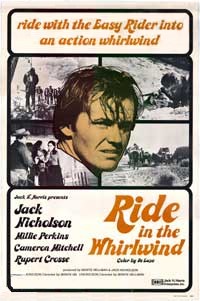 Three cowboys — Vern (Cameron Mitchell), Wes (Jack Nicholson), and Otis (Tom Filer) — are riding their horses across the old west when they come upon a cabin that is inhabited by one-eyed Blind Dick (Harry Dean Stanton) and his friends. Though they suspect that Dick may be an outlaw, the cowboys accept his offer to stay the night. The next morning, they wake up to discover that they are surrounded by a posse. Mistaken for members of Dick’s gang, Vern and Wes go on the run. Eventually, they find themselves hiding out at the home of Evan (George Mitchell), Catherine (Katherine Squire), and their daughter, Abigail (Millie Perkins). While Wes and Vern wait for their chance to escape, the posse grows closer and closer.
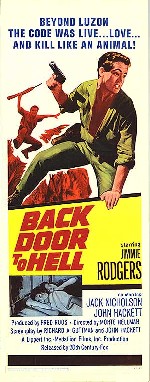 The time is World War II. The place is the Philippines, shortly before the famous return of Douglas MacArthur. Three U.S. soldiers have been sent on a very important mission to knock out a Japanese communication center before the American invasion. Lt. Craig (Jimmie Rodgers) is their leader and he worries that he might not have what it takes to kill a man. Sgt. Jersey (John Hackett) is cynical and tough. Cpl. Burnett (Jack Nicholson) is the radio man with a sarcastic sense of humor. They have been told to meet up with a rebel leader named Miguel but, shortly after arriving, they discover that Miguel has been killed and the new leader is Paco (Conrad Maga), who distrusts the Americans almost as much as he dislikes the Japanese. Meanwhile, a Japanese captain (Joe Sison) threatens to execute all of the children in a nearby village unless the Americans either surrender or are captured.
 Through the Shattered Lens