I have never actually seen the 1996 film The Island of Dr. Moreau but I certainly have read a lot about it.
It’s one of those films that seems to get mentioned whenever film critics start talking about the worst films of all time and, as a result, the story of the film’s production has become legendary. The film’s shoot was difficult, for reasons of both nature and human nature. The film was shot in the inhospitable Australian rain forest and shooting was briefly shut down due to a sudden hurricane. Richard Stanley, the original director, was unceremoniously fired by New Line Cinema and apparently proceeded to go native in the Australian wilderness, smoking a huge amount of weed while the studio executives feared that he would return and burn down the set. Veteran director John Frankenheimer was brought in to finish the film and clashed immediately with the film’s notoriously eccentric and difficult stars, Val Kilmer and Marlon Brando.
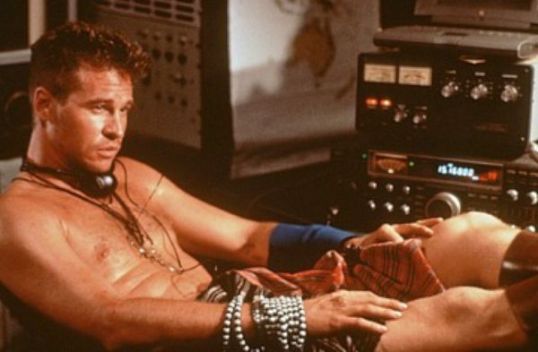
And I have to admit that, every time I read about The Island of Dr. Moreau, there’s a part of me that wants to track down and watch this film and see how bad it could possibly be. But, every time I find myself too tempted, I think about a shirtless Val Kilmer lounging around in a kilt and I quickly change my mind.
Bleh!
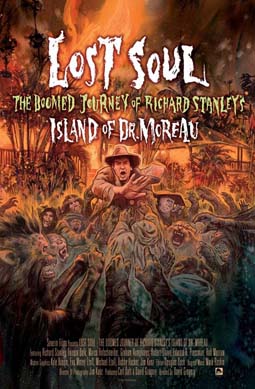
Fortunately, if I want to get a feel for the insanity behind the film’s production, I no longer have to actually watch The Island of Dr. Moreau. Instead, I can just get on Netflix and watch an entertaining documentary called Lost Soul: The Doomed Journey of Richard Stanley’s The Island of Dr. Moreau.
Lost Soul could have just as easily been called Everybody Hates Val Kilmer. Val himself declined to be interviewed for the documentary and I have to say that I think that was a huge mistake on his part because literally everyone who did agree to be interviewed appears to absolutely despise Val Kilmer. It’s not so much that everyone tells a story about Val’s bad behavior as much as the fact that, decades later, everyone still seems to be so traumatized by the experience of having been anywhere near him. (German actor Marco Hofschnieder especially seems to take a lot of delight in doing a devastating yet hilarious imitation of Val Kilmer smoking a cigarette and complaining about every line of dialogue, regardless of whether it was his dialogue or not.)
The documentary also includes plenty of crazy Marlon Brando stories but there’s a noticeable difference between the Brando stories and the Kilmer stories. Brando is portrayed as being an almost tragic figure, a great actor who hated his talent and, as a result, went out of his way to give performances that mocked the very idea of even trying to be good. As annoyed as everyone seems to have gotten with Brando, there’s still an undercurrent of affection to the Brando stories. That’s something that is definitely lacking from the Kilmer stories.
(According to the documentary, Brando was not a Val Kilmer fan. When Kilmer asked Brando if he had visited the Australian reef, Brando replied, “I own a reef,” and reportedly didn’t speak to Kilmer for the rest of the shoot.)
As interesting as the stories about Brando and Kilmer may be, the heart of the film rests with Richard Stanley, the promising young South African director whose brief “mainstream” film career was pretty much derailed by the drama surrounding The Island of Dr. Moreau. Interviewed at his home in France and captivating the audience with both his intense stare and his mordant sense of humor, Richard Stanley describes both his vision for The Island of Dr. Moreau and the pain of having that vision snatched away from him. Not only does he confirm that, as has long been rumored, he did sneak back onto the set as an extra but he also explains that the production’s problems were largely due to a mishap involving a warlock named Skip.
Lost Soul makes for an interesting cautionary tale about what happens when an artist has to deal with the establishment. Watch it with Jodorowsky’s Dune and have yourself a double feature of “what could have been” cinema.
With only five entries left in the 44 Days of Paranoia, now seems like the perfect time to look at one of the best conspiracy films ever made. First released in 1962, this film is not only one of the most influential thrillers ever made but it’s also a fiercely sardonic political satire that remains just as relevant today as when it was first released. It was also remade in 2004 and, while we’ll get to the remake, today we’re focusing on the original.
I’m speaking, of course, of the John Frankenheimer-directed classic, The Manchurian Candidate.
The Manchurian Candidate tells the story of Raymond Shaw (Laurence Harvey). The son of the wealthy and ambitious Eleanor (Angela Lansbury) and the stepson of the moronic Senator Johnny Iselin (James Gregory), Raymond is also a decorated war hero who has been credited with saving an entire platoon during the Korean War. When asked about Shaw, all of the members of the platoon respond with: “”Raymond Shaw is the kindest, bravest, warmest, most wonderful human being I’ve ever known in my life.”
Of course, that’s not true. It only takes a few minutes of screen time for the audience to realize that Raymond Shaw is none of those things. Instead, he’s a rather depressed loner who is full of resentment towards his mother and his stepfather. Shaw is so socially awkward that even he is shocked when he manages to successfully tell a joke. (“I just told a joke, didn’t I?” Shaw says in amazement.)
While Shaw pursues a career as a journalist, the fellow members of his platoon — including Maj. Marco (Frank Sinatra) — start to have disturbing nightmares, in which they find themselves observing a genteel garden show, during which Raymond is ordered to strangle one soldier and shoot another one in the head. Marco comes to suspect that the platoon may have been captured and brainwashed with communists. With the backing of Army Intelligence, Marco starts to investigate.
Meanwhile, Sen. Iselin has come to national prominence by claiming to have information about a communist conspiracy deep within the U.S. government. As becomes obvious in some of the film’s best scenes, Iselin is less concerned with fighting communists and more focused on keeping Raymond’s mother happy. Eleanor has decided that her husband is going to be the next President and her brainwashed son is going to help make it happen.
I think sometimes we tend to assume that, up until 1967, all movies were safe and predictable. The Manchurian Candidate, however, proves that is simply not true. In fact, with its cynical view of politics and its cast of fragile and damaged characters, The Manchurian Candidate is one of the most subversive films ever made. Rejecting the boring partisanship that typifies most politically themed films, The Manchurian Candidate presents us with a world where both the left and the right are equally corrupt and ultimately equally meaningless. It’s a political satire that transcends ideology and that’s certainly something of which America could use more.
It’s also an amazingly entertaining film. George Axelrod’s screenplay is full of wonderfully snarky moments while John Frankenheimer’s directs with an appreciation for both absurdity and melodrama. Angela Lansbury is both hilarious and chilling as one of the worst maternal figures to ever appear in the movies and she more than deserved the Oscar nomination that she received for this film. However, the entire film is brilliantly acted. Laurence Harvey is both sympathetic and off-putting as Raymond while Frank Sinatra (who previously appeared in another entry of the 44 Days of Paranoia, Suddenly) brings a wonderful blue-collar humanity to the role of Marco. Janet Leigh has a small role as Marco’s lover and the scene where they first meet on a train and have a charmingly nonsensical conversation is wonderfully odd and romantic. Finally, James Gregory gives a hilarious performance as the type of stupid but bombastic politician who will be familiar to anyone who has ever watched C-Span.
If you’ve never seen the original Manchurian Candidate, drop everything you’re doing and go watch it now.
For today’s entry in the 44 Days of Paranoia, let’s take a look at the 1964 political thriller, Seven Days In May.
Directed by John Frankenheimer (who also directed the conspiracy classic, The Manchurian Candidate), Seven Days In May opens with unpopular President Jordan Lyman (Fredric March) on the verge of signing a treaty with the Russians. The chairman of the joint chiefs-of-staff, Gen. James Scott (Burt Lancaster), is opposed to the treaty and feels that Lyman’s actions will lead to the collapse of the U.S. When Scott’s aide, Jiggs Casey (Kirk Douglas), thinks that he’s come across evidence that Scott is planning a military coup, he takes his suspicions to the White House. Working with an alcoholic Senator (Edmond O’Brien) and a cynical political aide (Martin Balsam), the President launches his own investigation into Scott’s activities.
When it was first released, Seven Days In May was very successful with both critics and audiences. Edmond O’Brien even received an Oscar nomination for best supporting actor. When viewed today, however, Seven Days In May feels rather quaint. A good deal of the film’s suspense was meant to be generated by the question of whether or not Gen. Scott is actually planning a coup. However, for the modern viewer, it’s really not a question worth asking. For us, it’s easy to watch this film and shout, “Of course he’s planning on overthrowing the government! He’s the most obviously villainous character in the entire film!” The idea of a military conspiracy to overthrow the U.S. government was perhaps shocking back in 1964 but today, we take the existence of such conspiracies for granted.
Seven Days In May is definitely a product of its time. Unlike John Frankenheimer’s other well-known conspiracy film, The Manchurian Candidate, there’s no sly undercurrent of satire or subversion running through Seven Days In May. Instead, Seven Days In May epitomizes everything that we think of when we think about the early 60s. The film’s politics are liberal but not radically so. The President is such an honorable leader that he won’t resort to the politics of personal destruction and reveal that Scott has a mistress. Casey explains that he disagrees with the President’s politics but that he is bound by duty to reveal Gen. Scott’s subversion. Indeed, by the end of the film, it’s obvious that we’re meant to condemn Scott not because he might overthrow the President but because he would subvert the democratic process to do so. Seven Days In May is a film that tells viewers to support and respect their elected leaders, whether they be good or evil and whether they’re played by Fredric March or Burt Lancaster.
When I listened to Casey explain why he was informing on a man who he claimed to admire and agree with, I was reminded of some of the recent political debates that we’ve had deal with her in America. All of those debates can pretty much be summed up by whether we, as citizens, are obligated to support a law even if we personally don’t agree with it or to respect a leader even if we do not agree with him. The answer, according to Seven Days In May, would appear to be yes.
While Seven Days In May is often a bit too ponderous for its own good, it’s still a well-made and watchable film. If you’re a history nerd like me, you’ll enjoy the film as a portrait of its time. John Frankenheimer directs as if the movie is a film noir and the film’s shadowy black-and-white cinematography looks great. Finally, if you’re a fan of the old school movie stars, how can you not enjoy a film that features Kirk Douglas, Fredric March, and Burt Lancaster?
The definition of the Japanese word ronin describes it as a samurai who has lost his master from the ruin of or the fall of his master. John Frankenheimer (with some final draft help with the script from David Mamet) takes this notion of a masterless samurai and brings to it a post-Cold War setting and sensibility that more than pay homage to the great stories and film of the ronin. One particular story about ronin that Frankenheimer references in detail is the classic story of the 47 Ronin. Ronin shows that in the latter-stages of his career, Frankenheimer was still the master of the political/spy-thriller genre. He infuses the film with a real hard-edge and was able to mix together both intelligence and energy in both the quieter and action-packed sequences in the film.
The film begins quietly with the introduction of the characters involved. We meet each individual in this quiet 10-minute scene that shows Frankenheimer’s skill as a director would always be heads and shoulders above those of the bombastic and ADD-addled filmmakers of the MTV generation (Michael Bay being the poster boy). Robert De Niro plays the role of one of the two American mercenaries (or contractors) who instantly becomes the focal point for everyone in the scene. His casual, but attentive reconnoitering of the Paris bar where the first meet occurs helps build tension without being being heavy-handed in its execution. It’s with the introduction of Jean Reno as the Frenchman in the group that we get the buddy-film dynamic as De Niro and Reno quickly create a believable camaraderie born of the times for such men during and after the Cold War.
The rest of the cast was rounded out by an excellent and high-energy turn from Sean Bean as an English contractor who might not be all that he claims and brags to be. The other American in the group was played by Skipp Sudduth who in his own understated way more than kept up with the high-caliber of actors around him. Finishing off and adding the darker and seedier aspects of the cast were Stellan Skarsgard as a former Eastern Bloc (maybe ex-KGB) operative and Jonathan Pryce as an IRA commander whose agendas for bringing this team of masterless ex-spies and operatives together might not be all as he claims. The only break in all the testosterone in the film was ably played by the beautiful, yet tough Natasha McElhone. Like Sudduth, McElhone more than keeps up and matches acting skills with the likes of De Niro, Reno and Skarsgard.
The film moves from the meeting of the group to the actual operation which brought all these disparate characters together. Taking a page from Hitchcock, Frankenheimer and Mamet introduces what would become the film’s MacGuffin. A “MacGuffin” being a plot device which helps motivates each character of its importance and yet we’re left to believe that the item is important without ever finding out why. The MacGuffin in Ronin ends up being a silver case which the IRA terrorists, the Russian Mob and seemingly every intelligence agency in Europe wants to get their hands on.
It’s up to De Niro and his group to steal the case from another party and this was where Frankenheimer’s skill in seemlessly blending spy-thriller and action film shows. From the set-up of the team and their plans, to a near double-cross during an arms deal to the actual operation to take the case, Ronin begins to move at a clipped and tension-filled pace. There’s no overly extraneous dialogue. Mamet’s script fleshes out the story and adds a sense and feel of intelligent professionalism to the characters.
The action sequences mostly involved car chases through the narrow streets of Nice, France to the metropolitan thoroughfares and tunnels of Paris. Frankenheimer shines in creating and directing these sequences. Sequences which he’d decided against the use of CGI. Using what he’d learned and perfected from his own past as a former amateur race car driver and from his own classic film Grand Prix, Frankenheimer used real life cars and drove them through real (albeit choreographed) traffic to give the sequences that sense of reality and speed that one couldn’t get with CGI. The car chase scene within the Paris thoroughfare tunnel against traffic has to go down as one of the best car chase put on film. With just abit of help from second unit directors Luc Etienne and Michel Cheyko, Frankenheimer pretty much did most of the filming of the car chases.
The story itself, after all the characterizations and high-energy, tense action sequences, was really bare bones and in itself its own MacGuffin. The story just becomes a prop device to help show the mercenaries’ special sense of honor in regards to working with people who might’ve been enemies in the past. The murky world they now live in after the collapse of the black and white sensibility that was the Cold War has become nothing but shades of gray. One little bit of trivia that I found interesting was the fact that Ronin included quite a bit of actors who portrayed past James Bond villains: Sean Bean (Janus), Jonathan Pryce (Carver) and Michael Lonsdale (Drax).
In the end, Ronin became the last great film from a great director. I don’t count Reindeer Games as anything but Frankenheimer picking up a check and the studio dabbling overmuch in the final look and feel of that film. Frankenheimer’s Ronin is a blend of smart dialogue, hard-edged characters, and tense-filled action that he manages to blend together to make a fine and intelligent film. The story’s myseries concerning the MacGuffin might not have been answered in the end, but the journey the audience takes with DeNiro, Reno and McElhone’s character in getting there more than made up for any flaws in the plot.
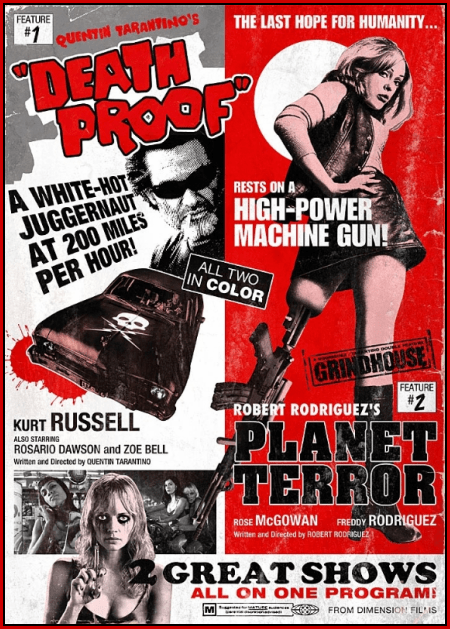
Robert Rodriguez and Quentin Tarantino have always professed to anyone within hearing distance their extreme and fanboyish love for the grindhouse days of filmmaking. Both directors’ resume of work look like a modern grindhouse films but with better writing, effects and directing. Anyone who grew up watching grindhouse film’s of the 70’s and 80’s can see it’s heavy influence on films such as From Dusk Til Dawn, Desperado, Pulp Fiction and Kill Bill. With 2007’s Grindhouse, both Rodriguez and Tarantino take their fanboy love for all things grindhouse and exploitation to a whole new level with personal take on the cheap John Carpenter-knock offs, zombie gorefests, slasher film and revenge-driven flicks that made being a young kid during the 70’s and 80’s quite enjoyable.
For those who do not know what grindhouse films are they’re the ultra-cheap and, most of the time, very bad, shlocky horror, revenge, softcore porn, badly-dubbed kung fu flicks and a myriad of other B- to Z-grade movies. These movies were shown in dingy, decrepit (usually former burlesque stagehouses) movie houses which showed double to triple-bills of titles for a low, cheap price all day long (where the popcorn and concession snacks were as stale as week-old coffee). These places and their films were book-ended by the cheap drive-in theaters which grew out of the suburban sprawl boom era of the 60’s and 70’s. One could not avoid the fact that the projector equipment were in bad shape and in desperate need of maintenance while the films played out. Then there’s the film reels themselves with their washed out sequences, out of focus scenes, burnt-in spots and missing film reels where the sex scenes would’ve been. This was the grindhouse experience and with the rise of Hollywood as a corporate entity even moreso than it’s been in the past and urban renewal projects by big city leaders, the grindhouse experience has pretty much faded away and kept alive only in the memories of its fans worldwide.
What Robert Rodriguez and Quentin Tarantino have cranked out with their three-hour long opus to those grindhouse days has been both a literal and thematic homage to an era long since gone. Grindhouse also has allowed Rodriguez and Tarantino to pull out all the stops in filming their respective halves of the film. Rodriguez went all-out in paying literal homage to the zombie gore-fests of George A. Romero, Lucio Fulci and Umberto Lenzi. Planet Terror plays like a hodgepodge of all the zombie movies from these masters of the walking dead but Rodriguez has the use of digital effects to match the over-the-top feel of the past zombie-fests without making the effects look too cheap.
The story for Planet Terror is quite simple yet full of so many incoherent subplots that trying to keep track with whats going on would just confuse a viewer even more. Rodriguez gets the grindhouse feel with such a ludicrous storyline. Whether it was done on purpose or not, the feeling of confusion in addition to the non-stop zombie action was only compounded even more by the digitally-added film stock scratches, burns to the edges of the reel and when the movie was about to get all hot and sexy, missing reel footage. Anyone who watched movies in grindhouse theaters would recognize the look quite well. Rodriguez goes all out in letting his zombie fanboy out. The violence in Planet Terror begins strong and just gets stronger and even more over-the-top right up to the final frame. Zombie’s getting their heads blown apart is shown in scratchy, loving detail with an impossible amount of blood, bone and brain for people to gawk at. The female characters are hot and sexy. Rose McGowan as Cherry Darling holds Planet Terror together with her spunky go-go dancer dreaming to be a stand-up comedienne turning into Ellen Ripley minus a leg but gaining an M16A3 w/ M203 grenade launcher as a leg prosthetic. Freddy Rodriguez as El Wray, her wayward and mysterious lover, almost seem to be channeling a hilariously bad version of Snake Plissken. These two make for quite the explosive couple as they must try and save their small Texas town from the infected townspeople turned pus-oozing, boil-ridden zombies.
Planet Terror sports a nice collection of current B-list actors like Josh Brolin (making like a Nick Nolte at his growliest) and Marley Shelton as a pair of married doctors with marital problems compounded by the increasing amount of zombies their hospital seem to be bringing in for medical help. There’s also genre veterans Michael Biehn, Jeff Fahey and Tom Savini to give Planet Terror the appropriate grindhouse look and feel to it. Ever the good friend and buddy collaborator, Rodriguez even gives Quentin Tarantino a role in his half of the film. He’s shown in the credits for Planet Terror as The Rapist. If any director seem destined to be one, if their love for movies didn’t steer them on the right path, Tarantino seem to look just like one to be called “Tha Rapist”.
There’s explosion and gore galore in Rodriguez’s ode to the zombie genre. Some who sees it might say there’s too much and they would be right if the title of the whole film wasn’t Grindhouse. I, for one, am glad Rodriguez decided to not hold back with what he threw onto the screen. I’m sure that when the dvd finally comes out and the unedited full version of Planet Terror is shown it’ll even surpass the 85-minute running time in the film. I think I can forgive Rodriguez for his gore excess and at times I actually wished for more, but then that would mean taking even more time before I get to Tarantino’s half of the movie. Planet Terror truly got the look of a grindhouse flick, but it’s Tarantino’s Death Proof half which got the spirit of grindhouse down to near-perfect.
Before Tarantino’s Death Proof half of Grindhouse begins the audience gets treated to a sort of intermission involving three fake trailers for movies which celebrate just how ridiculously fun grindhouse movies really were during the 70’s and 80’s. There’s Rob Zombie’s Werewolf Women of the SS which was this weird mish-mash of the women-in-prison flicks with that of the infamous Ilsa: She-Wolf of the SS films that brought about the exploitation in grindhouse. This trailer was great just for the inspired casting of Nicolas Cage as Fu Manchu and Sybil Danning as one of the so-called SS women werewolves. There’s also Edgar Wright’s fake trailer for Don’t (director of Shaun of the Dead and Hot Fuzz) which parodies the trailers for all the gothic, European haunted and horror movies where none of the actors in the trailer speak a word to make sure the film doesn’t get labeled as a “foreign film”. But it’s the third trailer in that intermission trio which had everyone in the audience reacting wildly.
Eli Roth’s Thanksgiving is a throwback to the seasonal-themed slasher flicks like Black Christmas but this time turns the yearly, turkey day and Pilgrim celebration into a trailer with some of the most disturbingly inventive scenes for a fake slasher movie. I don’t know what the Pilgrim serial killer was doing with that turkey at the end of the trailer but I’m sure it will have many people talking about it afterwards. It’s this Eli Roth trailer which fully captures the gritty and gratuitious nature of what makes a grindhouse horror movie. It’s also the one fake trailer I hope Roth would re-visit and turn into a full-length movie.
Now, with the trailers out of the way, Tarantino’s half of Grindhouse begins and we’re treated to a different take on the grindhouse experience. Death Proof begins as if it will continue Rodriguez’s literal examination and homage to the grindhouse experience, but after messing with the film’s focus, adding a few film scratches to the celluloid and even adding a missing reel gag, Tarantino suddenly slows all those grindhouse trickeries and actually ends up making a rip-roaring slasher-revenge-carchase flick. Tarantino takes one part slasher movie adds in a heavy dose of his own Reservoir Dogs (the talking between the female characters in Death Proof are as foul-mouthed and trivial as the diner scene in Reservoir Dogs) then mixes in equal amounts of Vanishing Point, Faster Pussycat! Kill! Kill! and I Spit On Your Grave. Instead of just mimicking these particular grindhouse classics, Tarantino uses his own flair for extended dialogue to slow down the pace of the film thus lulling the audience for the two pay-offs which happen in the middle and the end of Death Proof. Tarantino’s half of Grindhouse could’ve went nowhere with all its estrogen-laced talkies, but Kurt “I AM SNAKE PLISSKEN” Russell really saves the day once he makes his appearance as the automotive-themed serial killer, Stuntman Mike. Where Jason uses farming and bladed implements as his tool of the serial killing trade, Stuntman Mike uses both a 1971 Chevy Nova SS and a 1970 Dodge Charger R/T 440 as his weapons of choice. Both vehicles have been made death proof for filming violent car stunt sequences, but in order to appreciate it’s unique life-saving properties then one has to sit where Mike sits.
Kurt Russell can now add Stuntman Mike to his classic list of badass roles. Mike would feel quite welcome amongst the like of Snake Plissken, John J. MacReady, and Jack Burton to name a few of Russell’s classic characters. Mike comes across as cooly and slickly dangerous, yet not psychotic. His charm is quite disarming until it turns deadly. He really takes the slasher-character stereotype and turns it on its ear. Death Proof once again shows that when Tarantino gets to work with one of his boyhood idols he really gives them a role that they could sink their teeth into.
Death Proof captures the spirit of what makes a grindhouse exploitation film. Even with the heavy references to Vanishing Point, especially with a white 70’s Dodge Challenger used just like in that movie, Tarantino still injects his own brand of craziness to the whole movie. I know many who have complained that Death Proof was too much talk with only the car chase in the end being the saving grace. I politely disagree and say that it’s that very long periods of dialogue between the women in Death Proof that brings some of the spirit of grindhouse to the story. Many forget or don’t remember that most grindhouse cheapies had so much extraneous dialogue to hide the fact that the budget was low to none when the movies were being made so they had to fill-up the movie’s running time with as much nonsensical dialogue before the big effect shots payoff.
The final chase-scene between the Russell’s Stuntman Mike and the female-trio of Rosario Dawson, Tracie Thoms (channeling Jules from Pulp Fiction) and real-life stuntwoman Zoe Bell (she doubled as Uma Thurman in the more dangerous stunts in Kill Bill) has to go down as one of the craziest, whiteknuckling, barnburning car chase sequences of the modern times. No CGI-effects trickery and fancy MTV-style editing was used. George Miller, John Frankenheimer and Richard Sarafian would be proud of what Tarantino was able to accomplish with Death Proof‘s 20-minute long car chase. By the time Death Proof ends the audience have bee put through the wringer and one was hard-pressed not to cheer and root for Stuntman Mike even though we know we shouldn’t. Death Proof proves that “hell hath no fury like a woman scorned” or at least a trio of women endangered.
Grindhouse is a film not for everyone. There’s going to be quite a few people who won’t “get” the film homages and references by both Robert Rodriguez and Quentin Tarantino. Some would say that the movie was too over-the-top, badly made and just out there, but then they would be missing the point of the whole project altogether. For those who grew up watching these kind of films as kids and teenagers, it’s a belated Valentine’s gift from two fanboy filmmakers who finally were able to do the films they grew up idolizing and enjoying. For the rest who are not as well-versed in the grindhouse cinema, this is a good enough starter before they move on to try the classic ones which are now on video (I would suggest they find a worn-out VHS copy of it instead of the cleaned up DVD version). The film is over three-hours long, but one who goes in really can’t say that they didn’t get their money’s worth when they went in to watch Grindhouse.


 Through the Shattered Lens