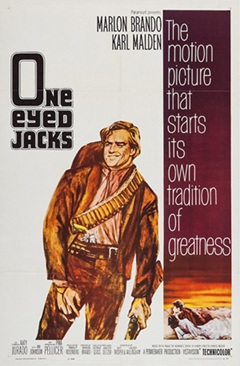
One-Eyed Jacks (1961, directed by Marlon Brando)


Rio (Marlon Brando), a young outlaw in the Old West, is betrayed by his partner and mentor Dad Longworth (Karl Malden) and ends up spending five years in a Mexican prison.  When Rio escapes, he gets together a new gang and heads for Monterey, California.  He wants to both get his revenge on Longworth and also rob the local bank.  Things get complicated when Rio actually confronts Longworth and suddenly realizes that he can’t bring himself just to gun the man down in cold blood.  Rio is not as ruthless of an outlaw as he thought he was.

However, Rio then meets and falls in love with Louisa (Pina Pellicer), Longworth’s stepdaughter  Longworth is willing to do whatever he has to keep Rio away from Louisa and, when Rio starts to think about going straight in an effort to win Louisa’s love, his new gang turn out to be even less trustworthy than his old partners.

A teenage rebellion film disguised as a western (and it’s not a coincidence that the main bad guy is named Dad), One-Eyed Jacks was Marlon Brando’s only film as a director.  The film was originally meant to be directed by Stanley Kubrick, who was working from a script written by a once-in-a-lifetime combination of Rod Serling and Sam Peckinpah.  Kubrick and Brando worked together to develop the film, with Brando insisting on Karl Malden as Dad.  (Kubrick wanted to cast Spencer Tracy.)  Ultimately realizing that working on One-Eyed Jacks would mean essentially taking orders from his star, Kubrick stepped down from directing so he could focus on Lolita and Brando took over as director.  The film finally went into production in 1958 and would not be released until 1961.  Brando’s perfectionism was blamed for the film going massively overbudget and, when it was finally released, One-Eyed Jacks was the first of Brando’s films to lose money.  The combined box office failures of One-Eyed Jacks and the remake of Mutiny on the Bounty left Brando in the cinematic wilderness for much of the 60s.

As for the film itself, One-Eyed Jacks takes what should have been a simple story and attempts to turn into an epic.  Rio spends a good deal of time brooding and the film seems to brood right along with him.  What starts out as a western becomes a forbidden love story as Rio and Louisa fall for each other.  Dad Longworth may be an outlaw-turned-sheriff but Malden plays him more as a possessive father who can’t handle that his two stepchildren — Rio and Louisa — are both turning against him and his strict rules.  Brando obviously viewed the film as being something bigger than a standard western.  Sometimes, his direction works and he does manage to get the epic feel that he was going for.  Other times, the film itself seems to be unsure what direction it wants to go in telling its story.  This is method directing.

Ultimately, One-Eyed Jacks is an interesting experiment, one that doesn’t really work but which still features Charles Lang’s outstanding cinematography and one of Karl Malden’s best performances.  As Brando’s only directorial effort, the film is a curiosity piece, one that will be best enjoyed by western fans who have the patience for something a little different.  And, for what it’s worth, based on the film’s visual beauty and the performances that he gets from the cat, I think Brando could have developed into a fine director with a little more experience.  However, it was not to be.


Horror Film Review: The Haunted Palace (dir by Roger Corman)


In the 18th century, the inhabitants of Arkham, Massachusetts yank Joseph Curwen (Vincent Price) out of his mansion and tie him to a tree.  They accuse Curwen of being a warlock who is in league with the devil and who has been bringing young women to his “palace,” and putting them in a trance.  They burn Curwen alive but, before the flames are lit, they also give Curwen a chance to speak and curse both them and their descendants.

You really do have to wonder about the logic behind witch (and warlock) burnings.  They seem counter-productive because they always give the accused just enough time to cast one final curse before being burned to a crisp.  Indeed, you have to wonder why witches and warlock were allowed any final words to begin with.  I mean, at some point, you would think everyone would notice that the final words were always a curse.

Anyway. 110 years later, Joseph Curwen’s descendant, Charles Dexter Ward (Vincent Price, again) rides into town with his wife, Anne (Debra Paget).  He is stunned to see that Arkham has apparently fallen on hard times, with many of the town’s people being horribly disfigured.  It’s explain to him that the disfigurements and the poverty are all a result of his ancestor’s curse.  That’s going to make things a bit awkward, considering that Charles Dexter Ward has not only inherited the Palace but he’s also inherited a copy of Necronomicon and a legacy of messing with Cthulhu.  The townspeople don’t want Ward around but he and Anne decide to spend the night in the Place regardless.

Of course, it doesn’t take long for Curwen’s spirit to possess Charles.  Soon, Charles is trying to resurrect Curwen’s mistress, Hester (Cathie Merchant) and pursuing Curwen’s goals of breeding a race of super humans by forcing the women of the town to mate with the fearsome Yog-Sothoth.  Charles also seeks vengeance on the descendants of those who burned Curwen at the stake, as if all of the poverty and the deformities aren’t punishment enough.  Again, this is why you don’t give warlocks and witches a chance to get out one last curse before being executed.

Though The Haunted Palace is usually considered to be a part of Roger Corman’s Edgar Allan Poe cycle, the story itself is actually based on H.P. Lovecraft’s The Case of Charles Dexter Ward.  (In Lovecraft’s novella, Ward seeks out his evil ancestor whereas, in the film, Ward is more or less an innocent victim.)  The film’s title comes from a Poe poem, which is recited at both the beginning and the end of the film.  But the film itself, with its references to the Cthulhu mythos and its hideous New England setting, is definitely a work of Lovecraftian horror.

Fortunately, it’s an effective work of Lovecraftian horror, one that captures the feeling of people unwisely trying to control a force of evil that they cannot begin to comprehend.  Roger Corman keeps the action moving quickly and creates a gothic atmosphere of impending doom.  Vincent Price, toning down his usual theatrics, is chillingly evil as Curwen and sympathetic as Charles.  The film’s strongest performance, however, comes from Debra Paget, who desperately tries to free her husband from Curwen’s control.  Any woman who has suddenly felt as if she can no longer recognize the man who she once loved will be able to relate to Paget’s performance.

The Haunted Palace is a strong entry in the films of Roger Corman and Vincent Price and one of the better adaptations of the work of H.P. Lovecraft.

Horror Film Review: Premature Burial (by Roger Corman)


Poor Guy Carrell (Ray Milland!)

The character at the center of the 1962 Edgar Allan Poe adaptation, The Premature Burial, Guy spends his days terrified of being buried alive.  Like his father before him, Guy suffers from a disease that can make him appear to be dead despite actually being alive.  Guy is convinced that his father was buried alive and swears that he could even hear his father crying for help inside of his tomb.  Though his fiancée, Emily (Hazel Court), insists that Guy is driving himself mad with his fears, Guy continue to spend his time trying to invent a coffin from which one can easily escape.  Even after Emily and Guy are married, Guy continues to obsess.

Finally, faced with the prospect of opening his father’s tomb to discover whether or not his father truly was buried alive, Guy appears to drop dead of a heart attack.  But is he really dead or is he about to be buried alive!?  And who is responsible for the series of mysterious events that apparently drove Guy to collapse of fright?  Watch the film to find out!  Or read the Edgar Allan Poe short story.

This was the third of Roger Corman’s Edgar Allan Poe adaptations and it’s the first one to not feature Vincent Price as the lead character.  For the most part, the members of the small cast all do a good job with their roles.  Ray Milland is both sympathetic and a little frightening as the obsessed Guy.  Heather Angel is properly enigmatic as Guy’s overprotective sister and Hazel Court will keep you guessing as far as her character’s motivations are concerned.  Dick Miller has a small but key role as a grave digger who seems to take just a little bit too much enjoyment from his work.  The film’s atmosphere is properly gothic and, if the film isn’t as visually audacious as the first two Poe films, Corman still finds time to include a creepy and psychedelic dream sequence.

That said, Vincent Price is still very much missed.  Corman reportedly wanted to use Price but, because Corman produced and financed the film  himself, Corman’s former business partners at American International Pictures would not allow Price to appear in the film.  (Price was under exclusive contract to AIP.)  By the time Corman and AIP worked out their disagreements and again joined forces, Ray Milland had already been cast in the lead role.

While the actors all do a good job, it’s hard to deny that Guy Correll would have been an ideal role for Vincent Price, even if it would have meant essentially re-doing his performance from The Pit and the Pendulum.  It’s not just that the film misses Price’s theatrical acting style.  The film also misses the energy that Price brought to the previous two Poe films.  The Premature Burial moves at a stately pace and, in the end, it’s a bit too slow and respectable for its own good.  Price would have jazzed things up and made a decent film into a truly memorable one.  Fortunately, Price would return for the later Poe adaptations.

Horror Film Review: X: The Man With X-Ray Eyes (dir by Roger Corman)


X: The Man With The X-Ray Eyes (1963, dir by Roger Corman, DP: Floyd Crosby)

Eyes.  They’re one of the most important parts of our body but they’re also frightening easy to damage. Unlike the heart or the liver or the brain, they don’t have a protective covering of skin and bone.  They sit exposed and  are easily injured.  They can be ripped out of one’s head, which is a scary thought.  As well, they tend to grow weaker over time.  I love my multi-colored eyes and I think they’re one of my best features but I still spend a lot of time wishing that they weren’t quite as vulnerable as they are.  I often say that I’m blind without my contacts or my glasses.  That’s not quite true, of course.  I can see enough to get by if I forget to put in my contacts but I still have to do a lot of squinting, enough so that most people can take one look at me and say, “You forgot to put in your contacts, didn’t you?”  In my case, my eyesight has definitely gotten even worse over the past few years.  I’ve been told that’s normal but it still freaks me out.  I worry about waking up one day and not being able to see anything at all.

Director Lucio Fulci, a diabetic who was slowly going blind during the final years of his life, was infamous for including scenes of eyes being either pierced or gouged out in his films.  The New York Ripper even featured one scene where an eye was slit in half with a razor blade.  (This occurred in a close-up, no less!)  In Joe D’Amato’s Beyond the Darkness, there’s a scene where a mad taxidermist replaces the eyes of his dead fiancée with glass and for me, that’s one of most disturbing elements of the film.  Horror directors understand the vulnerability of the eyes and the sadness when life is extinguished from those eyes.  Eyes are said to be the windows to soul and when those eyes are lifeless, it’s a reminder that a living soul is a fleeting thing.

Perhaps that’s why 1963’s X: The Man With The X-Ray Eyes is such an effective work of art.  Directed by Roger Corman, the film tells the story of Dr. James Xavier (Ray Milland), a doctor who has developed eye drops that, when taken, allow one to have x-ray vision.  Dr. Xavier claims that the eye drops will allow doctors to more easily diagnose their patients and certainly, he has a point there.  His friend, Dr. Sam Brant (Harold J. Stone), points out that the eyes are directly connected to the brain and that using experimental eye drops on them could potentially drive a person mad.  Dr. Xavier proves Dr. Brant’s point by losing his tempter and accidentally pushing him out of a window.

Ah, x-ray vision.  It all starts out fun.  Dr. Xavier is performing miracle surgeries and seeing what everyone looks like naked.  (The swinging jazz party scene is a classic example of how 60s B-movies teased audiences while never quite showing everything.) But once he’s forced to go on the run from the police, Xavier finds himself making a living as a carnival psychic while still trying to refine his eyedrops.  Xavier’s sleazy manager (Don Rickles) tries to turn Xavier into a faith healer but, with Xavier’s x-ray vision growing more erratic and more intense, Xavier ends up running off to Vegas with a former colleague, Dr. Diane Fairfax (Diana Van der Vils).

And again, it’s all fun and games as Xavier uses his powers to cheat at cards.  But then the megalomania kicks in and, after Xavier basically announces that he’s cheating, he finds himself being chased through the desert by a police helicopter and freaking out as more and more of the universe is revealed to him.  Much like a Lovecraftian protagonist who has been driven mad by the sight of the Great Old Ones, Xavier finds himself overwhelmed by the center of the universe.  At a tent revival, a preacher shouts, “If thine eye offends thee, pluck it out!”

The film’s final image is a shocking one and it stays with you.  (There were rumors that the film originally ended with Xavier shouting, “I can still see!” but Corman himself said that never happened.)  Even without that final image, this would be one of Corman’s best films, a surprisingly intelligent and rather sad story about a man who, in trying to see what is usually hidden, was driven mad by what he discovered.  Ray Milland was well-cast as Dr. Xavier and watching him go from being a somewhat stiff but good-hearted scientist to a raving madman at a revival is quite an experience, a testament to the vulnerability that all humans share.  In the name of science, Xavier goes from being a respected researcher to being chased through the desert by a helicopter.  The man who wanted to be able to see everything finds himself wishing to be forever blinded.  Sometimes, the film suggests, it’s best not to be able to see everything around us.  Sometime, the mysteries of the universe should remain mysteries and the rest of us should respect our own vulnerabilities.

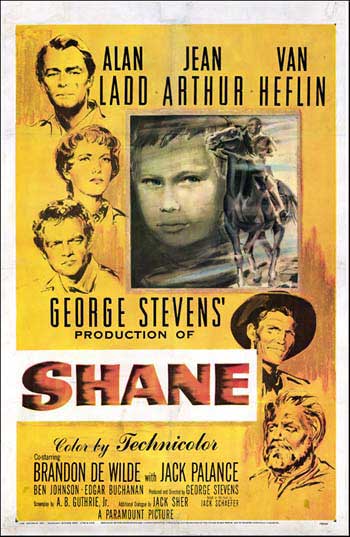
Lisa Reviews An Oscar Nominee: Shane (dir by George Stevens)


“Hey, Shane!  Come back, Shane!”

There’s a few ways in which you can view the 1953 film, Shane.

The more popular view is that it’s a Western about a man named Shane (Alan Ladd) who rides into town and gets a job working for the Starretts, Joe (Van Heflin) and Marian (Jean Arthur).  Joe is a farmer who is determined to hold onto his land, despite the efforts of cattle baron Rufus Ryker (Emile Meyer) to force him off of it.  While we don’t learn much about Shane’s background, it becomes apparent that he’s a man who can fight.  That comes in handy when Ryker brings in a sinister gunfighter named Wilson (Jack Palance).

Another view is that Shane is the story of a man who just wants to settle down but, instead, finds himself continually hounded by an annoying little kid, to the extent that he finally gets involved in a gun battle just so he’ll have an excuse to leave town and get away from the little brat.  Little Joey Starrett (Brandon deWilde) idolizes Shane from the minute that he comes riding up.  When he hears that Shane refused to get into a fight at the local saloon, Joey demands to know whether it was true.  He tells his mom that he loves Shane almost as much as he loves his father.  When Shane does get into a brawl with all of Ryker’s men, Joey stands in the corner and eats candy.  And then, when Shane tries to leave town, Joey runs behind him shouting, “Come back, Shane!  Come back!”

Myself, I think of it as being the story of Frank Torrey (Elisha Cook, Jr.).  Frank is the farmer that’s been nicknamed “Stonewall,” due to his status as a former Confederate and his quick temper.  Stonewall may be smaller than the other farmers but he’s usually the quickest to take offense.  Still, it’s impossible not to like him, largely because he’s played by Elisha Cook, Jr.  When Wilson feels the need to put the farmers in their place, he does so by picking a fight with Torrey.  Standing on a porch in the rain, looking down on the smaller man, Wilson starts to insult both him and the South.  When Torrey finally starts to reach for his gun, Wilson shoots him dead.  While Torrey lies in the mud, Wilson smirks.  It’s a shocking scene, all the more so for being shown in a long shot.  (By forcing those of us in the audience to keep our distance from the shooting, the film makes us feel as powerless as the farmers.)  If you didn’t already hate Wilson and Ryker, you certainly will after this scene.

Shane is a deceptively simple film, one in which many of the details are left open for interpretation.  We never learn anything about Shane’s background.  He’s a man who shows up, tries to make a life for himself, and then leaves.  He’s a marksman and an obviously experienced brawler but, unlike Ryker’s men, he never specifically looks for violence.  In fact, he often seems to avoid it.  Why?  The film doesn’t tell us but there are hints that Shane is haunted by his past.  Shane seems to want a chance to have a life like the Starretts but, once he’s forced to again draw his gun, he knows that possibility no longer exists.

Is Shane in love with Marian Starrett?  It certainly seems so but, again, the film never specifically tells us.  Instead, it all depends on how one interprets the often terse dialogue and the occasional glances that Marian and Shane exchance.  When Shane and Joe get into a fist fight to determine who will face Ryker and Wilson, is Shane really trying to protect Joe or is it that he knows Marian will be heart-broken if her husband is killed?

One thing’s for sure.  Little Joey sure does love Shane.  “Come back, Shane!”  Little Joey follows Shane everywhere, with a wide-eyed look on his face.  To be honest, it didn’t take too long for me to get sick of Little Joey.  Whenever director George Stevens needed a reaction shot, he would cut to Joey looking dumb-founded.  Brandon deWilde was 11 years when he appeared in Shane and he was nominated for an Oscar but he’s actually pretty annoying in the role.  Elisha Cook, Jr. was far more impressive and deserving of a nomination.

I know that many people consider Shane to be a classic.  I thought it was good, as long as the action was focused on the adults.  Alan Ladd plays Shane like a man who is afraid to get too comfortable in any situation and the film works best when it compares his reticence to Wilson’s cocky confidence.  Whenever Joey took center stage, I found myself wanting to cover my ears.

Shane was nominated for Best Picture but lost to From Here To Eternity.