Welcome Home, Soldier Boys (1971, directed by Richard Compton)


Talk about embarrassing!  When Lisa told me that today was Joe Don Baker’s birthday, I decided that I would review Speedtrap, as 1977 car theft movie that Lisa and I watched last week.  But, when I took a look at the imdb to double check the name of the character that Baker played in Speedtrap, I discovered that I had already reviewed it!

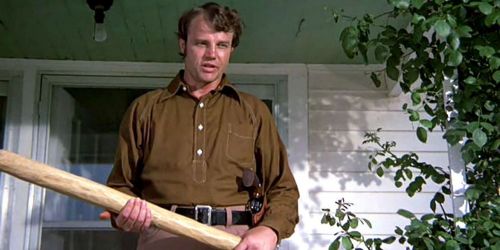
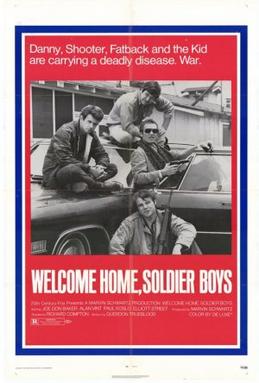
Instead of talking about Speedtrap a second time, I’m going to recommend one of Joe Don Baker’s early films.  In Welcome Home, Soldier Boys, Baker stars as Danny, the leader of a group of Green Berets who have just returned from Vietnam and can no longer find a place in society.  Danny, Kid (Alan Vint), Shooter (Paul Koslo), and Fatback (Elliott Street) go on a cross-country road trip.  After they kill a prostitute (Jennifer Billingsley) who demanded more money than they were willing to pay, they visit many sites from their youth.  They go to a high school basketball team.  They spend some time in a sleazy motel.  (Geoffrey Lewis plays the desk clerk.)  They get into a fight with a mechanic (Timothy Scott) over the price of some auto repairs.  After being cheated by one too many people and realizing that no one cares about the sacrifices that they made for their country, they put on their uniforms and violently take over a small town, leading the National Guard to show up to take them all out.

Welcome Home, Soldier Boys is a pretty ham-fisted anti-war allegory and the plot sometimes meanders too much for its own good.  With its road trip violence, its a dry run for director Richard Compton’s far more cohesive Macon County Line.  The movie still packs a punch, due to the efforts of the cast and the violent ending.  The movie is full of familiar characters actors, who are all convincing in their roles but it really is dominated by Joe Don Baker’s hulking intensity.  Danny is the dark side of the amiable country boys that Joe Don Baker would play in so many other movies.  Danny is angry but, as a stranger in a strange land, he’s sometimes sympathetic.  Ultimately, Danny wants the respect that was given to the returning soldiers of the previous generation.  Instead, he comes back to country that doesn’t want much to do with him or his friends.  Returning from serving overseas and still trying to deal with the things that he saw in overseas, Danny feels lost in and rejected by his home country.  It’s one of Baker’s best performances.

Happy 89th Birthday to Joe Don Baker!


I’ve loved Joe Don Baker since I first saw him portray Buford Pusser in WALKING TALL on Fox 16 out of Little Rock when I was a kid. There was something about the way he wields that big piece of lumber that got me excited. As I’ve watched more of his work, I realized just how charismatic he could be in the right roles. And he excelled at being a ruthless bad guy! Today, I share a scene from the excellent film CHARLEY VARRICK (1973), where Baker portrayed the sadistic “Molly.” 

Enjoy my friends! 

Monday Live Tweet Alert: Join Us For Speedtrap!


As some of our regular readers undoubtedly know, I am involved in hosting a few weekly live tweets on twitter and occasionally Mastodon.  I host #FridayNightFlix every Friday, I co-host #ScarySocial on Saturday, and I am one of the five hosts of Mastodon’s #MondayActionMovie!  Every week, we get together.  We watch a movie.  We snark our way through it.

Tonight, for #MondayActionMovie, the film will be 1977’s Speedtrap, starring Joe Don Baker! I picked it so you know it’ll be good.

It should make for a night of fun viewing and I invite all of you to join in.  If you want to join the live tweets, just hop onto Mastodon, find the movie on YouTube or Tubi, hit play at 8 pm et, and use the #MondayActionMovie hashtag!  The live tweet community is a friendly group and welcoming of newcomers so don’t be shy.   

See you soon for some Joe Don Baker excitement!

Speedtrap (1977, directed by Earl Bellamy)


In a southwestern metropolis, a mysterious criminal is stealing cars and outrunning the police.  When the insurance company realizes that the cops are never going to be able to do their job, they decide to bring in an outside hire to solve the crimes.  They turn to a paisley-shirt wearing private investigator named Pete Novick (played by Joe Don Baker).  Novick’s a hard-drinking, hard-living P.I. who is going to solve the case no matter what.  Authority figures like police Captain Hogan (Morgan Woodward) hate him.  Women like cop Niffty Nolan (Tyne Daly) and psychic New Blossom (Lana Wood) want to have him.  Men like mechanic Billy (Richard Jaeckel) want to hang out with him.  You get the idea.  It’s a Joe Don Baker movie.

Speedtrap is basically one car chase after another, the majority of which are excitingly filmed and continue until almost every car involved has been destroyed.  Though the movie was directed by Earl Bellamy, it has the feel of a Hal Needham film as it keeps the characterization to a minimum and instead focuses on vehicular mayhem.  Speaking of Hal Needham, it’s also easy to imagine Burt Reynolds, in his B-movie days, playing the role of Pete Novick but not even he would have been as perfect for the role or the movie as Joe Don Baker.  Baker shambles through the movie, all the while keeping the same passive-aggressive grin on his face.  There’s nothing smooth about Joe Don Baker, which is why he was fun to watch in a movie like this.  Whether he’s having a one-night stand with a psychic (only in order to help for “totally relax” so that she can have her visions) or going out of his way to annoy almost every single person that he meets, he’s undeniably Joe Don Baker.  During one chase scene, an annoyed Novick snaps, “Beep beep my ass!”  Only Joe Don Baker could have pulled that off.

Eventually, the thief steals the wrong car.  This one has a suitcase in back that’s full of the mob’s money.  This gives Robert Loggia a chance to ham it up as a mafia don who wants Novick to capture the thief and then turn him over to the syndicate.  Novick, however, has even less respect for the mob than he does for the police.  The mafia subplot is a distraction but Timothy Carey plays Loggia’s main henchman and brings with him a few moments of genuine menace to the film.

Speedtrap has never gotten a DVD or Blu-ray release but it’s an entertaining B-movie and it deserves one.  How about it, Shout Factory?  A million Joe Don Baker fans are looking to you.

Mongo’s Back In Town (1971, directed by Marvin J. Chomsky)


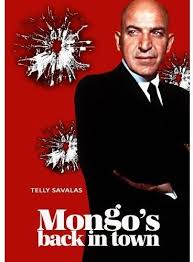
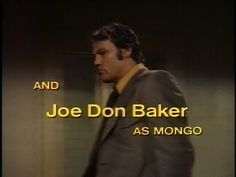
During the Christmas season, Mongo (Joe Don Baker) returns home.  However, Mongo hasn’t just come back for the holidays.  Mongo is professional killer, one of the best in the business.  His older brother, mob boss Mike Nash (Charles Cioffi), has a job for him.  He wants Mongo to wipe out a rival gangster.  Mongo’s willing to do it but he expects to be properly compensated for his trouble.  Family is family but Mongo’s a professional and a professional has to get paid.  Lt. Pete Tolsted (Telly Savalas) and his partner, Gordon (Martin Sheen), are the two cops who know that Mongo is bad news and who are determined to discover why Mongo is back in town.  Meanwhile, Mongo is falling in love with the naive Vicki (a very young Sally Field), a young woman who has fled West Virginia and is looking to restart her life in the big city.

This made-for-TV movie may not contain any huge surprises but it’s worth tracking down just for the cast.  Joe Don Baker, Telly Savalas, Martin Sheen, and Sally Field, all in the same movie and all at the top of their considerable game?  That’s more than worth the effort.  Joe Don Baker, in particular, is good.  Unfortunately, Baker doesn’t always get the respect that he deserves an actor.  It’s true that he’s appeared in his share of bad films and his range is limited.  But whenever he was cast in the right role — like in this movie or the first Walking Tall — he was a force of nature.  What’s most interesting about Mongo is that he doesn’t really like his work and he resents that it’s something that he’s been trapped into doing but, at the same time, he’s so good at it that it’s hard not to wonder what other career he could have possibly found as much success in.

Mongo’s Back In Town was released theatrically overseas under the title Steel Wreath.  (Maybe someone realized that Mongo’s Back In Town makes the movie sound like a screwball comedy.)  It can be viewed, under its original title, on YouTube.


Framed (1975, directed by Phil Karlson)


Revenge can be brutal, especially when you’ve been framed.

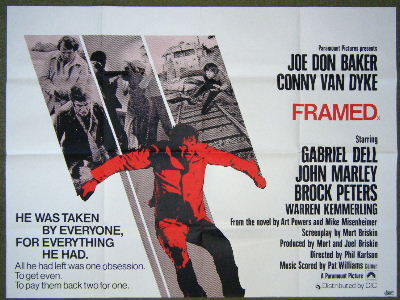
Joe Don Baker plays Ron Lewis, a surly nightclub owner and gambler who wins a small fortune, witnesses a crime, and nearly gets shot all in the same night.  When he reaches his house, he’s planning on calling the police but he’s confronted in his own garage by a sheriff’s deputy who tries to kill him!  In a lengthy and brutal scene, Ron beats the deputy to death and gouges out his eyes.  Even though Ron was only acting in self-defense, he’s charged with murder.  Told that there is no way that he’ll be able to win an acquittal, Ron pleads guilty to a lesser charge and is sent to prison for four years.

While he’s in prison, Ron befriends a mob boss (John Marley, who famously woke up with a horse’s head in his bed in The Godfather) and the boss’s number one hitman, Vince (Gabriel Dell).  While Ron is in prison, a group of men assault his girlfriend (country singer Conny Van Dyke) and tell her not to ask any questions about the events that led to Ron being framed.

After serving his sentence and getting into numerous fights with the guards, Ron is finally released.  When Vince shows up and tells Ron that he’s been hired to kill him, the two of them team up with an honest deputy (Brock Peters) and set out to find out why Ron was set up and to get revenge.

Framed is a brutal movie, Ron and his friends hold nothing back in their quest to get revenge.  Whether he’s shooting a man in cold blood or hooking someone up to a car battery in order to get information out of him, there’s little that Ron won’t do and the movie lingers over every act of violence.  Several pounds overweight and snarling out of his lines, Joe Don Baker may not be a conventional action hero but he’s believable in his rage.  He’s the ultimate country boy who has been pushed too far and now he doesn’t care how much blood he has to get on his hands.  However, because Baker does seem more like an ordinary person than a Clint Eastwood or a Charles Bronson-type, he retains the audience’s sympathy even as he splashes blood all over the screen.  As violent as his action may be, they always feel justified.

Baker’s performance and the believable violence are the film’s biggest strengths.  It’s biggest weakness is a plot that revolves around an elaborate conspiracy that doesn’t always make sense and some notably weak supporting performances.  Ron’s revenge may be brutal but it takes a while to get there and the first hour gets bogged down with Ron’s struggle to adjust to life in prison.  John Marley does a good job as Ron’s prison mentor but then he abruptly disappears from the movie.

Before making Framed, Baker and director Phil Karlson previously collaborated on Walking Tall.  Framed is far more violent than that film was but its plot doesn’t hold together as well.  However, if you’re just looking for a violent action film that features Joe Don Baker doing what he does best, Framed delivers.

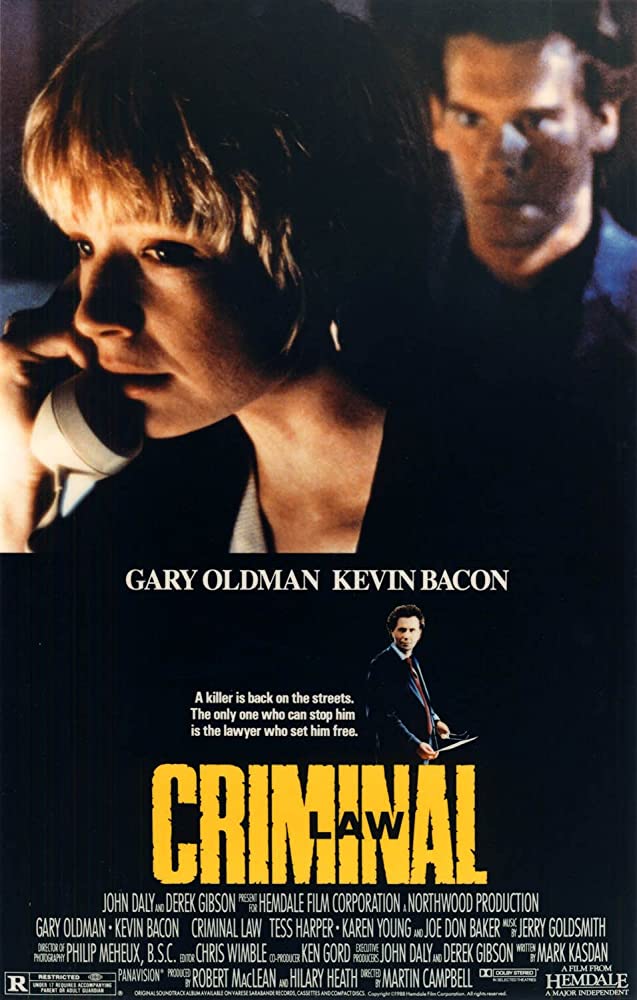
Criminal Law (1988, directed by Matin Campbell)


Gary Oldman is Ben Chase, a hotshot defense attorney who graduated from Harvard and now practices law in Boston.  That means that he gets to have a Boston accent and you know how much Gary Oldman loves playing a role with an accent.  Ben also has a pompadour because Gary Oldman always has something weird going on with his hair in almost every film he appears in.

Ben’s latest client is Martin Thiel (Kevin Bacon), a sociopathic rich kid who has been accused of murder.  Even though Ben thinks that Martin is probably guilty, he still gets Martin off the hook.  As soon as Martin get his acquittal, he starts murdering again.  Ben feels responsible so he decides that what he needs to do is trick Martin into implicating himself.  However, Martin knows what Ben is planning so, instead, he decides to frame Ben for the murders.  Somehow, it all links back to Martin’s feelings about abortion.  I guess Martin is against abortion or maybe he’s for it.  It was hard to keep track.  I watched the movie and I’m still not sure I followed everything that I saw.  It’s not that the plot is diabolically clever.  It’s just that it’s so incoherent that not a single plot point logically follows from another.

The film experiments with suggesting that there’s some sort of deeper connection between Martin and Ben.  Martin is obsessed with Ben and when Ben is in bed with his girlfriend, he briefly imagines that she’s turned into Martin and has a good old-fashioned freak out as a result.  It doesn’t make any sense.  First off, you have to believe that Ben can’t tell the difference between Kevin Bacon and his girlfriend.  Secondly, you have to then accept that Ben — a HARVARD GRADUATE — is so stupid that he would actually believe that his girlfriend had suddenly transformed into Kevin Bacon and must now be strangled.

Criminal Law is a film that you may be tempted to watch because of the pairing of Kevin Bacon and Gary Oldman but you’d be better off just watching JFK again.  They’re both great actors and and it’s always interesting to see them cast against type but neither one of them is particularly good in Criminal Law.  They’re let down by a script that doesn’t allow either one to create a consistent character.  Sometimes, Martin is a soulless attorney and other times, he’s a panicky social justice crusader.  Sometimes, Kevin Bacon is a clever sociopath and, other times, he’s just your typical mindless movie slasher.

On the plus side, Joe Don Baker is in this mess, playing a cop.  Joe Don Baker has played so many cops in so many bad movies that I wonder if he’s ever been tempted to try to arrest someone in real life.  In Criminal Law, he’s not given much to do but it doesn’t matter.  He’s Joe Don Baker!

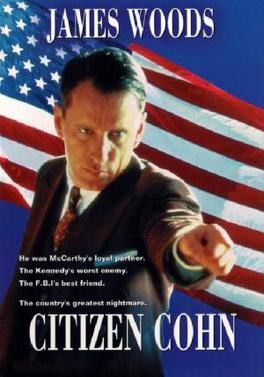
Citizen Cohn (1992, directed by Frank Pierson)


The year is 1986 and the powerful attorney Roy Cohn (James Woods) is dying.  The official story is that Cohn has liver cancer but the truth is that he’s dying of AIDS.  As he lies in his hospital bed, he thinks about his past and the events the led to him becoming one of the most feared and powerful men in America.  He is haunted by the ghosts of his many enemies, people like communist spy Ethel Rosenberg (Karen Ludwig) and his former colleague, Bobby Kennedy (David Marshall Grant).

Not surprisingly, a good deal of Cohn’s memories center around his association with Sen. Joseph McCarthy (Joe Don Baker), a charismatic alcoholic who, in the 50s, charged that he had a list with the names of communist spies deep within the government.  Cohn and Kennedy served as the counsels on McCarthy’s committees.  Cohn is with McCarthy from the beginning and he’s with him until the end of the senator’s career.  In fact, it’s Cohn’s own shadowy relationship with an army private that ultimately leads to McCarthy’s downfall.

Except for one aspect of the film, Citizen Cohn is one of the best films to ever be produced by HBO.  The film covers a lot of history in a little less than 2 hours and it does so in a way that is always interesting and easy to follow.  By including incidents from every phase of Cohn’s life, as opposed to just focusing on his time as McCarthy’, the film also shows how someone like Roy Cohn can become a behind-the-scenes power player despite the majority of the country having no idea who he is.  James Woods gives one of his best performances as the hyperactive and unapologetically corrupt Cohn while Joe Don Baker is perfect as the self-pitying Joseph McCarthy.

The problem with the film, and your mileage may vary on how big an issue this is, is that it almost presents Cohn’s final days — dying of AIDS in a lonely New York hospital room — as being some sort of deserved fate for everything that he did wrong in life.  For me, even in the case of someone like Roy Cohn, that’s a step too far and it comes very close to presenting AIDS as some sort of divine punishment (which, itself, comes dangerously close to mirroring the homophobic statements that were made — and still are being made — by anti-gay activists).  That may not have been the film’s intention but, with the flashback structure and all of his dead enemies materializing to taunt Cohn as he lies dying, it’s still a very valid interpretation.

Some of that is perhaps unavoidable.  Cohn, in both real life and the film, died largely unrepentant for anything he did during his life.  As the central character of a biopic, Cohn never has the type of big moment that you would hope for, where he would realize that it was wrong for him to destroy so many lives and show at least a hint of contrition for his past behaviors.  That Roy Cohn is even a compelling character is a testament to the talent of James Woods because it’s certainly not due to any sort of hidden goodness lurking underneath the surface of Cohn’s snarling personality.  The lack of apologies and regrets that made Cohn a powerhouse in real life also makes him an ultimately unsatisfying subject for a movie.

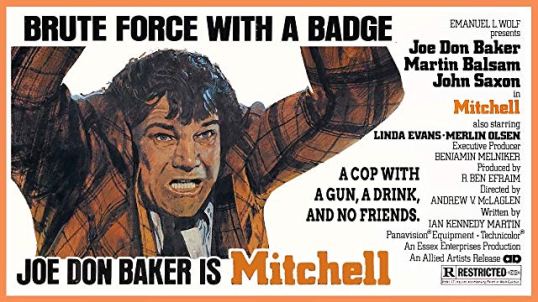
Mitchell (1976, directed by Andrew V. McLaglen)


Mitchell (played by Joe Don Baker and don’t you forget it) is a detective who rubs everyone the wrong way because he’s a huge slob.  In order to keep Mitchell from investigating a murder committed by a mobbed-up lawyer named Walter Deaney (John Saxon), Mitchell’s superiors order him to conduct surveillance on businessman James Arthur Cummings (Martin Balsam).  Cummings is in the export/import game, which can only mean that he’s looking to smuggle heroin in the United States.  Mitchell balks at having to spend hours sitting in a car and watching a house but he finally agree to do it just so he can show up his superiors.  “I’m going to get Deaney and Cummings!” he says.

In order to get Mitchell off of his back, Deaney sends him a prostitute named Greta (Linda Evans).  Mitchell doesn’t have any problem having sex with Greta but he does have a problem with her smoking grass.  After spending two nights with her, he hauls her off to jail for possession because the only intoxicant that Mitchell needs is Schlitz beer.

Eventually, both Deaney and Cummings get tired to being harrassed by this slob so they team up to kill him.  This leads to both a dune buggy accident that has to be seen to be believed and an exciting helicopter chase.

Mitchell is best-known for having been featured on an episode of Mystery Science Theater 3000.  Everyone remembers Joel and the bots making savage fun of Joe Don Baker and commenting on the plot’s incoherence.  What is less well-known is that the version that was shown on MST 3K was a heavily edited version that was missing some key scenes.  Earlier today, I watched the unedited version of Mitchell.  It’s still pretty bad but the plot does make slightly more sense.  In the unedited version, we actually learn why John Saxon just vanishes from the movie and we also see the end result of Mitchell’s final confrontation with Cummings, instead of just cutting away.  Even more importantly, in the unedited version, we discover that Mitchell spends the entire movie being threatened, abused, and insulted.  It makes it easier to understand why he’s in such a terrible mood throughout the entire film.  The unedited version of Mitchell is not much better than the edited version but it is a tougher and more violent film in every way.

Mitchell is usually described as being a take on Dirty Harry but it’s actually more of a French Connection rip-off.  The slovenly Mitchell has more in common with the erratic Popeye Doyle than with the cool and collected Harry Callahan.  Unfortunately, Mitchell doesn’t have any scenes that can compare to the chase scene from The French Connection nor does it have that film’s gritty, semi-documentary tone.  Whereas Doyle and Callahan got results through being smart along with being tough (Dirty Harry, for instance, goes out of its way to show that Callahan is dogged investigator and not just a trigger-happy cop), Mitchell just annoys people until they try to kill him.

For all the shit that Joe Don Baker has taken for starring in Mitchell, his performance is not that bad.  He’s convincing as a borderline fascist cop who doesn’t get much sleep and who doesn’t trust anyone.  It’s just that Mitchell, as written, is never a likable hero.  Instead, he’s the type of hero who busts his girlfriend because she has a tiny amount of grass in her purse.  Of the villains, John Saxon is believably sleazy as Deaney but Martin Balsam sleep walks through his role as Cummings and, even in the unedited version, his plan never makes much sense.  Balsam and Saxon should switched roles.

Finally, no review of Mitchell would be complete with including the lyrics of the haunting Mitchell theme song, sung by Hoyt Axton:

“My my my my Mitchell
What do your Mama say?
What would she do
if she knew you
were fallin’ round and carryin’ on that way…
Crackin’ some heads, jumpin’ in and out of beds
and hangin’ round the criminal scene…
Do you think you are some kind of a star like the guys on the movie screen…

Well oh my my my Mitchell
What would your captain say?
If he knew you was hangin’ round
Eatin’ with the crooks and shootin’ up the town
Know you been out there, roundin’ up the syndicate
succeedin’ where the others have failed
Oh my my my Mitchell
You shoot ’em just to get ’em in jail
When they take a look in the record book, they’ll find you got a lot of class…

The whole shebang, arrestin’ painted ladies for a little grass
Oh my my my Mitchell!”

“Mitchell!”
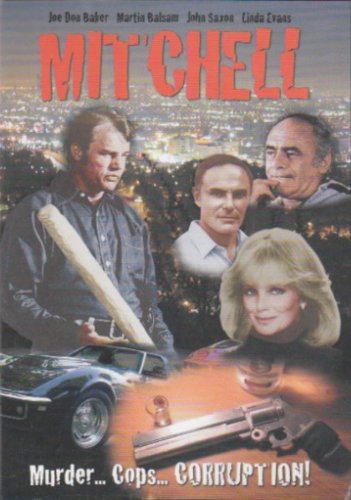
The cover of the unedited Mitchell DVD features Joe Don Baker from Walking Tall, Linda Evans from Dynasty, and a publicity still of John Saxon. Martin Balsam, however, does appear to have been taken from the film.
Horror Film Review: Cape Fear (dir by Martin Scorsese)


And I beheld as Scorsese remade a classic movie and, Lo, there was De Niro, decorated in india ink and speaking in tongues…

In 1991, Martin Scorsese remade the 1962 horror thriller, Cape Fear.  Both versions deal with the same basic story but each tells it in a very different way.  If the original Cape Fear was straightforward and to the point, Martin Scorsese’s version is so stylized that occasionally, it’s tempting to suspect that Scorsese might be parodying himself.  Zoom shots, negative shots, sweeping camera movements, Scorsese’s Cape Fear is full of all of them.  When a storm rolls in for the film’s operatic finale, the red clouds look as if their on fire.  Hell is coming to North Carolina, the film appears to be announcing.

While the plot largely remains the same, there are a few significant changes to the characters involved:

In the first Cape Fear, Robert Mitchum’s Max Cady was an arrogant, swaggering brute.  In the remake, Robert De Niro’s Cady is still an arrogant, swaggering brute but he’s now also an evangelical who is tattooed with bible verses and who speaks in tongues.  Cape Fear‘s approach to Cady’s religion is so over-the-top that it almost makes Stephen King’s approach to religious characters seem subtle and nuanced.  De Niro also speaks in a broad Southern accent.  Occasionally, De Niro gets the accent right but most of the time, he sounds like he’s in a Vermont community theater production of Cat On A Hot Tin Roof.

In the first Cape Fear, Gregory Peck’s Sam Bowden was a lawyer who caught Max while Max was attacking a woman and who then testified against Max in court.  That’s not the case with the remake’s version of Sam Bowden.  Despite being played by Nick Nolte, the remake’s Sam Bowden is such a wimp that you can’t help but dislike him.  His wife (Jessica Lange) doesn’t trust him.  His teenage daughter (Juliette Lewis) resents him and his attempts to control her life.  In this version, Sam didn’t testify against Max in court.  Instead, Sam was Max’s lawyer and withheld evidence that could have secured Max’s acquittal.  What Sam didn’t realize is that Max would spend his time in prison studying the law and that Max would eventually figure out what Sam did.

As in the original film, Max shows up in North Carolina and proceeds to stalk the Bowdens.  Unlike Mitchum, who was all quiet menace, De Niro plays Max as being loud and obnoxious, the type who will sit in a theater, light a cigar, and intentionally laugh at the top of his lungs.  Max knows enough about the law that he knows exactly what he can get away with.  He poisons Sam’s dog.  He rapes Sam’s associate, Lori (played, in a heart-breaking performance, by Ileana Douglas).  In one of the film’s most unsettling scenes, he pretends to be the new drama teacher and toys with Sam’s daughter.

With the help of a private eye (Joe Don Baker), Sam tries to get Max out of his life.  Eventually, Sam pretends to be out-of-town, all as part of a ruse to get Max to break into his house so that he can be shot in self-defense.  It’s here that Nolte’s wimpy performance becomes an issue.  It’s impossible not to laugh at the sight of Sam, all hunched down and desperately trying to run from room to room without being spotted through any of the windows.

To a certain extent, I suspect that were meant to see Sam as being a rather pathetic figure.  Scorsese doesn’t really seem to have much sympathy for him or his dysfunctional family.  If anything, the film seems to argue that Sam has been a bad lawyer, a bad husband, and a bad father and Max has been sent as a type of divine retribution.  Only by defeating Max can Sam find forgiveness and hope to have the type of life that Gregory Peck enjoyed in the first movie.

Scorsese’s Cape Fear is an uneasy mishmash of styles.  Is it an art film, a religious allegory, a horror film, or just a generic thriller?  It doesn’t seem to be sure.  Cape Fear‘s a Scorsese film so, of course, it’s always going to be worth watching.  But there are times when the film definitely runs the risk of overdosing on style.  Sometimes, Scorsese seems to be trying too hard to remind everyone that he’s a legitimately great director and ends up getting so invested in the film’s visuals that he runs the risk of losing the story.  De Niro has some scenes in which he is genuinely chilling but then he has other scenes where he is basically just a live action cartoon character.  The same can be said of the film itself.  It’s always watchable.  At times, it’s rather frightening.  But other times, it’s just too cartoonish to be effective.

If anything, this remake proves that sometimes, it’s best to keep things simple.