1982’s Pink Floyd — The Wall is a film that I have mixed feelings about.
Some of that is due to my feelings about Pink Floyd. On the one hand, I can’t deny their talent and I do like quite a few of their songs, if they do all tend to be a bit on the portentous side. On the other hand …. Roger Waters! Bleh, Roger Waters. Waters was one of the founders of Pink Floyd and, for a while, the band’s de facto leader. He’s also a rabid anti-Semite and a defender of Vladimir Putin’s. That said, I’ve discovered that I can justify listening to Pink Floyd by remembering that the rest of the band hates Roger Waters as well and that Waters himself eventually left Pink Floyd. Waters’s bandmate, David Gilmour, has flat-out called Roger Waters an anti-Semite. Last year, when we had a total eclipse of the sun, I was happy to be able to play the last two tracks of Dark Side of the Moon while enjoying the early and temporary evening. It just felt appropriate.
Outside of Dark Side of the Moon, The Wall is probably Pink Floyd’s best-known work. (When I was younger, I can remember my Dad playing it whenever he was driving across the country.) A concept album about how much it sucks to be a wealthy Englishman, The Wall is one of those albums and films that are beloved by people who consider themselves to be alienated. Even more so than the average Pink Floyd album, The Wall was the brainchild of Roger Waters and, when the movie version was made in 1982, Waters wrote the screenplay. That said, I think you can argue that, much as with Tommy, The Wall was ultimately more about the vision of the film’s director than that of the man who wrote the songs.
The Wall is definitely an Alan Parker production. It’s big. It embraces the sordid. It’s stylish almost to the point of parody. Every image has been carefully constructed by a director who got his start doing commercials and whose main goal was to get an immediate audience reaction. Much like Parker’s Midnight Express or Evita, it’s a film that grabs your attention while you’re watching it and only afterwards do you stop consider that there really wasn’t much going on underneath the surface.
Pink (Bob Geldof) is a self-loathing rockstar who is haunted by his childhood in post-WWII Britain and whose marriage is failing. He’s building a wall, brick-by-brick, to keep himself separated from pain but the price of becoming comfortably numb is to be so alienated that you imagine becoming a neo-Nazi who orders his followers to follow the Worm. The imagery is powerful. The animated sequences by Gerald Scarfe still make quite an impression, especially the marching hammers. The score features songs like Another Brick In The Wall, Comfortably Numb, and Run Like Hell. The film is relentless, full of downbeat imagery that is often excessive but which Parker understood would appeal to the film’s target audience. Indeed, it’s such an overwhelming film that it’s easy to overlook the fact that, even before he transformed into a fascist, Pink is a drab character and his main problem seems to be that he can’t seem to find anything good to watch on television.
That said, I have to admit that, despite myself, I do like The Wall. It’s just so shameless that it’s hard not to enjoy the silliness of it all. Add to that, Comfortably Numb is a great song. (Another Brick In The Wall is also a great song though perhaps not for the reasons that Waters thought it was.) The Wall is a monument to the joys of cinematic excess.
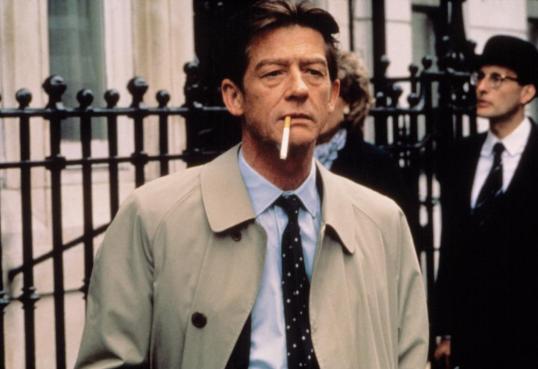
 London. 1961. Doctor Stephen Ward (played by John Hurt) is an artist and an osteopath. He counts among his patients some of the most distinguished men and women in British society, including the Minister of War, John Profumo (Ian McKellen). After meeting two young dancers, Christine Keeler (Joanne Whalley) and Mandy Rice-Davies (Bridget Fonda), Stephen becomes their mentor, the Henry Higgins to their Eliza Doolittle.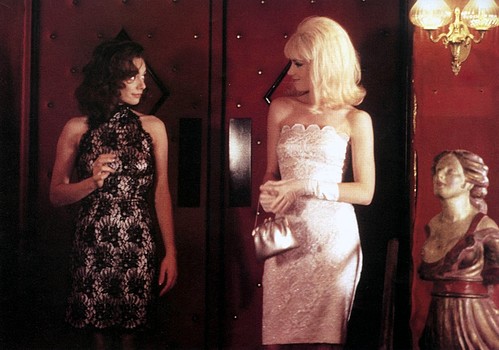
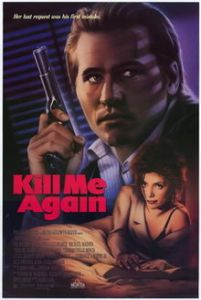 Fay Forrest (Joanne Whalley) and her boyfriend, Vince Miller (Michael Madsen), make their living stealing from the mob. After their latest job results in the death of a made man, Fay decides that she needs to escape from the abusive Vince. She runs away to Las Vegas, where she looks up a small-time, financially strapped P.I., Jack Andrews (Val Kilmer). She hires Jack to help her fake her death, offering to pay him $5,000 upfront and $5,000 after she’s dead. Jack is reluctant to get involved but he also has a loan shark threatening to break every bone in his body. Jack helps Fay fake her death but then Fay leaves town without paying him the second $5,000. Even worse, both Vince and the mob quickly figure out that Fay is not actually dead and join Jack in trying to track her down.
 Through the Shattered Lens