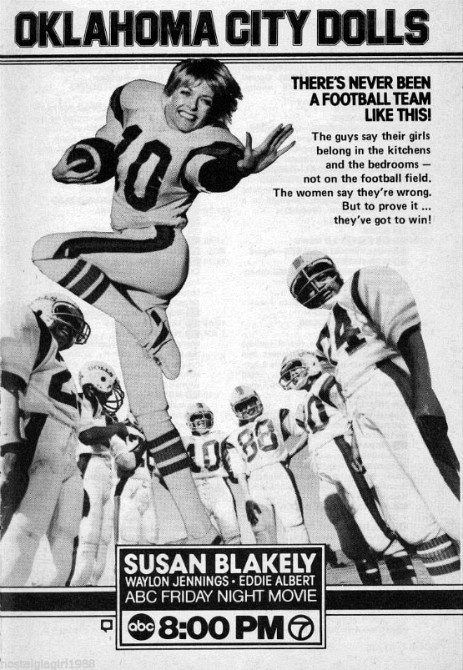
 At an Oklahoma manufacturing plant, the women are always expected to put in extra hours while their male co-workers practice as a part of the company’s football team. Shop steward Sally Jo (Susan Blakely) files a complaint with the EEOC. John Miller (Robert Hooks) pays a visit to the plant and says that the women have to be given the same opportunities and benefits as the man, including recreation time. The plant’s foreman, J.D. Hines (David Huddleston), agrees. The woman can have recreation time as long as they’re doing what the men are doing and that’s playing football. Determined to show up Hines and all of her sexist co-workers (and her boyfriend, played by Waylon Jennings), Sally Jo puts together a football team and even gets a broken-down former NFL coach (Eddie Albert) to serve as their trainer.
There actually was a woman’s football team called The Oklahoma City Dolls. They played in the National Women’s Football League and they won the league’s championship three times. However, they don’t appear to have anything to do with this movie, which is as much about Sally Jo trying to get a fair treatment for the workers as it is about hitting the field and running it in for a touchdown. There are some parts of the movie that work. I liked Eddie Albert’s performance as the alcoholic coach and the scene where he discovered that his community service would include coaching a group of women who had never played football before. Folk singer Ronee Blakley was good as the team’s emotionally fragile wide receiver. I even liked that the women didn’t all automatically become the world’s best football players. The movie’s main weakness was that Susan Blakely just wasn’t believable as someone who lived in a trailer park, used “ain’t” in every sentence, and spent her time organizing a union. She was too glamorous for the role and her scenes with Waylon Jennings all felt overwritten and overacted. The story couldn’t decide if it wanted to be a drama about working in a factory or a football comedy and it was pretty uneven as a result. The good thing is that the movie’s heart was in the right place, even if it didn’t always score a touchdown.
As for the real life Oklahoma City Dolls, they were active from 1976 to 1979. An attempt to revive the team in 1982 failed when their financial backers pulled out at the last seconds. The National Women’s Football League folded in 1988.
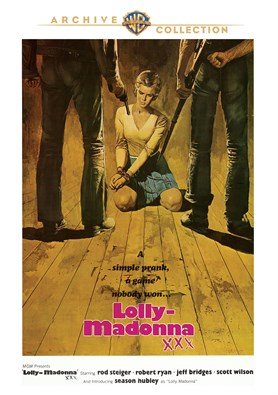 In the backwoods of Hicksville, USA, two families are feuding. Laban Feather (Rod Steiger, bellowing even more than usual) and Pap Gutshall (Robert Ryan) were once friends but now they are committed rivals. They claim that the fight started when Pap bought land that once belonged to Laban but it actually goes back farther than that. Laban and Pap both have a handful of children, all of whom have names like Thrush and Zeb and Ludie and who are all as obsessed with the feud as their parents. When the Gutshall boys decide to pull a prank on the Feather boys, it leads to the Feathers kidnapping the innocent Roonie (Season Hubley) from a bus stop. They believe that Roonie is Lolly Madonna, the fictional fiancée of Ludie Gutshall (Kiel Martin). Zack Feather (Jeff Bridges), who comes the closest of any Feather to actually having common sense, is ordered to watch her while the two families prepare for all-out war. Zack and Roonie fall in love, though they do not know that another Feather brother has also fallen in love with Gutshall daughter. It all leads to death, destruction, and freeze frames.
 Through the Shattered Lens