Terry Franken (Dwight Schultz), the arrogant director of a new musical that is playing out of town tryouts on the way to Broadway, is shot and killed at the theater. Recently fired stage manager Johnny Whitcomb (Jim Metzler) is arrested for the crime but Perry knows that Johnny is innocent. At the same time that Terry was getting murdered, Perry was in a hospital room recovering from knee surgery. He looked out the hospital window and saw Johnny across the street. Despite Perry providing an alibi, Johnny is still charged with murdering Terry. Broadway legend Amanda Cody (Debbie Reynolds) asks Perry to take Johnny’s case.
This Perry Mason movie featured Perry on the stand, testifying to having seen Johnny. The District Attorney (Valerie Mahaffey) tried to humiliate Perry by suggesting that he was on too many pain killers to be sure what he saw. Never try to humiliate Perry Mason! He’ll not only beat you in court but also make you look like a fool by getting the real murderer to confess while on the stand.
The key to proving Johnny’s innocence was finding the security guard (Rick Aiello) who worked at the theater the night that Terry was killed. Ken (William R. Moses) and his annoying girlfriend Amy (Alexandra Paul) handled that part of the case. Ken is still no Paul Drake, Jr. and his bickering with Amy is like nails on a chalkboard.
I actually remember watching this movie with my aunt when it came on Hallmark one weekend. My aunt enjoyed it. She liked Debbie Reynolds. This one was better than the previous movie. Along with Debbie Reynolds, the cast includes Jerry Orbach and Lori Petty. Dwight Schultz was great as the victim. I still miss William Katt and David Ogden Stiers, though. Perry doesn’t have the same connection to Ken that he had to Paul. David Ogden Stiers was great because, even though he always lost the case, he still seemed like he was a good enough lawyer that he could have won if things had gone differently. These new district attorneys never even have a chance against Perry.
In honor of Bruce Campbell’s 67th birthday, I decided to watch a movie he’s featured in that I’ve never seen before. I thought the horror-comedy SUNDOWN: THE VAMPIRE IN RETREAT looked like it might be fun so I went for it!
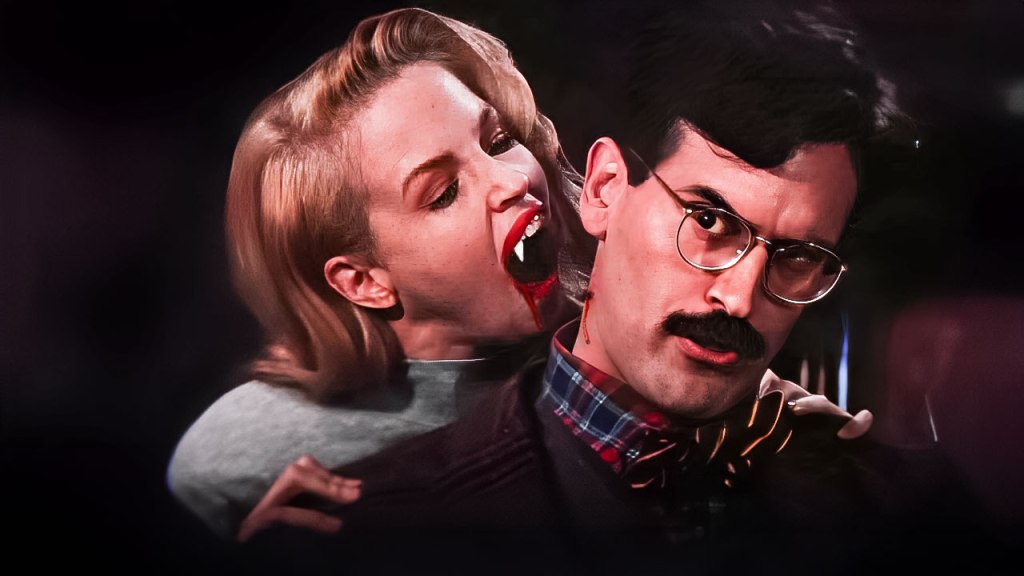
In the desert town of Purgatory, a colony of vampires led by Count Mardulak (David Carradine) want to live in peace, abstaining from human blood, and instead, drinking a blood substitute called “Necktarine,” which is produced in a local factory. They also use high powered sunscreen that allows them to go out in the day time as long as they wear thick sunglasses, big hats or umbrellas, and gloves. Unfortunately, the blood factory begins experiencing production issues, so Mardulak asks David Harrison (Jim Metzler), the unsuspecting human who designed the production process, to come to town and fix their problems. Harrison brings his family with him, including his wife Sarah (Morgan Brittany), and their two daughters. The Harrison family soon find themselves in the middle of an other worldly war as Jefferson (John Ireland) and Shane (Maxwell Caulfied), rebellious local vampires, plot to overthrow Mardulak so they can return to their murderous ways. Meanwhile, Robert Van Helsing (Bruce Campbell), the great grandson of the famed vampire hunter, walks into town, ready to romance the local vampire beauty Sandy (Deborah Foreman) and drive stakes into the hearts of as many bloodsucking freaks as possible!
As far as I’m concerned, SUNDOWN is a blast as a completely absurd horror-comedy that puts an interesting spin on traditional vampire legend, with its endless sunscreen slathering and a growing local weariness over “Necktarine” adding to the good times. It’s campy and silly, with purposely terrible stop motion bat effects, over-the-top family drama, and lots of cheesy one-liners, but of course that’s all part of the charm.
The B-movie dream cast is what I enjoyed the most about SUNDOWN. David Carradine plays it pretty straight as the town leader Count Mardulak, which is effective when you consider all of the craziness going on around him. Bruce Campbell, and his mustache, steals all of his scenes with his goofy charm and misguided heroics. And, of course, the inimitable M. Emmet Walsh is perfect as old man Mort, a vampire who loses his temper and beheads a disrespectful city slicker. He just can’t help himself. Throw in other veteran character actors like Bert Remsen and John Ireland and it’s easy to enjoy the movie no matter how silly it all gets.
On a personal note, I did want to point out a couple of performances in SUNDOWN that have Arkansas connections. First, Jim Metzler had a solid part a couple of years after this movie in the crime thriller ONE FALSE MOVE (1991), which was co-written by Billy Bob Thornton and partially filmed in Eastern Arkansas. It’s a great movie and Metzler is good in it. Second, Elizabeth Gracen has a small part in the film. Gracen, whose actual name is Elizabeth Ward, won the title of Miss Arkansas in 1981 and then went on to win Miss America in 1982. My uncle Billy was her hair stylist as she made her run to beauty pageant immortality. Other notable Gracen life events include her affair with Arkansas Governor Bill Clinton in 1983, her appearance in Steven Seagal’s MARKED FOR DEATH in 1990, and her Playboy spread in 1992. Interestingly, 18 years old at the time, I saw the layout when my girlfriend’s mom bought the issue and let me look at it!
Overall, SUNDOWN lets us know right off the bat the kind of absurd movie we’re dealing with, so you’ll either be into it or want to just move on. I was into it, mainly due to its strong cast. It’s not perfect, and it overstays its welcome by a good 15 minutes, but SUNDOWN is a fun watch for fans of silly horror-comedies and the excellent cast. I had a great time with it!
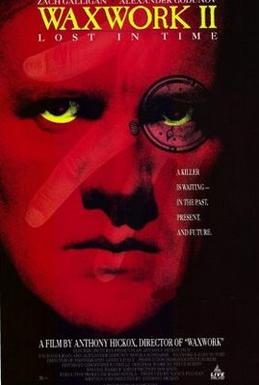
1992’s Waxwork II opens with the finale of the first Waxwork. The cursed waxwork is burning to the ground, taking out the monsters within, along with Sir Wilfred (Patrick Macnee) and Wilfred’s army of do-gooders. Only Mark (Zach Galligan) and Sarah (now played by Monika Schnarre) are able to escape. Fleeing the burning building, they manage to catch a cab. Sarah wonders what they’re going to do now. Mark replies that they’re going to go back to school and pretend that none of this ever happened.
Good luck with that! It turns out that one other thing did escape from the waxwork. A disembodied hand follows Sarah home and murders her abusive stepfather. Sarah manages to drop the hand down the garbage disposal, destroying it but also destroying the only proof she had that she didn’t kill her stepfather. Sarah is put on trial for murder and the jury does not appear to be impressed with her “It was a supernatural creature” defense.
What she and Mark need is proof that the waxwork was full of monsters. Fortunately, a trip to Sir Wilfred’s house reveals not only a recording of Sir Wilfred explaining how there’s an alternative universe known as the Kartagra but also a compass that can be used to find portals into the Kartagra. Mark and Sarah enter the Kartagra, searching for proof of Sarah’s innocence.
Mark and Sarah go from one universe to another, meeting iconic horror characters along the way. Just as with the exhibits in the first film, each universe features it own set monsters and its own distinctive style. For instance, Mark finds himself suddenly cast in the role of Henry Clerval, best friend of Baron Frankenstein (Martin Kemp) and the lover of the Baron’s wife, Elizabeth (who is actually Sarah). Of course, the Baron has more to worry about than his wife cheating with his best friend. There’s also the angry monster living in the basement and the angry villagers that are due to start pounding on the front doors of the mansion.
Later, Mark finds himself in a black-and-white recreation of The Haunting of Hill House, working with a researcher (Bruce Campbell) and two psychics to investigate reports of a ghost at an old house. Mark must bring peace to the ghost while avoiding all of the slapstick complications that one might expect when Bruce Campbell shows up as a paranormal researcher. While Mark is dealing with that, Sarah is floating in space, trying to protect the crew of her dingy spaceship from an acid spewing alien.
You get the idea. Waxwork II is essentially an affectionate collection of homages to other, better-known horror films and it must be said that Waxwork II does an excellent job of recreating each film, from the crisp black-and-white of haunted house scene to the grittiness of the Alien sequences to the over-the-top swordplay of a trip to a medieval world. There’s even a trip to the mall from Dawn of the Dead! Wisely, Waxwork II doesn’t take itself particularly seriously, with many scenes developing into outright comedy. Zach Galligan gives an enjoyable and nicely modulated comedic performance, even holding his own with Bruce Campbell.
At 104 minutes, Waxwork II runs a bit too long for its own good but it ends on a sweet note that nicely wraps up the entire saga. It’s a film that works as both a continuation of Waxwork and as an entertaining film on its own.
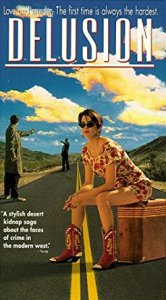
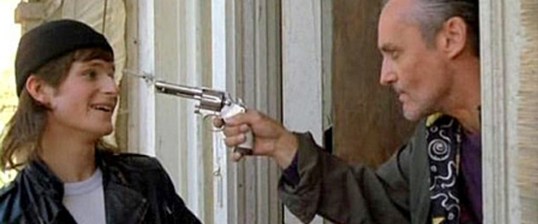
George O’Brien (Jim Metzler) is a former executive at a San Diego computer company who is driving across Nevada. He is heading to Reno, where he plans to set up a company with the embezzled millions that he has hidden in his trunk. When he spots former Vegas showgirl Patti (Jennifer Rubin) standing on the side of the road, he stops to pick her up. She explains that her car broke down and she needs a lift. George is happy to give her a ride. The only problem is that Patti is traveling with her boyfriend, Chevy (Kyle Secor). At first, Chevy just seems to be a goofy guy who talks too much. However, Chevy is actually a hitman, traveling to Vegas to kill a gangster (Jerry Orbach). After the hit, Chevy abandons George in the desert and steals his car. Determined to get his money, George pursues Chevy and Patty across the desert.
Starting like a caper film and ending like a spaghetti western, Delusion was one of the best (and most overlooked) of the many low-budget neo-noirs that came out during the first half of the 1990s. While the underrated Metzler and Secor both give good performances, Delusion is stolen by Jennifer Rubin, who is sexy, funny, and unpredictable as Patti. The scene where she performs These Boots Are For Walking is one of the best of the 90s. Whatever happened to her?
And why hasn’t this excellent retro thriller been given a proper release on DVD or Blu-ray? If any movie is deserves to be rediscovered via a special edition, it’s Delusion.
Ewwwwww! The movie reeks of stale cigarettes and Axe body spray!
976-Evil tells the story of two teenagers named Spike (Patrick O’Bryan) and Hoax (Stephen Geoffreys). You know what? Whether your parents decide to name you Spike or to name your Hoax, your life is pretty much fucked up from the minute either name is entered on your birth certificate. Anyway, Spike and Hoax are cousins. Spike is the dangerous bad boy who rides a motorcycle and wears a leather jacket. Hoax is the really nerdy kid who worships Spike and who lives with his ultra-religious mother (Sandy Dennis). Hoax can’t wait until the day he and Spike ride across the country on their motorcycles. Spike is just busy trying to get laid and looking forward to heading out on his own.
Anyway, Hoax eventually gets tired of being picked on all the time so he decides to call the phone number mentioned in the film’s title. Hoax discovers that he has a direct line to Hell and the voice on the other end has some definite ideas for what Hoax could do to even the score. For instance, Hoax could cause spiders to attack a Spike’s girlfriend. And, after that, Hoax could transform into a monster and attack the local bullies at their poker game.
“That’s a dead man’s hand!” Hoax announces, while literally holding up a dead man’s hand.
(That’s right! Turning evil means becoming a master of puns!)
Uh-oh! It looks like Hoax has been possessed by evil! Even worse, the phone bill is HUGE! Those calls to the Devil aren’t cheap, you know! Can Spike defeat his cousin or will evil rule the day?
Now, I will say this for 976-Evil: as annoying as Stephen Geoffreys is when he’s playing nerdy Hoax, he actually is a bit frightening as evil Hoax. For that matter, Patrick O’Bryan is probably does about as good a job as you can do while playing a character named Spike.
But otherwise, 976-Evil is nearly unwatchable. I mean that literally. The entire film appears to be covered by a layer of grime. Between the unappealing visuals, the poor dialogue, and the lack of appealing characters, there’s really not much in 976-Evil to hold our attention. It might help if we felt bad for Hoax but, even before he calls the phone number, he’s such a weirdo perv that you just kind of want him to go away. Hoax is basically the type of loser who thinks that an Axe body spray commercial is a documentary. You can imagine him desperately spraying himself before he goes to school every day and announcing, “I smell like Axe! I’m losing my virginity next period! And then me and Spike are going to ride our motor scooters to Toronto!”
Released in 1989, 976-Evil was also the directorial debut of Robert Englund. I kinda hate to be so negative about the film because Robert Englund is such a good actor and he always comes across as being such a nice guy. If you haven’t already, be sure to get a copy of Englund’s autobiography, Hollywood Monster. Englund tells a lot of good stories and is admirably positive about being a horror icon. But, though Robert Englund’s a great guy, 976-Evil just doesn’t work.
Seriously, he’s just one of those actors. He’s appeared in a countless number of films and he’s played a lot of different characters. He was a psycho vampire in Near Dark. He was the underwater explorer who got stuck with all of the worst lines in Titanic. In Frailty, he was a father who was driven to murder by heavenly visions. He was the sleaziest of sleazes in Nightcrawler. And, of course, in Big Love, he was an unrepentant polygamist. In all of these roles, Paxton showed the quirkiness that has made him so beloved to film lovers like me. Much like Kevin Bacon, it doesn’t matter what role Bill Paxton is playing. You’re going to like him and you’re going to be happy to see him onscreen.
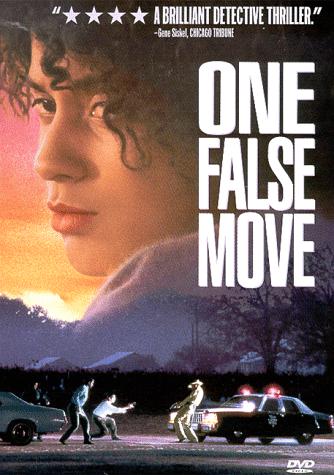
And yet, considering just how many popular films that he’s appeared in, it’s interesting to note that Bill Paxton’s best performance can be found in a film about which not many people seem to have heard. That film is the 1992 Southern crime drama, One False Move.
Actually, it does the film a disservice to refer to it as merely being a crime drama. I mean, it is a drama and it even has a properly dark ending to prove that fact. And it is about criminals and police officers. But ultimately, the film’s plot is just a starting point that the film uses to examine issues of culture, race, and guilt. In the end, One False Movie is an unexpectedly poignant and penatrating character study of 5 very different people.
We start out with three criminals. Ray (played by Billy Bob Thornton, who also co-wrote the script) is a career criminal, a white trash redneck who is not particularly smart but who is dangerous because he’s ruthless and he’s willing to whatever he need to do to survive. (If you’ve lived in the country, you will recognize Ray’s type as soon as you see him.) Ray’s girlfriend is Fantasia (Cynda Williams), a beautiful but insecure woman. And finally, there’s Ray’s partner and former cellmate, Pluto (Michael Beach). Of the three of them, Pluto is the most menacing, a knife-wielding sociopath with an IQ of 150. Even though he’s working with Ray and Fantasia, Pluto always makes it clear that he considers himself to be both separate from and better than both of them.
Ray, Pluto, and Fantasia have just brutally murdered 6 people in Los Angeles, all of whom were friends of Fantasia’s. Now, they’re making their way to Houston, planning on selling stolen cocaine. Pursuing them are two LAPD detective, Cole (Jim Metzler) and McFeeley (Earl Billings). When Cole and McFeeley come across evidence that the three criminals might have a connection with the tiny town of Star City, Arkansas, they call up the local sheriff.
And that’s where Bill Paxton shows up.
Paxton plays Sheriff Dale Dixon. Dale’s nickname is Hurricane and it’s soon obvious why. Like a hurricane, Dale never stops moving. He’s a well-meaning but hyperactive good old boy who has a talent for saying exactly the wrong thing. When he first talks to Cole and McFeeley over the phone, he amuses them with his enthusiastic bragging and briefly offends them with his casual racism.
Cole and McFeeley eventually end up taking a trip to Star City, so that they can investigate how the three criminals are connected to this tiny town. When Dixon meets up with them, he asks them if they could help him get a job with the LAPD. The two cops initially humor Dixon and laugh at him behind his back. When Dixon’s wife (a wonderful performance from Natalie Canerday) asks Cole to keep Dixon safe, Cole assures her that Ray, Fantasia, and Pluto are probably not even going to come anywhere near Star City.
However, Dixon soon reveals to the two cops that Fantasia’s name is Lila and that her family lives in Star City. What he doesn’t tell them, however, is that he and Lila have a personal connection of their own…
One False Move is a twisty and intense thriller, one that’s distinguished by strong performances from the entire cast. (Even Metzler and Billings bring unexpected shadings to Cole and McFeeley, who, in any other film, would have been portrayed as being stock characters.) But the film is truly dominated by Bill Paxton. When we first meet Dixon, he seems like a joke. We’re sure that he’ll somehow end up being the film’s hero (because that’s what happens in movies about small town sheriffs being underestimated by big city cops) but what we’re not expecting is that Dale is going to turn out to be such a multi-layered and fascinating character. Just as Dale eventually starts to lower his defenses and reveal who he truly is, Paxton also starts to reign in his initially overwhelming performance and reveals himself to be a subtle and perceptive actor. It’s a great performance that elevates the entire film. Al Pacino won the 1992 Oscar for Best Actor for his performance in Scent of a Woman. That award should have gone to the unnominated Bill Paxton.
It wouldn’t be fair to reveal One False Move‘s secrets. It’s a film that you really should see for yourself.
In his film guide, Heavy Metal Movies, Mike McPadden describes the disturbing 1987 teen crime drama River’s Edge as being “666 Candles“. It’s a perfect description because River’s Edge appears to not only be taking place in a different socio-economic setting than Sixteen Candles and The Breakfast Club but perhaps on a different planet as well.
River’s Edge opens with a close-up of a dead and naked teenage girl lying on the edge of a dirty, polluted river and it gets darker from there. The dead girl was the girlfriend of the hulking John Tollet (Daniel Roebuck, playing a character who is miles away from his role in Cavegirl). As John explains to his friends, he strangled her for no particular reason. His friends, meanwhile, respond with detachment. Their unofficial leader, the hyperactive Layne (Crispin Glover), insists that since nothing can be done about the dead girl, their number one concern now has to be to keep John from getting caught. While Layne arranges for John to hide out with a one-legged drug dealer named Feck (Dennis Hopper), two of John’s friends, Matt and Clarissa (played by Keanu Reeves and Ione Skye), consider whether or not they should go to the police. Oddly enough, John really doesn’t seem to care one way or the other.
Seriously, River’s Edge is one dark film. If it were made today, River’s Edge would probably be directed by someone like Larry Clark and, in many ways, it feels like a distant cousin to Clark’s Bully. The teenagers in River’s Edge live in a world with little-to-no adult supervision. Matt’s mom is more concerned with whether or not Matt has been stealing her weed than with the fact that Matt might be covering up a murder. The local high school teacher is a former hippie who won’t shut up about how much better his generation was compared to every other generation. In fact, the only adult with any sort of moral code is Feck and he’s usually too busy dancing with a sex doll to really be of much help. It’s a world where no one has been raised to value their own lives so why should they care about a dead girl laying out on the banks of the river?
The film features good performances from Keanu Reeves, Ione Skye, and Daniel Roebuck but really, the entire movie is stolen by Crispin Glover and Dennis Hopper. In the role of Layne, Glover is a manic wonder, speaking quickly and gesturing even when he isn’t making a point. When Layne first shows up, he seems like he’s just overly loyal to his friend John but, as the film progresses, it becomes more apparent that he’s less concerned about protecting John and more interested in ordering other people to do it. For Layne, protecting John is ultimately about maintaining power over Matt, Clarissa, and the rest of their friends.
As for Dennis Hopper — well, this is one of those films that you should show to anyone who says that Hopper wasn’t a great actor. The role of a one-legged drug dealer who lives with a sex doll sound like exactly the type of role that would lead Hopper to going totally over-the-top. Instead, Hopper gave a surprisingly subtle and intelligent performance and, as a result, he provided this film with the moral center that it very much needs.

 George O’Brien (Jim Metzler) is a former executive at a San Diego computer company who is driving across Nevada. He is heading to Reno, where he plans to set up a company with the embezzled millions that he has hidden in his trunk. When he spots former Vegas showgirl Patti (Jennifer Rubin) standing on the side of the road, he stops to pick her up. She explains that her car broke down and she needs a lift. George is happy to give her a ride. The only problem is that Patti is traveling with her boyfriend, Chevy (Kyle Secor). At first, Chevy just seems to be a goofy guy who talks too much. However, Chevy is actually a hitman, traveling to Vegas to kill a gangster (Jerry Orbach). After the hit, Chevy abandons George in the desert and steals his car. Determined to get his money, George pursues Chevy and Patty across the desert.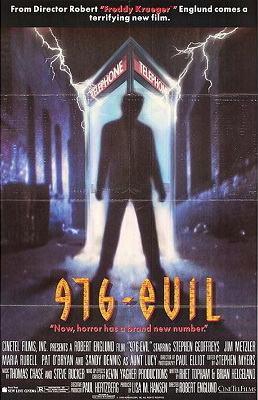
 Through the Shattered Lens