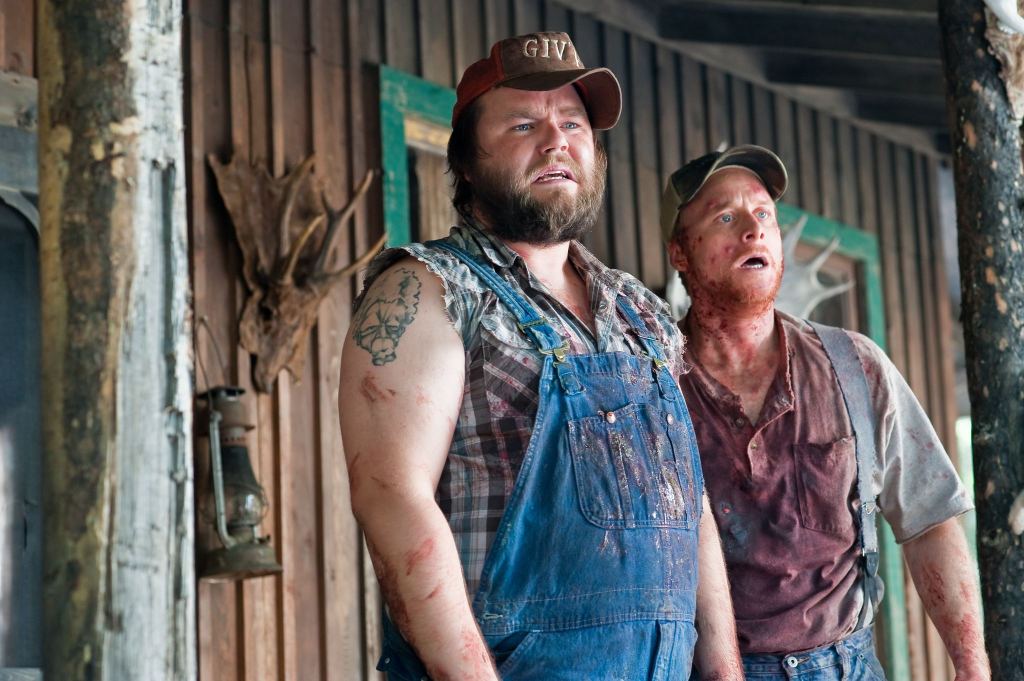
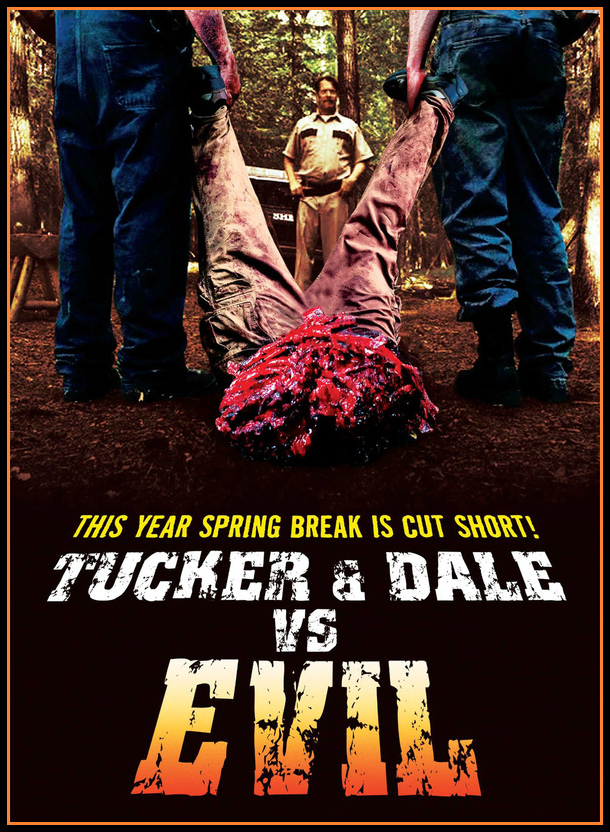
Every Monday night at 9:00 Central Time, my wife Sierra and I host a “Live Movie Tweet” event on X using the hashtag #MondayMuggers. We rotate movie picks each week, and our tastes are quite different. Tonight, Monday, July 28th, we’ll be watching TUCKER & DALE VS. EVIL (2020), starring Tyler Labine, Alan Tudyk, Katrina Bowden, Jesse Moss, Philip Granger, Brandon Jay McLaren, Chelan Simmons, Travis Nelson, Adam Beauchesne, and Eli Craig.
The plot:Two lovable hillbillies are headed to their “fixer-upper” vacation cabin to drink some beer, do some fishin’, and have a good time. But when they run into a group of preppy college kids who assume from their looks that they must be in-bred, chainsaw-wielding killers, Tucker & Dale’s vacation takes a bloody and hilarious turn for the worse.
Sierra and I have been on vacation over the last week, and we truly appreciate Lisa hosting for us while we were gone! Today, we’re both trying to get going again at work and in regular life, so I thought this horror-comedy, that I haven’t watched in many years, might be some easygoing fun! If it sounds fun to you, join us for #MondayMuggers and watch TUCKER & DALE VS. EVIL. It’s on Amazon Prime! I’ve included the trailer below:
The 2013 film, 13 Eerie, takes place on an island that is not quite as deserted as our heroes originally assumed.
The island, known as the Eerie Strait, was once the home of a brutal, maximum security prison. The island is full of abandoned buildings and abandoned vehicles, all of which sit there as monuments to the brutality of mass incarceration. Prof. Tompkins (Michael Shanks) teaches a class in Forensic science and he brings six of his best students (played by Katharine Isabelle, Brendan Fehr, Brendan Fletcher, Jesse Moss, Kristie Patterson, and Michael Eisner) to the island. With the help of an ex-convict named Larry (Nick Moran), Tompkins has set up several fake crime scenes (often featuring very real corpses) for his students to investigate. For the class, the students are required to work in teams of two and the teams are not allowed to communicate with each other. However, each team is given a walkie-talkie so that they can still communicate with Tompkins.
Now, just speaking for myself, I would probably drop the class rather than take part in any of this. Seriously, as soon as you tell me that I’m going to have to spend my weekend hanging out at an abandoned prison and examining real corpses, I would probably walk out of the classroom and switch majors. (Then again, I probably wouldn’t be majoring in forensics to begin with.) But Tompkins’s students are very enthusiastic about heading off to the island. I guess if doing obviously dumb things, going off to an isolated location with an ex-con would be an attractive option.
Anyway, the students head over to the Island and — surprise! — it turns out that there’s a lot of extra dead bodies lying around. At first, the students think that the extra bodies are all a part of their class but then some of the dead bodies come back to life. It turns out that the island — much like the prison camp in Garden of the Dead — was once used a place to experiment on prisoners. As a result, many of the former prisoners have now been transformed into flesh-eating zombies who roam the island and look for new victims.
(And again, anyone who has ever seen a zombie movie, should have realized that this would happen. It always amazing me that people in zombie movies have apparently never come across Night of the Living Dead on television late at night. At the very least, you would think that these people would have at least read an article or two about The Walking Dead. And really, even if you have somehow gone your entire life without being exposed to any zombie media, the sight of the dead walking around should be enough to convince most people to run away.)
13 Eerie has some atmosphere but it doesn’t really bring anything new to the zombie genre. In fact, it so closely follows the rules of the genre that it actually gets kind of boring. I appreciated, as always, the committed performance of Katharine Isabelle and I also liked that the film ended on a bit of a down note. But, for the most part, 13 Eerie doesn’t bring anything new to the world of the living dead.
Well, another Sundance Film Festival has come to a close! Here’s what won at this year’s festival. If this year is like other years, a few of the films mentioned below will also be players once Oscar season begins later this year. For instance, just from what I’ve read, I wouldn’t be surprised to see Minari‘s name come up quite a bit between now and next January.
U.S. Grand Jury Prize: Dramatic: “Minari” Lee Isaac Chung
U.S. Grand Jury Prize: Documentary: “Boys State,” Jesse Moss and Amanda McBaine
Alfred P. Sloan Feature Film Prize: “Tesla”
Adobe Mentorship Award for Editing: Carla Guttierez and Affonso Gonçalves
So, as you know if you’re one of our regular readers, I am currently in the process of cleaning out my DVR. That means that I’ve spent this week watching and reviewing a countless number of Lifetime and SyFy films. It’s been fun and I do love watching Lifetime films but I also have to admit that I’m glad to see that I only have 8 films left to go.
Earlier today, I continued to make progress by watching Buried Secrets. Buried Secrets originally aired on October 25th, on the Lifetime Movie Network. I didn’t get to see it when it originally aired because I was busy dancing in my underwear at a Halloween party. Fortunately, that’s why we have DVRs!
So, how to describe the plot of Buried Secrets? Seriously, it’s not easy as you might assume. There is a lot of stuff going on in Buried Secrets. In fact, it’s probably one of the most convoluted Lifetime films that I’ve ever seen. But let’s give it a shot:
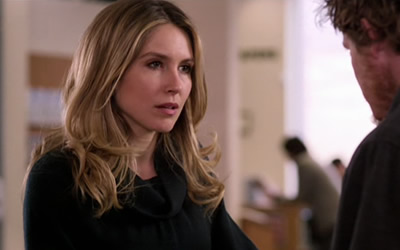
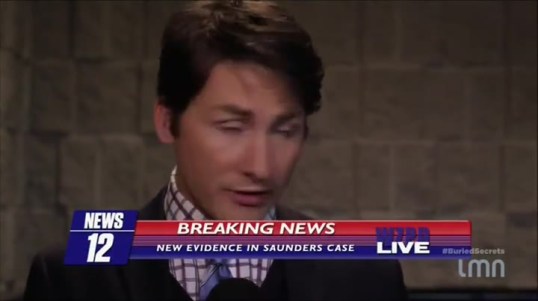
Sarah Winters (Sarah Clarke) was a police detective who was involved in investigating the mysterious murder of police informant, Derrick Saunders (Fulvio Cecere). However, before Sarah could solve the crime, she was accused of corruption and kicked off the force. Sarah, of course, was totally innocent and she feels that she was set up by one of her fellow detectives, Joan Mueller (Veena Sood). Mueller is now chief-of-police, largely because of the attention she gained by accusing Sarah of being corrupt.
Sarah also has a teenage daughter (Angela de Lieva) and a mother (Gabrielle Rose), who she doesn’t get along with. This is largely because Sarah was adopted and she is upset because her adoptive mother refuses to give her any information about her biological parents.
Since Sarah is no longer on the force, she writes a novel that becomes a best seller. The novel is based on the murder of Derrick Saunders and features an incompetent, untrustworthy detective named Meckler. When Mueller demands to know if Meckler is based on her, Sarah says that she is. In the real world, this would lead to Sarah being sued for libel and probably being driven to bankruptcy.
However, this is Lifetime world! Mueller is concerned about much more than the real identity of Detective Meckler. Mueller thinks that the book contains details of the crime, which prove that Sarah was the murderer.
Meanwhile, Sarah’s boyfriend, Barry (Dan Payne), is working on the security detail of Mayor Harding (Sarah-Jane Redmond). Harding is running for reelection but it looks like she might be on the verge of losing her office. So, Harding starts to sleep with Barry to get information about Sarah. Mayor Harding has decided that if she campaigns on a platform that calls for banning Sarah’s book, she’ll win reelection.
And yes, that makes absolutely no sense but just go with it.
Meanwhile, there’s a mysterious homeless-looking guy (Teach Grant) and he keeps popping up at the strangest times. He shows up at a book singing. He follows Sarah’s daughter in the park. And, of course, he spends a lot of time at the local DNA lab…
Okay, so you might think, after reading all of this, that Buried Secrets doesn’t make much sense. And it doesn’t! But that, to be honest, is the film’s main appeal. Since Buried Secrets refuses to be tied down by logic, that means that literally anything can happen! At it’s best, Buried Secrets creates its own hyper realized world, where everything is just a bit over-the-top and strange. It’s a world where a major municipal election hinges on banning a novel, where book signings are fraught with drama and peril, and where one teenager can change an entire city’s mind just by grabbing a microphone and giving an impassioned speech. It’s all so strange that there’s no way not to enjoy it.
One thing I like about genre films is the fact that, whether they’re good or bad, they mostly accomplish the part about entertaining it’s audience. For the good to great ones they don’t just entertain but raise the genre to new heights. For the bad ones they seem to entertain in unexpected ways. How often have one watched a bad genre film, realize it’s bad and still just roll with it, laughing at it becoming part of it’s appeal. We wouldn’t have gotten years and years of Rifftrax and MST3K without enjoying the badness of awful genre films. Then there are genre films which takes the very well-worn tropes of the genre. The very things we as an audience groan and snicker at and manages to turn it into a love-letter to the very thing they’re making fun of.
The horror-comedy Tucker & Dale vs. Evil takes the backwoods horror which has been a major staple of the slasher subgenre for over a quarter-century and tips it on it’s head to create a horror comedy that never runs out of laughs and still manages to show cringe-inducing death scenes. It stars Alan Tudyk and Tyler Labine in the roles of Tucker and Dale. We have two well-meaning “hillbillies” from the backwoods of West Virginia on their way to Tucker’s recently bought “fixer-upper” of a vacation home who come across a group of obnoxious college kids looking to spend the weekend on the shore of the very lake our two intrepid heroes’ vacation also sits off of. Through some misunderstanding between the very sweet-natured Dale who tries to befriend one of the pretty college girls in the group we see the beginning of events that will see death and mayhem visited upon both groups throughout the film.
We get the mandatory story telling us about how twenty years ago during Memorial Day a group of similar college kids were massacred by a couple of hillbillies on the very shores of the lake with only one survivor to tell the tale. This tale becomes the reason why the college kids start trying to “defend” themselves from Tucker and Dale who they thought kidnapped one of the girls in their group when in fact they had just rescued her from drowning. One by one each college kid dies in horrible fashion in their attempt to take on the oblivious Tucker and Dale who begin to think the group were on a suicide pact and means to take them down as well.
The film really does a great job of playing on the well-worn conventions of slasher films and making each such scenario play out in a way that if someone caught the scene a few seconds after it had already started they would think Tucker and Dale were trying to kill these kids. Each kill have just enough gore to satisfy horror fans so used to slasher films, but also funny enough every cringe was followed up by laughs.
One thing the film also had going for it was the chemistry between Tudyk and Labine as Tucker and Dale. They play off each other quite naturally that it’s not a stretch to believe these two were truly life-long friends who would brave the rush of misguided college kids to save each other. Even the college girl with the heart of gold, Allie (played by Katrina Bowden), adds to the film’s good-natured fun as she tries to explain to her friends that everything which has been going on (all the death and destruction) was all just a misunderstanding. Another thing which helps make the two leads in the film quite sympathetic has to be how obnoxious the kids really were who look down on the so-called “mountain folk” of the region because of their appearance thus their lack of education.
Eli Craig took three years to make Tucker & Dale vs. Evil, but the end result was all worth the wait. The film follows in the great traditions of horror-comedies of the past by never winking cynically at the audience at how smart it is, but letting the basic premise of the story play out as simply as possible. It helps to have a great duo in Alan Tudyk and Tyler Labine in the roles of the Tucker and Dale. This film may not make many critics running to proclaim it as a milestone in the genre but it does succeed in entertaining it’s audience and just ending up being one hilarious 90 minutes of campy horror.
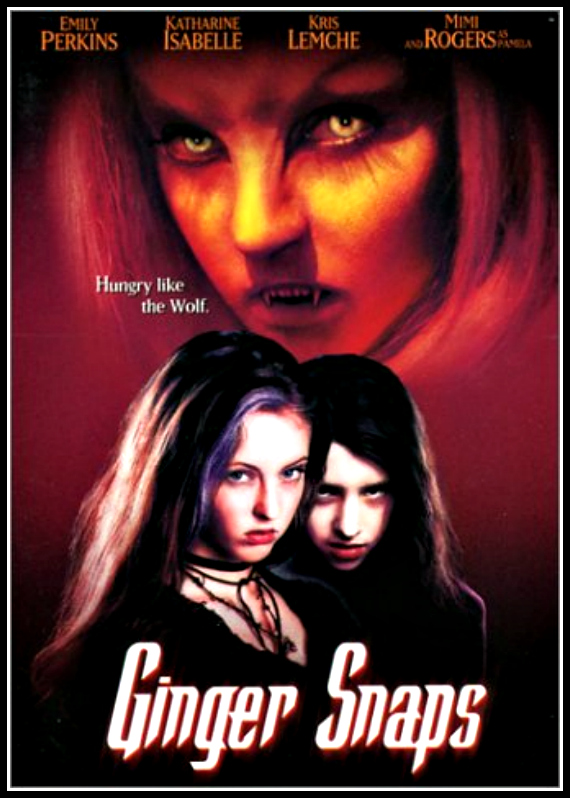
Werewolf horror films have not enjoyed the same prolific output as zombie or vampire cinema in recent decades. While the undead and bloodsuckers dominate both mainstream and indie horror, lycanthropes remain relatively underrepresented. In the last ten to fifteen years, the number of truly memorable werewolf films is small enough to count on one hand, suggesting that the subgenre is persistently niche despite the creature’s long-standing place in horror folklore. This scarcity makes standout entries even more notable, and among those, two titles remain touchstones for modern audiences: Neil Marshall’s gritty low-budget Dog Soldiers (2002) and the Canadian cult classic Ginger Snaps (2000), which preceded Marshall’s work by two years.
Ginger Snaps is as much a coming-of-age drama as it is a horror film, weaving werewolf mythology into a biting exploration of adolescence, sisterhood, and female identity. Set in a seemingly quiet Canadian suburb, the story follows sisters Ginger and Brigitte Fitzgerald, misfits bound by their shared cynicism, morbid sense of humor, and disdain for high school conformity. Isolated from their peers, they find comfort in their own dark, goth-influenced world, preferring late-night cemetery photography to pep rallies or social gatherings. Their bond is strong, but it faces a severe test one fateful night.
While walking home together, the sisters encounter something in the darkness—an unseen, feral creature that lunges, attacking Ginger with brutal force. The animal’s bite leaves a wound that begins to heal at an unnatural speed, and soon, strange transformations begin to manifest. At first, these changes seem physical—accelerated hair growth, heightened senses, and an insatiable appetite—but as time passes, her personality shifts as well. Ginger grows more assertive, sexually confident, and rebellious, traits that make her magnetic to others yet alienate her from her once inseparable sister.
Director John Fawcett and screenwriter Karen Walton craft the lycanthropy metaphor with unusual clarity: the werewolf curse mirrors puberty’s upheaval. Much like films inspired by the “body horror” sensibilities of David Cronenberg, Ginger Snaps draws unsettling power from portraying transformation as both horrifying and intoxicating. This duality captures adolescence’s contradictions—its liberating confidence and its destabilizing volatility—while reframing the traditional werewolf narrative to center on female experience. For Ginger, the physical metamorphosis coincides with new social dominance, a rejection of her former outsider identity, and an embrace of raw, animalistic freedom. For Brigitte, these same changes signify danger, loss, and the unraveling of the relationship she once relied upon.
The narrative excels in balancing its supernatural premise with human emotional stakes. While a less thoughtful script could have leaned entirely on gore and special effects, Ginger Snaps roots its horror in character dynamics. Walton’s writing, although sometimes heavy-handed in its metaphors, is remarkably strong for a film produced on a modest budget. Themes of loyalty, femininity, sexuality, and transformation run parallel to the literal werewolf plot, creating layers of meaning. This thematic richness ensures that the story resonates beyond its horror trappings, inviting audience discussion in a way that pure creature features often do not.
Central to this success are the performances. Katharine Isabelle embodies Ginger with feral charm, adeptly shifting from sardonic teenager to predatory seductress. Her portrayal never loses sight of the character’s humanity, even as the animal side takes over. Emily Perkins delivers an equally strong performance as Brigitte; her quiet, introverted resolve becomes the emotional anchor of the film, providing a moral counterbalance to Ginger’s volatility. Together, they create a convincing sisterly dynamic where love is tested by fear, jealousy, and survival.
Even the supporting cast contributes meaningfully, with Mimi Rogers standing out as Pamela Fitzgerald, the sisters’ well-intentioned but oblivious mother. Rogers resists the temptation to overplay the role for comic relief, giving Pamela a genuine warmth that contrasts the darkness overtaking her daughters’ lives. This restraint keeps the film grounded, preventing it from becoming camp and ensuring its humor arises naturally from character interactions rather than exaggerated antics.
Visually, Ginger Snaps sidesteps the glossy look of higher-budget Hollywood horror, opting instead for the muted realism of suburban streets and dimly lit interiors. This aesthetic choice enhances the film’s authenticity, making the supernatural intrusion feel more jarring. The creature effects, while limited by budget, are used sparingly and effectively; rather than relying on endless transformation sequences, the filmmakers allow viewers’ imaginations to fill in the most disturbing details. This restraint mirrors the approach of Dog Soldiers, demonstrating that practical effects and atmospheric tension often outshine CGI spectacle.
The film’s release trajectory reflects its cult status. Premiering at the 2000 Toronto International Film Festival, Ginger Snaps did not achieve immediate mainstream attention. Instead, it found its audience gradually, through word of mouth and home video rentals. Horror fans discovered it over time, drawn to its unconventional blend of teenage angst and supernatural dread. In the years since, it has earned a devoted following and spawned two sequels—Ginger Snaps 2: Unleashed (2004) and Ginger Snaps Back: The Beginning (2004)—that expanded the lore while retaining the core themes of the original.
Part of the film’s enduring appeal is that it approaches werewolf mythology with fresh eyes. Traditionally, cinematic werewolves are framed around male protagonists, their curse tied to aggression, uncontrollable rage, or forbidden lust in a way that reflects masculine fears and desires. By centering two teenage girls and equating lycanthropy with female sexuality and transformation, Ginger Snaps subverts these tropes, adding complexity to a genre often dominated by male perspectives. The werewolf becomes a vehicle for exploring how society reacts to—and attempts to control—the emergence of female autonomy.
Dark humor plays an important role as well. The Fitzgerald sisters’ sardonic wit is woven throughout, providing moments of levity even as events grow increasingly grim. These comedic beats arise out of their personalities, underscoring their outsider status and emotional coping mechanisms. The humor and horror work in tandem, preventing the film from collapsing into bleakness while maintaining its bite.
Thematically, Ginger Snaps joins a short list of werewolf films that transcend their genre trappings, akin to An American Werewolf in London (1981) or The Company of Wolves (1984). It invites analysis not just for its scares but for what those scares signify: the fear of change, the allure of liberation, and the strain placed on human bonds by transformation—be it supernatural or psychological. In this respect, it aligns with Cronenberg’s The Fly, where bodily change becomes the central metaphor for loss and evolution.
Two decades later, the film remains a touchstone for horror fans advocating for more diverse and conceptually rich werewolf stories. Its success highlights that the subgenre’s scarcity is not due to audience disinterest but perhaps to a lack of filmmakers willing to innovate beyond conventional “monster hunt” templates. As the horror landscape continues to evolve, Ginger Snaps offers a blueprint for blending creature mythology with compelling character drama, ensuring that lycanthropes can be as emotionally resonant as their undead or vampiric cousins.
For viewers wondering why werewolf cinema lags behind zombie apocalypses and vampire sagas, Ginger Snaps provides an answer: when the subgenre is approached with thematic depth, sharp performances, and genuine character stakes, it can be every bit as compelling—and perhaps even more relatable—than its supernatural peers. In weaving together dark humor, horror, and adolescence’s raw turbulence, the film stands as a rare entry that deserves both its cult following and its place in the broader horror canon.


 Through the Shattered Lens