Behind the Camera: The Unauthorized Story of ‘Diff’rent Strokes’ (2006, dir by Robert Iscove)


Norman Lear has television superstar Conrad Bain under contract and Fred Silverman wants to build a show around Bain and a talented black child actor named Gary Coleman.  Entitled Diff’rent Strokes and featuring Todd Bridges and Dana Plato as Coleman’s brother and stepsister, the show is a hit.  The three young actors briefly become superstars, much like the amazing Conrad Bain.  And then, when the show is finally canceled after ten years, it all goes downhill as Todd Bridges and Dana Plato run into trouble with drugs and the law and Gary Coleman, once one of the highest paid stars on television, discovers that he’s now flat broke.  All three of them learn how quickly the world can turn on you when you’re no longer considered to be a success.

Behind the Camera: The Unauthorized Story of ‘Diff’rent Strokes’ was another one NBC’s cheap movies about the behind-the-scenes drama of a popular sitcom.  (They also did Three’s Company and Mork & Mindy).  Like all of NBC’s Behind the Camera movies, it makes the mistake of thinking that everyone is as interested in the habits of network executives as the people who work for them are.  (This time, it’s Saul Rubinek who gets to play Fred Silverman.)  The actors who plays Bridges, Coleman, and Plato are convincing enough but the storytelling is shallow, featuring the same information that you would expect to find in an episode of the E! True Hollywood Story.  I was disappointed that we didn’t get any scenes of Alan Thicke recording the theme song.

Todd Bridges and the late Gary Coleman both appear as themselves, talking about their experiences with the show and the difficulties of navigating life after Diff’rent Strokes was canceled.  Bridges is down-to-Earth while Coleman rambles like someone who was still trying to figure out how his life had led up to this moment.  The ending, in which Bridges and Coleman stand at Dana Plato’s grave and Coleman delivers a nearly incoherent monologue, is the one time that the film really captures any feeling of emotional honesty.  It is obvious that both Bridges and Coleman are still haunted by what happened to Plato after the show ended.  Knowing that Coleman himself would die just four years after the airing of this movie makes the scene more poignant when viewed today.
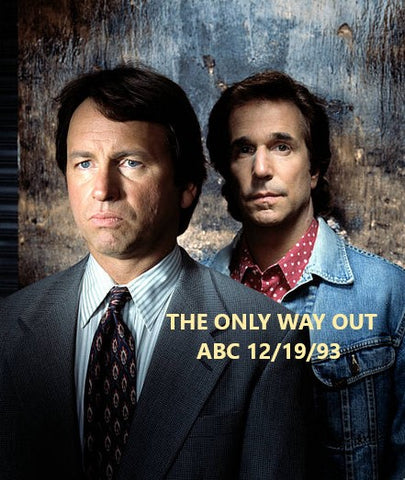
 

Retro Television Review: The Only Way Out (dir by Rod Hardy)


Welcome to Retro Television Reviews, a feature where we review some of our favorite and least favorite shows of the past!  On Sundays, I will be reviewing the made-for-television movies that used to be a primetime mainstay.  Today’s film is 1993’s The Only Way Out!  It  can be viewed on YouTube.

“I’ll kill you before I let you go,” Tony (Henry Winkler) says to his terrified girlfriend, Lynn (Stephanie Faracy).

Agck!  Those are frightening words and they are certainly not something that you would expect to hear from a character played by notorious Hollywood nice guy Henry Winkler.  And, indeed, it would probably shock most of the characters in the film if they knew how Tony talked to Lynn.  Tony is a grad student who has worked at any number of jobs.  While some people might say all of those jobs prove that Tony has a hard time sticking to anything, Tony has obviously learned how to convince people that he’s actually a just a determined man working his way through grad school and taking whatever job will help to pay the bills.  Tony is friendly and romantic and given to grand gestures.  He’s the type who shows up unexpectedly at Lynn’s place of employment with flowers.  He’s the type of guy that strangers applaud while those close to him look for any way to escape.

Lynn knows all about the other side of Tony.  Tony is controlling, obsessive, and abusive.  He hits her.  He barks orders at her kids.  When she tells him that she wants him out of her life, he refuses to go and blames her for all of their problems.  He’s someone who can quickly go from being everyone’s friend to being a monster.  He preys on insecurity and, whenever anyone stands up  to him, he plays the victim.  Tony is a classic abuser and the fact that he’s played by the likable Henry Winkler makes him all the more disturbing.  Like most abusers, Tony knows how to turn on the charm.  He knows the power of a smile and a few complimentary words.

Lynn is in the process of getting divorced from an architect named Jeremy (John Ritter).  It’s been a remarkably amicable divorce, with Jeremy and Lynn agreeing on joint custody and apparently not bearing any ill feelings towards one another.  The only problem is that Lynn cannot bring herself to actually sign the divorce papers.  Jeremy wants to marry Susannah (Julianne Phillips) and Susannah is not happy about the long wait.  She’s even less happy when Jeremy takes it upon himself to try to protect Lynn from Tony.  Soon, Tony is stalking Jeremy and Jeremy finds himself considering a particularly extreme solution to his problem.

It’s John Ritter vs Henry Winkler and the casting of two of Hollywood’s best-known nice guys as violent rivals works surprisingly well.  Winkler is memorably unhinged while Ritter plays a guy who is struggling to hold onto a life that, until Tony shows up, seemed to be perfect.  In the end, it’s not just Tony who catches us by surprise by just how far he’s willing to take things.  The film’s ending took me by genuine surprise.  Featuring excellent dramatic turns from two actors best known for their comedic skills, The Only Way Out is a superior melodrama.


Horror Movie Review: When A Stranger Calls Back (dir by Fred Walton)


The 1993 film, When A Stranger Calls Back, opens with the recreation of an urban legend.

A teenager babysitter named Julia Jenz (Jill Schoelen) arrives at a big suburban house for a routine baby-sitting gig.  The two children are already asleep in bed.  All Julia has to do is sent in the living room and do her homework until the parents return from their party.  Julia settles in.  She gets one mysterious phone call but hangs up.

Then, someone knocks on the door.

The man on the other side of the door explains that his car has broken down and he asks if he can come inside to call his auto club.  (This is one of those films that could have only worked in the age of landline phones.)  Julia doesn’t want to let the man into the house but the man is insistent that he needs Julia’s help.  Finally, Julia says that she’ll call the auto club for him but, when she goes to the phone, she finds that the line is dead.  Rather than tell the man the truth, Julia lies to him and says that she called the auto club.  The man thanks Julia and says that he’s returning to his car.

(What is an auto club?)

Eventually, the man returns, knocking on the door and asking if Julia really called the auto club.  Julia continues to lie, even as the man becomes increasingly belligerent.  What Julia doesn’t know but soon discovers is that the man is not outside talking to her but he’s actually inside of the house.  And he’s abducted the children!

The opening scene, which of course harkens back to the original When A Stranger Calls, is a genuinely well-done and suspenseful sequence.  Again, much like as if with the first film, the opening of When A Stranger Calls Back is so strong that the rest of the film can’t really keep up.

When A Stranger Calls Back is indeed a sequel to When A Stranger Calls, which means that, after Julia’s terrifying night of babysitting, the film jumps forward five years.  The children are never found and the man who knocked on the door is never identified.  Julia is now a college student but she’s still traumatized by the night and has a difficult time trusting anyone.  When she starts to suspect that someone has been in her apartment, she turns to Jill Johnson (Carol Kane), who is a counselor at the college and also the protagonist from When A Stranger Calls.  Jill helps Julie out, teaching her how to shoot a gun and also calling in the man who killed her stalker, John Clifford (Charles Durning).  Clifford figures out that Julia’s stalker is probably a ventriloquist.  Personally, I think the film made a huge mistake by making the stalker a ventriloquist instead of the ventriloquist’s dummy.

Despite strong performances from Carol Kane, Charles Durning, and Jill Schoelen, When A Stranger Calls Back suffers from the same problem as When A Stranger Calls.  After a scary and effective opening sequence, the rest of the film just feels like a letdown.  The killer in When A Stranger Calls Back is not quite as wimpy as the phlegmatic British guy from the first When A Stranger Calls but still, how intimidated can you be by a ventriloquist?  An even bigger problem is that When A Stranger Calls Back cheats at the end, suddenly revealing that a character who we had every reason to believe to be dead is actually alive.  It feels a bit as cop out on the part of the film, an attempt to slap an improbable happy ending on a film that would otherwise be pretty dark.

These films make me happy that I was never responsible enough to be a babysitter.

The TSL’s Horror Grindhouse: Christina’s House (dir by Gavin Wilding)


This 2000 straight-to-video film opens with a shocking and effectively violent scene in which an innocent girl scout is yanked into a dilapidated house and bludgeoned to death.  There’s even a slow-motion shot of crushed cookies falling to the floor.  It’s excessive, tasteless, and so ludicrous that it actually makes you think that Christina’s House could actually be, if nothing else, an enjoyably self-aware exploitation film.

Unfortunately, everything pretty much goes downhill after that scene.  The rest of the film deals with Christina (Allison Lange), a teenage girl with an annoying father named James (John Savage), an annoying brother named Bobby (Lorne Stewart), an annoying boyfriend named Eddy (Brendan Fehr), and an annoying admirer named Howie (Brad Rowe).  That may sound like a lot of annoying people for one person to deal with but Christina actually manages to be even more annoying than all of them.  Absolutely no one in this film comes across as being someone with whom you would want to be trapped in a murder house.

Anyway, Christina’s mom has been institutionalized in a Washington mental hospital so James, has rented out a nearby house.  (Naturally, it’s the same house where that girl scout was previously killed.)  James appears to be almost absurdly overprotective of and strict with Christina but it’s also possible that he might just be an asshole in general.  He’s certainly not happy that she’s dating Eddy, who is the local bad boy and who does stuff like hang out on the roof at night.  James would probably be happier if Christina was dating Howie, who has been hired to help fix up the house.  Howie’s so respectful and such a hard worker.  He’s a man who really knows how to handle a hammer.

Christina, however, has other things on her mind.  For one thing, young women are being murdered and the creepy sheriff (Jerry Wasserman) keeps coming by the house and asking strange questions.  Add to that, Christina sometimes thinks that she can hear someone or something in the attic.  Of course, every time that she tries to investigate, her father comes out of his bedroom and yells at her.

(It could just be that James doesn’t want his daughter spending her nights wandering around in her underwear and searching for a vicious killer, in which case James probably has a point.  Still, he’s kind of a jerk about it.)

Who is the murderer?  Is it Eddie, Bobby, or Howie?  Or could it maybe be James?  What if the sheriff’s somehow involved?  Well, don’t worry!  The identity of the murderer is revealed about an hour into this 90-minute film and it’s exactly who you think it’s going to be.

If not for the extremely odd performance of John Savage, this film would be totally forgettable.  Savage was the film’s “prestige” actor, a performer who previously appeared in films like The Deer Hunter, the third Godfather, Do The Right Thing, and The Thin Red Line before finding himself in Christina’s House.  John Savage attacks the role of James with all of the ferocity of an actor who has gone from co-starring with Robert De Niro and Christopher Walken to playing second fiddle to Allison Lange and Brendan Fehr.  Savage yells every line and glares at his co-stars with the fury of a man on a mission of vengeance.  As a result, both the actor and the character that he’s playing come across as if they’re always just one annoyance away from putting his fist through a wall.  James may be written as an overprotective father but Savage plays him as being a borderline sociopath.  It’s such a totally inappropriate and misjudged performance that it becomes oddly fascinating to watch.  It takes a great actor to give as entertainingly bad a performance as the one given by John Savage in Christina’s House.

With the exception of Savage’s over-the-top theatrics and Jerry Wasserman’s memorably creepy turn, the rest of the cast is largely forgettable.   The problem is that, as written, most of the characters are fairly unlikable and you really don’t care whether they die or not.  When the killer eventually trapped Christina and Bobby in their new home, I found myself more worried about the house than either of them.

Christina’s House is available on YouTube and sometimes, it shows up on late night television.  (I saw it on This TV.)  It’s pretty dumb but if you’re  fan of good actors bellowing in rage, you might want to watch it.