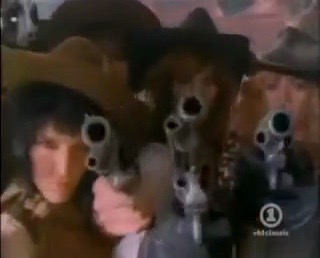
Music Video of the Day: The Wild and the Young by Quiet Riot (1986, directed by Jeff Stein)


The music video for Quiet Riot’s The Wild and The Young takes place in a future that’s controlled by the military and the Parents Resource Music Center (PRMC), the Tipper Gore-led organization that campaigned for albums and CDs to come with warning labels.  There were actually Senate hearings on obscene lyrics in 1985, with everyone from Dee Snider to Frank Zappa coming together to make the elected officials look stupid.

Director Jeff Stein has directed several TV shows, along with doing videos for The Who, Weezer, Tom Petty and the Heartbreakers, George Clinton, Cinderella, Warrant, and Wilson Phillips.

Music Video of the Day: The Wild and the Young by Quiet Riot (1986, directed by Jeff Stein)


The music video for Quiet Riot’s The Wild and The Young takes place in a future that’s controlled by the military and the Parents Resource Music Center (PRMC), the Tipper Gore-led organization that campaigned for albums and CDs to come with warning labels.  Because the PRMC was largely made up with the wives of U.S. Senators, there was actually a Senate hearing on obscene lyrics in 1985, which led to a bunch of Senators being made to look foolish by everyone from Dee Snider to Frank Zappa.

Director Jeff Stein has directed several TV shows, along with doing videos for The Who, Weezer, Tom Petty and the Heartbreakers, George Clinton, Cinderella, Warrant, and Wilson Phillips.

Music Video of the Day: We Will Rock You by Warrant (1992, directed by Jeff Stein)


Does anyone remember Gladiator?

No, I’m not talking about the Gladiator with Russell Crowe.  I’m talking about a film that came out in 1992 that starred James Marshall and Cuba Gooding, Jr. as two teenagers who get caught up in the lucrative world of street fighting.  Robert Loggia plays a trainer.

As was typical of films of the era, the soundtrack featured cover tunes by glam metal bands who were suddenly affordable due to the rise of Nirvana and grunge.  This video is for Warant’s cover of Queen’s We Will Rock You.  The video itself is split between footage of Warrant performing and footage taken from the movie.  So, if you’ve forgotten this version of Gladiator, consider this to be a refresher.

Enjoy!

Music Video of the Day: Don’t Come Around Here No More by Tom Petty And The Heartbreakers (1985, dir. Jeff Stein)


It’s about time I got to a music video that lead to the PMRC. It may not look like one that would, but it did.

At the beginning of the book, I Want My MTV, there’s a whole chapter about the issue. The authors start off by talking about Tipper and her daughter’s experience watching Hot For Teacher. According to the book, her daughter said the following:

Mom, why is the teacher taking off her clothes?

I would love to know if that was Kristin Gore considering she went on to have a career in comedy. She and Tipper even played on a Diva Zappa comedy single. Frank Zappa having testified at the congressional hearings over this stuff. Although it sounds like it was Sarah LaFon Gore Maiani judging by her age when she saw the two videos.

On another occasion, Gore and her six year old saw Tom Petty’s “Don’t Come Around Here No More” video–some other parent, having gone through the “Hot for Teacher” incident, might have learned a lesson and banished MTV from the home–and the girl was “disturbed,” Gore said, “because the last scene showed [an actress] turning into a cake and being sliced up.

I have feeling the authors of the book think this is ridiculous.

In September 1985, Senator John Danforth, also married to a PMRC member, convened a congressional hearing to discuss the excesses of rock music in the age of cable TV. And that is how the Commerce Committee of the 99th Congress of the United States, like millions of other Americans, watched “Hot for Teacher” and Twisted Sister’s “We’re Not Going to Take It” when they should have been working.

You got me as to what bothered them with We’re Not Gonna Take It, considering it’s a song about civil rights and standing up for what you believe in. At least with Hot For Teacher you could make the reasonable argument that while harmless entertainment, it should be aired when a six-year-old isn’t likely to stumble across it. I’m really glad we live in a time when music videos aren’t taken down from YouTube for explicit content. Oh, right, that happens.

Anyhow, lets talk about the video, including some bits from Alice herself, Wish Foley (Louise Foley).

Here’s the genesis of the video according to Tom Petty:

Dave Stewart and I wrote and produced “Don’t Come Around Here No More.” We were talking about the video while we were in the studio, and he said, “I’ve always wanted to be the guy sitting on a mushroom with long nails and a hookah. You know, like in Alice in Wonderland.” And I said, “That’s it. We’ll do Alice.”

Thus, Dave Stewart got his wish:

Tom Petty: We didn’t use any special effects. Everything that’s big was big, and everything that’s small was small. It was a two-day shoot, and each day was fourteen hours, way into the night. Even for musicians, those were challenging hours. But we knew while we were doing it how shit-hot it was.

I don’t want to copy the entire section on this video, so here are the highlights:

Wish Foley: When I went to the audition, there were fifteen or twenty girls coming in at the same time. They were models, in skimpy leather outfits with short skirts. Boobs everywhere. It was kind of gross; they would stand in front of a mirror and do their “come hither” look. And here I am, dressed up like Alice in Wonderland.

She was 21. She had done a bunch of commercials along with some TV work. She says she had been the original Joanie (Happy Days), but that after they shot the pilot, she was told that she looked too much like Cindy Brady. It’s funny that after this video, Foley went on to work on Disney productions such as Beauty and the Beast (1991), The Hunchback of Notre Dame (1996), and Hercules (1997). She was also in the movie, Harper Valley P.T.A. (1978) before going on to do this video.

Harper Valley P.T.A. (1978, dir. Richard C. Bennett & Ralph Senensky)

Jeff Stein: We built a giant teacup out of an aboveground pool.

Jeff Stein: The doughnut was a giant inner tube. I asked for the water in the teacup to be warm, and it wasn’t. She was in cold water on an air-conditioned stage for quite some time, and never said anything. When she came out, she had hypothermia.

Wish Foley: If you look closely, you can see me shivering. They bundled me up and shoved me into an emergency-wash shower.

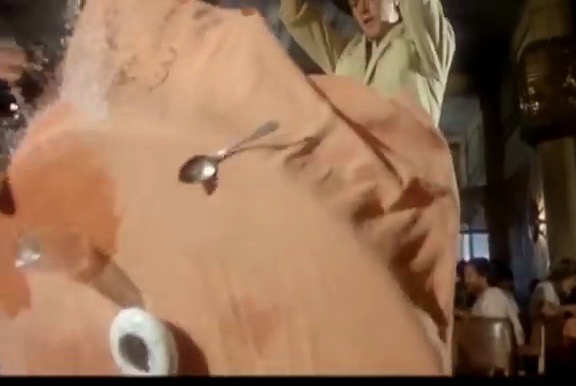
Tom Petty: For the last shot, where we cut a piece of Wish’s body and eat, we had a giant cake made in the shape of her body, and Wish slipped her head from underneath. That must have been uncomfortable as hell. There was only one cake, so we had one take to get it right.

Wish Foley: When people said that the cutting of the cake promoted cruelty to women, I had to laugh that people took it so damn seriously.

Jeff Stein: I was cited by a parents-teachers organization for promoting cannibalism.

It amazes me that this video was swept up in that whole thing. It’s a trippy music video based on a book that has been adapted into everything from an X-rated musical to a Goodtimes animated cash-in movie to an official Disney version.

I think my favorite part about this whole PMRC thing comes from Dee Snider. He both testified, and played himself in the VH1 movie about it called Warning: Parental Advisory (2002). In an interview, he said that he didn’t have a problem with there being a label on albums to tell parents about the content. He thought that was reasonable. He wasn’t happy about the way they were going about it. A bunch of wives of congressmen getting their husbands to hold sessions on the evils of music, which forced people like Snider, Zappa, and John Denver to have to come and testify in front of Congress about music and censorship.

John Diaz was the producer.

Tony Mitchell, Kathy Dougherty, and Peter Cohen did “special effects” for the video, according to mvdbase–despite what Tom Petty said about them not using special effects. They were probably the people responsible for creating the things, and that one special effects shot at the end.

Enjoy!

30 Days Of Surrealism:

  1. Street Of Dreams by Rainbow (1983, dir. Storm Thorgerson)
  2. Rock ‘n’ Roll Children by Dio (1985, dir. Daniel Kleinman)
  3. The Thin Wall by Ultravox (1981, dir. Russell Mulcahy)
  4. Take Me Away by Blue Öyster Cult (1983, dir. Richard Casey)
  5. Here She Comes by Bonnie Tyler (1984, dir. ???)
  6. Do It Again by Wall Of Voodoo (1987, dir. ???)
  7. The Look Of Love by ABC (1982, dir. Brian Grant)
  8. Eyes Without A Face by Billy Idol (1984, dir. David Mallet)
  9. Somebody New by Joywave (2015, dir. Keith Schofield)
  10. Twilight Zone by Golden Earring (1982, dir. Dick Maas)
  11. Schism by Tool (2001, dir. Adam Jones)
  12. Freaks by Live (1997, dir. Paul Cunningham)
  13. Loverboy by Billy Ocean (1984, dir. Maurice Phillips)
  14. Talking In Your Sleep by The Romantics (1983, dir. ???)
  15. Talking In Your Sleep by Bucks Fizz (1984, dir. Dieter Trattmann)
  16. Sour Girl by Stone Temple Pilots (2000, dir. David Slade)
  17. The Ink In The Well by David Sylvian (1984, dir. Anton Corbijn)
  18. Red Guitar by David Sylvian (1984, dir. Anton Corbijn)

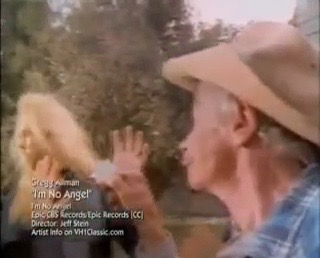
Music Video of the Day: I’m No Angel by The Gregg Allman Band (1987, dir. Jeff Stein)


Happy Memorial Day. Or at least as happy as it can be with the recent passing of Gregg Allman. I would have done a video for him yesterday, but there were extenuating circumstances that made it impossible–not the least of which is that their videos aren’t exactly well-documented or officially posted on YouTube.

Let’s look at this from the perspective of director Jeff Stein. You made a name for yourself with The Who documentary The Kids Are Alright (1979), which ensured that they wouldn’t be forgotten anytime soon by preserving their history. You directed one of the greatest live videos–Rebel Yell–for Billy Idol who was a 70s artist that you helped to make explode as an 80s MTV superstar. You took the not so photogenic The Cars, and turned in You Might Think, which was very ambitious and successful. You made Out Of Touch for Hall & Oates that Daryl Hall in I Want My MTV said, “was maybe our most significant video.” You survived the production of Torture by The Jacksons–even if that meant having to bring in a wax dummy of Michael and telling Paula Abdul she had to go when Jackie said she wanted to choreograph the video. You handled another 70s artist in Tom Petty And The Heartbreakers by making the wonderfully surreal Don’t Come Around Here No More. You also brought people the videos for My New Boyfriend by Carly Simon and These Dreams by Heart–both 70s artists.

Now you are approached to do a video for The Gregg Allman Band, probably based on your record of being able to bring 70s artists into the MTV-era. I know that the first thing that would have crossed my mind is ZZ Top. They were also a band that had been around since the early 70s, and Gregg would have been about 40 by the time you had to make a video for him. Too bad this video didn’t do for The Gregg Allman Band what the ZZ Top videos did. Then again, that was a minor miracle which even received its own chapter in I Want My MTV, so it’s unrealistic to expect lightning to strike twice. It’s a simple little video that could have just as easily been done as a stage performance. I’m guessing he wasn’t given much of a budget to make this video. I bring up Stein’s record and ZZ Top because ZZ Top was who I thought of when the ladies showed up, and I would imagine that Stein was approached because of his success with 70s musicians. Let’s walk through this video.

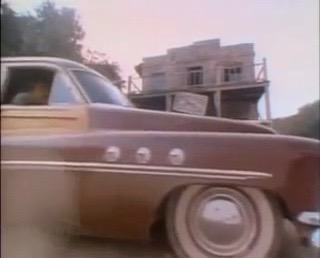
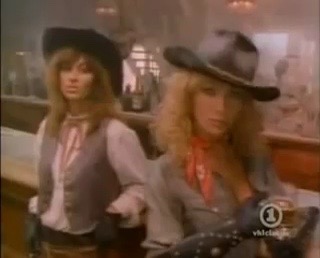
The band pulls up at a rundown saloon.

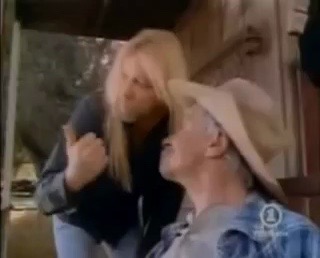
We see Gregg kick the tire and tell the attendant to fix the car.

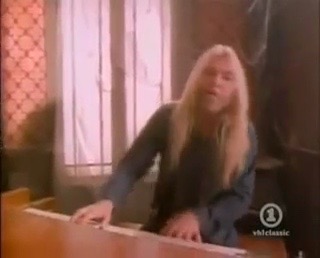
The band goes inside to find that under white sheets are instruments and other equipment that is already set up for them. They waste no time, and start playing.

We now find out one thing The Gregg Allman Band has in common with ZZ Top. They’re both a little magic. Gregg may not appear to deliver keys to a hot car, but his music does have the power push certain parts of a location into the past.

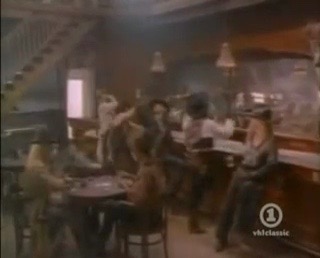
Apparently, this bar used to be frequented by gunslinging women.

Unruly gunslinging women at that at. Bonk! She’s out.

Now we get something I never would have imagined I’d see in a video for The Gregg Allman Band.

Hungry Like The Wolf by Duran Duran (1982)

A Duran Duran reference. Hungry Like The Wolf. I’m No Angel. I see the similarities.

The ladies soon take notice of Gregg, and appear to start to stick him up with their guns.

That’s when we find out that the ladies are indeed in the past as the video acquires a flashback tone. Gregg is taken outside.

They string him up. Gregg gets in a quick kiss before being hanged. Just before it happens, we see that he was the deputy sheriff in the past–or possibly in another life.

The trap door opens and he’s hanged. Then just after we see his feet dangling, it cuts to Gregg putting down the cover over the keys. It sounds like the lid of a coffin closing.

It’s a nice bit of matching on action that brings the music, the story in the song, and the story in the video to a close. Gregg and the band leave the bar to see if their car is fixed. Turns out the badge is still around and was stuck in their tire–somehow.

The attendant offers it to Gregg. I love his reaction: No way! I saw the previous scene. I’ll just be on my way now.

It lends credence to the belief that the song is partially autobiographical. Perhaps his rejection of the badge is Gregg making a break with his past in order to move on with his life.

I can’t imagine this particular video did a whole lot for Gregg Allman. However, I could be wrong. This came out a couple years after MTV founded VH1 in order to drive Ted Turner’s competing network, CMC, out of business, which it promptly did. VH1 did play stuff that wouldn’t have been shown on MTV. Allman did go on to do some other videos, including another one with Jeff Stein and even one with Michael Bay for the song I’ll Be Holding On that was on the Black Rain (1989) soundtrack.

The song was a number-one hit. How much of an affect the video had on its success, I don’t know. It was more of a universally playable song because it fit the AOR (Album-Oriented Rock) format. I’m sure that contributed to it doing so well. From what I’ve read, it seems to be credited with essentially bringing Gregg’s career back to life.

I find it humorous that Wikipedia says the song featured “Allman’s gruff vocals in a Bruce Springsteen sound-alike way.” I say that because director Jeff Stein is the one who was originally meant to direct Dancing In The Dark when Springsteen walked off the set because he didn’t like the direction the video was going, leading to Brian De Palma making the version we are familiar with today.

The video was produced by Mike Riffle. He produced around 10 music videos.

Rest in peace, Gregg Allman.

Music Video of the Day: You Might Think by The Cars (1984, dir. Jeff Stein, Charlie Levi, & Alex Weil)


Well, you might think this came out after A Nightmare On Elm Street (1984), but you’d be wrong. That movie came out in November and appears to have had an early limited release in October of 1984 while this music video premiered in March of that year. If you didn’t know that, then you probably would lump this in with all the other films that were inspired by that movie. It even comes complete with a bathtub sequence. When I was younger this was just that other early computer graphics music video that goes along with Money For Nothing by Dire Straits, but never seemed to get as much play on MTV. That’s probably because The Cars didn’t explicitly mention MTV in the song. The music video actually has less in common with horror movies of its’ era, and relies on classic monster movies such as The Fly (1958), King Kong (1933), and Robot Monster (1953).

This was pretty ambitious for the time, coming in with a budget of $80,000, which according to Wikipedia was about three times as much as was spent on music videos of the time. It also did quite well that year at the VMAs, getting nominated for six awards. It won the first VMA for Video of the Year. It also won awards from Billboard and the Videotape Production Association’s Monitor Awards.

What is amazing to me is how many credits I found attached to this music video.

The obvious one is the girl. That’s Susan Gallagher. I love how her IMDb bio mentions all kinds of things like where she trained to act, that she was cast in commercials, was on the TV Show Safe Harbor, worked for The Home Shopping Network, etc. No mention that she just happened to be the star of one of the most well-known, revolutionary, and heralded music videos of the 1980s. You might think that would be something you would want in your biography seeing as it instantly disambiguates her from just any old actor for a large number of people. Even her “other works” section only mentions that she was a National Guest Spokesperson for Dirt Devil Products. She seems to have largely dropped out of acting till the 2010s. She appeared in I Killed My BFF (2015) on Lifetime and has even gotten into directing recently.

Robin Sloane was the creative director on the music video. She worked/works for Elektra Records. I can only find one more credit for her in mvdbase, but based on IMDb, I am betting she worked as a creative director and producer on more than just Violet for Hole and One for Metallica.

Sloane came onboard after director Jeff Stein showed her some visual effects work that was being done by the company Charlex. He’s worked on around 40 music videos including some other well-known ones such as Don’t Come Around Here No More for Tom Petty & The Heartbreakers and the hilarious Cherry Pie for Warrant.

The music video was also directed by two of the founders of Charlex: Alex Weil and Charlie Levi.

Alex Weil seems to have only worked on one music video, but apparently was a pioneer in the video medium in general. I was able to find two of his short films on YouTube.

I was able to find a few more credits for Charlie Levi. He wrote and directed the movie Childless (2008). I even found an interview with him about the movie.

If that interview is to be believed, then he worked on more music videos than just this one.

There appears to be some disagreement between sources, but I think we can just assume that Jeff Stein, Alex Weil, and Charlie Levi all produced the music video.

Danny Ducovny shot the music video. I can find only a few credits for him, but one of them happens to working as an “additional photographer” on the film Tough Guys Don’t Dance (1987). I’m going to just assume that he shot the infamous scene from that movie. It makes me happy any time I can post it.

Yes, he also happens to be David Duchovny’s older brother despite the slightly different spellings of their last names.

Danny Rosenberg was one of the editors. I couldn’t find many other film credits, but he appears to have worked on two movies in the Wee Sing series. However, I do know what he does today thanks to his LinkedIn profile. He is now “Lord Protector/Chief Engineer” at Meta/DMA. According to their own website, they “write the code that makes the whole world sing.” This guy just can’t get away from working in things that sing one way or another.

The other editor was Bill Weber. There are a lot of Bill Weber’s on IMDb, but I am pretty sure that number III and V are him seeing as they both feature a bunch of LGBTIQ films along with working with Grateful Dead back in the 1980s.

Kevin Jones worked as the Lighting Director. Seeing as IMDb seems to have more Kevin Jones’ than they know what to do with, I have no idea what other credits he may have after this music video.

Bob Ryzner was the Art Director. I can’t find anything on him.

The only other credit I could find is for the company Charlex themselves who appear to have worked on the music video for Jealous by Beyoncé. I’m willing to bet there are many more, much like I completely believe that Robin Sloane was involved in more music videos as well.

That’s it! Enjoy this trip back to the early days of both music videos and computer animation going mainstream.

Music Video of the Day: Dancing In The Dark by Bruce Springsteen (1984, dir. Brian De Palma)


I love and hate when I end up with a music video like this one. I love it because there isn’t a whole lot to talk about, but that’s also why I don’t like it. At least Cyndi Lauper’s She Bop let me off the hook with a simple joke. That music video really does speak for itself.

Brian De Palma shot this video over two nights in Saint Paul, Minnesota on the 28th and 29th of June 1984. The first was purely shot for the music video. The other was shot on the opening night of the Born in the U.S.A. Tour. Springsteen and the E Street Band performed it twice during the show to make sure De Palma got enough footage. De Palma shot it because he was a big fan of Springsteen. As far as I know, there isn’t anything more to that.

The other major thing is that this is the music video with Courteney Cox getting pulled up onstage to dance with Springsteen. I love how she just launches up onstage with him. It looks like they had some steps or something so that Springsteen wouldn’t be yanking her up there.

As for the music video as a whole, it’s clean, simple, and De Palma obviously knew how to capture the energy of the group. You’d think that Springsteen hadn’t quite picked up acting because he seems starstruck and having the time of his life, but I don’t think so. I have never seen him live, but you can roll back to 1981 and watch the music video for The River to see that simply isn’t true. You can even go back further to 1977’s Thunder Road and see again that it isn’t true. I think the reason Springsteen looks like that is that it was probably the first time he was doing this kind of stage performance music video. I can imagine De Palma telling Springsteen to just let all the energy out regardless of what time they were shooting, and that he would make it look good.

Of course I type of all of that, and then stumble upon something really interesting. This was not the original way the music video was going to be done. It was originally going to be directed by Jeff Stein and shot by veteran cinematographer Daniel Pearl. There was a little falling out between Pearl and Springsteen during shooting that ended up coming around full circle on the shooting of Springsteen’s Human Touch. I would link to the site that explains the whole thing, but it looks like it might have been destroyed since it was posted in 2011, and is in limbo thanks to the Google Cache. Assuming that’s the case, I have repeated it below with a link to their site that may or may not work.

Here is an example of how the music video could have looked. Hopefully the two videos are still up when you read this post.

https://www.youtube.com/watch?v=EW_pPSi53dI

From the site called Golden Age of Music Video

At the end of July, a video surfaced online of the music video of Bruce Springsteen’s “Dancing In The Dark”, but not the iconic version directed by Brian DePalma where Courtney Cox makes her famous appearance at the end dancing with the Boss. This one is a somewhat blurry, copy-of-a-copy duplicated-tape version with Springsteen and Clarence Clemons on a soundstage, literally dancing in the dark.

So what IS this footage, where was it shot, and why has it never been seen before? Legend told of a first version of the song shot before the DePalma version, but no consensus has ever been reached on what happened.

Now, THE GOLDEN AGE OF MUSIC VIDEO has uncovered the true story of this first attempt to shoot the “Dancing in the Dark” video, straight from the two GAMV luminaries who helmed the original shoot: director of photography Daniel Pearl and video director Jeff Stein.

An award-winning cinematographer whose career spans nearly forty years, Daniel Pearl should be heralded as the MVP of the Golden Age of Music Video. Having acted as director of photography on a multitude of legendary music videos – everything from Michael Jackson’s “Billie Jean” to the Police’s “Every Breath You Take” to Guns N’ Roses “November Rain” – Pearl has always given music videos and commercials their cinematic due by treating each shot with feature film-level attention. Serving as cinematographer on the original “Texas Chainsaw Massacre”, Pearl has made all his music video projects, big budget or small, sparkle and shine in ways only the most gifted eye could.

“What happened was this,” Pearl explained about the first “Dancing” shoot. “I’d never worked with Jeff before, but Jeff is a New Yorker, and a producer named John Diaz put us together. Jeff’s idea was that ‘Dancing in the Dark’ was Bruce Springsteen in a completely dark space — black floor, black walls, black ceiling, stage as well. We’re at Kaufman Astoria Studios. Bruce Springsteen in a room in the dark. And I went, ‘Well, that isn’t really much of a concept,’ but he goes, “Oh no, it will be cool. Don’t worry about it, it’d be cool.’”

“Now for Bruce, this was the first single he’s releasing after Nebraska, which was not that big of a hit for him, so, Bruce is very nervous,” Pearl continued. “We’re all on set now and Bruce is really pumped. I mean, he’s been working out, and he has a little bit of stubble. Now, I would take a look at people when they first show up. I’ll say hello, and I take a quick look at their face to see, if I know them, if anything is changed – I’m seeing how to light them. I’m take a look at their face and where they part their hair — I mean, those all things that matter to me when I do the lighting. So anyhow, he’s got serious sideburns. Big sideburns, he’s pumped, rippling muscles in his arms, good muscle definition, he’s wearing a wife beater sleeveless shirt, sharkskin pants, and black pointy-toe shoes and basically, that’s the New Jersey, sort-of early ‘60s thing going on, right? But very manly, right? So I lit him very hard – hard edge lights for his rippling muscles, and just really chiseled him with light. He comes out and he stands there and he goes, ‘I don’t know. I think you should get like a big silk [lighting filter] out here and just put a big light through the silk, and silk over the camera, the big silk, you put a big light through it and I go, ‘That’s how we light Stevie Nicks.’ I said, ‘You’re not a p*ssy, you’re quite the opposite. You’re super manly here. I can’t light you like I would light a woman.’ And he said, ‘But that’s what I want.’ And Jeff Stein is there, and said, ‘Just try it once doing it Daniel’s way, and if you don’t like it, we’ll change it.’”

“So we shoot [a few takes], right? Then Bruce goes to the green room, and never returns. Bruce leaves. He just disappears. Doesn’t say a word to anybody, and he’s just out the door, gone. I’m like, ‘Oh, f*ck.’ I’m thinking to myself ‘Oh, my God. Am I, like, responsible for this falling apart?’ John Diaz says to me, “Don’t worry about it. It’s not on you, blah blah blah.’” But Pearl blamed himself and his comments for Springsteen’s quick departure.

Director Jeff Stein, a friend of Springsteen’s to this day, said he was brought in to direct this video, but immediately had misgivings about shooting Bruce in anything other than a concert setting. Then, when the concept of Springsteen and Clarence Clemons in an all-black background setting was established, Stein wanted to try shooting the video all in one take. Reluctant to further discuss the details of the shoot on the record with me, but acknowledging that Pearl was to blame for the walkout, Stein would only agree to be quoted as saying, “I love Bruce, and I had nothing to do with it [the video]. I usually take the blame, but not for that (laugh).”

The whole experience left Pearl somewhat scarred, resulting in him deflecting any opportunity to work with the Boss again. Pearl then started shooting various projects for commercial and music video director Meiert Avis, and soon, a Springsteen video was the next gig scheduled. Pearl said no. Three or four Springsteen videos came to Avis, and Pearl could not bring himself to say yes to any of them, still feeling guilt from the “Dancing in the Dark” experience.

“So Meiert goes to me, ‘So what am I going to do? I got a Bruce Springsteen job,’” Pearl recalls. “So I said, ‘I’m not going to shoot Springsteen. No, no, no. I told you, I don’t shoot Springsteen. No.’”

Little did Pearl realize that he was destined to cross paths with Springsteen again.

“So then a few years pass, and Meiert hired me to shoot a band called the Rituals and we’re shooting all the view on materials, it’s always like rituals like ancient African rituals, and we’re shooting in this cave and we got this moving camera. There’s lightning-strikes machine, and we’re shooting weddings and all first strange ritualistic behavior. And then when shoot material with this girl in like a ‘30s or ‘40s apartment. Well, we’re shooting the girl and there’s lightning flashing, and they told me we’re going to New Orleans, and there’s going to a street car and a spark when it goes over the joint. And so I’m playing with that in this shoot as well, and there are interior lights coming through the windows.”

“In between takes, I look, and Springsteen comes walking into the studio. So I go, ‘Oh, f*ck. What the f*ck is he doing here?’ I’m thinkin he’s probably coming out to a meeting with Meiert to talk about either what’s he going to be doing in the future, or look at some video Meiert made for him. So I just keep my eye here on the camera, thinking I’ll just stay with the camera and he’ll leave eventually. I won’t to have to deal with this guy. I’m not going to talk to him. So we’re shooting another take and as we finished the take, I get tapped on the shoulder by Springsteen, and he goes, ‘Daniel, the circle becomes complete.’ He says, ‘You were right on how you wanted to light me. I was wrong. This is my song. We’re shooting here now, and this is the only way we could get you to do it. I want to apologize because you were right.’ And that turned out to be the video for ‘Human Touch’, which I think, is a great video in a lot of ways.”

Music Video of the Day: Rebel Yell by Billy Idol (1984, dir. Jeff Stein)


I have to admit that there was some strong competition for the music video to feature today. There was the CGI fun of Money For Nothing by Dire Straits, the Michael Bay directed song about masturbation, Ice Ice Baby, and Shania Twain’s remake of a Robert Palmer video staring at me in the same list. However, I decided to just go with something that is pure fun.

I remember when MTV oddly decided to celebrate their 20th anniversary in 2001 rather than their 25th 5 years later. They invited back a bunch of musicians who had been big on the network. It seemed that all of them had lost it. I remember TLC sounding awful. Then Billy Idol came onstage. He was amazing, and so was his guitarist Steve Stevens. They played the living hell out of this song. They didn’t need to, but they did anyways. I remember them sounding as good as in this music video except they did it live.

I have nothing to say except that director Jeff Stein certainly captured Billy and his crew perfectly. A well-filmed concert video is one done by someone who knows the musician’s style. Jeff Stein obviously did. The music video was produced by Kathy Doherty who doesn’t appear to have done anything else. Jeff Stein on the other hand is another director we’ll see again.

ENJOY!!!