October True Crime: Karla (dir by Joel Bender)


When it comes to true crime cases, few are as disturbing as the story of Paul Bernardo and Karla Homolka.

Paul and Karla were a young, married couple who lived in Ontario.  They were both attractive.  They were both popular.  They were both superficially charming, in the style of someone who you might have taken a class with but the only thing you can really remember about them is their smile.  And they were both killers.  Paul Bernardo, a wannabe rapper who had previously made his money by smuggling cigarettes and who was also a serial rapist, murdered at the least three teenage girls, including Karla’s sister, Tammy.  When Paul was arrested, Karla told prosecutors that she had helped Paul with his murders but only because he threatened and abused her.  Prosecutors, perhaps moved by a picture that Karla’s friend took of her bruised face after one of Paul’s beatings, made a deal with her for her testimony.  In return for testifying against Paul Bernardo, Karla was convicted only of manslaughter and given a 12-year prison sentence.  (She was 23 at the time and would only be 35 when released from prison, assuming that she served the full sentence.)  However, during the trial, video tapes of the murders were uncovered and showed that Karla had been a far more active participant in the murders than she had originally admitted.  That included the murder of her sister, Tammy.

There were calls to rescind Karla’s plea bargain and to try her for murder but since her plea bargain had only required her to provide enough evidence to convict Paul, it was ruled that she had upheld her end of the bargain.  While Paul Bernardo is currently serving his life sentence, Karla Homolka is now free and living somewhere in Canada.

Needless to say, the case drew international attention, both due to the circumstances of Karla’s plea bargain and also to Paul and Karla’s image of being the “Ken and Barbie Of Serial Killers.”  It’s a case that continue to haunt Canada, an example of how the accused was ultimately treated with more respect than the victims.  For her part, Karla continues to claim that it was all Paul and that she was forced into helping.  Paul claims that he and Karla were equal partners and that the actual murders were all committed by Karla.  Personally, I think they’re both lying.

2006’s Karla stars Laura Prepon as Karla Homolka.  The film opens with her already in prison and being interviewed by a psychiatrist (Patrick Bauchau) who has been assigned to determine if there’s a risk of her reoffending.  As Karla tells her story, we see flashbacks of Karla’s life with Paul (Misha Collins).  Prepon and Collins are both chillingly believable as the soulless Paul and Karla.  Laura Prepon plays Karla as being a narcissistic sociopath who is incapable of understand that she’s not the victim in this story.  I imagine that Prepon’s performance probably captures the essence of the real Karla, even if Prepon doesn’t really look like her.

That said, the film itself is largely a surface level exploration of the case.  The film’s script attempts to maintain some ambiguity as to whether or not Karla Homolka was a voluntarily participant in the murders or if she actually was just too scared of Bernardo to stop him.  Prepon plays her as being a sociopath but the script still tries to play both sides of the debate and, as a result, the film falls flat.  The film may be called Karla but it doesn’t really get into her head and, as a result, it has all the depth of an Investigative Discovery special.  In the end, the film feels like it’s trying to exploit the notoriety around a famous case without taking a firm position on the case’s biggest controversy.  When it comes to the crimes of Karla Homolka, that’s not an option.
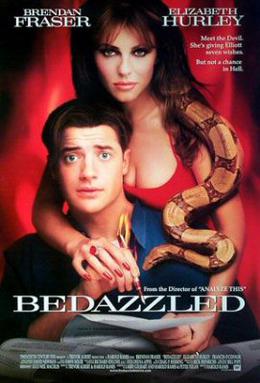
Bedazzled (2000, directed by Harold Ramis)


Elliot (Brendan Fraser) has a go-nowhere job at a computer company and an unrequited crush on Alison (Frances O’Connor), a co-worker who doesn’t even know who he is.  One night, at a bar afterwork, he’s approached by the Devil (Elizabeth Hurley), who offers Elliot seven wishes in return for his soul.  Elliot agrees but then he discovers that the Devil is tricky and his wishes always have an complication.  Elliot wants to be powerful so the Devil turns him into a Columbian drug lord.  Elliot wants to be sensitive and the Devil turns him into a whiny crybaby.  Elliot wants to be president and suddenly, he’s Abraham Lincoln being told to get ready for the theater.  Whenever things start to get too dangerous, the Devil brings Elliot back to reality so that she can continue to taunt him.

An Americanized remake of a British comedy that starred Dudley Moore and Peter Cook, Bedazzled was unfairly savaged by the critics when it was first released.  While it can’t match the wit and heart of the original and not all of the wishes are equally effective, the remake has its charms.  When Bedazzled first came out, most people talked about Elizabeth Hurley’s sexy performance of the Devil.  When she appears as a school teacher, it’s not a surprise that every student brings her an apple at the start of the day.  Hurley is so sexy that it’s easy to miss that she’s also giving a really good performance.  Hurley’s Devil is a prankster.  She likes to steal souls but mostly, she’s just having fun ruining all of Fraser’s wishes.  Brendan Fraser is likable as Elliot and the way he responds to each wish gives him a chance to show off his comedic skills.  Finally, the movie has a good ending, with Elliot growing up and realizing the truth about his crush on Alison.

Bedazzled may not be up to the level of some of director Harold Ramis’s other films but it’s still better than its reputation.

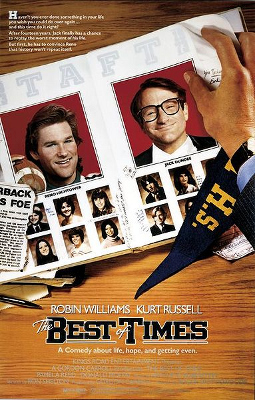
The Best Of Times (1986, directed by Roger Spottiswoode)


For years, banker Jack Dundee (Robin Williams) had been haunted by a pass that he dropped in high school.  The pass was perfectly thrown by quarterback Reno Hightower (Kurt Russell) but Jack couldn’t bring it in and, as a result, Taft High lost to its rival, Bakersfield.  Adding to Jack’s humiliation is that he now works for The Colonel (Donald Moffat), a confirmed Bakersfield fan who also happens to be Jack’s father-in-law.  When Jack visits a “massage therapist” (Margaret Whitton) and tells her about his problems, she suggests that he needs to replay the game.  Getting everyone interested in replaying the game is not easy.  No one wants to be humiliated a second time and Reno, who now fixes vans for a living, fears the he’s lost his edge.  Jack dresses up in the Bakersfield mascot’s uniform and vandalizes the town.  Finally, everyone is ready for the game.  Now, it’s a matter of town pride.

The Best of Times is a likable comedy about getting older and wishing you could have just one more chance to be young again and to have your entire future ahead of you.  Jack is haunted by that one dropped pass, feeling that it has cast a cloud over his entire life.  Reno is still a town hero but he’s struggling financially and in debt to Jack’s bank.  Replaying the game isn’t going to fix their lives but it is going to give them one last chance to relive their former glory and maybe an opportunity to learn that, even if they are getting older, they’re still living in the best of times.  The world that these two men live in is skillfully drawn and believable, with character actors like Moffat, M. Emmet Walsh, R.G. Armstrong, and Dub Taylor adding to the local color.  Jack and Reno’s wives are played by Holly Palance and Pamela Reed and they are also strong and well-developed characters.  Finally, Robin Williams and Kurt Russell are a strong comedic team.  Russell is perfectly cast as the aging jock and Williams gives one of his more restrained performances as Jack, allowing us to see the sadness behind Jack’s smile.

The stakes aren’t particularly high in The Best Of Times.  It’s just a football game between some middle-aged men looking to regain their youth.  But the story sticks with you.

Late Night Retro Television Review: Highway to Heaven 1.13 “Another Song For Christmas”


Welcome to Late Night Retro Television Reviews, a feature where we review some of our favorite and least favorite shows of the past!  On Thursdays, I will be reviewing Highway to Heaven, which aired on NBC from 1984 to 1989.  The entire show is currently streaming on Tubi and several other services!

It’s time for a Christmas episode!

Episode 1.13 “Another Song For Christmas”

(Dir by Michael Landon, originally aired on December 19th, 1984)

Oh, that Fast Eddie!

Played by the familiar character actor Geoffrey Lewis, Fast Eddie is a wealthy used car salesman.  He knows how to turn on the charm.  He knows how to close the sale.  Fast Eddie may have grown up poor but now he’s rich and he’s determined to not sacrifice one cent.  It’s the day before Christmas but Fast Eddie has no problem refusing to give money to charity.  He has no problem ripping off an elderly couple looking for an affordable car.  He has no problem firing Dave Ratchett (Jeff Doucette) when Dave refuses to roll back a car’s mileage.  Fast Eddie doesn’t care that Dave’s son is sick and Fast Eddie certainly doesn’t care that it’s Christmas Eve.  He even orders his butler (Ivor Barry) to work on Christmas Day.

Jonathan and Mark stop by Fast Eddie’s car lot but they don’t buy a car.  They just observe Fast Eddie at work.  After they leave, Mark watches as Jonathan has a brief conversation with Santa Claus (Don Beddoe).  It turns out that, like Fast Eddie, Mark doesn’t really have the Christmas spirit.  Jonathan suggests that Mark should re-read A Christmas Carol.  Mark starts to read it but falls asleep after the first page.

Meanwhile, at his mansion, Fast Eddie also falls asleep but is soon awakened by Jonathan who takes him to the past and shows Eddie how his poor childhood led him to grow up to become overly obsessed with money.  Mark then appears and shows Eddie what’s happening in the present.  Eddie’s lawyers are trying to shut down a charity so that Eddie can buy their headquarters.  Poor Dave Ratchett is having to explain to his family that he lost his job.  Eddie is moved by the sight of Dave’s wheelchair-bound son, who will die unless he gets the operation that Dave will now never be able to afford.  Finally, Jonathan takes him to the future and shows Eddie that no one will visit his grave after he dies.

Eddie wakes up infused with the spirit of Christmas and soon, he’s running around town and giving people, including Dave, all of his money and other gifts.  Interestingly enough, Mark also wakes up and he tells Jonathan that he had a dream in which he was the Ghost of Christmas Present.  Just like Eddie, Mark wakes up with a new appreciation for the Christmas holidays.

I’ve lost track of how many different version of A Christmas Carol that I’ve seen.  The idea of turning Scrooge into a used car salesman is an interesting one and I liked the fact that Eddie and Mark apparently both had the same dream.  This may be the only time in which one of the “ghosts” learned a lesson as well as Scrooge.  That said, Geoffrey Lewis — who was good in so many different films — goes a bit overboard as Fast Eddie.  He’s so desperate and twitchy that it’s easy to believe him as a used car salesman but not as a successful one.

Next week, Jonathan and Mark search for a missing friend.