Retro Television Reviews: The Love Boat 3.23 “Another Time, Another Place/Doctor Who/Gopher’s Engagement”


Welcome to Retro Television Reviews, a feature where we review some of our favorite and least favorite shows of the past!  On Wednesdays, I will be reviewing the original Love Boat, which aired on ABC from 1977 to 1986!  The series can be streamed on Paramount Plus!
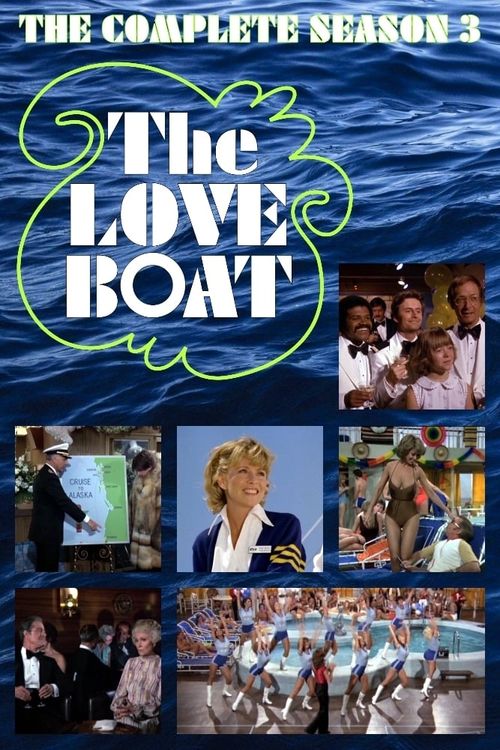
This week, Maureen McCormick returns to The Love Boat!

Episode 3.23 “Another Time, Another Place/Doctor Who/Gopher’s Engagement”

(Dir by Allen Baron, originally aired on March 1st, 1980)

Mrs. Elliott (Audrey Meadows) boards this week’s cruise with a very specific mission in mind.  She wants to find a husband for her daughter, Celia (Maureen McCormick).  Mrs. Elliott, whose husband owns a good deal of stock in the cruise line, at first eyes Doctor Bricker as a possible suitor for her daughter, despite the fact that the doctor is considerably older than Celia and has been divorced multiple times.  However, Celia is far more charmed by Gopher, who asks Celia to dance when Julie points out how miserable Celia looks at the ship’s Charleston night.

Celia is charmed by Gopher and, when he accidentally gives her a ring that he’s been carrying around in his pocket, she assumes that he’s asking her to marry him.  (The ring was actually lost by another passenger and Gopher was just carrying it around until he could put it in the lost-and-found.)  Celia says yes and suddenly, Gopher is engaged!  Mrs. Elliott is not happy about this, as Gopher is only an assistant purser.  As for Gopher, he tries to get out of the engagement by having Isaac tell Celia that Gopher’s a drunk.  This only makes Celia even more determined to marry Gopher (so she can “save” him) and this also gets Gopher in trouble with the Captain who, as the show sometimes remembers, is a recovering alcoholic.

Fortunately, Isaac eventually tells Celia the truth about what’s going on.  Celia is surprisingly forgiving, returning the ring and announcing that she and Gopher will always be good friends.  Celia also finds the strength to tell her mother to let her live her own life.  Mrs. Elliott is okay with this, because she has another daughter who needs a husband and Doc is still single.

This was a storyline that depended too much on everyone involved acting like an idiot.  Those are my least favorite stories.  But, just as with last week, Fred Grandy got to show off his tragic clown qualities and Maureen McCormick was so convincing in her role that it was hard not to suspect that perhaps she related to a character who was tired to everyone assuming that they knew what was best for her and her life.

Speaking of storylines that required everyone to act like an idiot, this episode also featured Bert Parks as Dr. Michael Mervey, a noted sex therapist.  Dr. Mervey boards the ship under an assumed named and tells the Captain that he just wants to relax and not have anyone asking him for any help with their problems or asking him to autograph his book.  However, Evelyn Miller (Phyllis Davis) has heard a rumor that Dr. Mervey is on the boat so she boards with the intention of tracking him down and seducing him.

The only problem is that Evelyn doesn’t know what Dr. Mervey looks like.  (I find that hard to believe, considering how famous Dr. Mervey is supposed to be.)  When she hears Isaac refer to another passenger (Arte Johnson) as being a “doctor,” Evelyn assumes the passenger must be Dr. Mervey.  But instead, he’s just Wilfred Johnson (Arte Johnson), a nerdy nuclear physicist.  At first, Dr. Johnson pretends to be Dr. Mervey but when the real Dr. Mervey inevitably spots Evelyn and starts to hit on her, the truth comes out.  Evelyn dumps Wilfred.  Feeling guilty, Dr. Mervey tries to give them a therapy session.  Neither wants to listen to Dr. Mervey but they do still realize that they actually love each other.  Wilfred and Evelyn leave the cruise arm-in-arm and Mervey pats himself on the back for a job well-done.

Again, this plot was way too dependent on everyone acting like an idiot.  That said, Bert Parks made me laugh as the self-important Dr. Mervey.

Finally, Jane Wyman stars as Sister Patricia, a nun who is heading to Acapulco to be a teacher.  When she discovers that her ex-boyfriend, Steve Brian (Dennis Morgan), is on the cruise, she is forced to reconsider her decision.  In the end, she decides to follow her calling but she tells Steve that they’ll be reunited in another time and another place.  When Stubing comforts Steve, Steve replies that, “if” there’s a Heaven, they’ll be reunited.

Uhmm…. Steve, if there is a Heaven, it’s probably not full of agnostics.  Just saying.

Anyway, this was a simple story and I could tell where it was going to go from the first minute the Steve greeted Patricia on the boat but it worked because of the old school charm of Dennis Morgan and Jane Wyman.  These two Hollywood veterans knew just how to best embrace the melodrama.

Thanks to Wyman and Morgan, this was a pleasant cruise.  Hopefully, next week will be just as pleasant.

Retro Television Reviews: The Failing of Raymond (dir by Boris Sagal)


Welcome to Retro Television Reviews, a feature where we review some of our favorite and least favorite shows of the past!  On Sundays, I will be reviewing the made-for-television movies that used to be a primetime mainstay.  Today’s film is 1971’s The Failing of Raymond!  It  can be viewed on YouTube!

Poor Raymond!

Played by a young Dean Stockwell, Raymond is patient at a mental hospital who blames everything that has gone wrong on his life on one failed test.  During his senior year of high school, he got a 61 on an English test and, as a result, he not only only failed the class but he also wasn’t allowed to graduate.  The test was administered by a substitute teacher named Mary Bloomquist (Jane Wyman), one who did not know that Raymond had a reputation for being a bit eccentric.  When Raymond tried to ask her whether or not the final two questions were for extra credit, Mary refused to call on him because she was more preoccupied with her failed affair with another teacher (Dana Andrews).  Raymond didn’t answer the final two questions, even though he believed that he had the correct answers.  Now, locked away in a hospital, Raymond comes across an article announcing that beloved teacher Mary Bloomquist will soon be retiring and moving to England.

Seeking revenge, Raymond escapes from the hospital.  While police Sgt. Manzek (Murray Hamilton) search for Raymond, Raymond returns to his old school.  When he finds Mary in her classroom, Mary mistakes Raymond for a mover responding to a classified ad asking for help in getting all of her things packed up.  Raymond may be a homicidal but he also craves direction and praise so he helps Mary with her packing.  As he packs, Mary talks about her decision to retire and it turns out that she’s not quite the monster that Raymond imagined her to be.  Mary is retiring because she feels that she has never made a difference as a teacher.

That said, Raymond is still determined to get his revenge.  He wants Mary to give him the test a second time and to give him a passing grade.  And if she doesn’t, he’s prepared to kill her.  Unfortunately, despite claiming to have spent years studying the material, Raymond still thinks that Robert Browning wrote the Rhyme of the Ancient Mariner.

As the old saying goes, you never know how much your actions might effect someone else’s life.  Mary is a dedicated and well-meaning teacher who cares about her students but her decision to fail Raymond, made on a day when she was distracted by her own personal problems, is something that Raymond has never forgotten or forgiven.  Mary can barely remember it happening but Raymond has based his entire life around that moment and, as the film progresses, it becomes clear that he’s incapable of understanding that the entire world doesn’t revolve around what happened to him during his senior year.  On the one hand, Mary definitely should have answered Raymond’s question about whether or not the final two questions were multiple choice.  On the other hand, Raymond has clearly been using the incident as an excuse to justify every mistake that he’s made sense.  Ironically, Raymond’s quest for revenge gives Mary the chance to finally be the teacher that she truly wants to be.

It’s an intriguing premise.  Unfortunately, like so many made-for-TV movies from the early 70s, The Failing of Raymond is occasionally a bit too stagey for its own good.  Despite only being 73 minutes long, it never really develops any sort of narrative momentum.  That said, Dean Stockwell gives a performance that makes clear why Alfred Hitchcock was planning on casting him as Norman Bates if Anthony Perkins somehow fell through.  As played by Stockwell, Raymond is unfailingly polite and so obviously wounded that it’s impossible not to feel sympathy for him, even when he’s threatening to kill his former teacher.  Jane Wyman, as well, gives a sympathetic performance as Mary, who, despite that one bad day with Raymond, really is the type of teacher we all wish we could have had.

This film was directed by Boris Sagal, who did several made-for-TV movies and also directed Charlton Heston in The Omega Man.  His daughter, Katey Sagal, makes her film debut in a small role as one of Raymond’s fellow patients.

Horror on the Lens: The Failing of Raymond (dir by Boris Sagal)


Raymond (Dean Stockwell) has just escaped from a mental hospital and he has only one thing on his mind.  Raymond wants revenge.  Having looked over the past events of his life, Raymond has figured out that things started to go downhill for him when he failed a test in high school.  He blames his failure on his old teacher, Mary Bloomquist (Jane Wyman).

At the same time that Raymond is escaping, Mary is planning her retirement.  She’s decided that she no longer wants to teach.  The job just doesn’t seem worth it anymore.  But Raymond has other ideas.  Raymond wants her to give him the same test that he failed ten years before.  And this time, Raymond wants her to pass him or else.

The Failing of Raymond is a made-for-TV movie from 1971 and it features a good performance from Jane Wyman and a great one from Dean Stockwell.  The film ultimately hinges on one question.  Did Raymond really fail that test or did Mary fail Raymond?

Enjoy!

http://www.youtube.com/watch?v=egFBvsOaLnY

The Fabulous Forties #39: My Man Godfrey (dir by Gregory La Cava)


My_man_godfrey

The 38th film in Mill Creek’s Fabulous Forties box set was My Man Godfrey, which is strange considering that My Man Godfrey is not a 40s film.  The back of the box insists that My Man Godfrey was made in 1946 but it was actually made in 1936.  Errors like this aren’t uncommon when it comes to Mill Creek but, even beyond that simple mistake, My Man Godfrey is clearly not a product of the earnest and pro-American 1940s.  My Man Godfrey may be a screwball comedy but it’s a comedy that is very much a product of the far more cynical 1930s.  It’s a comedy that could only have come out during the Great Depression, at a time when FDR was promoting his New Deal and yet many Americans were still out-of-work and struggling to make ends meet, forgotten by a country determined to buy into a feel good narrative regardless of any evidence to the contrary.

But no matter!  My Man Godfrey might not technically belong in the Fabulous Forties box set but I’m still glad that it was there because it is an absolutely fantastic film.

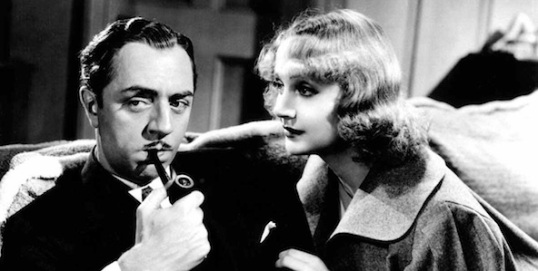
The Godfrey of the title is played by the always charming and always funny William Powell.  When we first see him, he’s living in a garbage dump with several other men who have lost their money, homes, and family.  These are men who spend their time wondering when and if things are ever going to get better.  While the rest of the country insists that happy days are here again, these men know it’s simply not true.  They are truly the forgotten men.

Fortunately, there’s also a scavenger hunt going on!

For charity, a group of rich people are running around the city and collecting various oddities.  And among those oddities — “a forgotten man!”  When wealthy and snobbish Cornelia Bullock (Gail Patrick) stops off at the dump, she offers Godfrey five dollars to come with her and be her “forgotten man.”  Offended, Godfrey reprimands her and a shocked Cornelia stumbles back and falls into an ash pile.  Cornelia’s younger sister, the flighty Irene (Carole Lombard), sees this and laughs.  Mostly to get back at Cornelia, Godfrey agrees to be Irene’s forgotten man.

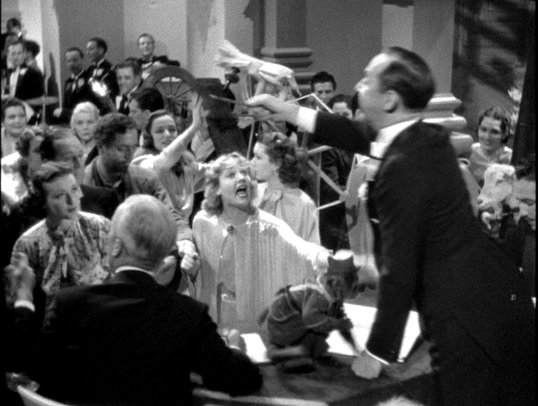
When Irene takes Godfrey to the Waldorf-Astoria Hotel so that the game’s organizers can declare him to be an authentic forgotten man, Godfrey is disgusted by the silly and wealthy people that he sees around him.  After he is authenticated, Godfrey proceeds to loudly denounce everyone in the hotel.  Every one is scandalized, except for Irene.  Irene asks Godfrey if he would like to come home with her and be her family’s new butler.  Reluctant but broke, Godfrey agrees.

One of the joys of this scene is seeing the other things people found during the scavenger hunt. Love the monkey.

One of the joys of this scene is seeing the other things people found during the scavenger hunt. Love the monkey.

Godfrey, however, is far less amused.

Godfrey, however, is far less amused.

The next morning finds Godfrey in the Bullock mansion, prepared to start his duties as a butler.  He turns out to be a surprisingly adept butler but there’s only one problem.  It turns out that everyone was drunk last night and, as a result, nobody remembers Irene hiring Godfrey.  As Godfrey reintroduced himself to the family, he gets to once again know the Bullocks.

For instance, patriarch Alexander Bullock (Eugene Pallette) is a well-meaning man but he’s incapable of controlling his eccentric family or their excessive spending.  He faces each day with the weary resignation that his household is a disorganized mess and that he’s on the verge of losing his business.

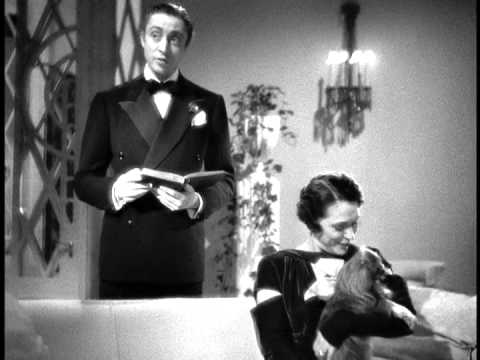
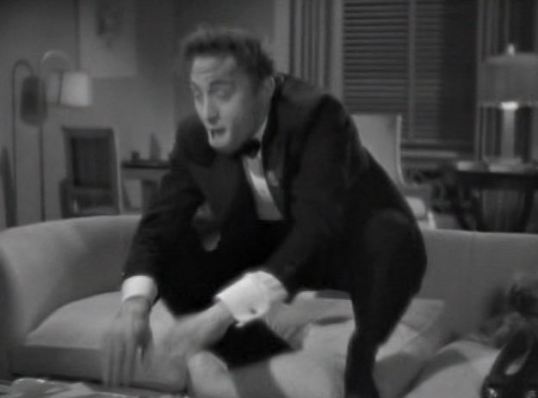
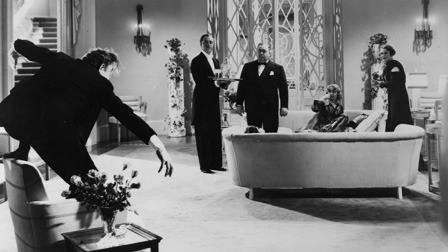
Alexander’s wife, Angelica (Alice Brady), lives in her own world and confronts every problem with nonstop and delusional positivity.  She is very excited to have taken on a protegé, an artist named Carlo (Mischa Auer, who was justifiably nominated for an Oscar for his wonderfully odd performance).  Carlo is often surly and spoiled but he does do a pretty good impersonation of a gorilla.  Whenever the often dramatic Irene is declaring herself to be the most miserable rich girl in the world, Angelica insists that Carlo cheer everyone up by grunting and jumping around the room.

Mischa Auer as Carlo

Mischa Auer as Carlo

Mischa Auer as a gorilla

Mischa Auer as a gorilla

(Apparently, the gorilla impersonation was something that Auer used to do at Hollywood parties.  The role of Carlo was specifically created with the idea of capturing Auer’s act on film.  As a result, Auer was one of the first actors to ever be nominated for Best Supporting Actor and he started a new career as a comedic character actor.)

Cornelia is selfish and materialistic.  Though she may not remember much about the scavenger hunt, she does remember Godfrey humiliating her.  From the minute she discovers that Godfrey is the new butler, she starts to conspire against him.  When her necklace disappears, everyone is sure that she hid it herself just to frame Godfrey.  The truth, of course, is a little bit more complicated.

And finally, there’s Irene.  Irene is spoiled but she’s not selfish.  She’s also not as ditzy as everyone assumes.  It’s just that she sees the world in her own unique way.  Almost as soon as Irene remembers that she hired Godrey, she decides that she’s in love with him.  She also decides that Godfrey is her protegé.  After all, if her mother can have a protegé, why can’t she!?

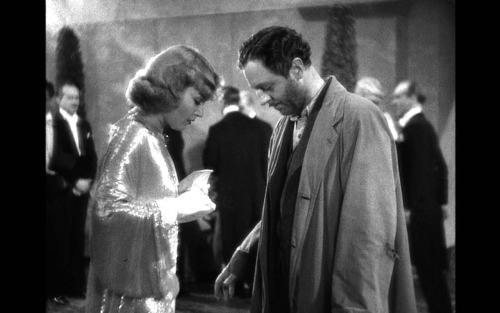
Carole Lombard and William Powell

Carole Lombard and William Powell

Carole Lombard was a masterful comedienne whose career was tragically cut short when she was killed in a plane crash in 1942.  Lombard is absolutely adorable in the role of Irene, a character to whom I very much related.

Of course, there is more to Godfrey and his past than he actually let on.   And, even after he becomes the new butler, Godfrey doesn’t forget where he was living just a few days before.  My Man Godfrey is a hilarious comedy but it’s also a comedy with a social conscience.

my-man-godfrey_592x299

I love this film.  It’s a screwball comedy in the best sense of the term, a film where all of the characters are eccentric while also remaining human.  William Powell and Carole Lombard were briefly married before they teamed up in My Man Godfrey and their chemistry is delightful to watch.  Finally, the supporting cast is memorable in the way that only a collection of great 1930s character actors can be.

My Man Godfrey is a great film.  It may not be from the 1940s but I’m glad it was included.

Godfreyw_bw_original

(By the way, just between you and me — I had a lot of fun watching this movie and writing this review.  It kind of reminded me why I started writing about movies in the first place.)

Cleaning Out The DVR #16: Johnny Belinda (dir by Jean Negulesco)


X-johnnybelindalenda48-jjp

Continuing my effort to watch 38 films in 10 days (and, as of today, I only have 6 days left!), I spent part of last night watching the 1948 film Johnny Belinda.

Johnny Belinda takes place in Canada, on Cape Breton Island.  The residents of the island are a hearty, no-nonsense group of people.  They work hard, they don’t play hard because they never play, they farm, and they don’t have much use for outsiders.  When a new doctor, Robert Richardson (Lew Ayres), arrives on the island, he has to work hard to earn their trust.

Dr. Richardson is fascinated by Belinda McDonald (Jane Wyman), a young woman who is deaf and mute.  Belinda lives on a farm with her father (Charles Bickford) and her aunt (Agnes Moorehead).  Everyone in the community assumes that Belinda is a simple-minded and, because her mother died giving birth to her, she is resented by her father.  Only Dr. Richardson believes that Belinda is in any way intelligent and, over her father’s objections, he teaches Belinda sign language.

Dr. Richardson’s secretary, Stella (Jan Sterling), falls in love with him and grows angry when it becomes apparent that he’s more interested in taking care of Belinda than pursuing an adulterous romance with Stella.  Meanwhile, Stella’s husband, a viscous alcoholic named Locky (Stephen McNally), gets drunk and rapes Belinda.  9 months later, when Belinda gives birth to a boy that she names Johnny, everyone assumes that Dr. Richardson is the father.  Soon, both Richardson and the McDonald family are being shunned by the judgmental community.

Locky, meanwhile, is determined to keep anyone from finding out about his crime, to the extent that he’s willing to commit murder.  Both Locky and Stella are determined to take Johnny away from Belinda and it all eventually leads to further tragedy and, somewhat inevitably, a dramatic murder trial.

Much like Random Harvest, Johnny Belinda is another film that I could imagine being remade for Lifetime.  It’s a well-made melodrama that appeals to all of the emotions and features a cast of talented actors doing good work playing characters that are probably just a bit too familiar.  In fact, there’s really not a single moment of Johnny Belinda that will take you by surprise but, despite that, the film still works.  Jane Wyman does such a good job playing the silent Belinda that it makes the entire movie worth watching.  (It’s interesting to contrast Wyman’s innocent, vulnerable, and sympathetic performance here with her far more severe work in The Yearling.)  Reportedly, Wyman devoted so much time and effort to her performance that it was cited as a reason for her divorce from future President Ronald Reagan.  For Johnny Belinda, Wyman lost the chance to be first lady but she did win an Oscar.

(And, for the record, Wyman voted for Reagan in 1980 and 1984, saying that it wasn’t often that you got to vote for your ex-husband.)

Johnny Belinda was nominated for best picture of the year and, with 10 nominations, it was the most nominated film of 1947.  Though it won an Osar for Wyman, it lost best picture to Laurence Olivier’s Hamlet.

Cleaning Out The DVR #10: The Yearling (dir by Clarence Brown)


Original_movie_poster_for_the_film_The_Yearling

After I finished Abduction: The Jocelyn Shaker Story, I decided to watch a film that was shown on TCM as a part of the 31 Days Of Oscars.  When I started the 1946 film, The Yearling, I thought it was going to be a sweet and heartwarming little movie about a country boy raising a deer.  Instead, it turned out to be a rather dark movie about how much it sucks to grow up in the country.  I can only imagine how many childen, back in 1946, were scarred for life by this movie.

The movie is actually about two yearlings.  The main one is Jody (Claude Jarman, Jr.), who lives in the bayous of 1878 Florida.  His family is a farming and hunting family.  They live in a small shack and struggle to make ends meet.  His father, Penny Baxter (Gregory Peck) is … well, he’s Gregory Peck.  He’s stern but warm and speaks with that deep voice that lets you know that you better pay attention to everything he says.  While Penny is generally laid back and enjoys a good laugh, his wife, Ora (Jane Wyman), is far more serious and severe.  Ora has lost three children and, as a result, she is both overprotective and emotionally distant from Jody.

Jody desperately wants a pet but Ora says that they can’t afford to feed any animals.  However, one day, Penny is bitten by a snake.  Apparently, the organs of a deer can be used to draw out snake venom.  (Seriously, until I watched The Yearling, I had no idea this was the case.  I once nearly stepped on a rattlesnake in New Mexico and it totally freaked me out.  It’s good to know that if I ever do get attacked by a snake, all I have to do is kill a deer.)  Penny shoots a doe and has Jody cut out its heart and liver.  After doing so, Jody notices that the doe had a fawn.  He begs to be allowed to adopt it and, overruling Ora, Penny says that he can.

After getting his deer, Jody goes to visit his best friend, Fodderwing (Donn Gift) and ask him what he thinks a good name would be.  However, Fodderwing’s father informs Jody that his friend has just died.  And really, that scene pretty much epitomizes what The Yearling is about.  Because it’s told almost entirely from Jody’s point of view, the film may occasionally look like an old school Disney film.  But death and hardship are very real in the world of The Yearling.  People die, even children.  Having a pet may make the reality easier to take but it doesn’t change the reality.

Jody names the deer Flag.  As the film progresses, both Jody and Flag grow up.  Unfortunately, as Flag gets older and bigger, he causes more and more trouble for both his family and the neighbors.  He eats crops and he destroys fences.  After Penny is injured, Jody is the one who ends up replanting the corn and fixing all the damage.  But, even after all of Jody’s hard work, Flag still knocks down another fence.  That’s when Jody is told that he must shoot his beloved pet…

And that’s why I went, “Agck!  What type of movie is this!?”

Well, it’s a coming-of-age movie and, unfortunately, Jody is living at a time when growing up means giving up childish things.  (That’s always been my least favorite verse in the Bible, by the way.)  The Yearling itself is a pretty good film, though I do have one major problem with it.  The film looks great and both Jane Wyman and Gregory Peck are expertly cast.  If you keep an eye out, you’ll even spot Henry Travers — Clarence the Angel from It’s A Wonderful Life — in a small role.

That said, my main objection to The Yearling — the thing that keeps it from being quite as good as it could be — is the performance of Claude Jarman, Jr.  In the role of Jody, Jarman goes so totally over-the-top with his line readings and his facial expressions that it immediately takes the viewer out of the film’s reality.  Whenever anything happens — whether its Penny getting attack by a snake or his mother throwing a plate at his deer or Flag knocking over a fence — Jarman responds by standing there with his eyes and mouth wide open.  His lines are delivered with a rushed enthusiasm that can’t hide the complete lack of authentic emotion in his performance.  Claude Jarman tries really hard but it’s not surprising to discover that, after The Yearling, he only appeared in a few more films before joining the Navy and then subsequently moving behind the camera as a producer.

Then again, the Academy thought highly enough of Jarman’s performance to give him an honorary Oscar.  The Yearling itself was nominated for best picture but it lost to another sad film about giving up childish things, The Best Years of Our Lives.

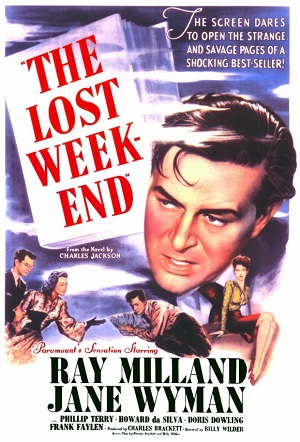
Lisa Reviews An Oscar Winner: The Lost Weekend (dir by Billy Wilder)


The_Lost_Weekend_poster

I’m currently stuck at home on this beautiful day, dealing with a really bad cold.  (Even as I sit here typing this up, I am currently in a feverish haze.)  It’s frustrating but, fortunately, I’ve got a lot of movies to watch.  After all, TCM is wrapping up their 31 Days of Oscars and my DVR is currently full of nominated films waiting to be reviewed.

For instance, I just watched the 1945 best picture winner, The Lost Weekend.  The Lost Weekend was directed by Billy Wilder, a director who is most often associated with sad-eyed comedies like Some Like It Hot, The Apartment, and The Seven Year Itch.  However, The Lost Weekend is most definitely not a comedy.  Instead, it’s an incredibly harrowing and rather depressing portrait of addiction and lost promise.

Don Birnan (Ray Milland) is a struggling writer.  When we first meet him, he’s packing for a weekend trip with his brother, Wick (Philip Terry).  The conversation between Don and Wick at first sounds friendly but soon, we start to hear hints of suspicion in Wick’s voice.  Wick seems incredibly concerned about what exactly Don is packing and Don starts to get defensive.  Don says that it’s been ten days since he had a drink and that there is no more liquor in the apartment.  However, whenever Wick turns his back, Don starts to search for the bottles that he’s hidden around his bedroom.  (He’s even got a bottle of whiskey hanging on a rope outside the window.)  It gets to the point that, whenever Wick isn’t looking, Don is holding a bottle.

And while that may sound potentially humorous, there’s nothing funny about the scene.  Don’s desperation is too real.  As someone who grew up having to deal with an alcoholic father, I recognized Don and his addiction immediately.  Everything about him — from his fast smile to his continual assurances that he’s cleaned himself up — is a facade, designed to help him survive until he can get his next drink.

The main thing about alcoholics is that they’re extremely clever.  Don knows that Wick wants to get him away for the weekend so that he can’t drink.  When Don’s girlfriend, Helen (Jane Wyman), mentions that she has two tickets for a concert, Don convinces Wick to go to the show with her.  Once Wick is out of the apartment, Don can sneak down to the neighborhood bar.  When it comes time to leave for that dry weekend vacation, Don manages to accidentally on purpose miss the train.

Left alone for the weekend, Don can now do what he wants.  He tries to write about his life as an alcoholic but discovers that his brain is too muddled for him to think straight.  So, instead, he drinks.  Unfortunately, Wick hasn’t left him any money and has also ordered all the local bars and liquor stores to not allow his brother to run up a tab.  As a result, Don finds himself scrounging for money.

In perhaps the film’s most famous scene, Don carries his typewriter down to the local pawnshop so that he can get money to buy a drink.  However, the pawnshop is closed for Yom Kippur.  The camera follows Don as he staggers around New York City, looking for an open pawnshop.  Wilder shot this scene on the streets of New York City, using a hidden camera.  The people who we see reacting to Don are not Hollywood extras but instead are actual New Yorkers who had no idea that the pathetic drunk they were gawking at was actually film star Ray Milland.

As the weekend plays out, Don transforms.  He goes from being smooth and outwardly confident to being unshaven and desperate.  Eventually, Don ends up in a sanitarium, where he’s taunted by a sadistic nurse.  (The nurse is played by Frank Faylen, who played Ernie the cab driver in It’s A Wonderful Life.)  Even when Don manages to get back to his apartment, he finds himself screaming as he hallucinates a bat eating a mouse.  Blood runs down the walls.

Does the film, at least, have a happy ending?  It depends.  The local bartender, Nat (Howard Da Silva), returns Don’s typewriter to him.  Helen convinces Don to write about his lost weekend.  Don says that he’s never going to drink again but, at the same time, we can’t help but remember that the movie started with Don saying the same thing…

As directed by Billy Wilder, The Lost Weekend plays out like a noir thriller, full of menacing shadows.  The score, composed by Miklos Rozsa, uses a theremin to let us hear the addiction-fueled chaos within Don’s head.  Best of all, Ray Milland totally loses himself in the role of Don Birnan, with the vanity of film stardom soon replaced with the pathos of addiction.  Even watching the film today, it’s easy to understand how The Lost Weekend won the Oscar for Best Picture of 1945.

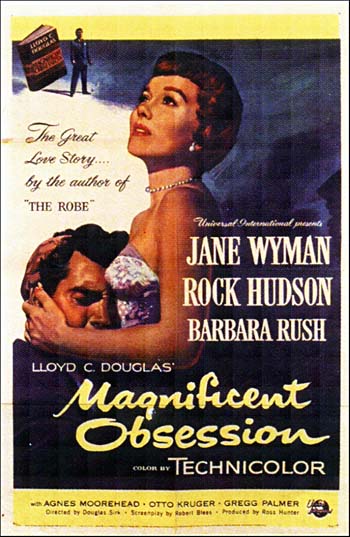
Embracing the Melodrama Part II #20: Magnificent Obsession (dir by Douglas Sirk)


Magnificent_obsessionThere’s a scene early on in the 1954 melodrama Magnificent Obsession in which formerly carefree millionaire Bob Merrick (Rock Hudson) meets with an artist named Edward Randolph (Otto Kruger).  We know that Randolph’s brilliant because he speaks in a deep voice, tends to be unnecessarily verbose, and often stares off in the distance after speaking.  Bob wants to know about a dead doctor who was a friend of Randolph’s.  Randolph explains the late doctor’s philosophy of doing anonymous good works.  Bob’s mind is blown.  (Hudson, who was never the most expressive of actors, conveys having his mind blown by grinning.)

“This is dangerous stuff,” Randolph warns him, “One of the first men who used it went to the cross at the age of 33…”

And a heavenly chorus is heard in the background…

And that one line pretty much tells you exactly what type of film Magnificent Obsession is.  It’s a film that not only embraces the melodrama but which also holds on tight to make sure that the melodrama can never escape.  There’s not a single minute in this film that is not hilarious overwritten.  It’s not just Randolph who tends to be portentous in his pronouncements.  No — everyone in the film speaks that way!

The dead doctor is dead specifically because of Bob.  Apparently, the doctor had a heart attack but the local hospital’s only resuscitator was being used to save the life of Bob who, while the doctor was dying, was busy recklessly driving a boat.

Helen (Jane Wyman), the doctor’s widow is, at first, bitter towards Bob and when Bob offers to donate $250,000 to the hospital, Helen refuses to accept his check.  This leads to Bob doing a lot of soul-searching and eventually having his life-changing conversation with Randolph.  Excited at the prospect of doing anonymous good works for the rest of his life, Bob tracks down Helen and tries to tell her that he’s a changed man.  Helen, however, wants nothing to do with Bob and ends up getting hit by a car while running away from him.  Helen survives but now, she’s blind!

Now, at this point, you might think that Bob has done enough to ruin Helen’s life.  At least, that’s the way that Helen’s family views it and when Bob attempts to visit her in the hospital, they order him to go away.

Eventually, Helen comes home from the hospital and starts to adjust to a life without eyesight.  One day, she meets a man on the beach and they start up a tentative romance.  What she doesn’t realize, at first, is that the man is Bob!  By the time she does realize who the man is, Helen has fallen in love with him.  However, she feels that it wouldn’t be fair to Bob to pursue a relationship with him and she leaves him.

So, of course, Bob’s response is to go to medical school and become a neurosurgeon.  Many years later, Helen has a brain tumor and needs an operation to survive.

Can you guess who her surgeon turns out to be?

Magnificent Obsession is almost a prototypical 1950s melodrama.  It’s big, it’s glossy, it’s self-important, and undeniably (and occasionally unintentionally) funny.  Even the total lack of chemistry between Hudson and Wyman somehow adds to the film’s strange charm.  It’s hard not to admire a film that starts out over-the-top and just grows more excessive from there.

Watching Magnificent Obsession is a bit like taking a trip into a parallel, technicolor dimension.  It’s strange, fascinating, and far more watchable than it should be.