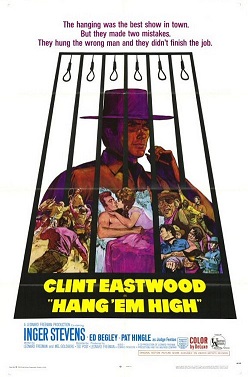
Hang ‘Em High (1968, directed by Ted Post)


1889.  The Oklahoma Territory.  A former lawman-turned-cattleman named Jed Cooper (Clint Eastwood) is falsely accused of working with a cattle thief.  A group of men, led by Captain Wilson (Ed Begley) lynch him and leave Cooper hanging at the end of a rope.  Marshal Dave Bliss (Ben Johnson) saves Cooper, cutting him down and then taking him to the courthouse of Judge Adam Fenton (Pat Hingle).  Fenton, a notorious hanging judge, is the law in the Oklahoma territory.  Fenton makes Cooper a marshal, on the condition that he not seek violent revenge on those who lynched him but that he instead bring them to trial.  Cooper agrees.

An American attempt to capture the style of the Italian spaghetti westerns that made Eastwood an international star, HangEm High gives Eastwood a chance to play a character who is not quite as cynical and certainly not as indestructible as The Man With No Name.  Cooper starts the film nearly getting lynched and later, he’s shot and is slowly nursed back to health by a widow (Inger Stevens).  Cooper is not a mythical figure like The Man With No Name.  He’s an ordinary man who gets a lesson in frontier justice as he discovers that, until Oklahoma becomes a state, Judge Fenton feels that he has no choice but to hang nearly every man convicted of a crime.  (Judge Fenton was based on the real-life hanging judge, Isaac Parker.)  Over the course of this episodic film, Cooper becomes disgusted with frontier justice.

HangEm High is a little on the long side but it’s still a good revisionist western, featuring a fine leading performance from Clint Eastwood and an excellent supporting turn from Pat Hingle.  The film’s episodic structure allows for Eastwood to interact with a motley crew of memorable character actors, including Bruce Dern, Dennis Hopper, L.Q. Jones, Alan Hale (yes, the Skipper), and Bob Steele.  HangEm High has a rough-hewn authenticity to it, with every scene in Fenton’s courtroom featuring the sound of the gallows in the background, a reminder that justice in the west was often not tempered with mercy.

Historically, Hang ‘Em High is important as both the first film to be produced by Eastwood’s production company, Malpaso, and also the first to feature Eastwood acting opposite his soon-to-be frequent co-star, Pat Hingle.  Ted Post would go on to direct Magnum Force.

Scalplock (1966, directed by James Goldstone)


In this comedic western, gambler Benjamin Calhoun (Dale Robertson) wins big in a poker game.  Not only does he walk away with several thousand dollars but he also now owns his own railroad, the BP;S&D.  Calhoun celebrates the biggest win of his career by tossing ten dollar bills at the townspeople, recruiting a worshipful young assistant (Bob Random), and commandeering a private railcar that belongs to wealthy Burton Standish (John Anderson).  In the car, he finds Marta Grenier (Diana Hyland), a “working woman,” who has been hired to provide company for Standish.

Calhoun and Marta ride off to check out Calhoun’s new railroad.  What he discovers is that the railroad that he won is not only not completed but the workers are striking because they haven’t been paid in two weeks.  The quick-thinking Calhoun offers to make all of the workers part-owners of the railroad.  With construction once again starting, Calhoun tries to figure out how to keep his new business open.  He also meets a strong-headed storekeeper named Joanna Royce (Sandra Smith).

When Standish finally shows up, it turns out that he was originally planning on buying the BP;S&D.  Will Calhoun hold onto the railroad and honor the promise he made to the workers or will he sell out to Standish?

For all the talk about completing the railroad, Scalplock ends with most of the work undone.  That’s because Scalplock was a pilot for The Iron Horse, a television series that lasted for two seasons in the 60s.  Scalplock (and The Iron Horse) is mostly a showcase for Dale Robertson, a low-key but always convincing actor who specialized in westerns.  Usually, Robertson was cast as an upstanding citizen and law enforcement agent.  In Scalplock, he’s playing the type of genial rogue that James Garner played on Maverick and later in The Rockford Files.  Robertson is likable in Scalplock and even convinces us that Calhoun would choose his workers over a quick payday.  Fan of the genre will enjoy Scalplock, as long as they don’t get too invested in witnessing that last track of rail laid into the ground.

Dale Robertson, who started his career in the 40s, continued to act through the 90s, though usually as a guest star instead of a series lead.  Robertson eventually retired to Oklahoma where he owned a ranch that was home to over 200 horses.  He passed away in 2013 at the age of 89.

Horror on TV: Thriller 1.8 “The Watcher” (dir by John Brahm)


For tonight’s televised horror, we have another episode of the Boris Karloff-hosted anthology series, Thriller!

In this episode, a religious fanatic in a named Freitag (Martin Gabel) lives in a resort community and targets young people who he believes have failed to live up to his standards.  His latest targets are played by Olive Sturgess and Richard Chamberlain.  This is actually a rather grisly little episode.  With its theme of religious hypocrisy, I can only imagine how people reacted when it was first aired on November 1st, 1960.

Enjoy!

Lisa Marie Reviews An Oscar Winner For Labor Day: On The Waterfront (dir by Elia Kazan)


On-the-Waterfront

I like On The Waterfront.

Nowadays, that can be a dangerous thing to admit.  On The Waterfront won the Oscar for Best Picture of 1954 and Marlon Brando’s lead performance as boxer-turned-dockworker Terry Malloy is still regularly cited as one of the best of all time.  The scene where he tells his brother (played by Rod Steiger) that he “could have been a contender” is so iconic that other films still continue to either parody or pay homage to it.  On The Waterfront is one of those films that regularly shows up on TCM and on lists of the greatest films ever made.

And yet, despite all that, it’s become fashionable to criticize On The Waterfront or to cite it as an unworthy Oscar winner.  Certain film bloggers wear their disdain for On The Waterfront like a badge of honor.  Ask them and they’ll spend hours telling you exactly why they dislike On The Waterfront and, not surprisingly, it all gets tedious pretty quickly.

Like all tedious things, the answer ultimately comes down to politics.  In the early 50s, as the House UnAmerican Affairs Committee conducted its search for communists in Hollywood, hundreds of actors, writers, and directors were called before the committee.  They were asked if they were currently or ever had been a member of the Communist Party.  It was demanded that they name names.  Refusing to take part was career suicide and yet, many witnesses did just that.  They refused to testify, apologize, or name names.

And then there was the case of Elia Kazan.  When he was called in front of HUAC, he not only testified about his communist past but he named names as well.  Many of his past associates felt that Kazan had betrayed them in order to protect his own career.  On The Waterfront was Kazan’s answer to his critics.

In On The Waterfront, Terry Malloy’s dilemma is whether or not to voluntarily testify before a commission that is investigating union corruption on the waterfront.  Encouraging him to testify is the crusading priest, Father Barry (Karl Malden), and Edie (Eva Marie Saint), the saintly girl who Terry loves.  Discouraging Terry from testifying is literally every one else on the waterfront, including Terry’s brother, Charlie (Rod Steiger).  Charlie is the right-hand man of gangster Johnny Friendly (a crudely intimidating Lee J. Cobb), who is the same man who earlier ordered Terry to throw a big fight.

At first, Terry is content to follow the waterfront of code of playing “D and D” (deaf and dumb) when it comes to union corruption.  However, when Johnny uses Terry to lure Edie’s brother into an ambush, Terry is forced to reconsider his previous apathy.  As Terry gets closer and closer to deciding to testify, Johnny order Charlie to kill his brother…

The issue that many contemporary critics have with On The Waterfront is that they view it as being essentially a “pro-snitch” film.  It’s easy to see that Elia Kazan viewed himself as being the damaged but noble Terry Malloy while Johnny Friendly was meant to be a stand-in for Hollywood communism.  They see the film as being both anti-union and Kazan’s attempt to defend naming names.

And maybe they’re right.

But, ultimately, that doesn’t make the film any less effective.  Judging On The Waterfront solely by its backstory ignores just how well-made, well-acted, well-photographed, well-directed, and well-written this film truly is.  Elia Kazan may (or may not) have been a lousy human being but, watching this film, you can’t deny his skill as a director.  There’s a thrilling grittiness to the film’s style that allows it to feel authentic even when it’s being totally heavy-handed.

And the performances hold up amazingly well.  Marlon Brando’s performance as Terry Malloy gets so much attention that it’s easy to forget that the entire cast is just as great.  Rod Steiger makes Charlie’s regret and guilt poignantly real.  Karl Malden, who gets stuck with the film’s more pedantic dialogue, is the perfect crusader.  Eva Marie Saint is beautiful and saintly.  And then you’ve got Lee J. Cobb, playing one of the great screen villains.

The motives behind On The Waterfront may not be the best.  But, occasionally, a great film does emerge from less than pure motives.  (Just as often, truly good intentions lead to truly bad cinema.)  Regardless of what one thinks of Elia Kazan, On The Waterfront is a great work of cinema and it’s on that basis that it should be judged.

On_the_Waterfront_poster