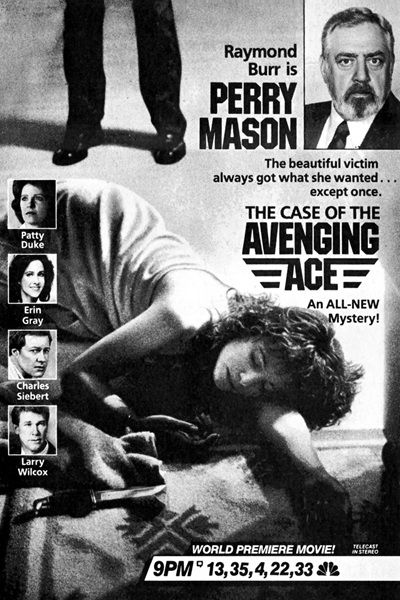
Back when Perry Mason (Raymond Burr) was a judge, he rejected the appeal of Kevin Parks (Larry Wilcox), an Air Force colonel who was accused of stalking and killing Amy Beth Sawyer (Dotty Coloroso). Even though Perry had his doubts, he did not find any legal grounds for an appeal. In the present day, when Parks is accused of killing a new witness who could have provided him with an alibi, Perry agrees to represent Parks in court and tries to prove that Parks was not guilty of either murder.
This movie was much more complicated than the typical Perry Mason movie but it was a good change of pace and the mystery itself kept me guessing. I was sure I knew who the murderer was and I turned out I was wrong. Perry’s guilt about turning down Kevin Parks’s original appeal added a new dimension to the movie and it was interesting to see Perry doubting himself, even if it was just for a few minutes.
Again, Raymond Burr spent most of this movie either sitting or leaning against something. Even unwell, he still gave a good performance and his chemistry with Barbara Hale was as charming as ever. Paul Drake, Jr. (William Katt) did the leg work and got involved in a few good chases. The only thing more interesting than the mystery was Paul’s hair, which gets bigger and bigger each movie.
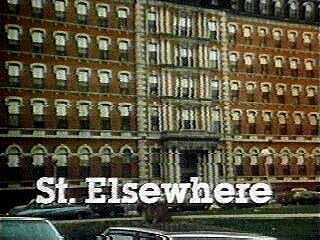
Welcome to Retro Television Reviews, a feature where we review some of our favorite and least favorite shows of the past! On Fridays, I will be reviewing St. Elsewhere, a medical show which ran on NBC from 1982 to 1988. The show can be found on Hulu and, for purchase, on Prime!
This week, Dr. Craig does the unthinkable …. maybe.
Episode 1.20 “Craig In Love”
(Dir by Victor Lobl, originally aired April 12, 1983)
Dr. Craig is indeed in love in this episode. He’s totally smitten with the Hungarian Dr. Vera Anya and, when his wife Ellen (played by Bonnie Bartlett, real-life wife of William Daniels) goes out of town to visit her mother, Craig makes plans to show Dr. Anya around the town and maybe more….
Ugh. Seriously, I don’t like the idea of Dr. Craig cheating on his wife and, though this episode leaves it ambiguous as to what actually happened, it totally appears that’s what Craig did over the weekend. Dr. Craig is pompous and full-of-himself and rude to almost everyone he talks to but it’s always appeared that he totally loved his wife. The whole idea of him thinking about cheating — much less actually doing it — just doesn’t seem right for his character. And, quite frankly, Dr. Anya wasn’t really that intriguing of a character so if Craig did share more than just that passionate goodbye kiss with her …. well, I prefer to pretend this entire storyline didn’t happen.
Far more interesting was the malpractice suit brought against Dr. Chandler and Nurse Daniels. As the hospital’s lawyer explains it, there really isn’t much of a case to be made for malpractice. Instead, the dead man’s family is just hoping to get a quick settlement out of it. Most doctors aren’t willing to pay the legal fees and don’t have the time to go to court. Chandler, however, is personally offended by the suit and pledges to do whatever he has to do fight it. Yay, Chandler! Seriously, I hate people who try to bully people into settlements. After my Dad died, there was this crazy woman who thought she could bully his estate into giving her half a million dollars. Instead, she received nothing and that’s exactly what she deserved. Both Denzel Washington and Ellen Bry gave good performances this week. Ellen Bry’s Nurse Daniels is quickly becoming one of my favorite characters. She doesn’t let anyone push her around.
Speaking of pushing people around, Dr. Morrison finally got sick of Dr. White’s drug addiction and the two of them ended up having a fist fight in the men’s room. Still, when White later crashed his girlfriend’s car and needed to be bailed out of jail, Morrison was the first person that he called. Morrison, being a saint, got White out of jail. White, being a jerk, barely even said thank you. Morrison went to Westphall with his concerns about Dr. White. Westphall responded that it wasn’t his place to give a fatherly lecture. That’s cold, Westphall. What about when he kills a patient because he’s high? Will you care then? No wonder St. Eligius is getting sued for malpractice!
Finally, Dr. Samuels had a cold so he spent the entire episode whining about it. Seriously, Dr. Samuels is one of my least favorite characters of all time.
This episode was uneven for me. I’m not happy about Dr. Craig being a cheater but I am happy that Dr. Chandler is standing up for himself. Dr. White appears to be heading to a very dark place.
There’s only two episodes left in the first season so I’m assuming we’re going to get some sort of closure to at least some of these storylines. We’ll see what happens next week!
Welcome to Retro Television Reviews, a feature where we review some of our favorite and least favorite shows of the past! On Fridays, I will be reviewing St. Elsewhere, a medical show which ran on NBC from 1982 to 1988. The show can be found on Hulu and, for purchase, on Prime!
This week, someone’s getting sued!
Episode 1.19 “Working”
(Dir by Bruce Paltrow, originally aired on April 5th, 1983)
Dr. Morrison becomes upset when he deduces that a patient (Ed Lauter) is trying to drink himself to death so that his family can collect his life insurance. Dr. Chandler becomes upset when one of his patients dies while being admitted to the hospital and the family ends up suing for malpractice. For once, Dr. Craig is not upset because he’s been charmed by a visiting surgeon (Rita Zohar) from Hungary. And, finally, Dr. White continues to be Dr. White as he obsesses over his separation, pops pills, and screws up even the simplest of medical tasks.
It’s just another day at St. Eligius!
This was a pretty good episode. Dr. Craig’s storyline was probably the weakest but William Daniels is such a good actor and Dr. Craig was such an interesting character that even a weak Craig storyline is still better than average. (That said, the visiting surgeon’s amazement at visiting at actual McDonald’s was a bit heavy handed.)
What really made this episode stand out is that Denzel Washington finally got to do something more than just stand in the background and nod. For most of the first season, Dr. Chandler has been portrayed as being perhaps the most perfect and ultra-competent resident in the history of medical residences so it was interesting to see him not having all the answers for once. Washington did a wonderful job portraying Chandler’s transformation from being almost cocky to being worried that he actually was, in some way, responsible for his patient’s death. (The fact that the other doctors just shrugged off the man’s death made Chandler even more determined to figure things out.) In the past, Chandler has always been quick to call out other people’s errors and this episode actually features him nearly coming to blows with White over White’s terrible job performance. Seeing Chandler having to critically examine his own job performance brought a bit more depth to the character.
Speaking of Dr. White …. WHAT A JERK! The first season is nearly over and it seems like the show is building up to something terrible happening to Dr. White. Whatever it may be, it’s hard not to feel that he brought it on himself. In a hospital full of dedicated doctors, Dr. White is the guy you never want to see come in your room. I have no idea what’s going to happen with this doctor but I can’t imagine it will be a good thing.
Finally, Morrison’s storyline left me wondering why Morrison always ends up with the most melodramatic patients. That said, Ed Lauter was one of the best and his scenes with Norman Lloyd’s Dr. Auschlander were wonderfully acted by both men.
This was a good episode. We’re approaching the end of season one and I can’t wait to see how things are going to wrap up with the doctors at Boston’s most underrated hospital.
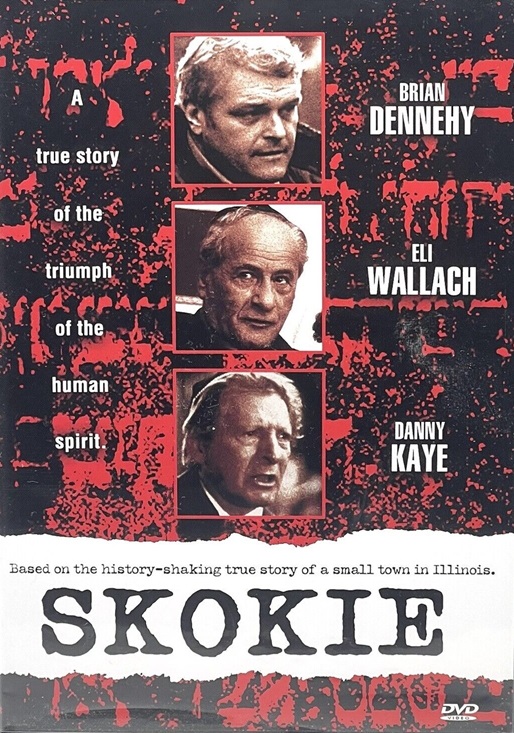
Skokie, a 1981 made-for-television movies, opens in a shabby Chicago office.
A group of men, all wearing brownshirts and swastika armbands, listen to their leader, Frank Collin (George Dzundza). Collin says that they will be holding their next rally in the town of Skokie. Collin explains that Skokie has a large Jewish population, many of whom came to the United States after World War II. Collin wants to march through their town on Hitler’s birthday.
If not for the swastika and the brownshirt, the overweight Collin could easily pass for a middle-aged insurance salesman, someone with a nice house in the suburbs and an office job in the city. However, Frank Collin is the head of the American National Socialist Party. a small but very loud group of Nazis who specialize in marching through towns with large Jewish populations and getting fee media attention as a result of people confronting them. Making Frank Collin all the more disturbing is that he isn’t just a character in a made-for-television movie. Frank Collin is a real person and Skokie is based on a true story.
The Mayor (Ed Flanders) and the police chief (Brian Dennehy) of Skokie are, needless to say, not happy about the idea of modern-day Nazis marching through their city. Though they inform Collin that he will have to pay for insurance before he and his people will be allowed to hold their rally, they know that the courts have been striking down the insurance requirement as being a violation of the First Amendment. While the mayor and the police chief worry about the political fallout of the rally, the Jewish citizens of Skokie debate amongst themselves how to deal with the Nazis. Bert Silverman (Eli Wallach) and Abbot Rosen (Carl Reiner) argue that the best way to deal with Collin and his Nazis is to refuse to acknowledge them, to “quarantine” them. As Rosen explains it, Collin is only marching to get the free publicity that comes with being confronted. If he’s not confronted, he won’t make the evening news and his rally will have been for nothing. However, many citizens of Skokie — including Holocaust survivor Max Feldman (Danny Kaye) — are tired to turning their back on and ignoring the Nazis. They demand that the Nazis be kept out and that, if they do enter the city, they be confronted.
With the support of the ACLU, Collin sues for his right to march through Skokie. The ACLU is represented by Herb Lewishon (John Rubinstein), a Jewish attorney who hates Collin and everything that he stands for but who also feels that the First Amendment must be respected no matter what. When Lewishon is asked how he, as a Jew, can accept a Nazi as a client, Lewishon relies that his client is the U.S. Constitution.
Skokie is a thought-provoking film, all the more so today when there’s so much debate about who should and should not be allowed a platform online. (Indeed, Collin and his Nazis would have loved social media.) Lewishon argues that taking away any group’s First Amendment rights, regardless of how terrible that group may be, will lead to slippery slope and soon everyone’s First Amendment rights will be at risk. Max Feldman, and others argue that the issue isn’t free speech. Instead, the issue is standing up to and defeating evil. The film gives both sides their say while, at the same time, making it clear that Frank Collin and his Nazis are a bunch of fascist losers. It’s a well-acted and intelligently written movie, one that rejects easy answers. Needless to say, at a time when so many people feel free to be openly anti-Semitic, it’s a film that’s still very relevant.
As for the real Frank Collin, he would eventually be charged with and convicted of child molestation. After three years in prison, he changed his name to Frank Joseph and became a writer a New Age literature. He’s looking for Atlantis but I doubt they’d want him either.
 Through the Shattered Lens