Retro Television Review: The Night They Saved Christmas (dir by Jackie Cooper)


Welcome to Retro Television Reviews, a feature where we review some of our favorite and least favorite shows of the past!  On Sundays, I will be reviewing the made-for-television movies that used to be a primetime mainstay.  Today’s film is 1984’s The Night They Saved Christmas!  It  can be viewed on Tubi and YouTube.

The Night They Saved Christmas argues that there are two types of people in the world.

There are people who still believe in Santa Claus and all that he represents and then there are the people who gave up their belief a long time ago.  Those who believe in Santa Claus are still full of the Christmas spirit and, under the right circumstances, they might even get to meet the elves and the jolly old man himself.  Those who do not believe are destined to waste their holiday on focusing on material things that aren’t really important.

Petroleum engineer Michael Baldwin (Paul Le Mat) doesn’t believe in Santa Claus and that’s why he had no trouble moving his entire family to the North Pole so that they could freeze while he headed up an oil exploration project.  Michael and his boss, billionaire Sumner Murdock (Mason Adams), are determined to find oil and they’ve got an endless supply of dynamite with which to search for it.

Michael’s wife, Claudia (Jaclyn Smith), still believes in the spirit of Santa and she encourages their children to believe as well.  For that reason, Ed the Elf (played by singer Paul Williams), is willing to take Claudia and the kids to North Pole City.  They get to meet Santa (Art Carney) and they even learn how Santa uses satellite technology to deliver presents all over the world.  The city is really quite impressive, with the movie making good use of matte paintings and miniatures to create the impression of a magical metropolis.  And Santa turns out to be a pretty nice guy, even if he does tell the elves that he’s sick of them singing Jingle Bells.

Unfortunately, North Pole City is in danger!  Every day, the oil company’s dynamite causes a mini-earthquake.  With the dynamiting getting closer and closer to North Pole City, Santa and the elves worry that they might be on the verge of getting blown up!  Can Claudia and the kids convince Michael to stop blowing up huge chunks of the North Pole before Christmas is ruined!?

Well, listen — I don’t think it’s a spoiler for me to tell you that Christmas is not ruined.  It would be pretty cynical for the movie to end with Michael blowing up Santa Claus and cynical is one thing that The Night They Saved Christmas is not.  This is a very earnest film, full of cheery elves, a paternal Santa, and lots of Christmas music.  Even greedy old Mr. Murdock turns out to be not that bad of a guy.  In the end, this film says that Santa and the spirit of Christmas is for everyone and that’s certainly not a bad message.  It’s a likeable movie for the holiday season and Art Carney is a perfect Santa Claus, even if he does appear to be a little underweight for the role.  As played by Carney, Santa is welcoming, good-humored, and still enthusiastic about his job, even after centuries of doing it.  He’s exactly the way you would want Santa to be.  This is a film that earns the right to wish everyone a merry Christmas!

A Movie A Day #209: Assassination (1987, directed by Peter R. Hunt)


Charles Bronson, man.

Long before Clint Eastwood starred in In The Line of Fire, Charles Bronson played an over the hill secret service agent in Assassination.  Having just returned to active service after a six month leave of absence, Jay Killian (Charles Bronson), thinks that he is going to be assigned back to the presidential detail.  Instead, he is given the job that no one wants.  Jay is assigned to protect the first lady, Lara Craig (Jill Ireland, Bronson’s real-life wife).

Lara is a handful.  Every one tells Killian that she is “even worse than Nancy.”  (This running joke probably played better in 1987.  If Assassination had been released ten years later, Lara would have been described as being “even worse than Hillary.”)  Lara does not like being told what she can and cannot do. When she refuses to follow Killian’s orders not to ride in a convertible, she ends up getting a black eye when a motorcycle crashes and Killian instinctively throws her to the floor.  Lara may not like Killian but when, she is targeted by a notorious terrorist (Erik Stern), she will have to learn to trust him.  Her life depends on it, especially when it becomes clear that the order to have her killed is coming from inside the White House.  It turns out that the President has been impotent for years.  That may not have troubled Lara before but now Killian is showing her that a real man looks like Charles Bronson.  A divorced president will never be reelected.  A widowed president, on the other hand…

Assassination was one of the last films that Bronson made for Cannon.  It’s never as wild as Murphy’s Law, Kinjite, or many of Bronson’s other Cannon films but it is always interesting to watch Bronson acting opposite of Ireland.  Bronson famously did not get along with many people but he loved Ireland and that was something that always came through in the 15 movies that they made together.  Whenever Bronson and Ireland acted opposite each other, Bronson actually seemed to be enjoying himself.  And while it may be subdued when compared to his other Cannon films, Assassination provides just enough scenes of Bronson being Bronson.

Who other than Bronson could tell his much younger girlfriend that, because of her, he might “die of terminal orgasm?”

Who other than Bronson could drive around a motorcycle with machine gun turrets and execute a jump that would put his old co-star Steve McQueen to shame?

Who other than Bronson could use a bazooka to kill one man and then smile about it?

Charles Bronson, man.  No offense to Bruce Willis, who will be trying to step into Bronson’s gigantic shoes with the upcoming Death Wish remake, but nobody did it better than Bronson.


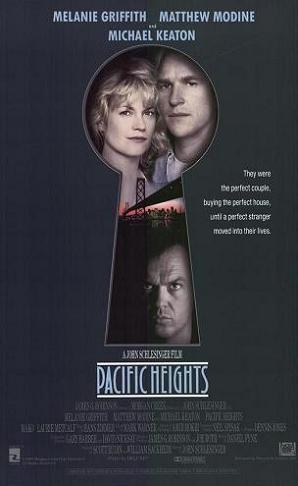
A Movie A Day #157: Pacific Heights (1990, directed by John Schlesinger)


Michael Keaton is the tenant from Hell in Pacific Heights.

In San Francisco, Patty (Melanie Griffith) and Drake (Matthew Modine) have just bought an old and expensive house that they can not really afford.  In order to keep from going broke, they rent out two downstairs apartments.  One apartment is rented by a nice Japanese couple.  The other apartment is rented by Carter Hayes (Michael Keaton).  Carter convinces Patty and Drake not to check his credit by promising to pay the 6 months rent up front.  The money, he tells them, is coming via wire transfer.

The money never arrives but Carter does.  Once he moves into the apartment, Carter changes the locks so that no one but him can get in.  At all hours of the day and night, he can be heard hammering and drilling inside the apartment.  Even worse, he releases cockroaches throughout the building.  When Drake demands that Carter leave, the police back up Carter.  After goading Drake into attacking him, Carter gets a restraining order.  Drake is kicked out of his home, leaving Patty alone with their dangerous tenant.

Pacific Heights is the ultimate upper middle class nightmare: Buy a house that you can not really afford and then end up with a tenant who trashes the place to such an extent that the property value goes down.  As a thriller, Pacific Heights would be better if Drake and Patty weren’t so unlikable.  (When this movie was first made, people like Patty and Drake were known as yuppies.)  Much like Drake’s house, the entire movie is stolen by Michael Keaton’s performance as Carter Hayes.  Carter was not an easy role to play because not only did he have to be so convincingly charming that it was believable that he could rent an apartment just by promising a wire payment but he also had to be so crazy that no one would doubt that he would deliberately infest a house with cockroaches.  Michael Keaton has not played many bad guys in his career but his performance as Carter Hayes knocked it out of the park.

One final note: Keep an eye out for former Hitchcock muse (and Melanie Griffith’s mother) Tippi Hedren, playing another one of Carter’s potential victims.  Her cameo here is better than her cameo in In The Cold of the Night.