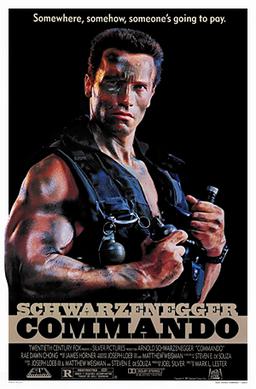
Commando (1985, directed by Mark L. Lester)


John Matrix (Arnold Schwarzenegger) is a former colonel in the U.S. Amy Special Forces.  He was one of the best at what he did but he’s now retired from all that and lives in the mountains of California with his young daughter, Jenny (Alyssa Milano).  When Capt Bennett (Vernon Wells), Martix’s former comrade-in-arms, kidnaps Jenny, Matrix is told that he has 11 hours to assassinate the leader of the country of Val Verde so that General Arius (Dan Hedaya) can launch a coup.  Knowing that the bad guys are planning on killing both him and Jenny no matter what he does, Matrix instead takes out Arius’s men as he makes his way to where Jenny is being held captive.

Commando is one of my favorite Schwarzenegger films.  It has some of the best one-liners (“I like you, Sully, I kill you last,”), some of the best character actors (Sully is played by David Patrick Kelly), and also one of Schwarzenegger’s best performances.  In Commando, Schwarzenegger shows that he’s willing to poke fun at himself, which was something that set him apart from many of the action heroes of the 80s.  (Stallone eventually learned how to poke fun at himself but it took a very long time.)  At his California home, Matrix chops down and carries a tree without breaking a sweat.  During a chase through a mall, Matrix easily lifts up a phone booth.  Matrix may be trying to save the life of his daughter but he still takes the time to come up with one-liners and fall in love with flight attendant Cindy (Rae Dawn Chong).  Commando is essentially just a big comic book brought to life and Schwarzenegger understands that and gives a very knowing, self-aware performance.  Director Mark Lester wastes no time getting to the action and the result is one of the most entertaining action films of the 80s.

Believe it or not, Commando was originally envisioned as being a Gene Simmons picture.  When the KISS frontman turned down the film, the script was rewritten for Arnold Schwarzenegger.  Schwarzenegger made this film after The Terminator and it was another box office success.  As for Gene Simmons, he would have to wait for Runaway to make his action debut.

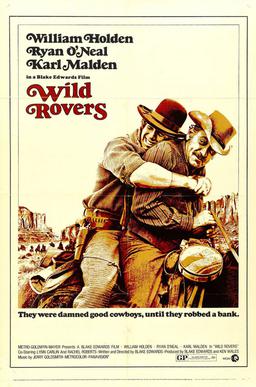
Wild Rovers (1971, directed by Blake Edwards)


In Montana, Walter Buckman (Karl Malden) runs his ranch with an iron hand, warning his neighbor, Hansen (Sam Gilman) not to even think of allowing his sheep to graze on his land.  Walter has two sons, hot-headed John (Tom Skerritt) and the laid back and good-natured Paul (Joe Don Baker).  When Walter learns that two of his ranch hands — aging Ross Bodine (William Holden) and young Frank Post (Ryan O’Neal) — have robbed a bank and are heading down to Mexico, he sends John and Paul to bring them back.  Walter is a big believer in the law and he’s not going to allow any of his people to get away with breaking it.

Ross is a veteran cowboy, who only robbed the bank after Walter withheld his pay to cover the damage of a saloon fight between Ross and Hansen’s men.  Frank is the wilder of the two.  He looks up to Ross and Ross is protective of Frank, even if he has a hard time admitting it.  Ross and Frank are heading down to Mexico so Ross can retire in peace.  Instead of going straight to Mexico, though, they make the mistake of stopping by a small town so Frank can play a little poker and visit the town’s brothel.

Wild Rovers was Blake Edwards’s attempt to make an epic, revisionist western and he includes plenty of shots of the sun setting over the mountains as well as several violent shoot-outs that are shot in Peckinpah-style slow motion.  Unfortunately, the story itself isn’t really strong enough to support Edwards’s ambitions and all of the shots of the countryside, while nice to look at, don’t really add up too much.  Wild Rovers was also a troubled production, with MGM slashing Edwards’s original three-hour film down to 106 minutes and advertising it with a poster featuring O’Neal hugging Edwards from behind, making the film look like a buddy comedy in the style of Butch Cassidy and the Sundance Kid (or an early version of Brokeback Mountain) as opposed to a violent and elegiac western.  (In 1986, a director’s cut was released, which ran for 136 minutes.)  If you only know Blake Edwards from his Pink Panther movies, the grim and tragedy-filled Wild Rovers will come as a surprise.

One thing that Wild Rovers does have going for it is a good cast.  William Holden and an energetic Ryan O’Neal are a solid team and Karl Malden, Tom Skerritt, Rachel Roberts, James Olson, and Moses Gunn all give good performances too.  This movie also provides Joe Don Baker with a sympathetic role and he’s very likable as the laid back Paul Buckman.  It’s not the type of role that Baker often got to play and it’s obvious that a lot of scenes between John and Paul were cut from the film but, in the truncated version, Joe Don Baker’s Paul Buckman becomes the moral center of the film’s story.

Wild Rovers was a disappointment at the box office, one of many that Edwards suffered in the 70s before he and Peter Sellers brought back Inspector Clouseau.

Cave-In! (1983, directed by Georg Fenady)


Sen. Kate Lassiter (Susan Sullivan) is visiting a cave in order to determine whether it’s safe to leave it open to the public.  Giving the senator and her group the grand tour is Gene Pearson (Dennis Cole), who is not only a park ranger but who is also Kate’s ex-boyfriend.  The question as to whether or not the cave is safe for the general public is answered by a sudden cave-in, which leaves Kate, Gene, and the others trapped.  Now, Gene has to lead the group across often dangerous terrain to safety.

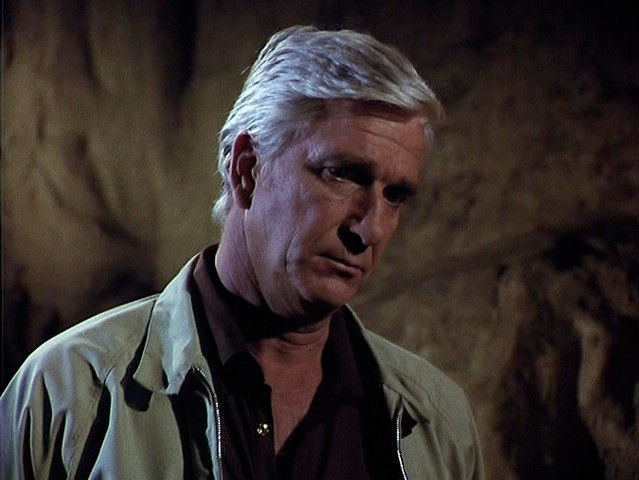
Along with Kate, the group includes a bitter cop named Joe Johnson (Leslie Nielsen!), his wife Liz (Julie Sommars), arrogant Prof. Harrison Soames (Ray Milland), and the professor’s shy daughter, Ann (Sheila Larkin).  Joe and Liz are struggling to keep their marriage together.  Prof. Soames refuses to allow his daughter to have a life of her own.  The six of them are going to have to somehow work together if they’re going to survive this cave-in!  Of course, they’re not alone.  There’s a seventh person in the cave.  Tom Arlen (James Olson) is a dangerous convict who was in the cave hiding out from the police.  Now, he’s trapped along with everyone else.

Cave-In is a pretty standard disaster movie.  Produced by Irwin Allen, it was originally filmed in 1979 but it didn’t air on NBC until 1983.  By that time, Airplane! had pretty much reduced the disaster genre to a joke.  Ironically, Leslie Nielsen himself has a starring role in Cave-In, playing exactly the type of character that he parodied in both Airplane! and Police Squad.  At the time he filmed Cave-In, Neilsen was still a dramatic actor but by the time the movie aired, his deadpan style was firmly associated with comedy.  Even when his dialogue is serious, the natural instinct is to laugh.

Cave-In gets bogged down by flashbacks.  Even though everyone should be concentrating on making their way to safety, it instead seems that they’re too busy obsessing on their backstory.  Since no one’s backstory is that interesting, the flashbacks don’t do much to liven up the film and, unfortunately, a cave-in just isn’t as compelling as a fire in skyscraper or an upside down boat.

On the plus side, every disaster movie needs an arrogant bastard who makes escape unnecessarily difficult and, in the 70s, no one played a better arrogant bastard Ray Milland.  Otherwise, Cave-In is a forgettable entry from the final days of the disaster genre.

A Movie A Day #59: Moon Zero Two (1969, directed by Roy Ward Baker)


moon_zero_two

Earlier today, I was reading a now-deleted tweet from Congressional candidate Brianna Wu, in which she speculated that private companies would militarize the moon and use it as a place to launch rocks at the Earth.  According to Wu, “Rocks dropped from there (the moon) have power of 100s of nuclear bombs.”

This, of course, immediately brought to mind Moon Zero Two, a “space western” that Hammer Films produced in the wake of 2001: A Space Odyssey.

The year is 2021 and the moon is being colonized by private companies.  The Americans and the Russians have made peace and now jointly run the Moon Hilton.  Bill Kemp (James Olson) was one of the first men in the moon but, having grown disillusioned with working for heartless corporations, Kemp is now an independent operator, salvaging meteorites with his Russian partner, Korminski (Ori Levy).  With his flight license about to be revoked by his enemies in the Corporation, Kemp has been grounded by his own girlfriend, Sheriff Elizabeth Murphy (Adrienne Corri).

Possible financial salvation comes when Kemp is hired by J. J. Hubbard (Warren Mitchell) to help him illegally salvage a sapphire asteroid that is orbiting the far side of the moon.  At the same time, a young woman named Clementine (Catherine Schell, who later starred in another science fiction epic about the moon, Space: 1999) wants Kemp to help her search for her brother, who went missing while also working on the far side of the moon.

Moon Zero Two starts with some Schoolhouse Rock-style animation that shows how the U.S. and the Russians originally landed on the moon:

Though the animated opening seems more appropriate for an Ealing comedy, the rest of Moon Zero Two is a fairly straight western, with claim jumpers, shootouts, and a few moments of comedy coming from the story being set on the moon instead of Arizona.  For instance, there’s a barroom brawl that takes place in zero gravity.  Even while paying homage to old westerns, Moon Zero Two also tries to predict the future, which looks a lot like 1969.  This means psychedelic costumes and a Vegas style dance revue at the Moon Hilton, one that is reminiscent of the USO show in Apocalypse Now.  The mix of styles is enjoyably absurd and everyone seems to be having fun playing cowboy.

vlcsnap-00005

James Olson is the token American in the cast but, for fans of British comedy, the most interesting thing about Moon Zero Two will be seeing Warren Mitchell, who played Alf Garnett in Til Death Do Us Part and inspired All In The Family‘s Archie Bunker, playing ruthless claim jumper, J. J. Hubbard.  Hubbard’s main henchman is played by Bernard Bresslaw, who some viewers may recognize from the Carry On films.  Also, Monty Python fans will want to keep an eye out for Carol Cleveland, who has a very small role as a stewardess.

Years after it was first released, Moon Zero Two was one of the first movies to be featured on Mystery Science Theater 3000.  This was one of the earliest episodes, from before even TV’s Frank joined the show.  I have not seen the MST 3K version but it is available both on YouTube and as a part of Shout Factory’s 25th Anniversary Box Set.

Here’s an artist’s rendering of Crow and Tom Servo having a Moon Zero Two-style shootout.

moonzero2dvd

Tomorrow’s movie a day will be another space western, Peter Hyams’s Outland.

c5vlntuu4aariuy

The TSL’s Daily Horror Grindhouse: Amityville II: The Possession (dir by Damiano Damiani)


amityville_ii_the_possession

Agck!

The 1982 “prequel” Amityville II: The Possession is a film that is so grimy and icky and yucky and disgusting that you’ll want to take a shower right after you watch it.  And then you’ll probably end up taking two more showers, just to be sure that you’ve washed the film away.

Seriously, this is an amazingly disturbing film.

Claiming to show how that infamous house in Amityville, New York came to be haunted in the first place, this film opens with The Montelli Family moves into a big house with quarter moon windows.  The family patriarch is Anthony (Burt Young), a former cop who walks with a cane.  Anthony is an angry monster, an abusive husband, and a terrible father.  His wife, Dolores (Rutanya Alda), lives her life in denial, insisting that a new house means a new beginning and continually praying that her family will find peace.  Anthony and Dolores have four children.  The two youngest are at the mercy of their angry father.  Teenagers Patricia (Diane Franklin) and Sonny (Jack Magner) are both looking forward to the day that they can escape their family.

As soon as the Montellis move in, strange things start to happen.  It turns out that there’s a strange tunnel in the basement, one that appears to lead to nowhere.  When obscene messages appear on the walls of the house, Anthony starts to beat the youngest children but, fortunately, Sonny grabs a rifle and points it at his father’s head.  When the local priest, Father Adamsky (James Olson), shows up to bless the house, he ends up getting so disgusted at Anthony that he leaves without finishing.

In fact, Father Adamsy is a remarkable ineffectual priest.  When he attempts to talk to Sonny, he simply assumes that Sonny isn’t talking because he’s rude.  What Adamsky doesn’t suspect is that Sonny’s being rude because he’s been possessed by a demon for the basement!  When Patricia confesses that she and Sonny have been having sex, Adamsky doesn’t do anything about it.  When Patricia tries to call him to let him know that her brother appears to be possessed, Adamsky refuses to answer the phone and instead goes skiing for the weekend.

And, of course, while Adamsky is gone, Sonny grabs that rifle and, in a nightmare-inducing series of scenes, kills everyone in the house…

Of course, when Father Adamsky returns, he feels guilty and he decides to perform an exorcism.  MAYBE HE SHOULD HAVE DONE THAT EARLIER!  But no … he had to go skiing…

Anyway, Amityville II: The Possession is a deeply icky film.  It’s undeniably effective and has a lot of scary moments but it’s not an easy film to sit through.  Between Anthony beating his family and Sonny walking into Patricia’s room and asking her to “play a game,” this is a film that really gets under your skin.  You’ll never forget it but, at the same time, you’ll also never want to watch it again.

Interestingly enough, Amityville II was directed by Damiano Damiani, an Italian director who is probably best known for movies like A Bullet For The General and Confessions of a Police Captain, genre films that often featured a subversive political subtext.  Though Amityvile II is not overly political, the film’s portrait of the suburban Montelli family as a ticking time bomb does definitely fit in with Damiani’s other work.  Damiani reportedly set out to make the most disturbing film that he possibly could and he succeeded.

Embracing the Melodrama Part II #53: Someone I Touched (dir by Lou Antonio)


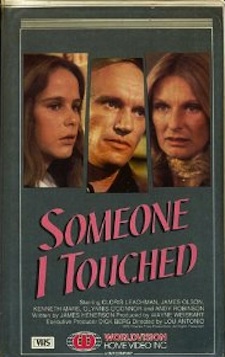
someoneitouch_225In the 1975 made-for-TV venereal disease epic Someone I Touched, there’s a scene of children’s author Cloris Leachman at work.  She’s sitting in her office, typing away on a manual typewriter.  Directly behind her is a crude drawing of a clown.  And to the right of her, there’s a statue of the same creepy clown.  Eventually, her husband (played by James Olson) comes into the office and, after a very long argument, finally forces himself to confess that, as the result of a one-night stand with a grocery store cashier (Glynnis O’Connor), he has syphilis.  And it’s possible that Cloris now has syphilis herself.  And, since Cloris is pregnant, it’s also possible that their baby may be born with syphilis.

And it’s all very serious and very dramatic and certainly, it’s nothing to laugh at.

But, I have to admit, that I could not stop thinking about that creepy clown.  And I have to admit that as Cloris was stumbling back in shock, I started to giggle because I just couldn’t stop thinking about what it must be like to work in an office surrounded by creepy clowns.  It made me think about The Sims and how, if your sims ended up getting depressed, the tragic clown would arrive and just makes things worse.

That’s the thing with Someone I Touched.  It’s a very serious film and yet it’s almost impossible to take that seriously.  Whenever a helpful health worker (Andy Robinson, the Scorpio Killer from Dirty Harry) shows up to dispense statistics or the cashier attempts to track down everyone that she’s ever had sex with or Cloris and Olson start to argue about the sad state of their marriage, you’re very aware that the film is dealing with some serious subject matter.  And yet, you can’t take it seriously because of all the little details.  You find yourself fixated on how ugly 70s interior design truly was.  You watch this tiny vein in Olson’s forehead and you worry if it’s going to explode during some of his more dramatic scenes.  You listen to dialogue like, “It (syphilis) can be a real drag if you don’t take care of it” and “Tramps get Syphilis!”  You realize that Leachman is supposed to be playing someone in her mid-30s, even though she was 49 when the film was made.  You listen as Olson explains his recent one night stand by saying, “I was looking down the barrel of my 40th birthday,” despite the fact that Olson looks like he’s in his mid-50s.  And let’s not forget those creepy clowns…

And you just can’t take the movie seriously.  You know that you should but you just can’t.  How could one well-intentioned film produce so many involuntary giggles?

Now, I know you’re probably thinking to yourself, “I would never watch a movie like that!”  But, if you change your mind, Someone I Touched is currently available on Netflix streaming.


Embracing the Melodrama Part II #31: Rachel, Rachel (dir by Paul Newman)


Original_movie_poster_for_the_film_Rachel,_RachelI recently saw the 1968 best picture nominee Rachel, Rachel on TCM and I have to say that, at first, I was rather underwhelmed by it.  Don’t get me wrong.  I thought it was well-acted.  I thought it managed to capture a lot of details of small town life.  I thought that, for a film made in 1968, it was surprisingly mature and nonjudgmental when it came to exploring feminine sexuality.  I was even more surprised to see a nearly 50 year-old movie that actually featured a sympathetic portrayal of a lesbian.  Just consider that the homophobic The Sweet Ride was released at the same time and you can see just how unusually progressive Rachel, Rachel was as far as this was concerned.

And yet, when I first watched Rachel, Rachel, it was difficult for me to connect with it.  And I really wasn’t sure why.  I mean, it is true that Rachel, Rachel is one of those films that moves at a very deliberate post but, trust me, I’ve seen and enjoyed many films that were a helluva lot slower than Rachel, Rachel.  But, for whatever reason, it took me two viewings to really appreciate Rachel, Rachel as a surprisingly sensitive character study.

The film is about Rachel (Joanne Woodward), a 35 year-old virgin who lives with her mother in a small Connecticut town.  Since the death of her stern and overbearing father, Rachel has lived with her mother.  She’s a withdrawn and meek woman who has frequent fantasies that veer between unrealistic happiness and nightmarish morbidity.  Her best friend, another unmarried teacher named Calla (Estelle Parsons), invites Rachel to a revival meeting and, for the first time in her life, Rachel actually allows herself to be openly passionate.  After the meeting, Calla suddenly kisses her.  Shocked, Rachel temporarily ends their friendship.

Even before the revival meeting, Rachel has run into Nick (James Olsen), a friend from high school who is in town to visit his family.  After getting kissed by Calla, Rachel ends up turning to Nick and losing her virginity to him.  Rachel believes that she’s in love with Nick and is soon fantasizing about their future children.  However, it’s obvious to everyone (except for Rachel) that Nick doesn’t quite feel the same way…

When I first saw Rachel, Rachel, I had a hard time relating to the character of Rachel.  I watched and, as much as I tried to be sympathetic, I still found myself wondering how anyone could possibly still be a virgin at the age of 35.  I mean, I understand that times were different and all but seriously!  I guess back then, people actually were serious about the whole “no sex before marriage” thing.  (That probably explains why people used to get married when they were 17.)  The film is full of largely silent flashbacks to Rachel’s youth and we see that she was raised in an emotionally repressed environment.  She was raised to wait for the right man to come along and, when he didn’t, Rachel eventually found herself as a 35 year-old virgin.

And, without getting too TMI here, let’s just say that I couldn’t relate to Rachel’s situation.

But, when I watched the film for a second time, I discovered that even if I don’t know what it’s like to be a 35 year-old virgin, a lot of Rachel’s experiences were, in their way, universal.  Consider the scene at the start of the film where Rachel fantasizes that everyone in town is staring at her as she walks down the sidewalk, all because her slip is showing.  Who hasn’t, at some point in their life, felt like everyone was staring at her and judging?  And, for that matter, who hasn’t had a Nick in their life?

Interestingly enough, Rachel, Rachel was the directorial debut of the iconic actor Paul Newman.  One thing that I’ve noticed about films directed by actors (especially first films) is that the actor-turned-director often seems to feel that he has to prove himself by indulging in as much showy cinematic technique as possible.  (And if you don’t understand what I mean, check out George Clooney’s Confessions of a Dangerous Mind.)  And, as much as I hate to admit it because I’ve never read one negative word about Paul Newman, I have to admit that Newman’s direction was one of the reasons why, at first, I found myself feeling detached from the film.

While Newman tells most of Rachel’s story in an admirably straight-forward way, he also included just a few too many arty flashbacks and fantasies.  Some of the fantasies — like the one at the start of the film that I mentioned two paragraphs ago — are handled well but others are distracting and they remind the viewer that they’re watching a film.  And Rachel, Rachel is a film that works best when it’s naturalistic.  Whenever it gets too self-consciously cinematic, it takes the viewer a few minutes to get sucked back into Rachel’s story.

But, and this is the important thing, Paul Newman also gets some great work out of his actors.  Judging from some other films in which I’ve seen him, James Olson was not a particularly good actor but he was great in Rachel, Rachel.  Estelle Parsons has been an overdramatic presence in a few films and a lot of tv shows but she’s great in Rachel, Rachel.  And then there’s Joanne Woodward, who was great in a lot of films, including Rachel, Rachel.  Newman and Woodward were married when they made Rachel, Rachel and were still married when Newman died 40 years later.  Newman reportedly directed Rachel, Rachel because he wanted Woodward to have a great role.  Woodward is on-screen throughout the entire film and Newman’s love for her is obvious in every frame.

Rachel, Rachel is a flawed and imperfect film but it’s still worth catching the next time that it shows up on TCM.

rachelrachel2