Film Review: Inchon (dir by Terence Young)


Inchon is an infamous film.

First released in 1982, this epic recreation of one key battles of the Korean War was an expensive film with a cast of well-known actors.  Jacqueline Bisset plays a wealthy army wife who tries to protect five South Korean children who have found themselves in the middle of the battle.  Ben Gazzara plays her husband, a major who is having an affair with the daughter of Toshiro Mifune.  David Janssen and real-life film critic Rex Reed wander through the film as journalist.  (Janssen growls like a man dealing with a serious hangover while Reed struggles to not look straight at the camera.)  Richard Roundtree plays a tough sergeant.  The great Italian actor Gabriele Ferzetti plays a Turkish officer.  And, finally, the role of legendary American general Douglas MacArthur — of “I will return” fame — is played by the very British Sir Laurence Olivier.  Olivier was apparently told that, in real life, MacArthur often sounded like the comedic actor W.C. Fields and Olivier often seems to be imitating Fields’s pinched style of speaking.  Olivier also wears almost as much makeup here as he did in his production of Othello.  MacArthur is portrayed as being almost a mystic warrior, a man who relies as much on his faith as his strategic genius to repel the communists.  (In victory, he recites The Lord’s Prayer.)  The film was directed by Terence Young, who previously brought James Bond to cinematic life.

Inchon is notorious for being a flop with both critics and audiences.  The film had a budget of $46,000,000 and reportedly made $5,000,000 at the box office before it was withdrawn.  The entirety of the budget was put up by the Unification Church, which is an organization that many people consider to be a cult.  (I like neither communists nor cultists so this film left me with no one to root for.)  The film proved to be such a flop at the box office that it has never been released on home video.  It did, however, air on television a few times and, in recent years, the television cut has been posted to YouTube.  That’s how I saw Inchon.

I watched Inchon because I’ve frequently seen it referred to as being one of the worst films ever made.  Watching the film, I have to say that I think the “worst film” label is a bit extreme.  For the most part, it’s just an extremely uneven and often rather boring film, one that mixed scenes of surprisingly brutal combat with dialogue-heavy scenes that just seem to drag on forever.  It’s a film that belongs as much in the disaster genre as the war genre as the film is full of rather shallowly-written characters who all have their own individual dramas to deal with.  Will Jacqueline Bisset save the children?  Who will sacrifice their lives to defeat the communists? Will Ben Gazzara, who often seems to be the sole member of the cast who is at least tying to give a credible performance, choose his wife or his mistress?  The film ultimately feels like a compressed miniseries.  Everyone has a story but hardly anyone makes an impression.

That said, Laurence Olivier’s performance as Douglas MacArthur …. agck!  Seriously, it’s hard to know where to even begin when it comes to talking about just how miscast Olivier is as the quintessential all-American general.  It’s been said that it takes a truly great actor to give a truly bad performance and Olivier certainly proves that to be true in this film.  Obviously frail and trying to sound like W.C. Fields, Olivier’s MacArthur is a general who would inspire zero confidence.  The film doesn’t help by portraying MacArthur as being an almost holy figure, one who is often framed to look like almost an angel descending from Heaven to lead the battle against America’s enemies.  The film is full of scenes of people discussing MacArthur’s genius just to be followed by a scene of Olivier looking old, tired, and rather grumpy.  There were a few times when I thought I could see Olivier’s hair dye running down the side of his face.  It may have been my imagination or just the graininess of the upload on YouTube but, given the quality of the film, I can’t really dismiss the possibility that it happened and no one felt like doing a second take.

As I said, Inchon can be found on YouTube.  It’s not the worst film ever made but that doesn’t mean it’s a good one.

The Life and Times of Judge Roy Bean (1972, directed by John Huston)


During the lawless day of the old west, a drifter named Roy Bean (Paul Newman) wanders into the desolate town of Vinegaroon, Texas.  When he enters the local saloon, he meets the vagrants who run the town.  They beat him, they rob him, and they tie him to the back of his horse and leave him to die.

Bean, however, does not die.  Instead, he’s nursed back to health by a beautiful young woman named Maria Elena (Victoria Principal).  Carrying a gun, Bean reenters the saloon and promptly kills nearly everyone who previously attacked him.  (“I’m not done killing you yet!” Bean yells at one fleeing woman.)  Bean sits down in front of the saloon and waits for justice.  Instead, he’s visited by a lecherous traveling preacher (Anthony Perkins), who buries the dead and gives Bean absolution.  Bean declares that he is now the “law of the West Pecos.”  As the preacher leaves, he looks at the audience and says that he never visited Bean again and later died of dysentery in Mexico.  He hasn’t seen Bean since dying so the preacher is sure that, wherever Bean went, it wasn’t Heaven.

Judge Roy Bean dispenses rough and hard justice from his saloon and renames the town Langtry, after the actress Lillie Langtry.  Bean has never met Langtry or even seen her perform but he writes to her regularly and pictures of her decorate the walls of his saloon.  Bean hires outlaws to serve as his town marshals and sentences prostitutes to remain in town and marry the citizens.  Lawbreakers are left hanging outside of the saloon.  Bean enters into a common law marriage with Maria and, for a while, they even own a bear, who drinks beer and helps Bean maintain order in the court.  Bean may be crazy but his methods clean up the town and Langtry starts to grow.  As Langtry becomes more civilized and an attorney named Arthur Gass (Roddy McDowall) grows more powerful, it starts to become apparent that there may no longer be a place for a man like Judge Roy Bean.

The real-life Judge Roy Bean did hold court in a saloon and he did name the town after Lilly Langtry.  It’s debatable whether or not he was really a hanging judge.  Because he didn’t have a jail, the maximum punishment that he could hand out was a fine and usually that fine was the same amount of however much money the accused had on him at the time of his arrest.  Because of his eccentricities and his reputation for being the “only law west of the Pecos,” Roy Bean became a legendary figure.  The Life and Times of Judge Roy Bean acknowledges from the start that it’s not a historically accurate, with a title card that reads, “Maybe this isn’t the way it was… it’s the way it should have been.”

Based on a script by John Milius and directed by Hollywood veteran John Huston, The Life and Times of Judge Roy Bean is one of the strangest westerns to ever be released by a major studio.  Featuring multiple narrators who occasionally speak directly to the camera, The Life and Times of Judge Roy Bean is an episodic mix of low comedy, graphic violence, and syrupy romance.  (The film’s sole Oscar nomination was for the song that played over scenes of Bean and Maria going on a romantic picnic with their pet bear.)  Familiar faces show up in small roles.  Along with Perkins and McDowall, Tab Hunter, Ned Beatty, Jacqueline Bissett, Ava Gardner, and Anthony Zerbe all play supporting roles.  Even a heavily made-up Stacy Keach makes an appearance as an albino outlaw named Bad Bob.

Jacqueline Bisset in The Life and Times of Judge Roy Bean

Milius has gone on the record as calling The Life and Times of Judge Roy Bean a “Beverly Hills western” and he has a point.  He envisioned the script as starring Warren Oates as a less likable and much more morally ambiguous version of Judge Roy Bean and he was not happy that his original ending was replaced by a more showy pyrotechnic spectacle.  Milius envisioned the film as a low-budget spaghetti western but Huston instead made a Hollywood epic, complete with celebrity cameos and a theme song from Maurice Jarre and Marilyn Bergman.  Milius said that his experience with The Life and Times of Judge Roy Bean is what led to him deciding to direct his own films.

Again, Milius has a point but John Huston’s version of The Life and Times of Judge Roy Bean has its strengths as well.  Though he may not be the madman that Milius originally envisioned, Paul Newman gives a good, grizzled performance as Roy Bean and the role served as a precursor for the type of aging but determined characters that Newman would specialize in during the final phase of his career.  Due to its episodic structure, the film is uneven but it works more often than it doesn’t.  The chaotic early scenes reflect a time when the west was actually wild while the later scenes are more cohesive, as society moves into Langtry and threatens to make formerly indispensable men like Roy Ban obsolete.  Even the cameo performances fit in well with the film’s overall scheme, with Anthony Perkins standing out as the odd preacher.  Finally, the young Victoria Principal is perfectly cast as the only woman that Roy Bean loved as much as Lily Langtry.

Though it’s impossible not to wonder what Warren Oates would have done with the title role, The Life and Times of Judge Roy Bean is a good end-of-the-west western.

Film Review: Save The Last Dance 2 (dir by David Petrarca)


Recently, I was shocked to discover that I had never reviewed the 2006 film, Save The Last Dance 2.

I mean, really, it seems like this is a film that I should have reviewed a long time ago. For one thing, it’s not only a dance film but it’s also a ballet film and, if you’ve been reading this site for a while, you know that I pretty much grew up going to dance class and doing pointe work and regularly injuring my ankle. Add to that, Saved The Last Dance 2 is a sequel to one of my favorite movies, the original Save The Last Dance. Really, why had I not already reviewed this film before tonight?

Well, some of it is because Save The Last Dance 2 isn’t very good. I mean, it’s basically a really forgettable sequel that lacks almost everything that made the original Save The Last Dance such a meaningful film. Oddly enough, despite preferring the original, I think I actually have watched Save The Last Dance 2 more times than I’ve watched the first film. For whatever reason, Save The Last Dance 2 is on Showtime constantly! It shows up early in the morning, when you’re still too tired to change the channel and you end up watching it because you’re lazy. This is a film that mocks you by both tarnishing the legacy of the first Save The Last Dance but by also reminding you that you don’t even have the willpower necessary to turn off the TV.

Save The Last Dance 2 continues the story of Sara, who has now been accepted to Julliard and who has broken up with her wonderful boyfriend from the first film. In the first film, Sara was played by Julia Stiles. In the second film, she’s played by Izabella Miko. On the one hand, Izabella Miko is far more convincing ballerina than Julia Stiles was. (Unlike Julia Stiles, Izabella Miko was a dancer who even studied at the School of American Ballet before she injured her back and decided to focus on acting instead.) On the other hand, Julia Stiles brought some needed edginess to the role whereas Izabella Miko is so constantly cheerful that it’s hard to really believe that the Sara in the sequel is the same Sara from the original film. Izabella Miko is likable as Sara but, in this sequel, the character has been robbed of everything that made her interesting in the first film. She’s just another cheerful teenager looking for success in an MTV Film.

Once Sara arrives at Julliard, she meets the usual collection of jealous classmates, demanding teachers, and quirky roommates. She also meets Miles (Columbus Short), a guest lecturer who is impressed by Sara’s hip-hop skills. Sara and Miles fall in love. Miles wants Sara to help him choreograph his next show but the demanding Monique Delacroix (Jacqueline Bisset) wants Sara to play the lead in Giselle. Playing the lead will demand all of Sara’s time and attention but it could also be her ticket to stardom. Unfortunately, it also means that she won’t be able to help out Miles, which this film portrays as somehow being the ultimate betrayal despite the fact that one assumes that Miles, being a guest lecturer on hip hop dance, knows more than one choreographer.

If the message of the first film was that Sara didn’t have to choose between loving ballet and loving hip hop, the message of the sequel is, “Actually, she does have to choose and she better pick the one that will allow us to put together a successful soundtrack.” It’s a bit depressing and hollow, to be honest. It goes against everything that made the first film special.

That said, I’ll probably watch Save The Last Dance 2 the next time I turn on the TV and it’s playing on Showtime. Changing the channel would require too much effort.

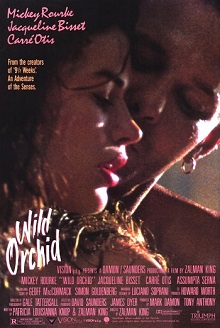
Cinemax Friday: Wild Orchid (1989, directed by Zalman King)


Emily (played by blank-faced model Carrie Otis) is a lawyer who can speak French, Spanish, Portuguese, Chinese, and Italian but who has never spoken the language of love.  A high-powered New York firm hires her away from her former employer in Chicago on the requirement that she immediately head down to Rio de Janeiro.  Claudia Dennis (Jacqueline Bisset) is trying to close the deal on buying a luxury hotel and she needs a lawyer now!

Claudia, however, has plans for Emily that go beyond real estate.  As soon as Emily arrives, Claudia arranges for her to go on a date with the wealthy and mysterious James Wheeler (Mikey Rourke).  Wheeler is single but he’s so far refused all of Claudia’s advances.  She wants to know if he’s adverse to all women or just her.  Wheeler is very taken with Emily but he’s been hurt so many times in the past that he can’t stand to be touched.  Instead, he gets his thrills by being a voyeur.

It leads to a trip through Rio, where everyone but Emily is comfortable with their sexuality.  When Wheeler isn’t encouraging her to watch a married couple have sex in the back seat of a limo, Claudia is encouraging Emily to disguise herself as a man and enjoy the nonstop carnival of life in Rio.  There’s a lot of business double-dealing, many shots of Mickey Rourke riding on his motorcycle, and a final sex scene between Rourke and Otis that is one of the most rumored about in history.  For all of the scenes of Wheeler explaining his philosophy of life, Wild Orchid doesn’t add up too much, though it certainly tries to.

Wild Orchid was a mainstay on late night Cinemax through most of the 90s.  This was Carrie Otis’s first film and to say that she gives a bad performance does a disservice to hard-working bad actors everywhere.  There’s bad and then there’s Carrie Otis in Wild Orchid bad.  She walks through the film with the same blank expression her face, playing a genius who can speak several languages but often seeming as if she’s struggling to handle speaking in just one language.  She looks good, though, and all the movie really requires her to do is to look awkward while Rourke and Bisset chew up the scenery.

On the one hand, Wild Orchid is the type of bad movie that squanders the talents of actors like Mickey Rourke, Jacqueline Bisset, and Bruce Greenwod (who has a small role as a sleazy lawyer) but, on the other hand, it’s a Zalman King film so it may be insanely pretentious but it’s also rarely boring.  Visually, King goes all out to portray Rio as being the world’s ultimate erotic city and the dialogue tries so hard to be profound that you’ll have to listen twice just to make sure you heard it correctly.  My favorite line?  “We all have to lose ourselves sometimes to find ourselves, don’t you think?”  Mickey Rourke says that and he delivers it as only he could.

Wild Orchid may have been a box office bust but it was popular on cable and on the rental market, largely because of that final scene between Rourke and Otis.  Mikey Rourke later married Carrie Otis.  Neither returned for Wild Orchid II: Two Shades of Blue.

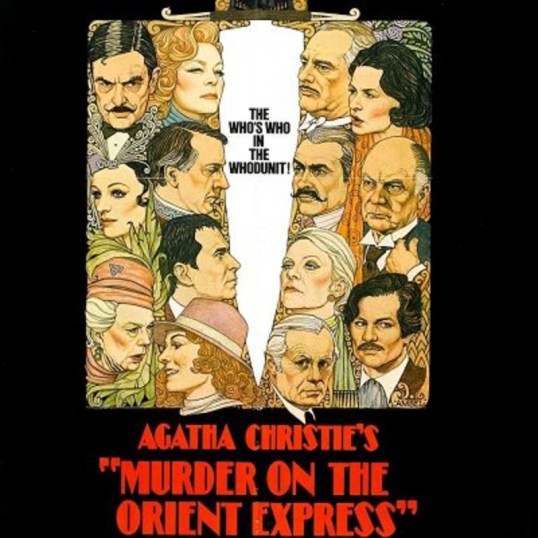
Film Review: Murder on the Orient Express (dir by Sidney Lumet)


There’s been a murder on the Orient Express!

In the middle of the night, a shady American businessman (Richard Widmark) was stabbed to death.  Now, with the train momentarily stalled due to a blizzard, its up to the world’s greatest detective, Hercule Poirot (Albert Finney), to solve the crime.  With only hours to go before the snow is cleared off the tracks and the case is handed over to the local authorities, Hercule must work with Bianchi (Martin Balsam) and Dr. Constantine (George Coulouris) to figure out who among the all-star cast is a murderer.

Is it the neurotic missionary played by Ingrid Bergman?  Is it the diplomat played by Michael York or his wife, played by Jacqueline Bisset?  Is it the military man played by Sean Connery?  How about Anthony Perkins or John Gielgud?  Maybe it’s Lauren Bacall or could it be Wendy Hiller or Rachel Roberts or even Vanessa Redgrave?  Who could it be and how are they linked to a previous kidnapping, one that led to the murder of an infant and the subsequent death of everyone else in the household?

Well, the obvious answer, of course, is that it had to be Sean Connery, right?  I mean, we’ve all seen From Russia With Love.  We know what that man is capable of doing on a train.  Or what about Dr. No?  Connery shot a man in cold blood in that one and then he smirked about it.  Now, obviously, Connery was playing James Bond in those films but still, from the minute we see him in Murder on the Orient Express, we know that he’s a potential killer.  At the height of his career, Connery had the look of a killer.  A sexy killer, but a killer nonetheless….

Actually, the solution to the mystery is a bit more complicated but you already knew that.  One of the more challenging things about watching the 1974 version of Murder on the Orient Express is that, in all probability, the viewer will already know how the victim came to be dead.  As convoluted as the plot may be, the solution is also famous enough that even those who haven’t seen the 1974 film, the remake, or read Agatha Christie’s original novel will probably already know what Poirot is going to discover.

That was something that director Sidney Lumet obviously understood.  Hence, instead of focusing on the mystery, he focuses on the performers.  His version of Murder on the Orient Express is full of character actors who, along with being talented, were also theatrical in the best possible way.  The film is essentially a series of monologues, with each actor getting a few minutes to show off before Poirot stepped up to explain what had happened.  None of the performances are exactly subtle but it doesn’t matter because everyone appears to be having a good time.  (Finney, in particular, seems to fall in love with his occasionally indecipherable accent.)  Any film that has Anthony Perkins, John Gielgud, Lauren Bacall, Sean Connery, Ingrid Bergman, and Albert Finney all acting up a storm is going to be entertaining to watch.

Though it’s been a bit overshadowed by the Kenneth Branagh version, the original Murder on the Orient Express holds up well.  I have to admit that Sidney Lumet always seems like he would have been a bit of an odd choice to direct this film.  I mean, just consider that he made this film in-between directing Serpico and Dog Day Afternoon.  However, Lumet pulls it off, largely by staying out of the way of his amazing cast and letting them act up a storm.  It looks like it was a fun movie to shoot.  It’s certainly a fun movie to watch, even if we do already know the solution.

Embracing the Melodrama Part III #4: The Grasshopper (dir by Jerry Paris)


“It’s very simple what I want to be: totally happy; totally different; and totally in love.”

— Christine Adams (Jacqueline Bisset) in The Grasshopper (1970)

Seriously, is Christine asking for too much?

Total happiness?  That may sound like a lot but trust me, it can be done.

Totally different?  That’s a little bit more challenging because, to be honest, you’re either different or you’re not.  If you have to make the effort to be different, then you definitely are not.

Totally in love?  Well, it depends on how you define love…

At the start of The Grasshopper, Christine thinks that she’s heading to America to find love.  While an oh-so late 60s/early 70s theme song plays in the background, Christine leaves her small hometown in Canada and she heads down to California.  She’s planning on meeting up with her boyfriend Eddie (Tim O’Kelly) and taking a job as a bank teller.

Of course, it soon turns out that working in a bank isn’t as exciting as Christine originally assumed.  Eddie expects Christine to just be a conventional girlfriend and that’s not what Christine is looking for. As well, it’s possible that Christine may have seen Targets, in which O’Kelly played an all-American boy who picks up a rifle and goes on a killing spree.

And so, Christine abandons Eddie and heads to Las Vegas.  Since this movie was made in 1970 and Uber didn’t exist back then, Christine’s preferred method of traveling is hitchhiking.  This gives her a chance to meet the usual collection of late 60s weirdos who always populate movies like this.  One driver crosses herself when Christine says that she plans to have a baby before getting married.  Another is a hacky Las Vegas comic.

In Vegas, Christine applies for a job as a showgirl.  As she explains to sleazy casino owner Jack Benton (Ed Flanders), she “once did Little Women in school.”

“Did you do it nude?” Jack replies.

Yep, that’s Vegas for you!  It’s the city of Showgirls, Casino, and Saved By The Bell: Wedding in Vegas, after all!

Anyway, thing do get better once Christine meets and falls in love with Tommy Marcott (Jim Brown), a former football player who is now working as a door greeter in Jack’s casino.  Everyone tells Christine not to get involved with Tommy.  One of Jack’s men, a menacing hitman who looks just like Johnny from Night of the Living Death (he even wears glasses), warns Christine to watch herself.

Through a long series of events, Christine ends up on her own again.  The usual collection of 70s events occur: murder, drugs, prostitution, and ultimately a stint as the mistress of a rich man played by Joseph Cotten.  The important thing is that it all eventually leads to Christine and a skywriter getting stoned, stealing a plane, and deciding to write a message in the sky.

That’s when this happens:

Yes, it’s all very 1970!

Anyway, The Grasshopper is one of those films that tries to have it both ways.  Establishment audiences could watch it and think, “Wow, those kids are really messed up.”  Counterculture audiences could watch it and say, “Old people are such hypocrites.”  Oddly enough, The Grasshopper was written by future director Garry Marshall and it’s an incredibly overwrought film.  There’s not a subtle moment to be found in the entire film and the film’s direction is flashy but empty.  However, for those of us who love history, it’s as close to 1970 as we’re going to get without hopping into a time machine.

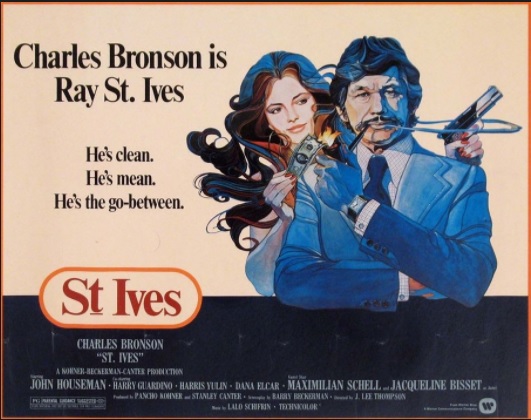
A Movie A Day #174: St. Ives (1976, directed by J. Lee Thompson)


Raymond St. Ives (Charles Bronson) is a former cop-turned-writer who desperately needs money.  Abner Procane (John Houseman) is a wealthy and cultured burglar who needs someone to serve as a go-between.  Five of Procane’s ledgers have been stolen.  The thieves are demanding a ransom and Procane believes that St. Ives is just the man to deliver the money.  But every time that St. Ives tries to deliver the money, another person ends up getting murdered and St. Ives ends up looking more and more like a suspect.  Who is the murderer?  Is it Janet (Jacqueline Bisset), the seductive woman who lives in Procane’s mansion?  Is it Procane’s eccentric psychiatrist (Maximillian Schell)?  Could it be the two cops (Harry Guardino and Harris Yulin) who somehow show up at every murder scene?  Only Ray St. Ives can solve the case!

Charles Bronson is best remembered for playing men of few words, the type who never hesitated to pull the trigger and do what they had to do.  St. Ives was one of the few films in which Bronson got to play a cerebral character.  Ray St. Ives may get into his share of fights but he spends most of the film examining clues and trying to solve a mystery.  The mystery itself is not as important as the quirky people who St. Ives meets while solving it.  St. Ives has a great, only in the 70s type of cast.  Along with those already mentioned, keep an eye out for Robert Englund, Jeff Goldblum, Dana Elcar, Dick O’Neill, Daniel J. Travanti, Micheal Lerner, and Elisha Cook, Jr.  It’s definitely different from the stereotypical Charles Bronson film, which is why it is also one of my favorites of his films.  As this film shows, Bronson was an underrated actor.  In St. Ives, Bronson proves that, not only could he have played Mike Hammer, he could have played Philip Marlowe a well.

St. Ives is historically significant because it was the first Bronson film to be directed by J. Lee Thompson.  Thompson would go on to direct the majority of the films Bronson made for Cannon in 1980s, eventually even taking over the Death Wish franchise from Michael Winner.

Lisa Cleans Out Her DVR: Secret World (dir by Paul Feyder and Robert Freeman)


(I’m currently cleaning out my DVR!  It’s going to take forever but I take like 20 capsules of Dexedrine a day so I’m pretty sure I’ll be able to stay awake until I’ve watched everything.  Anyway, I recorded the 1969 film, Secret World, off of FXM on February 1st.)

Poor Francois (Jean-Francois Vlerick)!  This eleven year-old has already experienced more tragedy than most people will have to deal with in a lifetime.  He was recently in a car accident, one that resulted in him being pinned underneath his mother’s body for several hours.  He now lives with his grandparents (Pierre Zimmer and Giselle Pascal) on their beautiful estate.  It’s a lonely life.  Francois spends most his time with his pet rabbit or, at least, he does until Wendy Sinclair (Jacqueline Bisset) shows up.

Wendy used to be his grandfather’s mistress.  She may still be.  The film is deliberately ambiguous about the current state of their relationship.  Grandma, of course, is not happy to see her.  Francois, on the other hand, becomes obsessed with her, watching her while she sleeps and even clipping off a lock of her hair.  For her part, Wendy good-naturedly tolerates Francois and his attention.

Then Olivier (Marc Morel) shows up.  Olivier is Francois’s uncle, a handsome and wealthy rogue.  The attraction between Olivier and Wendy is obvious, leading to both Francois and his grandfather growing jealous.  With all three of the men in love with Wendy, she eventually does have sex with one of them but the film deliberately declines to reveal whether she’s with Olivier or the grandfather.  (We only see a man’s hand and that man is wearing a glove as he approaches the naked Wendy.)

Secret World is a creepy little French movie, one of the many movies from the late 60s that featured boys and men lusting after Jacqueline Bisset.  Almost everything about this movie screams 1969, from the fashion to the cars to the oddly pretentious tone of the entire film.  Naturally, there’s the occasional jump cut and a few unnecessary close-ups.  There are hints of psychedelia in the shots where the sun shines over Olivier’s shoulder.  It even has a rather melancholy and ambiguous ending.  It’s a frequently gorgeous film, full of haunting shots of the French countryside.

And yet, the film adds up to almost nothing.  The movie was obviously trying to be a bittersweet coming-of-age story but it doesn’t work because the characters, as written, are almost all ciphers.  Francois is weird when we first meet him and he’s weird when we see him for the last time.  He’s one of those kids who is either going to grow up to be a writer or a serial killer.  Unfortunately, the film doesn’t seem to know which is true.

At first, I was expecting Secret World to turn out to be a horror film, mostly because little Francois was so creepy with the way that he was always staring at Wendy.  I’ve been stared at like that and it made my skin crawl.  As soon as Francois started wandering around with the scissors, I was like, “Merde!  Everyone in that château is about learn that there are worse things in the world than just ennui!”  But no, Secret World never followed up on any of those implications.  Instead, it just became a series of pretty and rather empty images.  There’s a lot of beauty but not much depth to be found in Secret World.

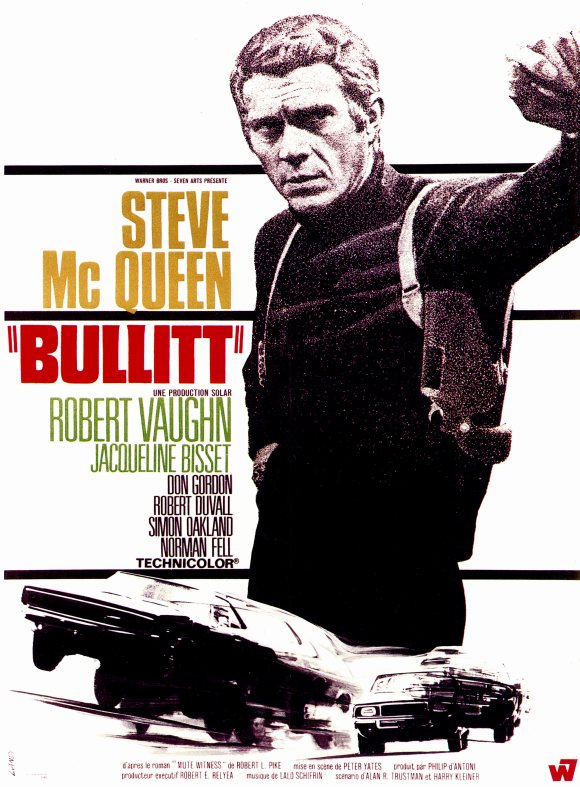
The Elements of Style: Steve McQueen in BULLITT (Warner Brothers 1968)


gary loggins's avatarcracked rear viewer

bullitt1

Steve McQueen was the personification of 60’s screen cool in BULLITT, a stylish action film directed by Peter Yates. It’s the first of producer Philip D’Antoni’s cop trilogy, both of which (THE FRENCH CONNECTION and THE SEVEN-UPS) I’ve previously covered. Unlike those two films, the grittiness of New York City is replaced by the California charm of San Francisco, and the City by the Bay almost becomes a character itself, especially in the groundbreaking ten minute car chase between McQueen’s Mustang and the bad guy’s Dodge Charger.

bullitt2

Style permeates the film from the get-go, with the snappy opening credits montage by Pablo Ferro. Then we get right into the story, as San Francisco detective Frank Bullitt is assigned to guard mob witness John Ross, scheduled to testify before a Senate Subcommitte on crime. Hot shot politician Walt Chalmers wants Bullitt because of his reputation and PR value with the papers. Things go awry when Ross…

View original post 579 more words

Playing Catch Up: Welcome to New York (dir by Abel Ferrara)


Welcome_to_New_York_(2014)

Gerard Depardieu is naked a lot in Welcome to New York and I know you’re probably being snarky and sarcastically thinking, “Well, then I’m definitely going to track down this film…” but actually, the frequent display of Depardieu’s body gets to the heart of what makes his performance so memorable.  Playing an extremely unsympathetic role, Depardieu doesn’t hide the character’s depravity from the audience.  He reveals every inch of the character, from his flabby body to his empty soul.  It takes courage to bring such an unsympathetic character to life and talent to keep the audience watching and fortunately, Depardieu has both of those.

Welcome to New York opens with Depardieu (as himself) talking to a group of reporters and explaining why he’s decided to play a character based on Dominique Strauss-Kahn in Abel Ferrara’s upcoming movie.  It’s an interesting way to start, both because it features Depardieu’s scornful opinion of politicians and because it leaves no doubt that, even if Depardieu’s character has been renamed Devereaux, Welcome to New York is directly based on the Dominique Strauss-Kahn case.

(Dominique Strauss-Kahn, of course, was the wealthy French socialist who many thought was going to be the next President of France until he was arrested after raping a hotel maid in New York City.  As a wealthy and well-connected white man, he was acquitted of raping the maid, who neither wealthy, well-connected, or white.   Throughout the trial, the usual collection of elitists complained about how Americans just didn’t understand French culture but, ultimately, Strauss-Kahn’s political career was ended by the scandal.)

Welcome to New York closely follows the facts of the Strauss-Kahn case.  Wealthy banker and politician Devereaux is in New York on business.  When he meets his daughter and her boyfriend, he spends the entire lunch asking them about their sex life.  When he returns to his hotel, he and his business associates hire a group of prostitutes and have one of the most depressing orgies ever captured on film.

I have to admit that during these first part of the film, I was often tempted to turn off Welcome To New York.  No, it wasn’t that the film was too explicit.  Instead, my problem was that Devereaux was such a dull character.  Devereaux has a lot of sex during the first third of the film but, at no point, does he seem to enjoy it.  Instead, he is detached from everything happening around him and it doesn’t exactly make for compelling viewing.

But, as the film played out, I realized that we weren’t supposed to find Devereaux in any way compelling.  Instead, Devereaux is portrayed as a hollow and empty shell.  For him, sex is all about entitlement and power.  After his is arrested for raping the hotel maid, Devereaux appears to be more surprised than anything else.  Rather than feeling regret at being caught or even fear that he might be convicted, Devereaux seems to be shocked that a man of his wealth would be held responsible for his actions.

After Devereaux is arrested, the film’s pace picks up a bit.  Devereaux’s wife, Simone (Jacqueline Bisset), flies to New York and takes over her husband’s defense.  It’s not that Simone feels that Devereaux has been wrongly accused.  In fact, Simone really doesn’t seem to care much for her husband in general.  However, Simone is determined that Devereaux is going to be the next president of France and she certainly has no intention of allowing some American criminal case to stand in his way.  Bisset gives a chilling performance as the almost fanatically driven Simone.

Soon, Devereaux is under house arrest and staying at a rented house.  (For these scenes, Welcome to New York filmed in the same house that Strauss-Kahn stayed at during his trial.)  It’s while locked away in the house that Devereaux finally starts to realize that he has gone too far.  It’s in the house that Devereaux remembers the man he was once was and is forced to confront the man that he has become.

Welcome to New York is not always an easy film to watch but, thanks to Depardieu and Bisset’s ferocious performances, it’s a film that will reward patient viewers.