Film Review: Lincoln (dir. by Steven Spielberg)


I am a history nerd.

If you’ve read my previous reviews here on the Shattered Lens, that’s not necessarily a major revelation.  Still, before I talk about Steven Spielberg’s latest film, the sure-to-be Oscar nominated Lincoln, you should know where I’m coming from as a reviewer.  Cinema may be my number one love but history, and especially political history, runs a close second.  To me, there is nothing more fascinating than learning how those in the past both viewed and dealt with the issues that we still face in the present.  Whereas some people take pride in being able to name every player that’s ever played for the Dallas Cowboys, I take pride in the fact that I can not only name every President and Vice President in order but I can also tell you exactly who they had to defeat in order to serve in those offices.

I love history and therefore, it was hard for me not to feel as if Lincoln was a film that was made specifically for me.  Covering the final four months of the life of the 16th president, this film tells the story of Lincoln’s struggle to pass the 13th Amendment and to bring an end to the U.S. Civil War.  The film also documents Lincoln’s troubled marriage to the unstable Mary and his son’s decision to enlist in the Union Army.  Even though Spielberg and screenwriter Tony Kushner don’t include any vampires*, there’s still a lot going on in Lincoln and it is to their credit that the film remains compelling despite the fact that everyone already knows how the story is going to end.

Daniel Day-Lewis is getting a lot of critical acclaim for his performance in the title role and, for once, I actually have to agree with the critics.  Abraham Lincoln is one of the most iconic figures in American history.  He is such an icon that, at times, it’s hard to believe that this larger-than-life figure, with his stove-pipe hat and his homely face, was an actual human being who lived and breathed and died like any other human being.  It’s easier to think of him in the same way that Jesus Christ used to be represented in films like Ben-Hur, as an inspiring character who is always standing just a little bit off-camera.  The brilliance of Day-Lewis’s performance is that he makes us believe that this legendary figure could actually exist with all the rest of history’s mortals.  For lack of a better term, Day-Lewis humanizes Lincoln.  His performance contains all the bits of the Lincoln legend: the fatalistic melancholy, the steely resolve, the quick humor, and occasional flashes of self-doubt.  The genius of the performance is the way that it takes all the legendary pieces and arranges them to create a portrait of a very believable man.

Though the film is dominated by Day-Lewis’s lead performance, the film’s supporting cast does a good job at bringing to life the people around Lincoln.  Whenever one film can manage to find roles for Hal Holbrook, David Strathairn, Jared Harris, James Spader, John Hawkes, and Jackie Earle Haley, you’ve got good reason to be optimistic about what you’re about to see.  Probably the film’s showiest supporting role goes to Tommy Lee Jones, who plays the firebrand abolitionist Thaddeus Stevens.  Admittedly, Tommy Lee Jones gives a standard Tommy Lee Jones performance here but, especially when paired with Day-Lewis’s more internal acting style, the end result is still fun to watch.  Also giving a good performance is Sally Field, who plays Lincoln’s mentally unstable wife.  Historians have rarely been kind (or fair) to Mary Lincoln but Field makes her into a difficult but sympathetic figure.  Finally, even though the role of Lincoln’s son is not a challenging one, I’m always happy whenever Joseph Gordon-Levitt shows up onscreen.

Ultimately, however, Lincoln is a Steven Spielberg film.  Spielberg is a very good director but he’s also a very safe one.  The same can be said of Lincoln as a film.  The film’s cinematography, art design, and costume design are all brilliantly done and award-worthy but it’s still hard not to occasionally wish that Spielberg would have enough faith in his audience that he wouldn’t feel the need to have John Williams provide constant musical cues to let us know what we are supposed to be feeling about what we’re experiencing.  If you’re looking for hints of moral ambiguity, an unflinching examination of the rivers of blood that flowed on the Civil War battlefield, or for an in-depth portrait of Lincoln’s personal demons (and most historians agree that he had a few), you might want to look elsewhere.  This is not Martin Scorsese’s Lincoln.  This is Steven Spielberg’s Lincoln.  This is a film that is meant to be inspiring (as opposed to thought-provoking) and, for the most part, it succeeds.

I have to admit that I went into Lincoln expecting to be disappointed.  Ever since the film first went into production in 2011, websites like Awards Daily have been hyping this film to death.  Before many of them had even seen the completed film, online critics were announcing that both the film and Daniel Day-Lewis were the clear front-runners for the Oscars in 2013.  As anyone who has read my previous reviews on this site knows, nothing turns me off more than the bandwagon mentality of the critical establishment.  Often times, when a film is embraced as vehemently and as early as Lincoln has been, I feel almost honor-bound to be a hundred times more critical of it than I would be of a film like Step Up Revolution.

However, Lincoln is a rarity.  It’s a film that, for the most part, actually lives up to all the hype.

—-

*I imagine that little joke will cause a lot of confusion to anyone who, ten years in the future, happens to stumble across this review.  To you, future reader who has forgotten all about Abraham Lincoln: Vampire Hunter, I can only apologize.

Trailer: Lincoln (dir. by Steven Spielberg)


One of the films for 2012 that’s seen by many as a major player in the end of the year Awards season. Steven Spielberg’s long-delayed and gestating historical drama about Abraham Lincoln will finally make it onto the big-screen this early November. Spielberg had initially chosen Liam Neeson to play the 16th President of these United States but as the project continued to get delayed he backed out and in comes Daniel Day-Lewis to take on a very difficult role.

Lincolnis based off of Doris Kearns Goodwin’s biography of the 16th President, Team of Rivals: The Political Genius of Abraham Lincoln. With Tony Kushner tasked with finally hashing out a final draft of the screenplay the film finally went into production in 2009. The cast is an ensemble led by Day-Lewis that includes several past Academy Award and Emmy winners like Tommy Lee Jones, Sally Field and Hal Holbrook with other acting luminaries like Joseph Gordon-Levitt, Walton Goggins, David Straithairn, Jared Harris and Jackie Earle Haley.

The first trailer finally arrived today, September 13, 2012, during a Google+ hangout with Spielberg and Gordon-Levitt and reaction to the trailer seems to range from “give Daniel Day-Lewis the Oscar already” to “an Oscar-bait if there was ever one”. No matter where one sat in their reaction to this trailer it will be interesting to see if Spielberg will come out with a film that doesn’t come off as maudlin and manipulative, but deliver a film that explores and tries to explain why Lincoln became such a beloved President in his time despite making so many unpopular decisions and sitting through the worst era of American history (Civil War) and decades since his death.

Here’s to hoping that the film is less like Amistad and more like Schindler’s List in terms of tone and narrative. We know why Lincoln is seen as the greatest President we ever had. What we want to know is the why’s.

Lincoln arrives in the theaters this November 9, 2012.

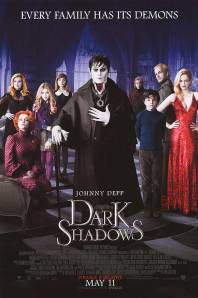
Trash Film Guru Vs. The Summer Blockbusters – “Dark Shadows”


First off, a qualification : if you’re a lifelong (or thereabouts) fan of Dan Curtis’ classic Dark Shadows TV series, I can understand why you would hate Tim Burton’s new film of the same name. It’s many things, but old-school Dark Shadows isn’t one of them. Feel free, with my full blessing (whatever that’s worth), to absolutely despise this flick right down to a molecular level if you fit into this category of viewer. But if you don’t —

— then seriously, where is all this vitriol coming from? I’m not saying it’s a tremendous or important movie by any means, but it’s brainless, entertaining, heavy-on-the-camp fun that’s pretty solidly constructed Burton-by-the-numbers.

And maybe that’s the problem. Tim Burton’s work has, indeed, become almost relentlessly formulaic by this point : de-fang horror/gothic/50s-era sci-fi concepts to make them palatable to mainstream family audiences, concentrate heavily on the visuals, strenuously avoid even the hint of any political subtext, add in a dash of blatantly-obvious-but-ultimately-respectful-to-its-source self-satire, have your admittedly talented cast skew their performances toward the knowingly pantomime, and voila! You’ve got yourself morbidity for the masses.

Apparently this is now some sort of crime. Granted, Dark Shadows is no Ed Wood or Big Fish, but it doesn’t wallow in Burtonian excess the way that the more successful (as far as the box office goes) Charlie And The Chocolate Factory or the mega-successful Alice In Wonderland did. But judging by the reaction out there on Twitter and other “social media” sites, you’d think this was somehow the nadir or Burton’s career (how quickly we seem to forget Mars Attacks!) — in fact, it seems to be generating as much overly-malignant hatred as The Avengers is generating overly-effusive praise. But hell, at least this movie is recognizably the work of a singular creative vision (albeit not one operating at its peak) rather than pure CGI assembly-line product that could have been directed by any of dozens of different self-styled “action auteurs” (I’ve said it before and I’ll say it again — if The Avengers had been helmed by Jon Favreau, it would essentially be no different) who are ultimately as interchangeable as the material they produce.

The cast is the usual mix of Burton way-more-than-regulars (Johnny Depp in the title role of Barnabas Collins, Helena Bonham Carter as family doctor/lush Julia Hoffman, Christopher Lee in a terrific cameo — as opposed to his pointless quick turn in The Wicker Tree — as an “old man of the sea”-type), talented, well-cast veterans (Michelle Pfeiffer as tired family matriarch Elizabeth Collins Stoddard, Jackie Earle Haley as the hapless Willie Loomis) and up-and-coming talents (Eva Green as Barnabas’ principal object of love/hate, Angelique Bouchard, Bella Heathcote as his principal object of love only, Victoria Winters, Jonny Lee Miller as weak-willed family weasel  Roger Collins, Chloe Grace Moretz  doing her teen-with-a-‘tude thing as Carolyn Soddard), and while none are giving what could in any way be called inspired turns, all are solid and dependable.

As is the story, an uncomplicated affair about Barnabas emerging from the grave, vamped to the hilt, in the early 70s to help his fallen-on-hard-times clan rebuild their fishing and canning empire in the face of rival competition that’s equally supernatural in origin, with a little bit of reincarnation-themed romance thrown in for good measure. It’s hardly demanding stuff, of course, but it’s perfectly suited to function as precisely what it is — a distracted afternoon’s or evening’s summer lightweight entertainment. Joss Whedon does this with a team of super-heroes and we call him a genius. Tim Burton does it with harmless comic vampires and we say he’s jumped the shark. Go figure.

All of which goes to show nothing so much as the herd mentality so prevalent amongst today’s film-buff “community.” In truth, both Dark Shadows and The Avengers are cut from remarkably similar cloth — throwaway big-budget diversionary fare that demands nothing of its audience and gives you pretty much exactly what you figure to be in for when you buy your ticket. One is being praised for it because, hey, other people immediately started talking about how good it is, and one is reviled because, hey, other people immediately started talking about how stupid it was. But you know what? At least Dark Shadows has no pretense of being anything other than precisely what it is, and no army of zombies (or vampires) doing its studios’ dirty work for it and publicizing it like mad for free.

I freely admit that might be a big reason why I actually enjoyed this a little more than Marvel’s billion-dollar-bonanza, and I also freely admit that actions taking place off-screen should , by all rights, play absolutely no part in how I react to what’s taking place on-screen. But it’s not a perfect world. And Dark Shadows is far from a perfect film. But I ended up liking it it a lot more than I was honestly expecting to — and if you go into it with an open mind, who knows? Maybe you will, too.