Horror Film Review: Mesa of Lost Women (dir by Herbert Tevos and Ron Ormond)


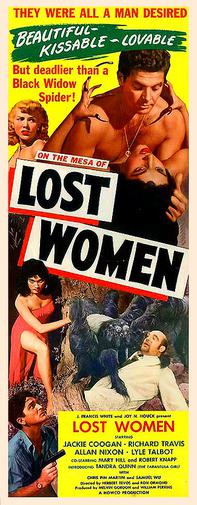
“Have you ever been kissed by a girl like this?” a disembodied voice asks at the start of 1953’s Mesa For Lost Women as a pair hands with claw-like fingernails caresses the face of someone who is later identified as being “Doc” Tucker (Allan Nixon).

Things get stranger from there.  A couple is found lost and dehydrated in the Mexican desert.  Grant Phillips (Robert Knapp) rambles about “super bugs” out in the desert and how they have to be destroyed.  American land surveyor Frank (John Martin) assumes that Grant must be delirious but Frank’s assistant, Pepe (Chris Pin Martin), knows differently.  We know that Pepe knows differently because the narrator tells us that Pepe had heard all about the monsters in the desert but Pepe keeps that information to himself….

Who is this narrator and why is he so condescending?  (For the record, he’s actor Lyle Talbot, who split his career between major, Oscar-winning productions and stuff like this.)  Have you ever noticed that a narrator usually just leaves you feeling even more confused by what you just watched?  There’s a trailer playing right now for a film called Ella McCay that opens with Julie Kavner saying, “Hi, I’m the narrator!” and whenever I hear that line, I’m just like, “Oh, this film is going to be so bad!”

I think it’s because most narrators are added after the fact, in an attempt to give some sort of uniformity to a badly constructed movie.  The narrator is there to tell us stuff that a good movie would be able to show us.  For instance, in the trailer for Ella McCay, Julie Kavner tells us that “I’m nuts about her,” as a way to assure us that Ella McCay is someone worth making a movie about.  Now, ideally, you wouldn’t have to have someone tell you that.  You would just watch the movie and say, “Hey, Ella McCay!  She deserves all the happiness in the world!”  But when your trailer is a bunch of scenes of Ella McCay acting a bit immature for someone who is destined to become “governor of the state you were born and raised in,” you need that narrator to say, “No, she’s likable, I promise!”

By that same logic, Mesa of Lost Women was apparently a mash-up of several different films, none of which had a complete script.  Narrator Lyle Talbot is here to tell us that, despite what we’re seeing, Mesa of Lost Women is an actual movie with an actual story as opposed to just a bunch of random scenes that were haphazardly crammed together.  We get a flashback of a scientist named Masterson (Harmon Stevens) traveling to the laboratory of Dr. Aranya (Jackie Coogan) and discovering that Aranya is creating giant tarantulas and transforming human women into mind-controlled slaves with the instincts of a spider.  Masterson doesn’t think that’s ethical so Aranya’s assistant, Tarantella (Tandra Quinn), gives him an injection that turns him into a simpleton.  Masterson ends up in a mental hospital, though he later escapes.  Meanwhile, an American businessman and his girlfriend (Mary Hill) come to Mexico and witness Tarantella dancing in a bar.  Masterson shows up and shoots Tarantella and then takes everyone hostage so that he can force Grant, who we now discover is a pilot, to fly him to the mesa of lost women …. or something.

Despite the best efforts of the narrator, the film is impossible to follow.  A big problem is that Dr. Aarnya’s plan never makes much sense.  How is creating a giant spider and a bunch of women who think that they’re spiders going to help him conquer the world?  The other problem is that the film had two directors, one of whom was an enigmatic German named Herbert Tevos who got the job by claiming to have directed Josef von Sternberg’s The Blue Angel.  Tevos’s footage of Dr. Aranya, the giant tarantula, and the “lost women” was not enough to secure the film distribution so a second director, Ron Ormond, was brought in to shoot a bunch of new footage to make the film more commercial.  Tevos’s film became an extended flashback in the middle of Ormond’s film and the whole thing is a big mess.

In fact, the film is such a mess that some people insist Ed Wood must have been involved.  It is true that narrator Lyle Talbot also appeared in Plan 9 From Outer Space and Glen or GlendaPlan 9‘s Mona McKinnon appears as a spider woman.  So does Dolores Fuller, who was Wood’s girlfriend at the time.  Wood later “borrowed” Mesa of Lost Women‘s score for Jail BaitMesa of Lost Women was definitely Wood-adjacent but, by all accounts, Wood didn’t actually do any work on the film.  This mess of a film belongs to Tevos and Ormond.

And it is a mess.  It’s a watchable mess, in much the same way that a nuclear meltdown would probably be watchable.  But, nonetheless, it’s still a mess and the incoherence of the plot really does get on one’s nerves, despite the best efforts of Lyle Talbot.  Talbot can’t sell the viewer on Mesa of Lost Women.  Maybe he would have had better luck with Ella McCay.
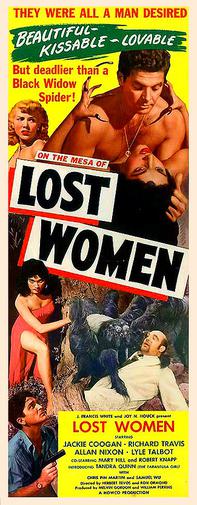
Horror on the Lens: Mesa of Lost Women (dir by Herbert Tevos and Ron Ormond)


Today’s Horror on the Lens is the infamous 1953 film, Mesa of Lost Women.  Off in the middle of the desert, Dr. Aranya (Jackie Coogan) is conducting dangerous experiments that are resulting not only in giant spiders but also a master race of superwomen who Aranya is planning to use to conquer the world or something.

Mesa of Lost Women is a bit of a disjointed film.  It was originally filmed by a German director named Herbert Tevos, who claimed to be an associate of Erich Von Stroheim’s and a former collaborator of Marlene Dietrich’s.  However, despite his claims of being well-connected, no one was particularly impressed with Tevos’s first cut of the film so Ron Ormond was brought in to film additional scenes, the majority of them featuring Jackie Coogan as the insane Dr. Aranya.  Jackie Coogan was, at the time, still best-known for playing The Kid in the Charlie Chaplin film of the same name.  After Mesa, he would go on to play Uncle Fester on the original Addams Family.

Anyway, Mesa of Lost Women is one of those B-movies that simply has to be seen and heard to be believed.  (Lyle Talbot provides the narration, which is judgmental even by the standards of the 1950s.)  Enjoy Mesa of Lost Women!

October Hacks: The Prey (dir by Edwin Brown)


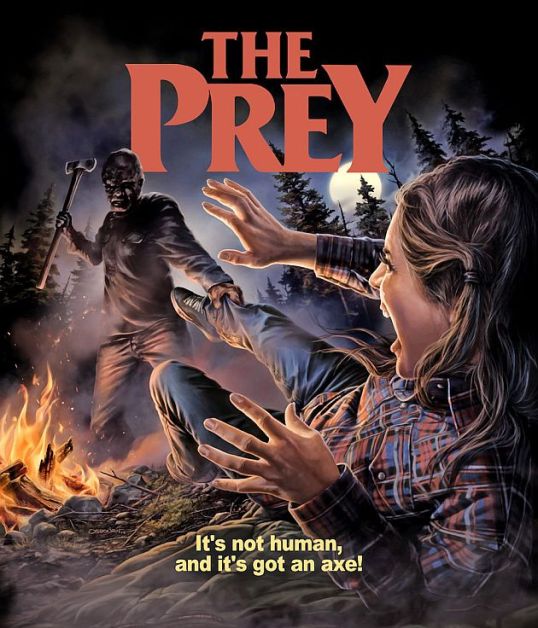
The 1983 slasher film, The Prey, opens with a wildfire raging through the Rocky Mountains, destroying a community of people who lived in a cave.  32 years later, the only survivor of the fire (played by Carel Struycken, who would later be memorably cast on Twin Peaks as the “It is happening again” giant), wanders through the forest.  When he spots a middle-aged couple camping and tending to a campfire, the survivor snaps and kills them both.

The next morning, a van drives through the national park.  Inside the van are three young couples, Nancy (Debbie Thureson) and Joel (Steve Bond), Bobbie (Lori Lethin) and Skip (Robert Wald), and Gail (Gayle Gannes) and Greg (Philip Wenckus).  They are looking forward to a nice weekend of camping, sex, and mountain climbing.  The girls are especially happy when they meet the handsome local parker ranger, Mark O’Brien (Jackson Bostwick).  The couples head into wilderness, little realizing that they are being followed and watched by the murderous survivor.

Watching The Prey, I was reminded of why I don’t go camping.  I mean, I like looking at nature.  I like handsome park rangers.  There’s a sweet scene where Mark tells an extremely corny joke to a baby deer and it made me go, “Awwwwww!”  But seriously, I would never want to spend my night sitting around a campfire or sleeping on the ground.  Not only is the wilderness full of bugs but there’s always the danger of getting trapped in a sudden storm or some other natural disaster.  And I have to admit that I’m just not a fan of the way that people act while camping.  My fear is that, if I ever did go camping, I would end up with people shouting, “Go!  Go!  Go!’ at me.  If my camping companions insist on going mountain climbing, am I obligated to accompany them?  If one of them falls off the side of the mountain, that’s really going to ruin my weekend.

As for The Prey as a film, the plot is standard slasher stuff.  Attractive young people end up stranded out in the middle of nowhere and they are picked off, one at a time, by a monster who seems to take issue with anyone trying to have any fun.  That said, The Prey has enough strange moments to make it memorable.  With an 80-minute running time, The Prey is an oddly paced film.  (And yes, oddly paced does often translate to boring.)  The majority of the film is just made up with footage of the three couples walking through the forest and having conversations that were reportedly improvised by the cast.  (Gayle laughs as she talks about a time that she nearly drowned.)  The film is full of skewed camera angles that give the entire proceedings an off-balance feel and occasionally the action cuts away from the main characters to Mark playing a banjo or another park ranger (played by former Charlie Chaplin co-star Jackie Coogan) having a tense conversation with a policeman who calls to ask about the missing middle-aged couple.  The survivor doesn’t really go after the main couples until the film’s final 15 minutes and the pace suddenly quickens as if to mirror the relentless violence of the film’s killer.  The strange pacing and the weird details gives The Prey a dream-like feel and the ending, in which the survivor reveals that he has interests outside of killing, is fascinating in just how unexpectedly bizarre it is.

The Prey was undoubtedly made to take advantage of the popularity of other wilderness slasher films but it’s just weird enough to establish an identity of its own.

Kitty Litter: SEX KITTENS GO TO COLLEGE (Allied Artists 1960)


gary loggins's avatarcracked rear viewer

sexkits1

Let’s get it out of the way right now- SEX KITTENS GO TO COLLEGE is bad. Real bad. Like mind-numbingly bad. Despite the presence of sex kittens Mamie Van Doren and Tuesday Weld, this movie is a smelly litter box in desperate need of cleaning. It’s an Albert Zugsmith extravaganza, so you know right off the bat it’s gonna be a stinker. Zugsmith had once been a producer at Universal, overseeing prestige films like WRITTEN ON THE WIND and TOUCH OF EVIL. But when he went into independent productions, Zugsmith chose to go the low-budget exploitation route and even though he managed to attract some well-known names, his little epics usually stunk to high heaven.

sexkits2

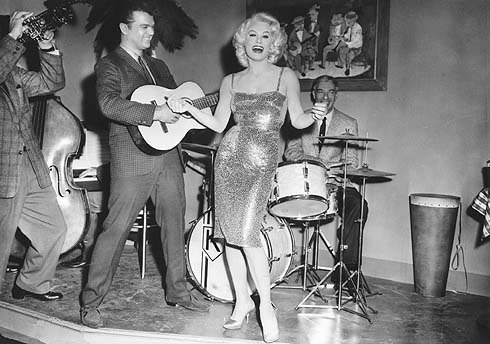
The movie revolves around the talents of Mamie Van Doren, a beautiful creature whose best assets weren’t her acting. She plays Dr. Mathilda West, a genius hired to take over the science department at Collins College. Thinko, a supercomputer/robot type thing…

View original post 372 more words

Scenes That I Love: “Tomorrow Is A Drag” from High School Confidential


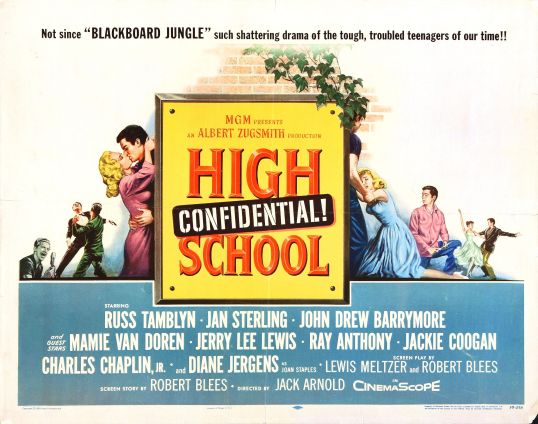
high_school_confidential_poster_03Tonight, TCM has been showing a marathon a Mamie Van Doren films.  I just sat through The Beat Generation, a 1959 film where Mamie is among the many women to fall victim to a crazed beatnik known as the Aspirin Kid.

Now, to be honest, The Beat Generation is not a very good film.  In fact, it’s probably one of the most anti-female movies that I’ve ever seen.  Watching it, I found myself very happy that I was not alive during the 50s.

However, it did remind me of the far superior High School Confidential, another film that featured a bunch of faux Beatniks and Mamie Van Doren in a supporting role.  Released in 1958 and directed by Jack Arnold, High School Confidential is a lot of fun.

And that brings us to tonight’s scene that I love.  In the scene below, “beatnik” poetess Philippa Fallon recites a poem while secret drug dealer Jackie Coogan plays the piano.  I love this scene because it’s just so typical of the way that exploitation films from the 50s tended to portray the beat generation.

I have to admit that whenever I see one of these old films that attempted to cluelessly portray (and mock) the beatniks of the 50s, I’m reminded of the similarly clueless way that bloggers are portrayed in most current films and Aaron Sorkin-penned television series.