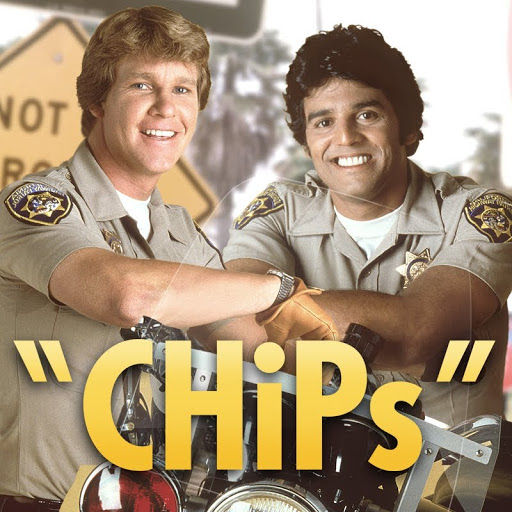
Welcome to Late Night Retro Television Reviews, a feature where we review some of our favorite and least favorite shows of the past! On Mondays, I will be reviewing CHiPs, which ran on NBC from 1977 to 1983. The entire show is currently streaming on Prime!
It’s arson and basketball on CHiPs!
Episode 4.12 “Home Fires Burning”
(Dir by Charles Bail, originally aired on February 1st, 1981)
Two arsonists (David Hayward and Michael Cavanugh) are setting RVs on fire as a part of an insurance scam. One man (Jack Kruschen) who hires the arsonists is horrified when their carelessness leads to a security guard getting seriously injured. If the guard dies, the man is looking at serious jail time! (Luckily, the guard doesn’t die and apparently, everyone just forgets about sending his boss to jail.)
Luckily, Baker is there to help track the arsonists down. Ponch, on the other hand, is busy putting together a Highway Patrol basketball team. It’s hard not to notice how much time the Highway Patrol spends on stuff like basketball, dirt bike competitions, and drag car racing. Somehow, Ponch has gone from being the department’s screw-up to now being the guy who is automatically given all of the responsibility. It’s the Ponch Show and everyone knows it.
This episode was directed by veteran stuntman Charles Bail and it does have some spectacular stunts. (A car jumping through an exploding RV was my favorite.) And let’s be honest. I could sit here and spend hours talking about CHiPs became the Ponch Show during the fourth season and how the rest of the cast was underutilized. And I would be totally correct. But the stunts and the car crashes are the main appeal of this show and this episode featured several examples of each.
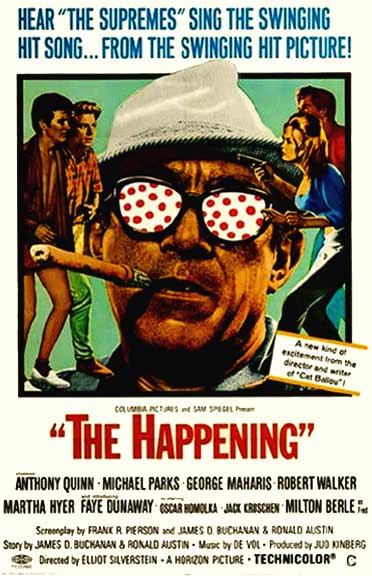
The 1967 film, The Happening, opens with two “young” people — Sureshot (Michael Parks) and Sandy (Faye Dunaway) — waking up on a Florida beach. The previous night, they attended a party so wild that the beach is full of passed out people, one of whom apparently fell asleep while standing on his head. (It’s a happening!) From the dialogue, we discover that, despite their impeccably clean-cut appearances, both Sureshot and Sandy are meant to be hippies.
After trying to remember whether or not they “made love” the previous night (wow, how edgy!), Sandy and Sureshot attempt to find their way off of the beach. As they walk along, they’re joined by two other partygoers. Taurus is played by George Maharis, who was 38 when this film was shot and looked about ten years older. Taurus is a tough guy who carries a gun and dreams of being a revolutionary and who says stuff like, “Bam! Et cetera!” Herbie is eccentric, thin, and neurotic and, presumably because Roddy McDowall wanted too much money, he’s played by Robert Walker, Jr.
Anyway, the four of them end up stealing a boat and talking about how life is a drag, man. Eventually, they end up breaking into a mansion and threatening the owner and his wife. Since this movie was made before the Manson murders, this is all played for laughs. The owner of the mansion is Roc Delmonico (Anthony Quinn). Roc used to be a gangster but now he’s a legitimate businessman. The “hippies” decide to kidnap Roc because they assume they’ll be able to get a lot of money for him.
The only problem is that no one is willing to pay the ransom!
Not Roc’s wife (Martha Hyer)!
Not Roc’s best friend (Milton Berle), who happens to be sleeping with Roc’s wife!
Not Roc’s former mob boss (Oscar Homolka)!
Roc gets so angry when he find out that no one wants to pay that he decides to take control of the kidnapping, He announces that he knows secrets about everyone who refused to pay any money for him and unless they do pay the ransom, he’s going to reveal them. We’ve gone from kidnapping to blackmail.
Along the way, Roc bonds with his kidnappers. He teaches them how to commit crimes and they teach him how to be anti-establishment or something. Actually, I’m not sure what they were supposed to have taught him. The Happening is a comedy that I guess was trying to say something about the divide between the young and the middle-aged but it doesn’t really have much of a message beyond that the middle-aged could stand to laugh a little more and that the young are just silly and kind of useless. Of course, the whole young/old divide would probably work better if all of the young hippies weren’t played by actors who were all either in their 30 or close enough to 30 to make their dorm room angst seem a bit silly.
It’s an odd film. The tone is all over the place and everyone seems to be acting in a different movie. Anthony Quinn actually gives a pretty good dramatic performance but his good performance only serves to highlight how miscast almost everyone else in the film is. Michael Parks comes across like he would rather be beating up hippies than hanging out with them while Faye Dunaway seems to be bored with the entire film. George Maharis, meanwhile, goes overboard on the Brando impersonation while Robert Walker, Jr. seems like he just needs someone to tell him to calm down.
But even beyond the weird mix of acting style, the film’s message is a mess. On the one hand, the “hippies” are presented as being right about the establishment being full of hypocritical phonies. On the other hand, the establishment is proven to be correct about the “hippies” being a bunch of easily distracted idiots. This is one of those films that wants to have it both ways, kind of like an old episode of Saved By The Bell where Mr. Belding learns to loosen up while Zack learns to respect authority. This is an offer that you can refuse.
The one that most people seem to know and which regularly shows up on cable is the 1991 version. This version was directed by Martin Scorsese and features Oscar-nominated performances from Robert De Niro and Juliette Lewis. This is the version that has De Niro speaking in a broad Southern accent and attacking people while speaking in tongues. If you’ve ever watched a rerun of an old sitcom and wondered why the laugh track was going wild at the sight of a tattooed prisoner lifting weights in a cell while portentous music boomed in the background, it’s because you were watching a parody of Scorsese’s Cape Fear.
That, however, is not the first version of Cape Fear.
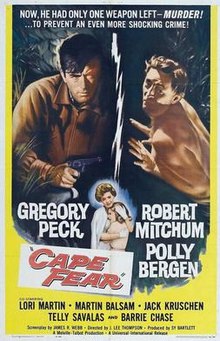
The first version of Cape Fear came out in 1962. It was a black-and-white film that was directed by J. Lee Thompson. In this version, the recently released rapist, Max Cady, is played by Robert Mitchum. Sam Bowden, the attorney that Cady blames for his incarceration, is played by Gregory Peck. Whereas the Scorsese version was highly stylized, the original Cape Fear is brutally straight forward. (While Scorsese’s Cape Fear goes on for over two hours, the original Cape Fear tells its story in a brisk 100 minutes.) While I think that Scorsese’s Cape Fear has its strong points, the original Cape Fear is superior in almost every way.
The original is certainly far more frightening than the remake. What the original may lack in stylization, it makes up for in plausibility. It’s scary because you can imagine everything in the film actually happening. Robert Mitchum and Gregory Peck may both be iconic film stars but they’re also believable as human beings.
For modern audiences, it’s easy to smirk at Peck with his upright image and his sonorous voice but what made Peck a great actor was his ability to make it all seem natural. Peck never seemed like he was acting like an honest man who always tried to do the right thing. Instead, he simply was that man. It’s perhaps significant that Peck played Sam Bowden the same year that he played another honest lawyer, Atticus Finch, in To Kill A Mockingbird. The only real difference between them is that, whereas Atticus was always confident and sure of himself, Sam is frequently helpless. He knows that Max is stalking him and his family and he’s just as aware that there’s nothing he can do about it. When Max rapes a woman (Barrie Chase) that he meets at a bar, she refuses to testify against him. When Sam’s dog turns up dead, everyone knows that Max killed him but there’s no way to prove it. When Sam hires three men to intimidate Max, Max beats them up and promptly tries to get Sam disbarred. When Sam finally resorts to plotting Max’s murder, we’re seeing Atticus Finch pushed beyond his limit.
As for Robert Mitchum, his animalistic performance is frightening precisely because it feels very real. Everyone has known a Max Cady, even if they didn’t realize it at the time. Max gives a fiercely physical performance, often appearing shirtless and strutting through his scenes with a sexual arrogance that’s both frightening and, at times, far more tempting than anyone would want to admit. The scenes in which Max attacks Barrie Chase and Polly Bergen (who plays Peck’s wife) are absolutely terrifying but, for me, the most disturbing moments in Cape Fear are the moments when Max is silent. Even when he’s not speaking, Mitchum allows you to see every depraved thought going through is head.
What’s the scariest moment for me? When the camera catches Max watching Sam’s teenage daughter (Lori Martin). It’s not just that I know what’s going on in Mitchum’s mind as he stares at her. It’s because I know what it’s like to be watched. It’s a scene that’s unsettling because it makes me consider just how many Max Cadys are out there right now.
The battle between Max and Sam is a fascinating one. In prison, Max studied enough law to become as knowledgeable about how to manipulate it as Sam. Under pressure, Sam grows more violent and more willing to circumvent his oath to uphold the same law that Max is now using against him. It makes for a frightening film, one that will stick with you long after you watch it.
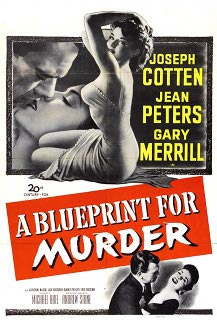
(I am currently in the process of cleaning out my DVR! I recorded the 1953 film noir, A Blueprint for Murder, off of FXM on February 21st.)
Much like Alfred Hitchcock’s Shadow of a Doubt, A Blueprint for Murder stars Joseph Cotten in a story about a seemingly wonderful person who might actually be a murderer. Actually, now that I think about it, it seems like Joseph Cotten appeared in quite a few films that centered around that idea. What distinguished A Blueprint For Murder is that, for once, Joseph Cotten is not the murderer. Instead, he’s the one who is forced to deal with the overwhelming evidence that someone in his life might be a sociopath.
Cotten plays Cam Cameron, who is shocked when his niece, Polly, suddenly takes ill and dies. Cam’s immediate response is to comfort his sister-in-law, Lynne (Jean Peters). And yet, Lynne doesn’t seem to be too upset over Polly’s death. Could it be because Polly was only her stepdaughter? Or maybe Lynne is no longer surprised by sudden death, seeing as how her husband also died after a sudden and mysterious illness.
Or could it be that Lynne murdered both Polly and her husband? That’s the theory put forward by Maggie (Catherine McLeod), the wife of Cam’s friend, Fred (Gary Merrill). Maggie thinks that it sounds like both Polly and her father were poisoned with strychnine! As the initially skeptical Fred points out, when Lynne’s husband died, he put all of his money in a trust for his children. If his children die, Lynne stands to inherit the fortune. Polly’s already dead. The only remaining obstacle would be Cam’s nephew, Doug.
Much like Don’t Bother To Knock, A Blueprint for Murder barely clocks in at a little over 70 minutes. It’s a briskly told melodrama and, seen today, it’s easier to imagine it as an episode of a television series than as an actual movie. As I watched it, I kept thinking that it felt like an old episode of CSI Miami, with Joseph Cotten in the role that would have been played by David Caruso. (“Two deaths in one family? It sounds like something’s in the water and it’s not fluoride.” YEEEEEEEEEEAHHHHHH! DON’T GET FOOLED AGAIN!! NO NO!) For that matter, it was also easy for me to imagine A Blueprint For Murder being remade for Lifetime, with Josie Davis in the Joseph Cotten role and maybe AnnaLynne McCord replacing Jean Peters.
A Blueprint For Murder is actually pretty predictable up until the final 15 minutes. It’s during the final 15 minutes that Cam, Lynne, and Doug all end up on a cruise ship together and, in an effort to prove his suspicions, Cam does something that has so much potential for backfiring that it kind of makes you reconsider everything that you previously assumed about him. To be honest, it doesn’t make much sense. It’s hard to believe, despite what Cam insists, that what he did was his only possible option. Then again, it is the 1950s. In an era before DNA testing, maybe the only way to solve a crime was by doing something crazy.
That said, I enjoyed A Blueprint for Murder. It’s a real time capsule film and you know how much I love those. I may never be able to find a time machine but I can always experience the past by watching something like A Blueprint for Murder. Joseph Cotten is, as always, a sturdy lead. In real life, Jean Peters’s acting career was somewhat derailed when she married legendary weird guy Howard Hughes. In this film, she gives a great performance as the potentially murderous sister-in-law.
If you’re a fan of 50s noir or either of the two leads, keep an eye out for A Blueprint For Murder.
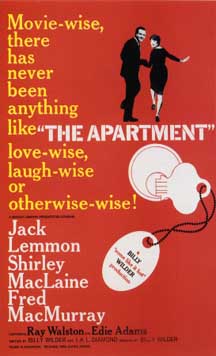
After the Nun’s Story, I continued to experience TCM’s 31 Days of Oscar by watching the 1960 best picture winner, The Apartment. The Apartment is unique among Oscar winners in that it’s one of the few comedies to win best picture. (Though, in all honesty, it would probably be more appropriate to call The Apartment a dramedy.) It was also, until the victory of The Artist, the last completely black-and-white film to win best picture.
(And, as long as we’re sharing trivia, it was also the first best picture winner to feature a character watching a previous best picture winner. At the start of the film, Jack Lemmon deals with insomnia by watching Grand Hotel.)
The Apartment tells the story of C.C. “Bud” Baxter (Jack Lemmon), an anonymous officer worker who is determined to climb the corporate ladder despite not being very good at his job. However, Baxter does have one advantage over his co-workers. He’s single and therefore, his apartment has become the place to go for corporate executives who need a place where they can safely cheat on their wives. Bud spends his day trying to coordinate who is going to be in his apartment and when. Meanwhile, he spends his nights exiled from his own home and wandering around New York. In fact, the only beneficial thing about this arrangement is that all of Bud’s supervisors have been giving him good evaluations in return for using his apartment. (Well, that and Bud’s neighbor, played by Jack Kruschen, is convinced, based on the thinness of the apartment walls, that Bud must be a great lover.)
When Bud finally does get his promotion, it’s only because the personnel director, Jeff D. Sheldrake (an amazingly sleazy Fred MacMurray), wants to use Bud’s apartment. Bud celebrates his promotion by finally working up the courage to ask out Fran (Shirley MacClaine), an elevator operator who works in the office. What Bud doesn’t realize is that Fran is also the woman who Sheldrake wants to bring to the apartment….
Fran is convinced that Sheldrake is going to leave his wife for her. What she doesn’t realize — and what Fred MacMurray’s performance makes disturbingly clear — is that Jeff Sheldrake is basically just a guy having a midlife crisis. He’s the type of middle-aged guy that every woman has had to deal with at some point, the guy who pulls up next to you in a red convertible and stares at you from behind his sunglasses, attempting his best to entice you into helping him relive the youth that he never had. When Fran eventually learns the truth about Sheldrake, it leads both to near tragedy and to Bud having to decide whether he wants to be a decent human being or if he wants to keep climbing the corporate ladder.
When one looks over a chronological list of all of the best picture winners, it’s a bit strange to see The Apartment listed in between Ben-Hurand West Side Story. As opposed to those two grandly produced and vibrantly colorful films, The Apartment is a rather low-key film, one that devotes far more time to characterization than to spectacle. And while both Ben-Hur and West Side Story are ultimately very idealistic films, The Apartment is about as cynical as a film can get. The Apartment may be a comedy but the laughs come from a place of profound sadness.
Because it’s more interested in people than in spectacle, The Apartment holds up better than many past best picture winners. We’ve all known someone like Bud. We’ve all had to deal with men like Sheldrake. And, in one way or another, we all know what it’s like to be someone like Fran. The Apartment remains a truly poignant and relevant film.
 Through the Shattered Lens