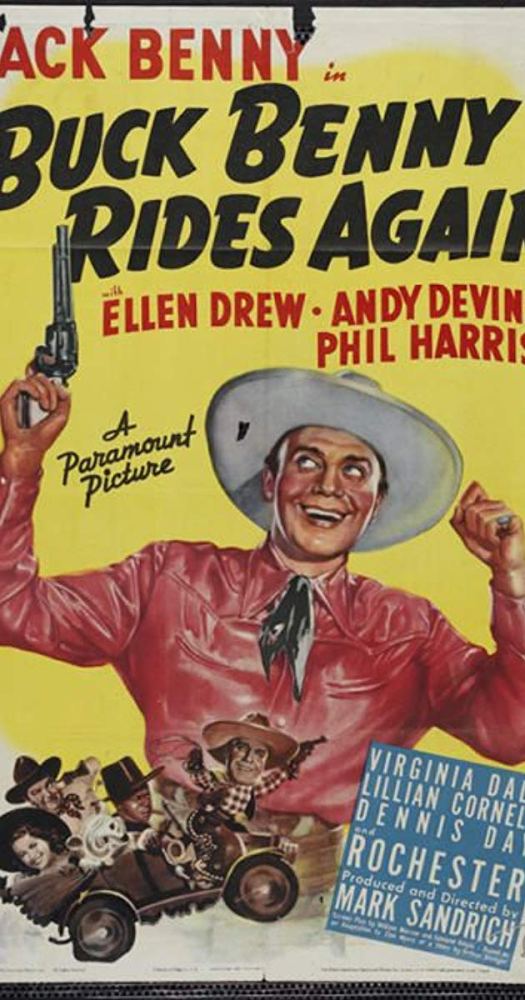
Jack in the Saddle: BUCK BENNY RIDES AGAIN (Paramount 1940)


gary loggins's avatarcracked rear viewer

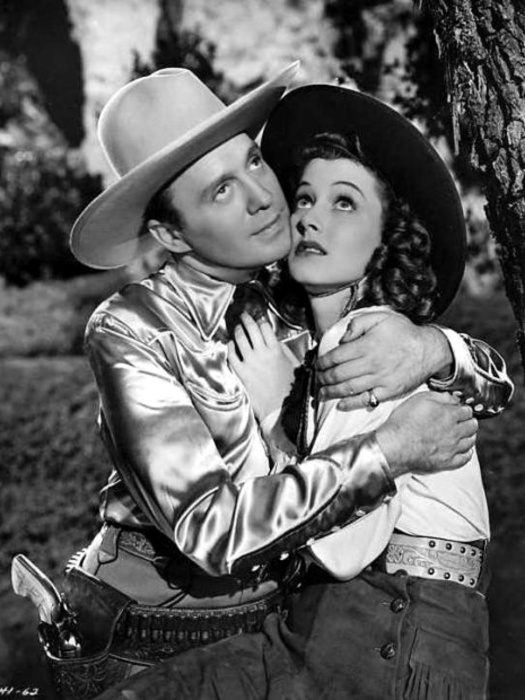
The gang’s all here in BUCK BENNY RIDES AGAIN – Jack Benny’s radio gang, that is! Eddie “Rochester” Anderson, announcer Don Wilson, band leader Phil Harris, comic actor Andy Devine, and crooner Dennis Day all show up for this fun-filled musical comedy romp directed by Mark Sandrich. Even Jack’s radio nemesis Fred Allen is heard (though not seen) cracking jokes at his rival’s expense!

The movie plays like an extended sketch from one of Jack’s radio or TV programs, as the vain Jack falls for pretty Joan Cameron (Ellen Drew), one of a trio of singing sisters (the other two are Virginia Dale and Lillian Cornell) trying to break into show biz. They “meet cute” when Jack accidentally smashes into Joan’s taxi. Jack keeps flubbing his chances with Joan, who only goes for manly, rugged Western types (“I wouldn’t go out with him if he drove up in a sleigh…

View original post 381 more words

Polish Ham: Jack Benny in TO BE OR NOT TO BE (United Artists 1942)


gary loggins's avatarcracked rear viewer

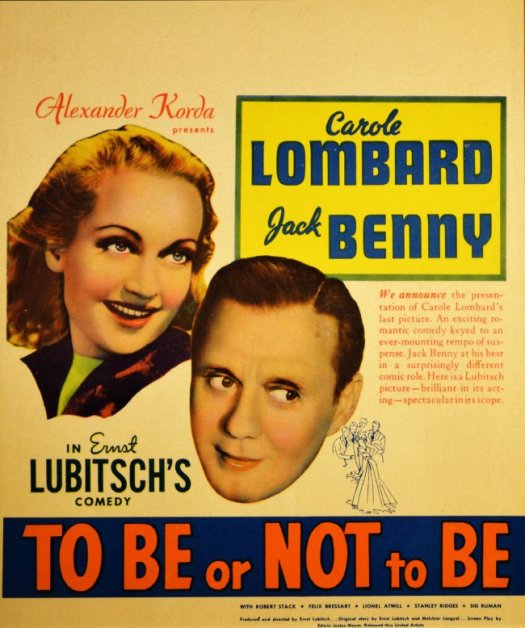
Comedian Jack Benny got a lot of mileage (and a lot of laughs) making fun of his movie career, especially THE HORN BLOWS AT MIDNIGHT . While that film isn’t half as bad as Jack claimed it was, even better was Ernst Lubitsch’s TO BE OR NOT TO BE, a topical (at the time) tale of a band of Polish actors taking on the invading Nazis during WWII. Jack’s got his best film foil here, the marvelous Carole Lombard, and the movie’s got that wonderful “Lubitsch Touch”, a blend of sophistication and sparkling wit evidenced in classic films ranging from THE MERRY WIDOW and DESIGN FOR LIVING to NINOTCHKA and HEAVEN CAN WAIT.

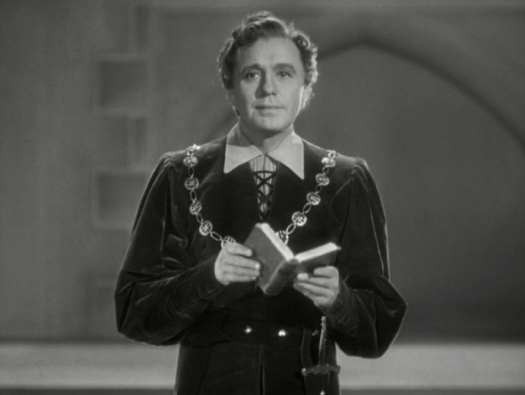
Benny plays Joseph Tura, the self-proclaimed “greatest actor in the world”, and Lombard is his bantering wife Maria. Together, they lead a troupe of actors in Warsaw in a production of “Hamlet”, but every time Tura begins…

View original post 546 more words

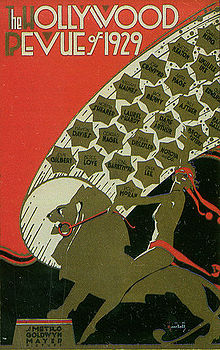
Lisa Reviews An Oscar Nominee and It’s Damn Important: The Hollywood Revue of 1929 (dir by Charles Reisner)


220px-The_Hollywood_Revue_of_1929_(film)_poster

Last night, I really needed a break from thinking about this stupid, asinine presidential election that we have coming up here in the U.S.  Fortunately, TCM provided me with one by showing The Hollywood Revue of 1929!

The Hollywood Revue of 1929 is probably one of the most obscure film to ever be nominated for best picture.  It’s a plotless collection of songs and comedy bits, all performed by actors who were under contract to MGM.  In fact, the movie might be best described as a two-hour commercial for MGM.  The message of the film seems to be: “Now that movies have sound, look what MGM can do!”

With the exception of Greta Garbo and Lon Chaney, every MGM star makes an appearance in Hollywood Revue.  Everyone sings a song and does a dance, even if some of them are better singers and dancers than others.  The revue is hosted by Conrad Nagel (who looks very dapper in a tux but still seems to be strangely uncomfortable with his hosting duties) and Jack Benny (who plays his violin and gets annoyed every time he’s interrupted by an MGM stock player).  Joan Crawford (who Nagal describes as being “one of my favorites”) sings, “Got A Feeling For You,” and she may be off-key but you can’t help but appreciate the fact that she’s doing her best.  Buster Keaton does a dance.  Laurel and Hardy perform a magic act that doesn’t go very well.  Marion Davies does a tribute to the military and I’m sure that, somewhere, William Randolph Hearst was smiling.  Chorus girls sit in the background and smile at the camera and, as someone who knows what it’s like to be in the chorus, I enjoyed watching as a few of the smarter and braver ones attempted to steal the audience’s attention away from the headliners.

At one point, Jack Benny reached into his suit jacket and revealed that a miniature version of actress Bessie Love was apparently living in the pocket.  He held Bessie in the palm of his hand and proceeded to have a conversation with her and all I could think about was the end of Mulholland Drive, when that tiny old couple cornered Naomi Watts in her apartment.  When Benny placed Bessie on the ground, she grew to normal height and sang a song.

During the second half of the film, silent screen star John Gilbert plays the balcony scene from Romeo and Juliet, opposite Norma Shearer.  First he does it in Shakespeare’s words and then he does it again in 1929 language.  Lionel Barrymore directs them.  Interestingly enough, Shearer (who was married to The Hollywood Revue‘s producer, Irving Thalberg) would later play Juliet in 1936’s Romeo and Juliet.  Barrymore, though best remembered as Mr. Potter from It’s A Wonderful Life, actually was a prominent film director in 1929 and would even invent the boom mic.  As for Gilbert, legend has it that the Hollywood Revue was the first time that audiences actually heard him speak and they were so unimpressed with his voice that his career ended.  Having now seen Gilbert speak — well, he didn’t have the greatest or sexiest voice but he still sounded better than Jean Hagen did in Singin’ In The Rain.

Speaking of Singin’ In the Rain, that song was specifically written for Hollywood Revue!  The entire cast sings it at the end of the film.

Seen today, there’s something charming about how old-fashioned and corny The Hollywood Revue is.  I imagine that some people will laugh at it but, honestly, it’s still more entertaining than that stupid live version of The Sound of Music that they put on TV two years ago.  The Hollywood Revue is basically the classic film equivalent of a high school talent show, where everyone does their best and a good deal of the charm comes from seeing how silly it all is.  If you love TCM, you’ll enjoy seeing all the Golden Age performers trying to do their best.  If you don’t love TCM, then go to Hell.

The Hollywood Revue is usually listed as being a nominee for best picture.  Actually, the truth is a little bit more complicated.  For the 2nd annual Academy Awards, there were no nominees.  Instead, the awards were determined by a select committee and only the winners were announced.  Much like the Cannes Film Festival, no film received more than one award.  Broadway Melody (which starred Hollywood Revue‘s Bessie Love) was named best picture.

However, notes were kept of the committee’s meeting and those notes indicate that Hollywood Revue was considered as a possible pick for best picture.  Hence, Hollywood Revue is considered to be a best picture nominee even though there were no official nominees that year.

Anyway, if you’re a classic film lover, keep an eye out for Hollywood Revue the next time that it shows up on TCM!

Lisa Reviews An Oscar Nominee: Broadway Melody of 1936 (dir by Roy Del Ruth)


PosterBroadwayMelody1936_01

It’s Oscar month and you know what that means!  It’s time for TCM to do their annual 31 Days of Oscars!  For the next 31 days, TCM is going to be showing movies that were nominated for and occasionally won Oscars.  This is a great month for me because it has long been my goal to see and review every single film that has ever been nominated for best picture.  Considering that close to 500 movies have been nominated, that’s no small task.  However, over the past four years, I have definitely made some progress, as you can see by clicking on this link and looking at a list of every single best picture nominee.  Thank you, TCM, for helping me get closer to my goal!

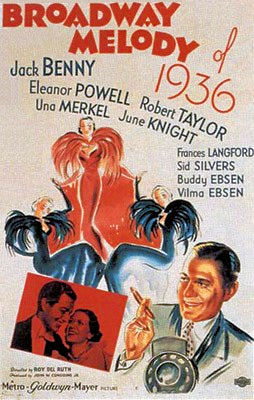
For instance, if not for TCM, how would I ever had the chance to watch Broadway Melody of 1936?  Broadway Melody of 1936 was one of the twelve films to be nominated for best picture of 1935 but it’s now largely forgotten.  When film loves discuss the best musicals of the 30s, it’s rare that you ever hear mention of Broadway Melody of 1936.

Technically, it can be argued that Broadway Melody of 1936 was the first sequel to ever be nominated for best picture, despite the fact that it has little in common with Broadway Melody, beyond taking place on Broadway and being nominated for best picture.  (Broadway Melody won the award.  Broadway Melody of 1936 lost to Mutiny on the Bounty.)  Silence of the Lambs, The Godfather, Part II, Mad Max: Fury Road, Toy Story 3, and The Bells of St. Mary’s are all sequels that were nominated for best picture but Broadway Melody of 1936 did it first.

As for what Broadway Melody of 1936 is about … well, it’s really not about anything.  Oh, don’t get me wrong.  The film has a plot.  Irene Foster (Eleanor Powell) wants her former high school boyfriend, Broadway director Robert Gordon (Robert Taylor), to cast her in his new show but Gordon refuses because he doesn’t want the innocent Irene to be exposed to the sordid world of show business.  Fortunately, Irene has some allies who are willing to help her get that role.  Ted Burke (Buddy Ebsen) is an appealingly goofy dancer who, at one point, wears a Mickey Mouse sweatshirt.  Bert Keeler (Jack Benny) is a columnist who rattles off his “New Yawk cynical” dialogue in the style of most 1930s news reporters.

Broadway Melody of 1936 has a plot but it’s not really that important.  The story is just an excuse for the songs and the dance numbers.  And while none of the numbers are spectacular (especially when compared to other 30s musicals, like 42nd Street), they are all definitely likable.

Seen today, Broadway Melody of 1936 seems like an odd best picture nominee.  It’s not bad but there’s nothing particularly great about it.  To truly appreciate the film, it’s probably necessary to try to imagine what it was like to watch the film in 1935.  At a time when the country was still in the throes of the Great Depression, Broadway Melody of 1936 provided audiences with an escape.  Audiences could watch the film and imagine that they, just like Eleanor Powell, could leave behind the dullness of reality and find stardom in the glamorous and glitzy world of Broadway.

Never doubt the power of escapism.


Benny’s From Heaven: Jack Benny in THE HORN BLOWS AT MIDNIGHT (1945)


horn11Jack Benny claimed 1945’s THE HORN BLOWS AT MIDNIGHT killed his movie career. After rewatching it, I can’t understand why. This comedy/fantasy is just as good as any Bob Hope or Red Skelton film of the era. Yet the critics of the time savaged it, and Benny spent the rest of his life cracking jokes about what a turkey the movie was. I disagree, and think THE HORN BLOWS AT MIDNIGHT deserves a second look.

Jack plays Athanael, a third rate trumpeter playing third trumpet for a radio show sponsored by Paradise Coffee (“the coffee that makes you sleep”). Lulled to sleep himself by the dulcet tones of the show’s announcer, Athanael dreams he’s playing his trumpet in a heavenly orchestra. Beautiful harpist Elizabeth (Alexis Smith) recommends him to the chief angel (Guy Kibbee) for an important mission. It seems Earth has been acting up, with “persecution and hatred everywhere”, and The Big Boss (aka God) has decided to eliminate it. Athanael is sent to play “the first four notes of the Judgment Day Overture” precisely at midnight and signal the end of the world.

Our hero lands at a swank hotel, where he’s spotted by two fallen angels (Allyn Joslyn, John Alexander) who’re comfy with their corrupt lives. Athanael saves a desperate cigarette girl (Dolores Moran) from suicide and misses his chance to blow at midnight. He loses the trumpet when he can’t pay for a meal and Elizabeth is sent to straighten out the mess. The fallen angels conspire with a slick thief (Reginald Gardner) to steal the horn. A merry mix-up ends with everyone hanging from the hotel’s rooftop scrambling for the horn.

horn3

I won’t spoil the ending, but suffice it to say Athanael wakes from his dream to deliver the punchline. There are lots of historical and heavenly puns (seeing people jitterbugging on the dance floor, Athanael exclaims “I must tell St. Vitus about this”)and plenty of silly sight gags. The score by Franz Waxman adds to the fun, aided by music cues you’ll surely recognize from Warner Brothers’ Looney Tunes (an uncredited assist from cartoon maestro Carl Stalling).

The cast is loaded with comic actors like Franklin Pangborn, Margaret Dumont, ex-wrestler Mike Mazurki, and Hollywood’s favorite souse Jack Norton. And then there’s Jack. He’s perfect in the role, and his impeccable timing, comic delivery, and that unmistakable mincing walk are on full display. Director Raoul Walsh was better known for his tough, manly films (THE ROARING 20’S, HIGH SIERRA, WHITE HEAT), but handles the comedy with a sure hand.

horn2

While THE HORN BLOWS AT MIDNIGHT is no classic, it’s not as bad as you may have heard. It’s certainly not as bad as Jack Benny made it out to be all those years. He certainly got some mileage out of making fun of it, though. Watch and judge for yourself. I don’t think you’ll be disappointed. Then again, I’m a huge Jack Benny fan, in case you haven’t guessed, so I may be a little biased.

Ghosts of Christmas Past #2: The Jack Benny Program S8E7 “Christmas Shopping”


For the past few months, I’ve been exploring what I used to dismissively call “the old people stations.”  These are television stations like MeTV, Antenna TV, Cozi TV, and TVLand which specialize in showing episodes of old television shows.  Of the old shows that I’ve recently discovered, The Jack Benny Program is one of my favorites.

Each episode featured comedian Jack Benny playing himself and being cheap, egocentric, and annoying.  In many ways, the show feels like a forerunner for shows like Curb Your Enthusiasm.

With this being the holiday season, what better time than to feature a Christmas episode of the Jack Benny Show.  In this episode, Jack attempts to buy a Christmas present.

This episode originally aired on December 15th, 1957.

Enjoy!