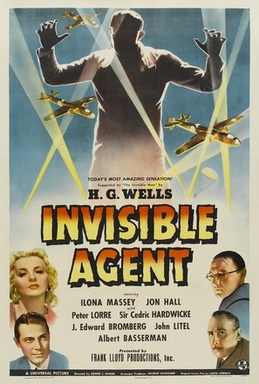
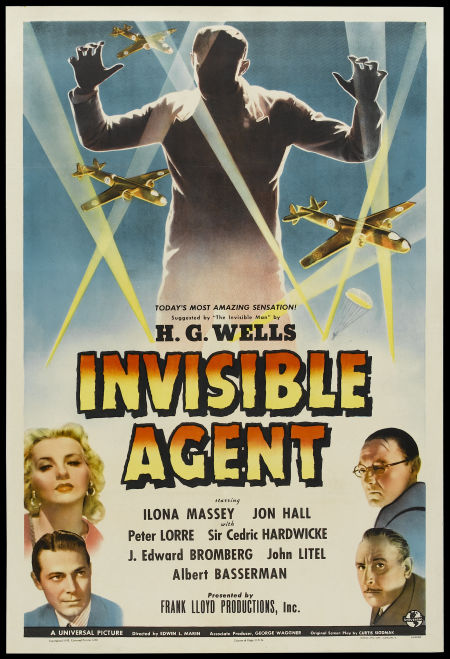
In 1942, the world was at war and everyone, whether a soldier or a civilian, was expected to do their part for the war effort. That included the best and the brightest of Hollywood. Stars like Jimmy Stewart, Clark Gable, and Henry Fonda enlisted in army. Others sold war bonds and narrated patriotic news reels. Even the Universal monsters did their part for the war effort, with the Invisible Man becoming the Invisible Agent in the 1942 film of the same name.
Invisible Agent opens in 1940, with Frank Griffin, Jr. (Jon Hall), the grandson of the original Invisible Man, being confronted by a Nazi (Sir Cedric Hardwicke) and a Japanese spymaster (Peter Lorre) at his print shop in Manhattan. They want his grandfather’s invisibility formula. At first, they offer to pay him for it. Then, when Frank refuses, they threaten to chop off his fingers. Frank manages to escape with both his fingers and the formula. As Frank later tells the Americans, he’s not willing to give the formula to anyone because he knows how dangerous it can be if not used properly. As far as Frank is concerned, the formula must never be used again. Frank does say that he might change his mind under extraordinary circumstances.
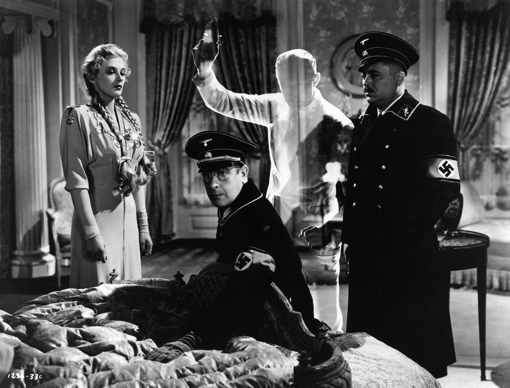
The film cuts to a series of headlines announcing that the Japanese have bombed Pearl Harbor. The circumstances are now extraordinary and Frank agrees that it is time to use the formula for the war effort. But he agrees to do so on the condition that only he be allowed to take the formula. Frank becomes the Invisible Agent, taking the formula and then parachuting into Nazi Germany. Unseen, Frank searches for information about Nazi spies in the U.S. and the details of Germany’s plan to bomb New York. Along the way, he meets Maria Sorenson (Ilona Massey), a wealthy German woman who is lusted after by the members of the German high command but who is actually working for the Resistance. Frank also finds himself, once again, coming across the two men who previously threatened him in New York.
Here are the positive things about this film. Invisible Agent has an intriguing premise. The Nazis are such monsters that even the once fearsome Universal monsters are joining the effort to take them down. The film also features two intelligent performances from Cedric Hardwicke and Peter Lorre, both of whom bring some unexpected shadings to their villainous roles. The opening scene in Manhattan plays out like an intense film noir and, once the action moves to Germany, director Edwin L. Marin keeps things moving at a steady pace.
Unfortunately, Invisible Agent has one huge problem that it cannot overcome. Jon Hall gives a remarkably charmless performance in the title role, flatly delivering his lines and showing very little in the way of personality. When you’re not seen for the majority of the film, it’s important to have a voice that’s full of personality. That’s one reason why the previous Invisible Man films benefitted from the casting of actors like Claude Rains and Vincent Prince. Jon Hall, on the other hand, just comes across as being dull. He gives a boring performance, whether visible or not and, as a result, Invisible Agent falls flat in a way that the previous Invisible films did not. There’s no real stakes in his turning invisible because there really wasn’t much to him to begin with.
Still, I thank the Invisible Agent for his service.
Previous Universal Horror Reviews:
- Dracula (1931)
- Dracula (Spanish Language Version) (1931)
- Frankenstein (1931)
- Island of Lost Souls (1932)
- The Mummy (1932)
- The Invisible Man (1933)
- The Bride of Frankenstein (1935)
- Dracula’s Daughter (1936)
- Son of Frankenstein (1939)
- The Invisible Man Returns (1940)
- The Wolf Man (1941)
- Ghost of Frankenstein (1942)
- Frankenstein Meets The Wolf Man (1943)
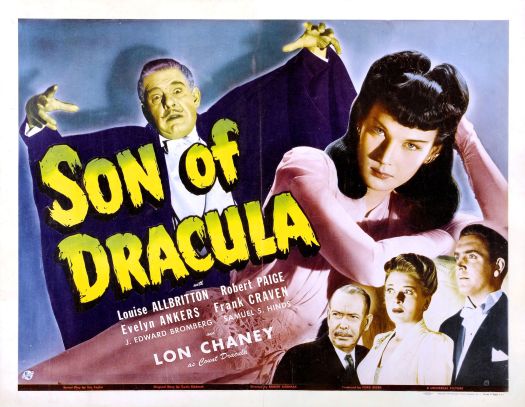
- Son of Dracula (1943)
- House of Frankenstein (1944)
- House of Dracula (1945)
- Creature From The Black Lagoon (1954)




 Through the Shattered Lens