“There comes a time when a man has to stand up and be counted.” — Zack Carey
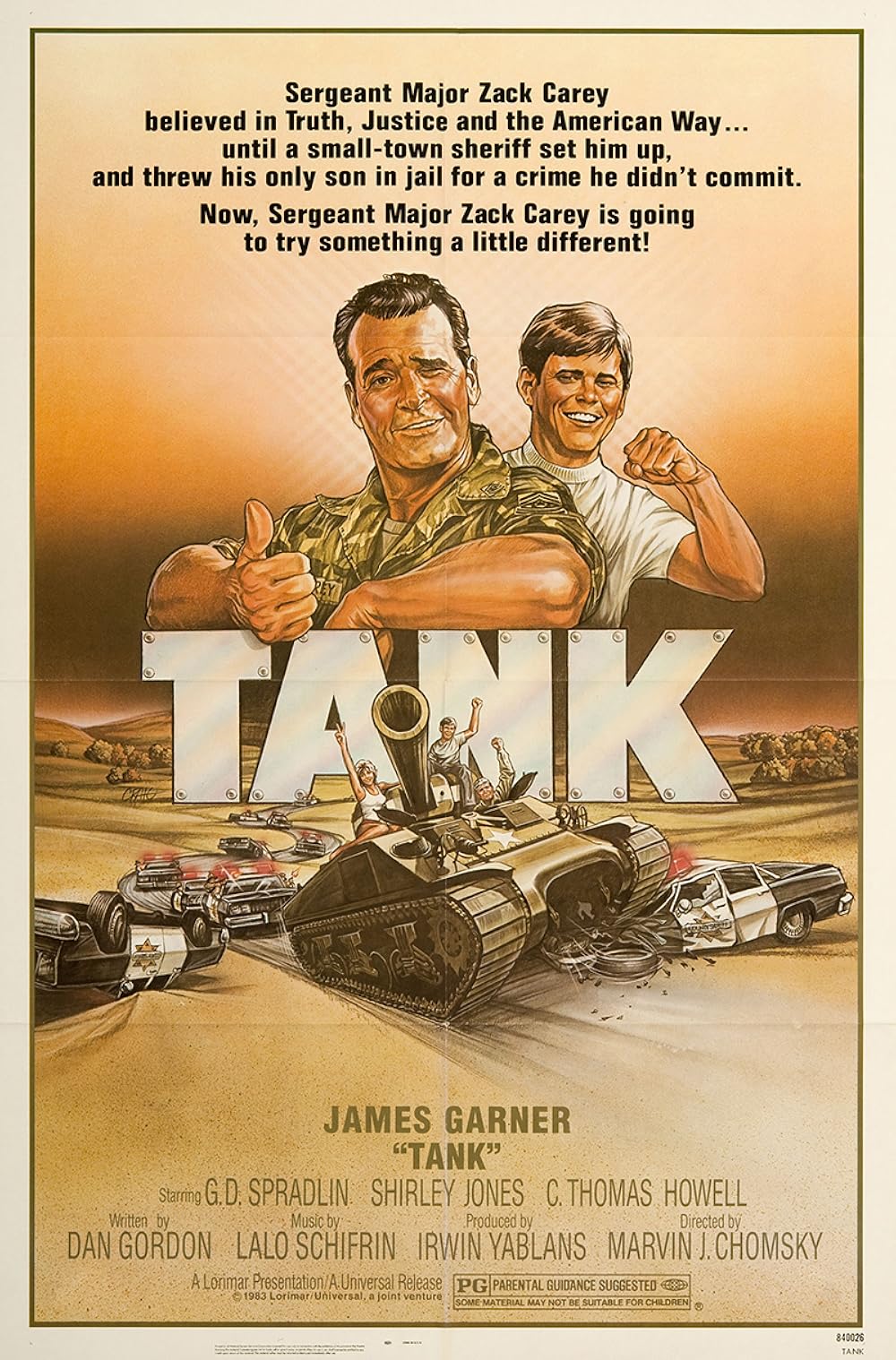
The 1984 action‑drama Tank is a small‑town parable dressed up as a military gimmick picture: an aging Army sergeant major, a battered old Sherman tank, and a corrupt sheriff. At its best, the film leans into James Garner’s quiet charisma and the absurdly specific “one man versus a whole county” premise; at its worst, it staggers under inconsistent tone and a plot that veers between heartfelt family‑drama and almost cartoonish vigilantism. Taken as a product of the early‑mid‑1980s, however, Tank holds up as a reasonably entertaining, if not especially deep, genre hybrid that works more through Gardner’s presence and a few solid set pieces than through psychological complexity or formal ambition.
James Garner plays Zack Carey, an Army sergeant major who moves his family to a small Georgia town near a training base, where he has acquired a battle‑worn M4A3 Sherman tank as a personal hobby and morale project. The setup is already a little out of the ordinary: an enlisted man whose side hustle is maintaining a World War II relic, while his wife LaDonna (played by Shirley Jones) quietly pushes back against the constraints of Army life and small‑town politics. The film’s opening stretches the believability of that scenario thin, but Garner’s easygoing authority and dry humor sell the idea that Zack is exactly the kind of practical, no‑nonsense soldier who would grow attached to a tank and treat it like a second family member. The script uses this setup to position the vehicle not just as hardware, but as a symbol of the character’s livelihood, dignity, and sense of duty.
The trigger for the conflict is an incident at a local bar, where Zack intervenes when a local deputy, who also moonlights as a pimp, roughs up a teenage prostitute named Sarah. The sheriff, Eugene Buelton (played with oily menace by C. Thomas Howell), is deeply corrupt and runs the town like a fiefdom, using his deputies to intimidate anyone who crosses him. When Zack’s teenage son, Billy, is later framed for a crime and thrown into a primitive prison camp, the fuse is lit. The film’s moral map is deliberately simple: Buelton is cartoonishly evil, Buelton’s deputies are unreliable tools of his will, and the Careys are painted as upright, essentially decent people caught in an unjust system. That simplicity works in Garner’s favor, because it lets the film focus on emotional stakes—father‑son loyalty, a wife’s fear for her family—rather than intricate political nuance.
What gives Tank much of its energy is the moment Zack decides to fight back with the only weapon he truly controls: his Sherman. The image of a lone, aging non‑commissioned officer rolling down country roads in a clanking World War II tank is inherently cinematic, and director Marvin J. Chomsky milks it for both action and symbolism. The scenes where Zack smashes through the sheriff’s office, disrupts the local jail, and later drives straight into the work farm to free Billy are played with a pulpy, almost comic‑strip bravado. The tank becomes a rolling moral absolutist: clumsy, loud, and impossible to ignore, cutting through the town’s layers of bureaucracy and intimidation in a way that mirrors Zack’s own frustration with a justice system that refuses to protect his son. The film’s action sequences are not particularly innovative by modern standards, but they benefit from the authenticity of the M4A3 and the straightforward choreography that lets the vehicle feel like a physical presence rather than a CGI abstraction.
Where Tank runs into trouble is in its fluctuating tone and some of its secondary choices. The subplot involving Sarah, the teenage prostitute, is handled with mixed success. On one hand, it adds a layer of social commentary about exploitation and small‑town complicity; on the other, it sometimes feels tacked on, introduced more as a narrative convenience than a fully developed character arc. The film wants to position her as a sympathetic victim who finds a kind of makeshift family inside the tank, but the material doesn’t dive deep into her background or inner life, leaving her more of a device than a rounded personality. This uneven handling reflects a broader issue: the movie vacillates between being a gritty crime drama, a family‑centric tearjerker, and a lighthearted action‑comedy. At times it feels like a made‑for‑television movie with a slightly bigger budget, hit by the same kind of tonal indecision that often plagued mid‑tier 1980s genre pictures.
Garner’s performance is the single element that keeps Tank consistently watchable. His Zack Carey is neither a cartoon hero nor a brooding anti‑hero; he’s a working‑class soldier approaching the end of his career, tired of compromise and willing to push back when pushed too far. Garner underplays the action‑hero theatrics, relying instead on quiet resolve, a dry sense of humor, and a lived‑in weariness that makes Zack feel like someone you might have actually met in an Army post or small town. Shirley Jones, as his wife, brings a grounded warmth to the domestic scenes, and the dynamic between Zack and his son Billy feels occasionally sentimental but never entirely false. The relationship between father and son anchors the film’s more outlandish elements, turning the tank chase into a visible metaphor for a father’s desperation to protect his child in a system that treats both as expendable.
Visually, Tank is workmanlike rather than stylish. The Georgia countryside is shot in broad daylight, with an emphasis on wide shots that showcase the tank moving through fields, back roads, and small towns. The tank itself is the film’s most vivid visual motif, a hulking, almost anachronistic machine that looks slightly out of place in a 1980s setting, yet somehow believable as the relic of a bygone era carried forward by a man who still believes in clear‑cut notions of right and wrong. The production favors practical effects and real locations over glossy stylization, which gives the material a modest, sometimes cheap‑looking quality but also lends it a concrete, lived‑in feel. The score, composed by Lalo Schifrin, adds a number of flavors—military marches, light jazz, and even a faintly disco‑tinged theme—further underscoring the film’s genre‑mixing instincts without always achieving cohesion.
Thematically, Tank leans heavily on the idea of individual resistance against corrupt authority. The sheriff’s abuse of power, the rigged legal process, and the near‑absence of any higher‑level oversight all feed into a classic American underdog narrative: one man, one tank, and a small band of allies taking on a system that has long since stopped pretending to be fair. The film stops short of overtly political commentary, but it clearly sympathizes with the notion that ordinary people sometimes have to go outside official channels when those channels are rigged against them. At the same time, the movie softens its edges with a crowd‑pleasing finale that reframes Zack and his allies as folk heroes, welcomed by a gathering of onlookers at the Tennessee border. This turn toward feel‑good spectacle undercuts some of the grittier implications of the earlier material, but it also fits the early‑1980s appetite for triumphant, crowd‑friendly resolutions.
As a time capsule of 1980s genre filmmaking, Tank is more interesting than it is groundbreaking. It is neither a forgotten masterpiece nor a laughably bad curio; it sits somewhere in the middle, powered by James Garner’s steady presence and the appealingly simple conceit of a World War II tank as a one‑man war machine. The film’s weaknesses—a schematic morality play, uneven tone, and underdeveloped secondary characters—are real, but they don’t completely erase its modest strengths. If viewed as a straightforward, mid‑tier action‑drama with a strong central performance and a memorable mechanical co‑star, Tank emerges as a fair, unpretentious, and occasionally rousing piece of 1980s entertainment.

 Through the Shattered Lens