Made-For-TV Horror Review: Mind Over Murder (dir by Ivan Nagy)


In the 1979 made-for-TV movie, Mind over Murder, Deborah Raffin stars as Suzy.

Suzy is a model and an actress.  She has a nice apartment, which she shares with her football-loving boyfriend, Ben (Bruce Davison).  She has a best friend (Penelope Willis), who is constantly looking to get laid.  Her latest job requires her to dance with a man who is dressed up like a giant hamburger.  It would seem that, by the standards of 1979, Suzy has the perfect life.

However, her life is turned upside down when she suddenly starts having visions.  All of the action around her will either switch to slow motion or stop altogether while Suzy has a vision of a scary-looking bald man (Andrew Prine) stalking her.  Her most disturbing vision involves Suzy hearing the sound of a pilot begging for help while his airplane crashes.  Ben tells her that she’s probably just working too hard but, the next morning, Suzy looks at a newspaper and immediately sees a headline about a plane crash.

With Ben dismissing her concerns, Suzy takes it upon herself to meet with the two detectives (David Ackroyd and Robert Englund — yes, Robert Englund!) investigating the plane crash.  They are surprisingly sympathetic to Suzy’s story of hearing the plane crash before it happened.  They arrange for her to meet a psychic researcher, who explains that Suzy must have some sort of mental connection to whoever was responsible for the crash.  While Ben continues to be skeptical and jealous of all the time that she’s spending with one of the detectives, Suzy keeping having disturbing visions of the bald man….

Considering its origins as a made-for-TV movie, Mind Over Murder is a surprisingly frightening film.  This is a film that proves that slow motion can make just about anything creepy and Deborah Raffin does a good job of showing us just how much Suzy dreads those moments when everything starts to slow down and she realizes that she’s about to get hit with another vision.  That said, what truly makes this film frightening is the performance of Andrew Prine, who plays the bald man as being every woman’s nightmare.  He’s a misogynist, the type who is convinced that every woman should be in love with him and that those who aren’t should be punished.  Whether he’s appearing in Suzy’s visions or stepping into her reality, Andrew Prine is never less than terrifying.

Along with featuring a scary performance from Prine, this film also features a genuinely likable one from Robert Englund.  Englund is playing a nice guy here.  In fact, before he made horror history in A Nightmare in Elm Street, Englund almost always played nice guys.  It’s interesting to watch him here, with his friendly manner and his polite style, and to imagine the roles Englund would have ended up playing if he hadn’t gotten typecast as a horribly scarred serial killer.

The first hour of Mind over Murder is brilliant.  The final 30 minutes, unfortunately, find the film turning into a far more conventional thriller, as Suzy’s visions are replaced by the Bald Man actually coming after her.  That said, this is still an effective horror thriller and one that deserves to be rediscovered this Halloween season.
Playing With Fire (1985, directed by Ivan Nagy)


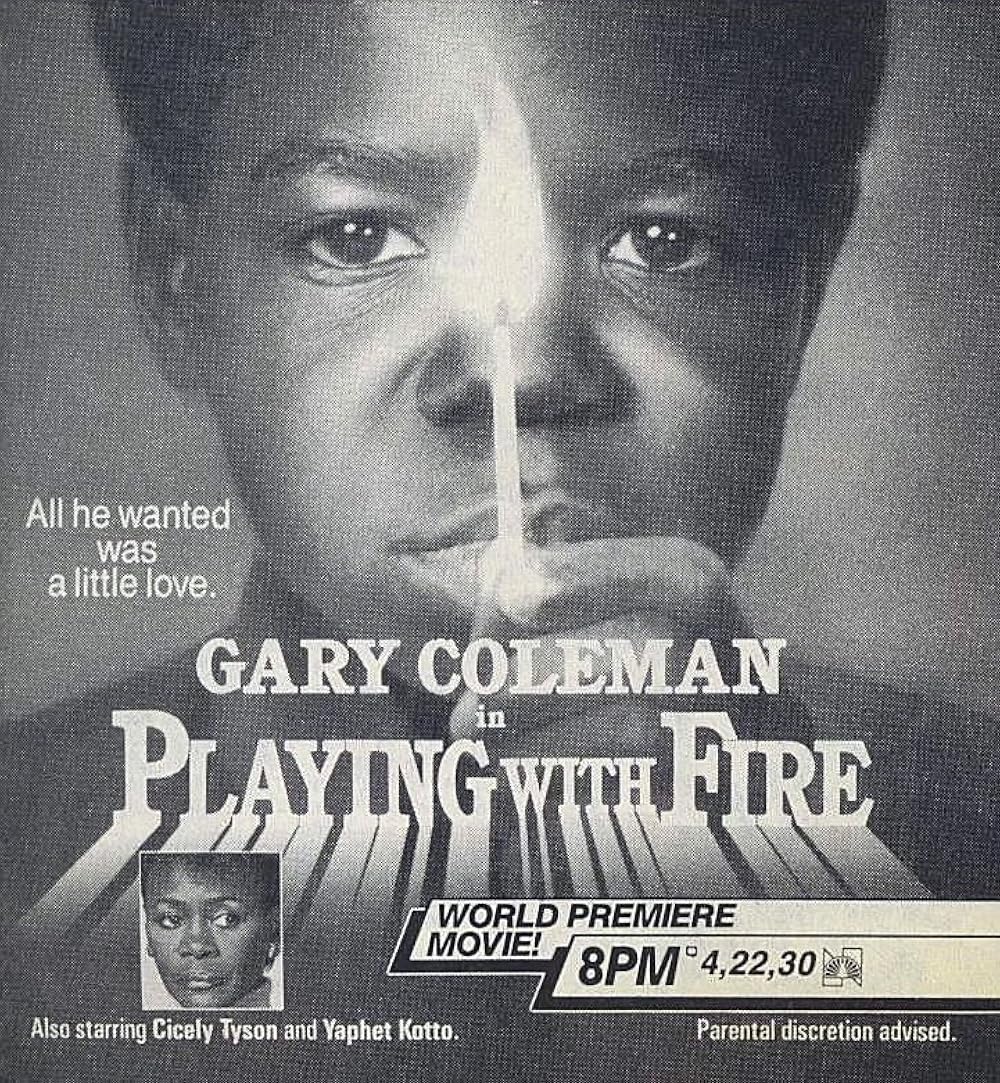
David Phillips (Gary Coleman) is a teenager who sets fires when he gets upset.  He has many reasons to be upset.  His parents (Ron O’Neal and Cicely Tyson) are getting divorced and are constantly fighting.  His teachers at school are always getting on his back.  He has to take care of his younger siblings and his dog.  He can’t even get the bigger kids in school to let him play basketball with them.  At first, David just plays with his lighter but, after he accidentally sets his mother’s coat on fire, David discovers that he likes to watch things burn.  David and his mother both claim it’s just coincidence that David is always nearby whenever a fire breaks out but Fire Chief Walker (Yaphet Kotto) knows what’s really going on.  After David nearly burns down his house, Walker tries to reach him before it’s too late.

This isn’t really meant to be a horror film  but it’s shot like one, with plenty of scenes of Gary Coleman staring at a burning fire with a possessed-look in his eyes.  The movie tries to make David sympathetic but the scene where he threatens his own dog with a lighter suggests that David has more problems than just his parents splitting up.  This was Gary Coleman’s first dramatic role.  I think it may have also been his only dramatic role.  It’s not that he’s not convincing as a really angry kid.  It’s just that he’s Gary Coleman so, no matter how much the movie tries, it still comes across as being a special episode of Diff’rent Strokes where Arnold becomes a pyromaniac.  Coleman tries to play up the drama of the situation but it’s hard not to laugh whenever he looks shocked at one of the fires that he has just started.  Every scene seems like it should end with Conrad Bain showing up with the cops.

For years, this movie was next to impossible to find but finally, someone found an old VHS tape in their garage and uploaded the movie to both YouTube and the Internet Archive, ensuring the world will never forget the time that Gary Coleman played with fire.

One final note: the director is better known for eventually becoming business partners with notorious Hollywood madam, Heidi Fleiss.

Late Night Retro Television Reviews: CHiPs 1.12 “Aweigh We Go”


Welcome to Late Night Retro Television Reviews, a feature where we review some of our favorite and least favorite shows of the past!  On Mondays, I will be reviewing CHiPs, which ran on NBC from 1977 to 1983.  The entire show is currently streaming on Freevee!

This week, Ponch and Baker are ordered to make life difficult for the Teamsters!

Episode 1.12 “Aweigh We Go!”

(Dir by Ivan Nagy, originally aired on December 22nd, 1977)

No, that’s not a typo.  The name of this episode is indeed “Aweigh We Go.”  It makes sense once you watch the episode.

Things get off to a classic CHiPs start, with Baker and Ponch chasing some rich scumbag in a fancy sportscar.  The driver doesn’t think he has to slow down or pull over, even when he’s being pursued by the cops.  He’s such a reckless driver that he nearly sideswipes a station wagon that is towing a boat.  The boat gets loose and crashes into a beauty salon.  No one’s hurt but Ponch is excited when he discovers the boat’s for sale.  He starts making plans to buy the boat from its owner (Sean Morgan), a guy who is named Sven Larson for no particular reason.

Unfortunately, Ponch makes the mistake of mentioning his plans in front of Sgt. Getraer.  Getraer proceeds to buy the boat out from under him.  Ponch, needless to say, is miffed and Getraer finally agrees to co-own the boat with Baker and Ponch.

That’s not the only surprise that Getraer has up his sleeve.  Because of an officer shortage, he is forced to send Ponch and Baker to work at a weighing station for a week.  Under the sarcastic command of Capt, Vogt (played by Bruce Glover, who is best-known for playing Mr. Kidd in Live and Let Die), Baker and Ponch learn all about how to weigh trucks to make sure that they are in regulation.  Interestingly enough, the episode devoted a lot of time to showing how a weighing station works.  You could probably argue that it actually spends too much time on it.  Myself, I have family in the trucking industry so I found it interesting to see what they would have had to deal with in the 70s.  I imagine all of the nitpicky rules and regulations are probably even worse today.

Of course, there’s still time for the usual CHiPs shenanigans.  Ponch and Baker chase down and arrest a hijacker played by a rather sinister Gerald McRaney.  And they rescue a baby from a crashed car.  As usual, the emphasis is on all of the members of the Highway Patrol working together to keep the world safe for drivers.

As for the boat, it sinks the first time Ponch tries to take it out on the water.  Oh, Ponch!  Usually, I’m pretty critical of Erik Estrada’s scenery chewing performance on this show but I will admit to laughing at his rather frantic facial expression as he watched the boat sink.

This was a pleasant episode.  I stand with the truckers!

Film Review: Deadly Hero (dir by Ivan Nagy)


First released in 1975, Deadly Hero tells the story of Edward Lacy (Don Murray).

Lacy is an 18-year veteran of the New York Police Department and a proud family man.  Lacy is clean-cut, handsome in a blandly pleasant way, and he has a wife and several children.  He’s a member of the Knights of Columbus and there are times when he imagines himself pursuing a career in politics.  One of the first things that we see Lacy do is introduce an anti-crime mayoral candidate named Reilly (George S. Irving) at a Knights of Columbus rally.  Lacy goes out of his way to make sure that he and his family make a good impression but Reilly barely seems to notice him.

Lacy is also a racist who enjoys pulling and using his gun.  He was once a detective but a long string of brutality complaints has led to him being demoted back down to being a patrolman.  He and his partner (Treat Williams, making his film debut) spend their time patrolling the streets of New York City, getting dirty looks and verbal abuse from the people who they are supposed to be protecting.  Much like Travis Bickle in the following year’s Taxi Driver, Lacy obsesses on the crime and the decay that he sees all around him.

Sally (Diahn Williams) lives a life that is a hundred times different from Lacy’s.  She’s a cellist and a conductor.  She spends her days teaching and her nights conducting at an avant-garde theater.  Sally and Lacy have little in common but their lives become intertwined when Sally is attacked and briefly held hostage by a mentally disturbed mugger named Rabbit (James Earl Jones).  Responding to a call put in by Sally’s neighbor (Lila Skala), Lacy discovers Rabbit holding a knife to Sally’s throat in the hallway of Sally’s apartment building.  At first, Lacy handles the situation calmly and he manages to talk Rabbit into not only releasing Sally but also dropping his knife.  However, instead of arresting the now unarmed and docile Rabbit, Lacy shoots and kills him.

Knowing that he’s about to be investigated and that he’s made enemies in the department due to his political activities, Lacy convinces the still-shocked Sally to lie and say that she witnessed Rabbit lunging for Lacy’s gun before Lacy fired.  Lacy is proclaimed a hero and soon, Reilly is inviting him to appear at rallies with him.  Lacy’s political dreams seem to be coming true but Sally starts to feel guilty about lying.  Realizing that Sally is planning on revealing the truth about what happened, Lacy goes to extreme measures to try to keep her quiet.

Deadly Hero is an interesting film, one that is certainly flawed but which ultimately works as a portrait of the authoritarian mindset.  Ivan Nagy directs without much visual flair and, especially at the start of the film, he struggles to maintain a consistent pace.  For instance, the scene where Rabbit initially menaces Sally seems to go on forever, long beyond whatever was necessary to convince the audience that Rabbit was a dangerous guy.  (With the amount of time that Nagy lingers over shots of Sally being menaced by Rabbit, I was not surprised to read that Nagy and Dianh Williams apparently did not get along during filming.)  That said, the film’s low budget actually works to its advantage, with the grainy cinematography giving the film a gritty, documentary feel.  The film was shot on location in New York City and it’s interesting to watch the actors interact with real New Yorkers.  While Lacy is never a sympathetic character, seeing the actual streets of New York does go a long way to explaining why he’s so paranoid.  This is one of the many 70s films in which the overriding message seemed to be that New York City was the worst place on the planet.

The film is dominated by Don Murray, who plays Lacy as being a blue-collar fascist who has learned how to hide his anger and his hatred behind a quick smile and an outwardly friendly manner.  Feeling confident that everyone will back him up, he has no hesitation about executing an unarmed black man.  Even when it becomes obvious that Sally is not going to continue to lie about what happened, Lacy is still arrogant enough to assume that he can charm her into changing her mind.  When that doesn’t work, Lacy becomes increasingly unhinged and vindictive.  The film’s final ambiguous image suggests that there really is no way to escape the Edward Lacys of the world.

With its portrayal of a violent cop who is convinced that he will be protected by the system, Deadly Hero feels extremely relevant today.  Of course, Deadly Hero also suggests that the same system that Lacy is exploiting can be used to take him down, with Lacy eventually being investigated by both Internal Affairs and the District Attorney’s office.  The film leaves it ambiguous as to whether or not the rest of the police are as dangerous as Lacy.  Is Lacy a product of the system or is he just someone who has figured out how to exploit the system?  To its detriment, that’s a question that the film doesn’t answer.  Still, much like Harvey Hart’s similarly underappreciated Shoot, Deadly Hero is an always-interesting and occasionally insightful look at the authoritarian mindset.

A Movie A Day #163: Captain America II: Death Too Soon (1979, directed by Ivan Nagy)


America’s most patriotic beach bum is back!
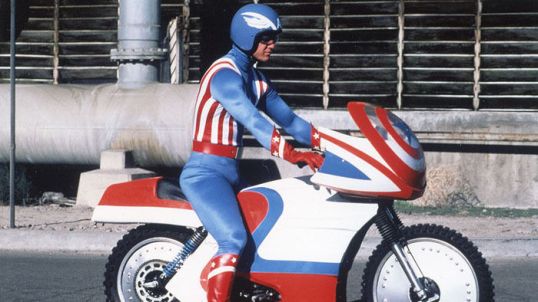
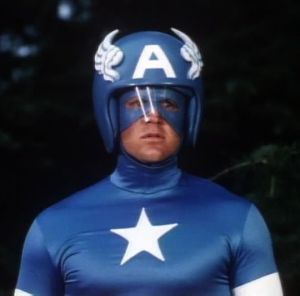
The infamous international terrorist, Miguel (Christopher Lee), is demanding millions of dollars from the U.S. government.  If he doesn’t get his cash, Miguel will unleash a formula that causes rapid aging.  Who else can stop him but Captain America (Reb Brown)?  While Cap searches for Miguel in a small town that appears to be full of bullies, comely single mothers, and children in desperate need of a father figure, Doctors Simon Mills (Len Birman) and Wendy Day (Connie Sellecca) search for a way to reverse the aging process.

This is the second of two pilots that were produced in 1979 in an attempt to start a weekly Captain America television series.  This Captain America had little in common with his comic book counterpart.  In the two pilots, Steve Rogers was a laid back beach bum who drove a Chevy Van and owned a really groovy, red, white, and blue motorcycle.  Having recently gotten out of the army, Steve would have been just as happy to spend his time sketching the beach as saving the world from HYDRA.  Whenever he put on the costume of Captain America, he carried a transparent shield that was supposed to be bullet proof but which looked like it was made out of flimsy plastic.  In Captain America II: Death Too Soon, Cap uses his shield to protect himself from a wild dog and the shield literally bends when the dog jumps against it.  Reb Brown played Cap in both pilots and, while he was more likable than Matt Salinger, he was no Chris Evans.

Still, the presence of both Christopher Lee and Connie Sellecca help to make the second pilot a marginal improvement on the first one.  The second pilot is almost good enough to make the case that, if not for that damn transparent shield, a weekly Captain America television series would not have been that bad.  It was not to be, of course.  It would be over 30 years before a movie finally got both Captain America and his shield right.