Game Review: Desolation (2020, Earth Traveler)


Desolation is an entrant in the 2020 Interactive Fiction Competition.  All of the entries can be played here.

In this piece of horror-themed Interactive Fiction, you have just escaped from a mansion and a blood-thirsty cult and now, suddenly, you’re in the desert.  You have no food.  You have no water.  Your phone isn’t going to save you and the sun isn’t going to stop beating down on you.  You’ve got a flashlight but that won’t help if you die of thirst and there’s a good chance of that happening since you’re stranded in the desert.

Or are you?

Desolation does a good job of keeping you guessing as to what’s really going on.  After a few turns of wandering around in the desert, the game took an unexpected turn and then, a few turns later, it took another unexpected turn.  I can’t go into the details without spoiling the game but I will say the Desolation kept me on my toes.  I’m terrible at IF games that require you to figure out how to survive in a desolate location.  I always go the wrong direction or pick up the wrong object.  That happened to me a few times while playing Desolation but I still enjoyed the game.  It’s a real challenge and requires more than a little thought.  If you’ve never played an IF game before, this is probably not the one to start with.  But people who know the format should enjoy the challenge of Desolation.

One final note: Desolation is actually a sequel to an earlier game, Two Braids Girl.  I haven’t play the earlier game but that didn’t stop me from enjoying Desolation.
Desolation can be played here!

Game Review: Ascension of Limbs (2020, AKheon)


Ascension of Limbs is an entrant in the 2020 Interactive Fiction competition.  You can browse and play all the entries here.

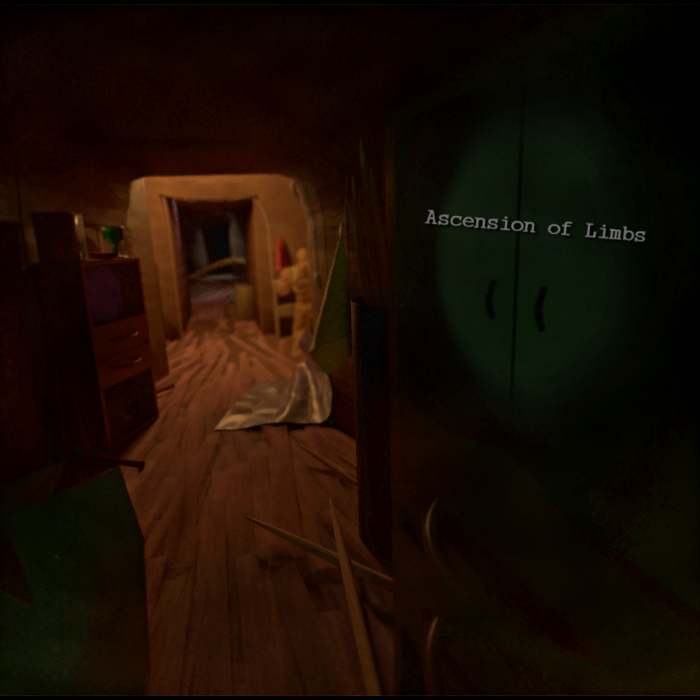
In Ascension of Limbs, you play the owner of a mysterious antique store.  You may have bought the store.  You may have inherited from a relative.  You may have gotten it in some other mysterious way.  There’s a lot of randomization involved in Ascension of Limbs, which means that you can play the game several times and have a totally different experience each time.

Your goal in Ascension of Limbs is to not go broke, to not go insane, and to not end up poor and destitute.  That’s not as easy as it sounds.  There are some dangerous things in that antique shop and, if you’re not careful, they can sap away your sanity and lead you to do some terrible things.  (Losing a point of sanity limits what you can do in the store, sometimes at the worst possible moment.)  If you can’t find anything to sell, you’ll lose money.  Lose all your money and the game is over.  It’s not easy to make money when you’re also losing your mind.  Lose your mind and the game is also over.  Balancing both money and sanity will be challenge but the game offers a lot of ways to do it.

Make your choices.  Do you promote your store or do you hope the customers will just find you?  Do you call the police about criminals or do you use them to commit insurance fraud?  Do you build up a strong base of loyal customers or do you murder them, for either their money or as an exchange for forbidden knowledge?  The choice is yours!

Ascension of Limbs is a challenging game but I can’t recommend it enough.  For those with patience and a tolerance for the occasionally macabre, Ascension of Limbs is a game to play again and again.

Play it here.

Game Review: Last House On The Block (2020, Jason Olson)


Last House On The Block is an entrant in the 2020 Interactive Fiction Competition.  All of this year’s entries can be played here.

Mr. Harrison, who has lived in your neighborhood longer than anyone who can remember, has died.  Mr. Harrison was the neighborhood hermit, a quiet elderly man who lived in a big house and who rarely talked to anyone.  Everyone assumed that he had to be rich.  Because Mr. Harrison had no family, the city is going to come to his house and take everything.  That leaves you with only one chance to explore his house on your own and find the money that you’re sure Mr. Harrison had secreted away.

Just from the set-up, Last House On The Block sounds like it’s going to be horror game but actually, it’s a slice-of-life.  You explore Mr. Harrison’s house and see how the old man lived.  In order to discover where Mr. Harrison hid his secrets, you’ll have to pay attention to ever detail and start solving puzzles early.  From the very start of the game, you’re presented with a puzzle that will either lead to you having a friend to help with your search or leave you with the next-to-impossible task of doing it all by yourself.  Some of the puzzles are more difficult than others.  Luckily, the game does have a walk-through.  I had to refer to it several times but there’s not a single puzzle in the game that can’t be solved on your own.  You just have to pay attention.

Last House On The Block is a good example of a search-and-explore type game.  I appreciated and enjoyed the care that went into describing each room in the house.  By the end of the game, I could visualize every aspect of Last House On The BlockIt can be played hereThe walk-through is here.

Game Review: Electric word, “life” (2020, Lance Nathan)


Electric word, “life” is an entrant in this year’s Interactive Fiction Competition.  Right now, because it’s October, I’m just playing the horror and Halloween-themed entries but all sorts of different games have been entered in this year’s competition and I look forward to playing all of them in November.

Electric word, “life” takes place at a Halloween party in 1999 but it’s not really a horror game.  There are elements of the supernatural in the game but the game is more about memories and grieving than it is about the paranormal.  Your roommate is throwing a Halloween party and, realizing that your flat is full of strangers, you’re looking for a way to either escape or at least find some peace and quiet.  Then, suddenly, your friend Andy shows up but there’s something different about him.

Like most games designed with Twine, Electric word, “life” is more a short story than a traditional game.  You point and click to move the story along and to get extra details.  There are a few choices you can make but they all appear to eventually lead to the same conclusion.  Luckily, it’s a very well-written and emotionally-effective story.  I especially liked the amount of detail that Lance Nathan went into when it came to recreating Halloween, 1999.  Everything from the Matrix costumes to the music playing at the party felt spot-on.  Playing the game, you feel like you really are at that party, listening to strangers chat each other up and wondering how you’re going to clean up the mess afterwards.  When Andy arrives, you’re as relieved as the narrator to see a friend and when Andy reveals his secret, it’s an emotional moment for both the player and the narrator.

Electric word, “life” is a simple but rewarding work of Interactive Fiction.  It can be played by clicking here.

Game Review: The Pinecone (2020, Joseph Pentangelo)


The Pinecone is one of the entrants in this year’s Interactive Fiction Competition.  In this work of flash fiction, you’re waiting for the school bus to arrive.  It’s another cold and boring morning.  You’re running late but so is the bus.  It’s while you’re waiting for the bus that the goats arrive.  How you react to the goats will determine whether or not you make it to school.  That my sound simple but there’s more to it than just standing to the side while they walk by.  You never now where a goat might show up.

This is a brief but well-written and frequently funny game.  Because of movies like The Witch, I was expecting the goats to act in a certain and more sinister way.  While they didn’t (and this is not a horror game, despite the presence of goats), the game still did a good job of showing why you wouldn’t necessarily want to mess around with a goat.  Towards the end of the game, there is a literal laugh out loud moment involving a goat and a school bus.  The game’s worth playing just for that.

The Pinecone is simple but it’s also a game that rewards being replayed.  Unlike a lot of Twine works, your decisions really do affect the outcome of the game.  Making the correct choice early on in the game will give you more options later on.  Making the wrong choice will lead to your options being limited and you missing school.

It’s not a difficult game but it probably does help to know something about goats before playing The Pinecone.  After you’ve done research, The Pinecone can be played here.

Game Review: Baby Face (2020, Mark Samples)


In this work of Interactive Fiction, the recent death of your mother forces you and your father to come to terms with Babyface, a semi-legendary bogeyman who haunted you in the past and who may still be living in his old house, watching as people walk by.

Babyface is more of a short story than an actual game.  There are things for you to click in order to move the story forward but there really aren’t any decisions for you to make.  If you’re looking for a traditional IF experience, with you explore locations on your own and it’s up to you to figure out what the clues mean and how to solve all the puzzles, Babyface is not it.

Instead, it’s a story that puts you right in the head of the main character.  Even though you don’t really control her actions, you still see the story through her eyes.  It’s both well-written and well-designed (using Twine) and it uses both audio and photographs to create and maintain a spooky atmosphere.  Inspired by a nightmare, this story does a good job of capturing dream logic and keeping the player off-balance.  It may not be a traditional game but it is a good read for fans of horror.

Babyface has been entered into the 2020 Interactive Fiction competitionIt can be experienced here.

Game Review: Vampire Ltd (2020, Alex Harby)


One of the best Interactive Fiction games that I’ve played recently, Vampire Ltd. is described as being “a corporate espionage adventure (with vampires in it).”

Taking place in a world where vampires are not only known to exist but where they often become rich and powerful businessman, Vampire Ltd. has the player take on the role of Nero Brashov.  Nero is a former aristocrat, a current vampire, and a failed businessman.  But the failure is not your fault.  You were cheated by your business partner, Hadrian.  Now, Hadrian is on the verge of unveiling something that he calls the Moonlite and you’re determined to get revenge by sneaking your way into his corporate office and destroying the machine.

The only problem is that you’re a vampire and you can’t enter unless someone invites you in.  Can you convince someone to do that?

A clever and very detailed mix of horror and corporate espionage, Vampire Ltd. is a frequently hilarious text adventure in which you alternate between dealing with the realities of corporate life and your desire for revenge.  While the puzzles are not excessively difficult, they do require a little work to figure out but the game comes with a walk-through for those who might get lost.

Vampire Ltd. is a game that benefits from being played more than once.  There’s a lot that your vampire can do.  It’s not necessary to do all of it to win the game but it’s still rewarding to replay and discover all of the different things that can happen.  Fortunately, the game ends with a series of suggestions of things that you might want to try when you play a second or third time.

Vampire Ltd. is an entry in this year’s Interactive Fiction Competition It can be played here.

Game Review: The Brutal Murder of Jenny Lee (2020, Daniel Gao)


Jenny Lee was only seventeen years old when she was brutally murdered, beaten to death with her own saxophone.  Now, seventeen years later, you have been sent into the past to investigate her murder.  A disembodied voice follows you everywhere you go, sometimes offering up hints but sometimes reprimanding you if you find clues to a solution that the voice doesn’t want to hear.  The voice makes it clear that you have a limited amount of time to solve the murder and when that time expires, so will you.  When you’re not investigating, you’re in limbo, where you can move in every direction but you can never escape.  Or can you?

This work of Interactive Fiction is actually two mysteries in one.  The first is the mystery of who murdered Jenny Lee.  The other is the mystery of who you are and why you’ve been sent to the past.  Neither is an easy mystery to solve and, fortunately, the game does have a walk-through for those who just want to find out what’s going on in the most straight-forward way possible.  However, it’s best to play this game without using the walk-through so that you can fully immerse yourself in the world that it creates.  Not everything you see in the game is going to be relevant to solving the mystery.  Like all good detective stories, there are red herrings.

The best advice I can give you for what to do while playing The Brutal Murder of Jenny Lee is to write things down.  A lot of the game’s clues involve remembering either directions or passcodes.  Making the right or wrong decision when going either north, south, east, or west be can be the difference between a good ending and a bad ending.

The Brutal Murder of Jenny Lee is an entry in this year’s Interactive Fiction Competition.  It, and all of the other entries, can be played here.

Game Review: Alone (2020, Paul Michael Winters)


You’re alone.

You want to be alone.

Surviving what has happened to the world requires you to be alone.

But if you want to keep driving down the hallway, you’re going to have to find the closest garage and get some gas.  And when the gas pumps turn out to be locked, you’re going to have to figure out how to get them unlocked and you might not be able to do it alone.

Alone is a post-apocalyptic Interactive Fiction game.  While you try to solve the puzzle of how to unlock the gas pumps, you also find journals and other notes that reveal what has happened to the world and why it’s so important to stay isolated from other people.  It’s not a bad text game.  The descriptions are sparse but effective and the puzzles are not that difficult to solve as long as you pay attention.  As befits its story, it’s a straight forward game without any unnecessary padding.  In the game, you don’t have any time to waste and neither does Alone.

Not surprisingly, Alone is one of many IF games that I’ve played this year that deals with people having to isolate themselves because of an apocalyptic events.  This is the year of the quarantine so, of course, it’s going to be reflected in our games, books, and movies.  I think that’s one reason why Alone sticks with you.  Right now, a lot of people are feeling alone.  Depending on the choices you make and how you play the game, Alone can end on a note of either hope or uncertainty.  It’s up to you.

Alone is one of the entrants in the 26th annual Interactive Fiction Competition, which is currently ongoing and accepting entries until November 29th.  You can play it (and all the other entries) by visiting the Interactive Fiction Comp’s home page.

Game Review: Six Gray Rats Crawl Up The Pillow (2015, Caleb Wilson as “Boswell Crain”)


You are Rinaldo di Gorgonzola, a spoiled fop living in Renaissance-era Italy.  With the plague shutting down most of the country and with you needing money to pay your rent, you accept a bet.  All you have to do to win is spend the night in the deserted castle of a recently deceased nobleman.

The main challenge of this Interactive Fiction game is to figure out how to get to sleep.  Getting in the caste is easy.  Since there’s only three rooms in the castle, finding the bedroom is easy.  Once you figure out that the command is “enter bed” and not “lie on bed,” getting on the bed is easy.  It’s getting to sleep that’s the hard part.  Not only are there things you have to do — like get undressed, eat, and read — before you can go to sleep but you also have to deal with a series of memories.  This game is unique in that your inventory includes memories that have to be examined before you can go to sleep.  Each memory leads to another memory until you finally reach one memory that will not go away.  The solution for getting rid of that memory is so simple that I’m worried that it took me so long to solve the puzzle.  I might not be as good at these games as I think I am.

The game doesn’t end once you fall asleep.  There’s some other things that you have to deal with.  You didn’t think that spending the night in a dead nobleman’s castle would be easy, did you?  But those puzzles are considerably easier to solve than the puzzle of how to get to sleep in the first place.

Six Gray Rats Crawl Up The Pillow is a well-written and atmospheric game.  There’s a lot of unexpected wit to be found in the game.  At one point, I grew so frustrated with trying to figure out how to go to sleep that I commanded the game “shoot shelf,” just to be reprimanded for always thinking about myself.  Another entertaining thing to do is to try to pick up the corpse of the nobleman.  (Yes, it does seem that the body was just left in the bedroom.)  I liked the way the game incorporated memories into the inventory, though I think some of the memories could have been combined to help the game flow better.  It took me about 40 minutes to play the entire game.  Someone who is actually good at this will probably be able to do it in 10.  It can be downloaded from here.