Rancher Bob “Utah” Neyes (Russell Hayden) heads into Canada to meet up with his business partner. Unfortunately, his partner has been murdered by outlaw Nails Nelson (Douglas Fowley). Mountie Jack Craig (Lyle Talbot) almost arrests Utah for the crime but he becomes convinced that Utah is innocent and Nails is guilty. Along with fur trader Ivy Jenkins (I. Stanford Jolley), Craig and Utah try to break up Nails’s fur-smuggling operation.
While I was watching it, I thought this movie seemed even more familiar than the usual Poverty Row western. I realized that’s because I had actually seen Russell Hayden and most of the rest of the cast in another movie that had a similar plot, right down taking place on the other side of the border. That other movie was called ‘Neath Canadian Skies. Both it and North of the Border are among the four Canadian western films that Robert Lippert produced in 1946, all of which starred Russell Hayden and were directed by B. Reeves Easton. Supposedly, it took 20 days to shoot all of them.
As for North of the Border, it’s only 42 minutes long and none of those minutes are wasted. There’s all of the usual horse chases and gunfights that fans want from these films. For me, the most interesting thing about the film was getting to see Lyle Talbot play something other than a boring authority figure. Also, this film features Inez Cooper, a pretty redhead who had a short career but whose beauty and personality as well-remembered by fans of Poverty Row westerns. She plays the love interest in this one and there’s no doubt that most men would give up living in Utah for her.
This low-budget western programmer tries to draw viewers in by using the name of an icon of the old west but it doesn’t take place in Deadwood, there’s no poker game, no dead man’s hand, and Wild Bill (Tom Brown) is presented as being a corrupt sheriff who works for evil businessman Jim Bailey (Denver Pyle). Denver Pyle, we all know him best as Uncle Jesse on theDukesofHazzard. He’s a bad guy here, the film’s Boss Hogg.
Our hero and the man who kills Wild Bill Hickok is a horse trader Johnny Rebel, who tells his story in flashback and who is often called “Mr. Rebel.” Johnny Rebel is played by Johnny Carpenter, no relation to the director. This Johnny Carpenter was a stunt man who took control of his career and wrote and played lead in a series of forgettable B-westerns, like this one. Carpenter probably could have been quite the hero in the Poverty Row days, when fast-paced westerns were being released on a weekly basis and directors and actors knew exactly what a matinee audience wanted. By the time IKilledWildBillHickok came out, westerns had started to grow up.
There’s the usual amount of stock footage. Director Richard Talmadge was himself a former stunt man so he does get a few good stunts into the last 15 minutes of the movie. Before the final gun battle, this movie about Wild Bill Hickok is nowhere near wild enough.
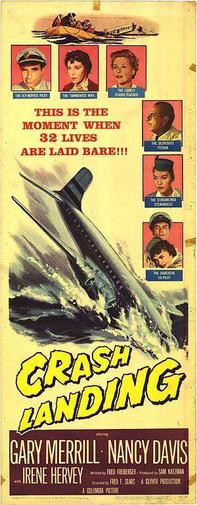
Flying from Lisbon to New York City, a commercial airline is flying over the ocean when two of its engines fail. When the propellers fail to restart, Captain Steve Williams (Gary Merrill) realizes that he will have to land the plane in the ocean. The Navy is standing by to rescue the passengers. It’s just a question of whether or not Steve and his crew can land the plane without injuring the passengers or causing the plan to break in half.
This is a disaster film that doesn’t really have a disaster. The members of the crew all work professionally and efficiently to make sure that the landing is a success, even though none of them have ever had to ditch a plane before. The Navy shows up on time and ready to help. With one exception, the passengers react calmly and do what they’re told. An Orthodox priest prays for the plane. The flight attendants neatly pack all of the kitchen utensils. The only drama comes from a boy who is traveling with his dog Wilbur and is upset to hear that Wilbur will have to stay in the back of the plane, where he will probably drown. The boy’s father says, “I’ll buy you a new dog,” and the boy asks that his baseball cap be placed by Wilbur’s cage so that Wilbur knows his owner was thinking of him. Don’t worry kid! Steve Williams isn’t going to let your dog die.
It’s strange to see a disaster film without any real drama. The crew thinks that Williams can be overbearing but it turns out he knows what he’s doing. At home, his wife (Nancy Davis, in her final film role) thinks that Steve is too hard on their son. Their son is going to grow up knowing how to land airplanes in water. This is almost the Sully origin story. Otherwise, the film emphasizes the way that everyone works together and doesn’t panic. The scene where the plane lands in the water features some good special effects but otherwise, the movie is pretty dull. It could have used Leslie Nielsen and Peter Graves.
Actress Nancy Davis retired from movies after this one but she remained in the public eye as the wife of future President Ronald Reagan.
In the 18th century, the inhabitants of Arkham, Massachusetts yank Joseph Curwen (Vincent Price) out of his mansion and tie him to a tree. They accuse Curwen of being a warlock who is in league with the devil and who has been bringing young women to his “palace,” and putting them in a trance. They burn Curwen alive but, before the flames are lit, they also give Curwen a chance to speak and curse both them and their descendants.
You really do have to wonder about the logic behind witch (and warlock) burnings. They seem counter-productive because they always give the accused just enough time to cast one final curse before being burned to a crisp. Indeed, you have to wonder why witches and warlock were allowed any final words to begin with. I mean, at some point, you would think everyone would notice that the final words were always a curse.
Anyway. 110 years later, Joseph Curwen’s descendant, Charles Dexter Ward (Vincent Price, again) rides into town with his wife, Anne (Debra Paget). He is stunned to see that Arkham has apparently fallen on hard times, with many of the town’s people being horribly disfigured. It’s explain to him that the disfigurements and the poverty are all a result of his ancestor’s curse. That’s going to make things a bit awkward, considering that Charles Dexter Ward has not only inherited the Palace but he’s also inherited a copy of Necronomicon and a legacy of messing with Cthulhu. The townspeople don’t want Ward around but he and Anne decide to spend the night in the Place regardless.
Of course, it doesn’t take long for Curwen’s spirit to possess Charles. Soon, Charles is trying to resurrect Curwen’s mistress, Hester (Cathie Merchant) and pursuing Curwen’s goals of breeding a race of super humans by forcing the women of the town to mate with the fearsome Yog-Sothoth. Charles also seeks vengeance on the descendants of those who burned Curwen at the stake, as if all of the poverty and the deformities aren’t punishment enough. Again, this is why you don’t give warlocks and witches a chance to get out one last curse before being executed.
Though The Haunted Palace is usually considered to be a part of Roger Corman’s Edgar Allan Poe cycle, the story itself is actually based on H.P. Lovecraft’s The Case of Charles Dexter Ward. (In Lovecraft’s novella, Ward seeks out his evil ancestor whereas, in the film, Ward is more or less an innocent victim.) The film’s title comes from a Poe poem, which is recited at both the beginning and the end of the film. But the film itself, with its references to the Cthulhu mythos and its hideous New England setting, is definitely a work of Lovecraftian horror.
Fortunately, it’s an effective work of Lovecraftian horror, one that captures the feeling of people unwisely trying to control a force of evil that they cannot begin to comprehend. Roger Corman keeps the action moving quickly and creates a gothic atmosphere of impending doom. Vincent Price, toning down his usual theatrics, is chillingly evil as Curwen and sympathetic as Charles. The film’s strongest performance, however, comes from Debra Paget, who desperately tries to free her husband from Curwen’s control. Any woman who has suddenly felt as if she can no longer recognize the man who she once loved will be able to relate to Paget’s performance.
The Haunted Palace is a strong entry in the films of Roger Corman and Vincent Price and one of the better adaptations of the work of H.P. Lovecraft.
The frontier community of Bonanza Town has been taken over by the corrupt businessman, Krag Boseman (Myron Healey). No one can stand up to Krag because the local judge (Luther Crockett) is under Boseman’s control. The judge’s son (Ted Jordan) writes to the Durango Kid and asks him to come to Bonanza Town and lead a group of vigilantes to overthrow Boseman.
The Durango Kid, whose real name is Steve Ramsay (Charles Starrett) somehow receives the letter and heads into town. As Steve, he gets a job working for Boseman and looks for evidence that Boseman is actually being bankrolled by a notorious outlaw named Henry Hardison (played by the film’s director, Fred Sears). As the masked Durango Kid, he defuses the vigilante’s violent plan and, with the help of Smiley Burnette, he investigates what Boseman has on the judge.
Charles Starrett played the Durango Kid in 131 films. In fact, he appeared in so many movies that the majority of Bonanza Town is made up of flashbacks from 1947’s West of Dodge City. Despite all of the flashbacks, Bonanza Town is one of Starrett’s better films, featuring an interesting story and good performances from both Fred Sears and Luther Crockett. Sears shows some imagination with his staging of the many gunfights and, as always, Starrett is convincing riding a horse and carrying a gun.
Bonanza Town is a fairly serious film and Smiley Burnette’s trademark comedic relief feels out of place but the kids in 1951 probably enjoyed it. While everyone else is shooting guns and committing murder, Smiley is running his barber shop and turning a potato into a musical instrument. While the Durango Kid dispenses frontier justice, Smiley sings a song and leaves his customers bald. They were a good team.
The drama continues: I received a call from FedEx about the status of my new DirecTV receiver (the old one being fried beyond repair) . The new box is now sitting in a warehouse, undeliverable because DIRECTV GAVE THEM THE WRONG ADDRESS!! You’d think after almost two years they’d have my address, right? Wrong! FedEx told me I have to call DirecTV and have them fix the address or drive an hour out of my way to pick it up myself. So I proceeded to call the corporate beast and was transferred to a woman who barely spoke English, gave her all my information, then was transferred to another woman who spoke even worse English and repeated the process all over again! After a half hour of this nonsense, I was then told I’d have to wait an additional 3-5 days before my new box arrives… hopefully at the right address! ARRRGGGGHH!!!!
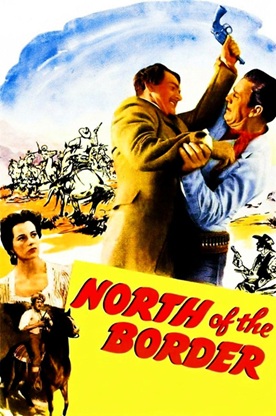 Rancher Bob “Utah” Neyes (Russell Hayden) heads into Canada to meet up with his business partner. Unfortunately, his partner has been murdered by outlaw Nails Nelson (Douglas Fowley). Mountie Jack Craig (Lyle Talbot) almost arrests Utah for the crime but he becomes convinced that Utah is innocent and Nails is guilty. Along with fur trader Ivy Jenkins (I. Stanford Jolley), Craig and Utah try to break up Nails’s fur-smuggling operation.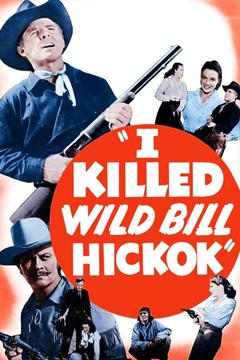


 Through the Shattered Lens