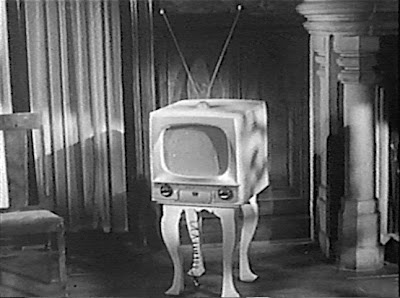
In the third episode of Hammer House of Horror, Denholm Elliott plays an estate agent who finds himself having a series of nightmares about his wife (Pat Heywood) and his secretary (Lucy Gutteridge) and a murder that may or may not have happened on Friday the 13th. This episode is an enjoyably surreal trip into the subconscious.
In the UK, Rude Awakening originally aired on September 27th, 1980.
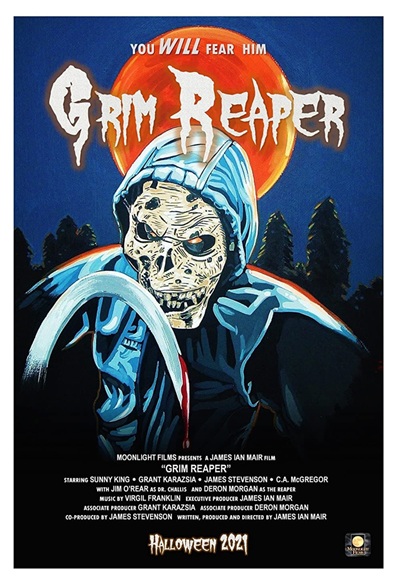
In 2021’s Grim Reaper, escaped mental patient Victor Cunningham (Deron Cunningham) is wandering around a small country town and killing people.
That’s pretty much the entire plot. Grim Reaper is only a 70-minute film and the majority of those minutes are made up of either Cunningham wandering around in his grim reaper mask, Cunningham’s victims being stalked, and the police being ineffective. (The main detective wears a baseball cap that read: POLICE. It’s a good thing that the guy was wearing that baseball cap because, otherwise, I would have just mistaken him for a local bartender.) Our final girl has a big bruise on her face and is trying to escape an abusive relationship, which adds a level of poignance to her story.
There’s a tendency amongst many to be automatically dismissive of DIY slasher films like GrimReaper. It’s true that Grim Reaper has its amateurish moments and that the soundtrack leans a bit too heavy on the metal and it’s also obvious that most of the actors were not professionals but I have to admit that I kind of enjoyed the movie and not just in an ironic sense. It helps that the film was obviously made by people who appreciate the genre and, watching the film, one gets the feeling that it was a fun set. It may seem like a backhanded compliment to say that the film is comfortable with being what it is but you need only compare it to some of the current big budget horror films to see the difference between a horror film made be fans of the genre and people who think that they’re somehow better than the horror label. Even shot on video, the film still had somewhat effective shots. Director James Ian Mair appears to have a good eye and he even manages to make good use of natural light. That’s the same thing that got Chloe Zhao an Oscar and a Marvel movie.
Sometimes, you just have to be willing to appreciate a film for what it is.
Charles Bronson played a cop a bunch of times in the 1980’s, but my personal favorite is Leo Kessler from 10 TO MIDNIGHT. Kessler wants to be a better dad to his daughter Lori (Lisa Eilbacher), but first he needs to catch a psychotic killer who’s murdering beautiful young women. One of the most interesting things about 10 TO MIDNIGHT is the way it tries to fuse a badass cop film with the popular slasher films of the 1980’s. It’s arguably Bronson’s best Cannon film, and Gene Davis is a certifiable creep as the slasher, Warren Stacy. Enjoy this infamous scene where Kessler confronts Stacy about his, ummm… private sexual activities!
In 1979’s The Toolbox Murders, someone is murdering the female tenants of a building in Los Angeles. The killer, who wears a mask and a leather jacket, uses tools. One woman is killed by a hammer to the head. Another is skewered by a power drill. One is stabbed with a screwdriver. Another is shot with a nail gun. The identity of the killer would be a total mystery if not for the fact that we’ve already seen Cameron Mitchell’s name in the cast list.
Indeed, it’s a bit pointless to cast Cameron Mitchell in any sort of whodunit-type of film. Nine times out of ten, Mitchell being in a movie means that that Mitchell (who, in the early days of his career, originated the role of Death of a Salesman‘s Happy Loman on Broadway) is going to be revealed as the murderer. In this case, Mitchell plays Vance Kingsley, the owner of the building. Vance has never recovered from the death of his daughter so he’s punishing women who he considered to be sinful.
The actual toolbox murders are pretty much finished after the first twenty minutes of the film. The rest of the movie deals with Laurie (Pamelyn Ferdin), a 15 year-old girl who is kidnapped by Vance and his nephew, Kent (Wesley Eure). Joey (Nicholas Beauvy), who is Laurie’s brother, attempts to find and then rescue his sister and turns out to very much not up to the task. The film itself ends on a rather sick note, one that is followed by a title card that informs us that the film is based on a true story. Yeah, sure, it was.
The Toolbox Murders has somehow earned a reputation for being a gory and shocking grindhouse film. It was among the films that was banned in the UK for several years. It’s actually not that gory and the use of tools to commit the murders is not quite as clever as the film seems to think it is. Even the nail gun murder (which is the film’s best known moment) feels rather awkward as the victim (Kelly Nichols) never really makes a run for it despite the fact that Vance has to stop to reload after every nail that he fires.
The scenes with Laurie being held hostage are far more disturbing and weird, largely due to Mitchell’s characteristically over-the-top portrayal of Vance’s psychosis. When you watch a movie called The Toolbox Murders, you’re probably not expecting a lengthy scene where Laurie — pretending to be Vance’s dead daughter — tells a long story about what it’s like in the afterlife. In the role of Vance’s nephew, Wesley Eure is even more disturbing than Mitchell. As opposed to the sinister-looking Mitchell, Eure actually has the look of a nice, young community college student and that makes his actions at the end of the film all the more icky to watch.
The Toolbox Murders doesn’t quite live up to its bloody reputation but it’s still a disturbing film nonetheless. Did you know that Heaven smells like lollipops? After this film, you’ll never forget.
Yor (Reb Brown, wearing a loin-cloth and blonde wig) is a hunter who makes his way through the desert, fighting dinosaurs and cavemen and drinking the blood of his enemeis. Yor finds a village and, after saving Kalaa (Corrine Clery) and Pag (Luciano Pigozzi) from a dinosaur, he becomes a valued member of the community. Yor does not know much about his past and he is searching for the meaning behind an amulet that he wears. With Kalaa and Pag, he goes on a quest for answers and instead finds himself being attacked by flying saucers, robots, and laser beams. Despite the dinosaurs and the cavemen, it turns out that this film is taking place in the future, after a nuclear apocalypse.
That’s a great twist and it’s too bad that the film’s title gives it away. When I first saw this movie as a kid, I loved it. What kid wouldn’t love a movie the mixed dinosaurs with flying saucers? Rewatching it as an adult, I still love this film even though I now know better than to take it seriously. It’s a cheap production and the special effects are so ineptly done that, when the killer robots shoots their laser guns, the beams don’t even appear to be coming out of the barrel. But I still appreciate the way the film combined two genres, caveman fantasy and post-apocalyptic science fiction and the cast’s commitment to bringing this mix of styles to life. Director Antonio Margheriti knew that the best way to deal with an incoherent plot was just to toss in a lot of action. No matter what else you might say about Yor, it’s not boring.
Reb Brown plays Yor and, despite the fight wig, gives one of his better performances. It helps that, for once, he doesn’t scream like a girl during the action scenes. John Steiner plays the evil Overlord gives another one of his trademark evil performances. Yor even gets a Flash Gordon-style theme song!
The movie ends with a cliffhanger and the narrator asking, “Will he succeed?” Tragically, there was never a Yor 2.
Today would have been the 102nd birthday of actor Charlton Heston.
This scene that I love comes from one of the few horror films in which Heston appeared. An adaptation of Richard Matheson’s I Am Legend, 1971’s The Omega Man featured Charlton Heston as Robert Neville. By night, Neville protects his house against the mutant horde. By day, he tracks those sleeping mutants down and watches Woodstock over and over again.
From the years 2007 to 2013, it’s hard to think of anyone who was as universally despised as Drew Peterson.
Drew Peterson was the Illinois cop who first came to national attention when his fourth wife, Stacy, went missing. Stacy had been on the verge of completing her nursing degree at the time of her disappearance. Though Drew was a cop, he wasn’t the one who reported her missing. Instead, it was her sister who called the police after she failed to hear from Stacy. When Drew was asked about Stacy, he seemed unconcerned and even cocky as he claimed Stacy had run off with another man. Few people believed him. It had only been three years since another Peterson had been convicted of murdering his wife and, like Drew, Scott Peterson also claimed that his wife left their home and vanished.
The investigation into Stacy’s disappearance led to authorities taking another look at the death of Drew Peterson’s third wife, Kathy Savio. Kathy death had originally been found to be an accidental drowning, though how one can drown in an empty bathtub was never really explained. A second autopsy revealed evidence of a struggle and, in 2013, Drew Peterson was convicted of her murder. Drew Peterson is currently in prison and Stacy is still listed as missing.
The thing that sticks out about Drew Peterson is how smug he always seemed. Like Dennis Rader (who was a serial killer by night and a neighborhood compliance officer by day), Drew Peterson was the ultimate nightmare authority figure. He had a uniform and he had a badge and he had an attitude that said, “I can do whatever I want and if you complain, nobody will believe you.” When we looked at Drew Peterson, we saw every cop who had ever pulled someone over for a busted taillight or he had ever tried to hit on someone after stopping them for speeding. Even when he had people accusing him of killing Kathy, Drew would appear on television and smirk and basically dare you to do anything about it. If you want to know what we mean when we use terms like “mansplaining,” go watch an interview with Drew Peterson.
Drew Peterson’s legal troubles were so drawn out that the 2012 Lifetime film, Drew Peterson: Untouchable, actually went into production before Peterson had even been convicted of anything. (Peterson actually filed a cease and desist letter demanding that production be halted.) The film ends not with Drew Peterson being convicted of killing Kathy but instead with Rob Lowe (playing the paunchy, middle-aged Peterson) doing a slow motion strip tease after being arrested. The film does a very good job of not outright accusing Peterson while, at the same time, reminding viewers of why so many of them instantly disliked him.
Of course, when the film was first aired, it received a lot of attention for casting the amiable and handsome Rob Lowe as Drew Peterson, a man who was neither of those things. Lowe gives an excellent performance as Peterson, capturing the somewhat desperate swagger of a man who doesn’t want to admit that he’s aging. Lowe captures Peterson’s cockiness and his manipulative nature and, even more importantly, he captures the arrogance of a man who believes that, because he wears a uniform, he can get away with anything. As his victimized wives, both Kaley Cuoco and Care Buono gave poignant performances.
I don’t know where Drew Peterson is but, wherever he’s serving his time, I hope he’s being forced to watch this movie at least once a day.
In 1986’s The Wind, Meg Foster stars as Sian Anderson. Sian is a novelist who lives in Los Angeles with her wealthy boyfriend, John (David McCallum). How wealthy is John? He’s so wealthy that he can sit out by his pool with a telephone. (That’s 80s wealthy!) He’s so wealthy that, when Sian says that she’s going to go to Greece so she can work on her next novel, John rents out the Goodyear Blimp and has it say, “Bon Voyage.”
(It would have been funnier if it had said, “The World Is Yours.”)
On the Greek isle of Monemvasia, she rents the home of Elias Appleby (Robert Morley), an eccentric man who tells her that she must be careful during the night because the heavy winds can be deadly. He probably also should have warned her that the handyman, Phil (Wings Hauser), was crazy. No sooner has the wind started howling outside and Sian has started work on her latest novel (which, from what we hear of her writing, sounds absolutely awful), then wild-eyed Phil starts acting crazy and homicidal. Isolated and too stupid to figure out how to use a Greek phone (and yes, that actually is a plot point), Sian tries to survive the night.
TheWind was directed by Greek journalist-turned-filmmaker Nico Mastorakis. Anyone was has seen a previous Mastorakis film will immediately be able to spot that The Wind is a product of his somewhat unique aesthetic vision. As with almost all of Mastorakis’s films, The Wind is both a thriller and a travelogue. Yes, Phil is trying to kill Sian but — hey! Look at how pretty the island is! As well, in typical Mastorakis fashion, the cast is a hodgepodge of familiar faces who don’t all seem as if they belong in the same movie. Along with Meg Foster, Wings Hauser, Robert Morley, and David McCallum, the film also features Steve Railsback as a friendly sailor who, stranded on the island by the wind, attempts to help Sian out.
The other big Mastorakis trademark is that none of the characters in the film seem to like each other. That makes sense when it comes to Sian and Phil. But what is one to make of the scene where Appleby gives Sian a tour of the home and the two of them, who have just met, immediately start snapping at each other for no reason? They’ve just met and they really don’t have any reason to be arguing with each other. But that’s what they do because this is a Nico Mastorakis film.
For me, the funniest part of the film involves John. Worried that Phil is going to kill her, Sian finally gets to talk to John on the phone. The connection is bad but John, who is sitting out by his pool, still clearly hears Sian say that someone is trying to kill her. The line then goes dead. John contacts the international operator and says that he has to make an emergency call to Greece but he’s not sure about the exact number. The international operator replies that a call cannot be made with an exact number. So, what does John? He shrugs, hangs up, gets in the swimming pool, swims a few laps and nearly misses it when Sian, hours later, calls him again. To reiterate: John, a wealthy man with Goodyear Blimp connections, heard that the love of his life was isolated and in fear of her life and his response was to go for a swim.
On the plus side, The Wind is actually decently paced and Nico Mastorakis makes the use of his limited locations. Meg Foster and Wing Hauser are both such eccentric performers that it’s impossible not be entertained by the sight of them acting opposite each other. Even by his usual standards, Hauser is memorably unhinged here. This film is ludicrous and a lot of fun. It’s a Nico Mastorakis film, after all.
This October, I’m going to be doing something a little bit different with my contribution to 4 Shots From 4 Films. I’m going to be taking a little chronological tour of the history of horror cinema, moving from decade to decade.
Today, we take a look at the first half of the 1920s.
4 Shots From 4 Horror Films
The Cabinet of Dr. Caligari (1920, dir by Robert Wiene)
 Yor (Reb Brown, wearing a loin-cloth and blonde wig) is a hunter who makes his way through the desert, fighting dinosaurs and cavemen and drinking the blood of his enemeis. Yor finds a village and, after saving Kalaa (Corrine Clery) and Pag (Luciano Pigozzi) from a dinosaur, he becomes a valued member of the community. Yor does not know much about his past and he is searching for the meaning behind an amulet that he wears. With Kalaa and Pag, he goes on a quest for answers and instead finds himself being attacked by flying saucers, robots, and laser beams. Despite the dinosaurs and the cavemen, it turns out that this film is taking place in the future, after a nuclear apocalypse.


 Through the Shattered Lens