Horror on the Lens: The Cabinet of Dr. Caligari (dir by Robert Wiene)


The Cabinet of Dr. Caligari is a film that I’ve shared four times previously on the Shattered Lens.  The first time was in 2011 and then I shared it again in 2014, 2015, 2016, 2017, and 2018!  Well, you know what?  I’m sharing it again because it’s a classic, it’s Halloween, and everyone should see it!  (And let’s face it — it’s entirely possible that some of the people reading this post right now didn’t even know this site existed in any of those previous years.  Why should they be deprived of Caligari just because they only now arrived?)

Released in 1920, the German film The Cabinet of Dr. Caligari is one of those films that we’ve all heard about but far too few of us have actually seen.  Like most silent films, it requires some patience and a willingess to adapt to the narrative convictions of an earlier time.  However, for those of us who love horror cinema, The Cabinet of Dr. Caligari remains required viewing.  Not only did it introduce the concept of the twist ending (M. Night Shyamalan owes his career to this film) but it also helped to introduce German expressionism to the cinematic world.

My initial reaction to The Cabinet of Dr. Caligari was that it simply wasn’t that scary.  It was certainly interesting to watch and I was happy that I was finally experiencing this film that I had previously only read about.  However, the film itself was obviously primitive and it was difficult for my mind (which takes CGI for granted) to adjust to watching a silent film.  I didn’t regret watching the film but I’d be lying (much like a first-year film student) if I said that I truly appreciated it after my first viewing.

But you know what?  Despite my dismissive initial reaction, the film stayed with me.  Whereas most modern films fade from the memory about 30 minutes after the end credits,The Cabinet of Dr. Caligari has stuck with me and the night after I watched it, I even had a nightmare in which Dr. Caligari was trying to break into my apartment.  Yes, Dr. Caligari looked a little bit silly staring through my bedroom window but it still caused me to wake up with my heart about to explode out of my chest.

In short, The Cabinet of Dr. Caligari passes the most important test that a horror film can pass.  It sticks with you even after it’s over.

For the curious with an open mind to watch with, here is Robert Wiene’s The Cabinet of Dr. Caligari!

Enjoy!

Music Video of the Day: Lose My Mind by Jai Wolf, feat. Mr. Gabriel (2019, dir by Andrew Donoho)


In space, no one can hear you scream.

However, they can hear you lose your mind.

I really like this video, mostly because it starts out all light-hearted before then suddenly turning into Event Horizon just to then become light-hearted again before ending a note of senseless tragedy.  It’s a bit like life and probably a more realistic look at intergalactic travel than something like Passengers.  (Remember that movie?)

To be honest, if I was stuck in the a space shuttle and I didn’t have anyone around, I’d probably end up dancing and singing too.  That’s why this video gets to me.  I can relate.

This video was directed by the prolific Andrew Donohoe, who has also done videos for twenty-one pilots, Skrillex, and Janelle Monae.  The lonely astronaut was played by Kally Khourshid while the doomed gentleman on the space station was played by Damian Lang.

It may not technically be a horror video but it’s still creepy enough for October!

Enjoy!

Horror on TV: Degrassi: The Next Generation 4.14 “Secret, Part One” (dir by Eleanore Lindo)


Tonight’s televised horror comes to use from the year 2004 and the nation of Canada!  Love you, Canada!

In this episode of Degrassi: The Next Generation, the students at Toronto’s Degrassi Community School are still struggling to come to terms with a recent school shooting that left one student dead and another paralyzed.  What better way to help the school deal with their trauma than a play?  And what better play to select than an adaptation of …. Dracula?

J.T. (Ryan Cooley) and Libertry (Sarah Barrable-Tishauer) are directing their own script.  Starring in the play is Emma Nelson (Miriam McDonald).   Before the shooting, Emma was known for being rather strident about her political and environmental activism.  After the shooting, Emma has been spiraling out of control.  And, as we all know, spiraling out of control on Degrassi inevitably leads to a visit to the ravine where all-around trouble-maker Jay (Mike Lobel) has a van and a collection cheap bracelets.

Meanwhile, in another part of the school, Ashley (Melissa McIntyre) tries to get Craig (Jake Epstein) to join a support group that will help him deal with his recent bipolar diagnosis.  Craig is upset to discover that Ellie (Stacey Farber) is in the same group.  This episode was the start of the very long and very angsty Craig/Ellie relationship arc.  When I first watched Degrassi, I always related to Ellie and I still do to a certain extent but, in retrospect, I think I was probably a lot more like Ashley when I was in high school.

This episode of Degrassi aired, in Canada, on November 30th, 2004.  This episode was considered to be so controversial that it actually made national news when it later aired in the United States.  (I can actually remember watching some outraged wannabe censor talking about how Degrassi was a corrupting influence.)  Part Two of Secret, which we’ll get to tomorrow, was even more controversial.

As for how this fits in with October …. it’s Dracula!  And really, when you think about it, Jay’s a bit of a real-life Dracula.  That’ll especially become clear in the next episode.

Anyway, here is tonight’s episode.  Remember — whatever it takes, you can make it through!


The TSL’s Horror Grindhouse: Single White Female 2: The Psycho (dir by Keith Samples)


13 years after the release of the first Single White Female and a countless host of imitations, an official sequel was released straight-to-video in 2005.  Subtitled “The Psycho,” (because apparently, Jennifer Jason Leigh was totally stable in the first film), Single White Female 2 tells the story of what happens when one roommate becomes obsessed with the other.  It all leads to murder and sexual infidelity and sudden hairstyle changes.

Maybe you’re thinking that this sounds exactly like the first Single White Female.  And, okay, there are some similarities.  But just consider some of the differences!

1. In the first Single White Female, Jennifer Jason Leigh’s character grows obsessed with Bridget Fonda after moving into Fonda’s apartment.  In Single White Female 2, Tess (played by Allison Lange) becomes obsessed with Holly (Kristen Miller) after Holly moves into Tess’s apartment.  See, this time, the psycho has her name on the lease.  HUGE DIFFERENCE!

2. In the first Single White Female, the plot is set in action after Bridget Fonda discovers that Steven Weber cheated on her.  In the sequel, the plot is set in motion by Holly’s original roommate, Jan (Brooke Burns), seducing a client who Holly was also sleeping with.  Again, that’s a huge difference and it also leads us to wonder if maybe Holly just sucks at choosing roommates.

3. In the first Single White Female, Jennifer Jason Leigh played an unstable bookstore employee.  In the sequel, Tess is a nurse who has a history of killing people who she feels would be happier dead.  In other words, Tess is a psycho with a mission.

4. In the first Single White Female, Jennifer Jason Leigh’s character hung out in a sleazy S&M club.  In the sequel, Tess actually performs on stage.

5. The first Single White Female actually looked like a real movie whereas the sequel has the flat and rather bland look of a film shot for and on video.

6. In the first Single White Female, you could understand why an insecure person would want to steal Bridget Fonda’s identity.  In the sequel, Holly’s identity doesn’t seem to be interesting enough to justify trying to steal.

7. In the first Single White Female, Jennifer Jason Leigh gave a performance that inspired both fear and sympathy.  In the sequel, Tess is just your typical straight-to-video movie psycho.  There’s no indication that she could have ever been anything other than a straight-to-video movie psycho.

8. The first Single White Female was a good film, almost despite itself.  The sequel is rather dull.

So, I guess my point here is that, if you want to watch a movie about a roommate stealing someone’s identity and getting a new haircut, the first Single White Female is the one to go with.  The sequel doesn’t really add anything worthwhile to the story, nor does it improve on it in any way.  Give some credit to Brooke Burns, who plays Holly’s untrustworthy ex-roommate and who, at the very least, seems to understand the type of movie in which she’s appearing.  Brooke Burns gets the worst lines but she at least seems to be having fun delivering them.  Otherwise, it’s best just to forget about this sequel.

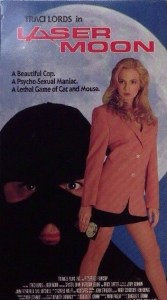
Straight From The Direct-To-Video Film Vault: Laser Moon (1993, directed by Douglas K. Grimm)


Like so many straight-to-video thrillers from the 90s, Laser Moon opens with a serial killer.  This one stalks women whenever there’s a full moon.  His weapon of choice appears to be a laser pointer but it’s supposed to be a real laser.  When late night DJ Zane Wolf (Harrison le Duke, doing a barely passable Eric Bogosian impersonation) starts getting phone calls from a man claiming to be the killer, Detectives Barbara Fleck (Traci Lords) and Vincent Musso (Bruce R. Carter) get involved.

If you’ve ever wondered what would happen if you mashed up Talk Radio with the type of movies that used to play regularly on late night Cinemax, the end result would probably be better than this.  Oh, don’t misunderstand.  Laser Moon tries it’s hardest to be something more than just another low budget, direct-to-video thriller.  Zane Wolf claims to be a cynic and he smokes a cigarette right in front of a “no smoking” sign.  (I have pictures of myself doing the exact same thing in high school.  Take that, evil sign!)  When the killer calls Zane Wolf’s show, the discussion involves all sorts of philosophical issues but the problem is that neither one of them has much to say.  Zane is a cardboard nihilist, the type who can’t come up with anything more profound than telling his listeners to “do what you’re afraid to do.”  “You walk alone,” he tells another caller.  Why are people listening to this guy again?

Traci Lords is miscast as a police detective but she still gives the best performance in the film, showing once again that there was more to her as an actress than just her notoriety as a former underage porn star.  Laser Moon may be one of her worst films but at least it ends with a twist involving the use of holograms.  That’s not something you see every day.

Video Game Review: Vampiric Tower (2000, Mike Behrens)


Vampiric Tower is a simple but addictive puzzle game that I found on the Internet Archive.

In this game, you are a purple haired vampire in a ten-story, fifty-room tower.  Your goal is to go through each room and collect all of the vials of blood.  Only after all of the vials have been collected will the door to the next room open.  At first it’s simple:

Things get more complicated with each room that you enter.

For instance, in the room above, there’s plenty of blood but there’s also objects in the way.  Fortunately, you can turn into a bat and fly over the obstacles but there’s only so many times that you can transform and you always have to return to your “human” form if you want to collect the blood.  You can push the obstacles out of the way but, if you’re not careful, you can very easily ended up locking yourself into a corner.

Each room has more obstacles than the last and you’ll have to be smart about how you use your transformation powers if you’re going to get all of the vials.

You’re also not alone in the tower.

Those jack o’lanterns may not look dangerous but get in their line of sight and they’ll kill you.

Vampric Tower is a simple puzzle-solving game but it’s also very addictive.  No sooner have you managed to figure out how to escape one room than you find yourself in an even more elaborate and dangerous location.  How quickly can you make it through the vampiric tower?  Play the game to find out!

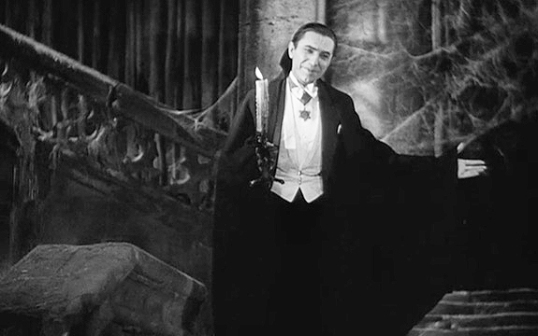
Horror Scenes That I Love: Bela Lugosi Introduces Himself In Dracula


I swear, nothing annoys me more than when wannabe hipsters go out of their way to trash old movies.

You see that a lot on twitter.  People who, for the most part, haven’t even studied film or cultural history will try to post something snarky about a film that was made decades before they were born.  They either make fun of the acting or the dialogue or they attempt to call out the film for not being properly woke.  It’s an easy way to get likes and retweets but it’s also about as intellectually lazy as you can get.

For instance, there’s a tendency to dismiss the 1931 version of Dracula and Bela Lugosi’s performance in the lead role.  Personally, I do think that Dracula is a bit too stagey (it was, after all, based on a stage play that was based on Bram Stoker’s novel) and I wouldn’t put it up there with director Tod Browning’s best work.  The Spanish-language version of Dracula, which was filmed at the same time, is technically a better film.  But, that being said, I will accept no criticism of Lugosi’s performance.  Lugosi is the perfect Dracula.  If he seems overly theatrical …. well, Dracula’s a pretty theatrical character.  It has to be remembered that Lugosi is playing a character who is supposed to be several hundred years old.  If he acts like a man out-of-time, that’s because that is exactly what he is.

Ultimately, it comes down to this — a lot of actors have played Dracula.  Some of them have been very good in the role.  Some of them have been very bad.  But, if not for Lugosi, none of them would have had the opportunity.

So, in honor of that legacy, today’s horror scene that I love comes from the original Dracula and features Bela Lugosi at his creepiest:


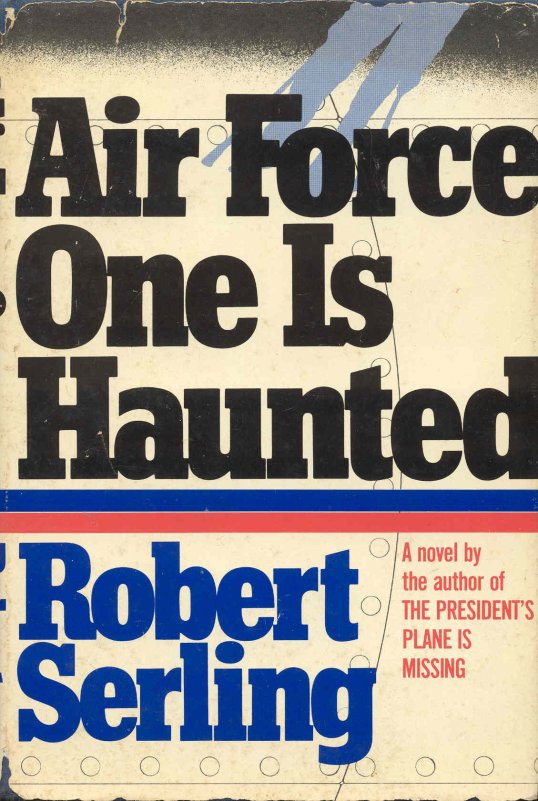
Book Review: Air Force One Is Haunted By Robert J. Serling


OH MY GOD, AIR FORCE ONE IS HAUNTED!

A few weeks ago, I was going through my aunt’s collection of old paperback novels, searching for anything that I could possibly review during October.  While I found a good deal of promising books, I have to admit that I almost squealed for joy when I came across Air Force One Is Haunted.

Now, don’t get me wrong.  I had never heard of the book before and I knew absolutely nothing about the plot.  But I saw that title and I knew I just had to read it.  I mean, seriously — Air Force One Is Haunted!  That’s like the greatest title ever!  I looked at that title and I asked myself, “What’s haunting Air Force One?  Angry druids?  Zombies?  Succubi?  Woodrow Wilson?”  Either way, it sounded like it had the potential to be terrifying!

Then I got home and I read the book and I discovered that …. well, let’s just say that my imagination got ahead of me.

Air Force Is Haunted was originally published in 1985 and the author was not only a world-renowned aviation expert but he was also the brother of Twilight Zone-creator Rod Serling.  So, it’s perhaps not surprising that Air Force One Is Haunted feels like an extended episode of The Twilight Zone.  It’s one of those things where a good but conflicted person has the chance to do something that seems like it might be good for him but it will also be bad for the world at large.  Fortunately, a ghost shows up and gives him a lot of advice.

The conflicted person, in this case, is President Jeremy Haines.  Haines is in his second term and it seems like the entire world is falling apart around him.  America’s in the middle of a great depression.  Russia and China are teaming up to possibly try to take over the world.  President Haines could always launch a first strike, which would wipe out Russia as a world power but which would also kill a lot of innocent civilians.  He can’t make up his mind what to do and, as a result, people across the world are starting to view him as being weak.  The President has even started to see a psychiatrist but they’re soon too busy having tasteful, mass market paperback-style sex to actually do anything about the President’s issues.

If only there was a mediocre ex-president that Haines could talk to and get some advice from!  However, it appears that even Jimmy Carter is refusing to take his calls.

That’s when FDR shows up.

That’s right.  It turns out that FDR is haunting Air Force One and, whenever President Haines boards the plane, he ends up getting advice from him.  FDR has a lot of stories to tell about governing during an economic depression.  He also says “Bully,” a lot, even though that was Teddy’s phrase.

Anyway, I think the book would have been a bit more interesting if FDR had turned out of be some sort of malevolent demon who intentionally gave President Haines bad advice that eventually led to World War III.  And, to be honest, I kept expecting that too happen.  I kept expecting FDR’s eyes to suddenly burn like hellfire as he said, “Burn it!  BURN IT TO THE GROUND!”  But that never happened.  Instead, this is one of those books where FDR is the greatest dead president ever and, in the end, middle-of-the-road liberalism keeps the world safe for democracy.

As you’re probably guessing, this is kind of a corny book but it is written with a lot of sincerity.  One gets the feeling that Serling really did feel that, if only America’s leaders just looked to the ghost of FDR, every problem in the world would be solved.  The book is also overwritten in the way that well-meaning, melodramatic novels of the past often were.  One character is identified as having a “gnawing ulcer of doubt” deep in the “bowels of his conscience.”  (Ewwwwwww!)  That’s the type of book that this is.  It’s definitely a product of its time but, if you’re a history nerd like me, that’s not necessarily a bad thing.

If anyone is haunting Air Force One, I personally hope that it’s Rutherford B. Hayes.  He was the best!

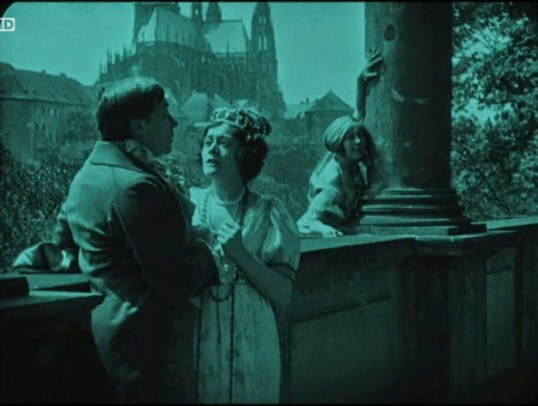
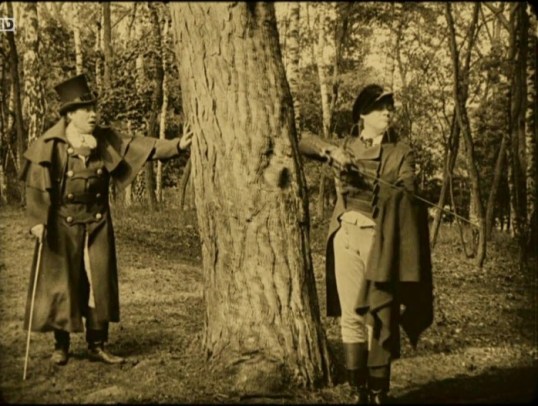
International Horror Film Review: The Student of Prague (dir by Stellan Rye and Paul Wegener)


The year is 1820 and Balduin (Paul Wegener) has a problem.

Yes, he might be the most popular student at the University of Prague.  And yes, he may be known as the greatest swordsman in the city.  And yes, he might get invited to all of the parties and he might have a lot of friends who all look up to him.  However, what Balduin does not have is money.  While everyone else seems to be living a life of luxury, Balduin lives in a tiny room where his only luxury is the mirror in which he often appreciates his own reflection.

Balduin could really use some money because he’s fallen in love with Countess Margit (Grete Berger) but there’s no way that a member of the noble class could ever marry a destitute man.  Instead, it appears that Margit is destined to marry her cousin, the Baron (Fritz Wiedermann).

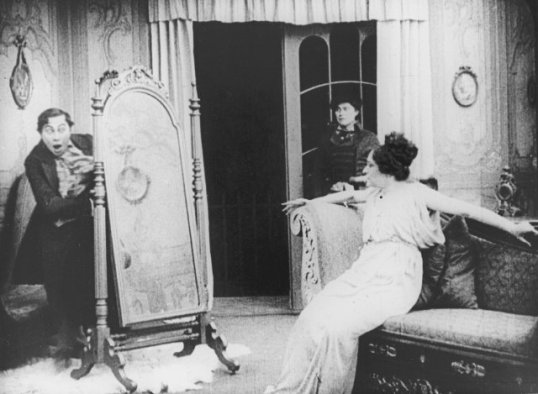
However, an old man named Scapinelli (John Gottowt) claims to have a solution.  He promises to give Balduin a fortune in gold if he agrees to let Scapinelli remove just one thing from his room.  Convinced that he’s fooled the old man because he has nothing of worth in his room, Balduin agrees to Scapinelli’s conditions.  Scapinelli promptly turns to the mirror and, as Balduin watches, Balduin’s reflection steps out of the mirror and then leaves with Scapinelli.  Balduin starts to laugh hysterically.

So now, Balduin has no reflection but he does have a lot of money!  Balduin sets out to try to win Margit away from the Baron.  Making things difficult is that, no matter where Balduin goes, someone always seems to be following him. Sometimes, it’s a mysterious wandering girl (Lyda Salmonova) who always seems to be intent on eavesdropping on every conversation that he has.  And then other times, it’s his doppelganger!  There’s now two Balduins running around Prague and, whenever the first Balduin finds himself alone with Margit, the second Balduin always seems to pop up and ruin everything.

Obviously something must be done….

This German silent film was first released in 1913 and it’s considered by some to be the first feature-length horror film.  (Georges Méliès directed several films featuring ghosts and haunted houses but the majority of those films ran only a handful of minutes.)  It’s also considered to be one of the first art films and, since Paul Wegener financed the production and distributed the film himself, also the first independent film.  It was also the first film to make use of the type of double exposure tricks that we today take for granted.  In 1913, audiences were stunned to see Paul Wegener apparently acting opposite himself.  The film was a big hit, with none the less than psychoanalyst Otto Rank praising the film for its psychological depth.

Of course, to watch the film today, audiences have to adjust both their expectations and the way that they take in and process cinematic storytelling.  As of this writing, The Student of Prague is 106 years old and it’s definitely a film of its time.  The camera largely remains stationary and, from a modern perspective, the film is rather slow-paced.  And yet, the film’s story remains rather intriguing.  Despite the static camera work, the film manages to create and maintain a properly ominous atmosphere and a scene in which Balduin and Margit attempt to meet in a cemetery is effectively creepy.  Paul Wegener’s performance holds up well.  Largely eschewing the overly theatrical acting style that we usually tend to associate with silent cinema, Wegener gives a nuanced and effectively subtle performance as both Balduin and his doppelganger.  When he’s acting opposite of himself, you don’t think about the fact that you’re witnessing an early camera trick.  Instead, Wegener creates two separate but believable versions of the same character.  The doppelganger represents all of Balduin’s undesirable impulses and everything that has kept Balduin from achieving happiness.  By the end of the film, Balduin can’t live with his doppelganger but he can’t live without him as well.

The Student of Prague is an interesting piece of history and one that every true student of horror should watch and learn from at least once.