Book Review: The Mind Reader by R.L. Stine


In this YA thriller from 1994, R.L. Stine tells the story of Ellie. Ellie and her father have just moved back to Shadyside after being gone for 14 years. Ellie was only two when they left town due to the trauma of her mother’s death. Though Ellie doesn’t remember, her father says that her mom died of appendicitis.

Her father’s not totally happy about returning to Shadyside but Ellie could really use a change of pace. Ellie recently broke up with her boyfriend because she discovered that he was cheating on her. How did she discover this? She has psychic powers, of course! It’s interesting how anyone who leaves Shadyside and then returns a few years later manages to develop psychic powers. It turns out that Ellie’s psychic powers aren’t just helpful when it comes to busting cheating boyfriends! They’re also good for discovering the dead body of Melinda, her best friend’s sister! And, not only that, but Ellie’s powers also offer up some clues about what really happened to her mother! Ellie has some mysteries to solve, whether she wants to or not. Who killed Melinda? What happened to her mother? And why is that cute but weird guy Brian stalking her?

The Mind Reader actually tells a pretty sad story. Every family in this book has some deep, terrible secret and it’s almost entirely due to terrible parenting. This is one of the few Stine books that left me worried as to just how the main character was going to be able to go on with her life after experiencing all of this. Still, I had to respect the fact that Stine stayed true to the book’s premise. There was no sudden amnesia. It didn’t turn out to be a dream. Ellie had psychic powers and they told her a lot of really big things at the worst possible time. That’s the way psychic powers work on Fear Street.

Anyway, I enjoyed The Mind Reader. It’s a quick read and some of Ellie’s vision are really macabre! I’m glad I’m not psychic.

Horror on TV: Friday the 13th 1.15 “Vanity’s Mirror” (dir by Willam Fruet)


Tonight’s episode of Friday the 13th: The Series is considered by many to be one of the best episodes of the series.

In this episode, the antique is a gold compact.  It causes men to fall in love with whoever owns it.  Unfortunately, the men usually become so obsessive that the owner of the compact has no choice but to kill them.  Hey, it happens.

In Vanity’s Mirror, the compact has fallen into the hands of an awkward teenager named Helen, who is poignantly played by Ingrid Veninger.  As is often the case with the best horror stories, Helen is as much a victim as a villain.

This episode originally aired on March 5th, 1988.

Book Review: True Indie: Life and Death in Filmmaking by Don Coscarelli


Don Coscarelli just might be the nicest guy to ever make a horror movie.

Okay, obviously, I don’t know that for sure. A lot of people make horror movies and a lot of them are actually pretty nice and I don’t want to short change anyone. Still, if you read his 2018 memoir True Indie, the main impression that you come away with is that Don Coscarelli is a nice, down-to-Earth guy who truly loves to make movies.

In the book, Coscarelli tells how he went from making making his first two films when he was still a teenager to directing Phantasm, an indie film that was a surprise hit and ensured that Don Coscarelli would be forever beloved by horror fans everywhere. Not only does he discuss how he came up with the film but he also discusses what it was like to work with people like Angus Scrimm and Reggie Bannister. He follows-up by discussing the production of Beastmaster, which was considerably more troubled than the production of Phantasm. (At one point, Beastmaster star Marc Singer throws a tantrum because he feels that Coscarelli has “abandoned” him on location.) From Beastmaster, it’s back to doing sequels to Phantasm, some of which are better than others and some of which, sad to say, are screwed by the executives. Some of the book’s best parts are when Coscarelli discusses what he had to put up with while dealing with studio execs who didn’t necessarily understand what Phantasm or horror in general was all about. Seriously, you think as you read those passages, just let Don and Reggie do whatever they want! Eventually, Coscarelli directs Bubba Ho-Tep and gets to work with Bruce Campbell, which is definitely a happy ending.

True Indie is a likable book. Coscarelli is an entertaining storyteller and his love of movies is obvious on every single page of the book. He comes across as the ideal indie director, a passionate artist who simply wants to entertain his audience while staying true to his vision. It’s an inspiring book, to be honest. You read it and you’re happy that Don Coscarelli is still out there and that he’s still doing it his way.

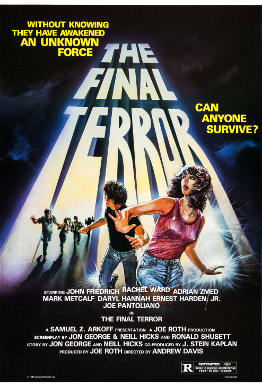
The TSL’s Grindhouse: The Final Terror (dir by Andrew Davis)


“Marco!?”

“Melanie!?”

“Margaret!?”

“Dennis!?”

“Eggar!?”

“Windy!?”

If you watch the 1983’s The Final Terror, be prepared to frequently hear the names of the film’s characters.  For a slasher film about a bunch of campers wandering through the forest, The Final Terror has a surprisingly large cast and they all spend a good deal of time walking around and yelling out each other’s names.  Somehow, people keep getting lost even though they know that there’s a killer out there and they all really should be sticking together.

Interestingly enough, for a slasher film, there aren’t that many deaths.  The majority of the cast survives.  Even the most obnoxious of the campers, the one who seems like an obvious victim, manages to make it through to the finale.  I guess we should be happy that most of them survived and this was apparently their final terror.  The majority of the campers were teenagers and if you’re having your surviving your final terror when you’re not even old enough to drink yet …. well, consider yourself lucky.

The Final Terror is set up like an entry in the Friday the 13th franchise but it’s never anywhere close to being as sleazy as those films.  Whether that’s a good or a bad thing depends on what you, as a viewer, want in terms of a wilderness slasher film.  If you want lots of sex, blood, and people making stupid decisions, The Final Terror will probably bore you to death, despite the fact that it includes all three.  If you want a relatively realistic film about being lost in the wilderness while being stalked by an unseen killer, you’ll probably appreciate The Final Terror.  This film was directed Andrew Davis, who went on to direct several big budget Hollywood action films.  Before he became an action director, though, he worked as an assistant to cinematographer Haskell Wexler on the semi-documentary Medium Cool.  Davis brings that realistic style to The Final Terror.  Even though the film does feature some familiar faces, it’s easy to believe that you’re just watching a bunch of campers trying to survive for the weekend.

As for the cast, Rachel Ward plays one of the leaders of the campers.  Joe Pantoliano makes an early appearance as the creepy Eggar.  Daryl Hannah plays Windy.  Mark Metcalf plays another camper named Mike.  The entire ensemble actually does a pretty good job.  As I said, you really do believe that the majority of the cast are delinquent teenagers who have been sent on a camping trip.  When they work together to keep someone from bleeding to death, it almost feels like an educational film.  “Because the campers worked together,” you can imagine a narrator saying, “they might survive The Final Terror.”

The Final Terror is not bad, though I have to admit that I like my 80s slashers to be a little bit more sordid.  But for what it is — an attempt to take a realistic approach to a genre that is regularly held in dismissive disdain — The Final Terror works surprisingly well.  As captured by Andrew Davis, the wilderness is both beautiful and terrifying.  You’ll never catch me camping!

International Horror Review: Robo Vampire (dir by Godfrey Ho)


Oh, hey, Robo Vampire!

Yeah, Robo Vampire.

Robo.  Vampire.

It gets less exciting every time you say or think it.  The first time you see a title like Robo Vampire, you’re all excited but then you think about it and you realize that there’s no reason for a robot to turn into a vampire because robots don’t need blood.  And the idea of a vampire becoming a robot …. I mean, how the Hell would that even work?

I watched Robo Vampire and I’m still not really sure how it all worked.  This film came out in 1988 and it was directed by Godfrey Ho, who is apparently known in some circles as being the Ed Wood of Hong Kong action cinema.  The film …. listen, I watched this thing and I don’t have the slightest idea what was actually happening for the majority of it.  The friends with whom I watched the film explained to me that Robo Vampire was actually a compilation film, compiled of scenes that were shot for several different Godfrey Ho movies.  That would explain why there was next to no continuity for scene to scene and why the plot was the most random hodgepodge of concepts that I’ve ever some across.

What little plot that there was in this mess dealt with Tom Wilde, a narcotics cop who gets blown away in the line of duty.  However, Tom’s superiors decided that they can salvage him by turning him into a robot with no memories of his past.  Before you can say “Wait a minute, what about Robocop?,” that’s exactly what they do.  Tom is now a cyborg.  For his first mission, he’s sent to the Golden Triangle to take down a drug lord who is holding another agent hostage.  

So far, we’ve got a robot.  But where are the vampires?

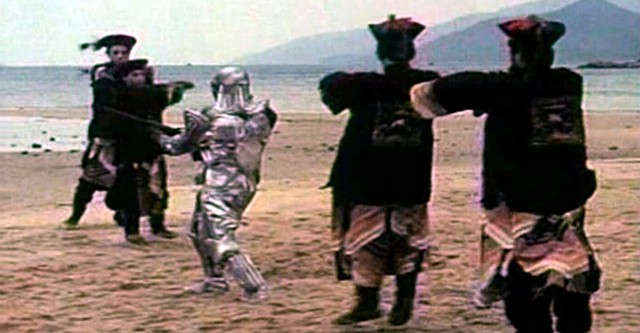
The vampires show up once the drug lord realizes that he’s going to need some help defeating a robot.  So, he has his people cast come magic and soon, there’s a bunch of zombie/vampires hopping around.  And when I say hopping, I mean that they literally hop around.  I noticed the same thing about the zombies in Kung Fu Zombie.  In the defense of that film, though, Kung Fu Zombie was kind of meant to be a comedy.  Robo Vampire seems to take itself pretty seriously.  (Watching the film, I thought I recognized a few shots that had apparently been lifted from Kung Fu Zombie but I haven’t been able to independently verify whether that’s really the case.  Some day, when I think I can handle the punishment, I’ll sit down and watch Kung Fu Zombie and then Robo Vampire and compare the two for myself.)

Eventually, Tom gets around to launching his rescue operation.  There’s a lot of shooting.  There’s a lot of scenes of Robot Tom wandering around robotically.  There’s a lot of hopping vampires or zombies or whatever they’re supposed to be.  But, as far as I can tell, there were no robot vampires.  Now, I say as far as I can tell because the film was edited so haphazardly that it wouldn’t surprise me to discover that there was like a hundred different versions of Robo Vampire floating around.  Who knows what have happened in the director’s cut?

Anyway, Robo Vampire is petty much impossible to follow and the film does itself no favors by inviting you to compare it to the original Robocop.  That said, the hopping vampires were kind of cute and this is truly a one of a kind movie.  You should watch it just so you can say that you did.

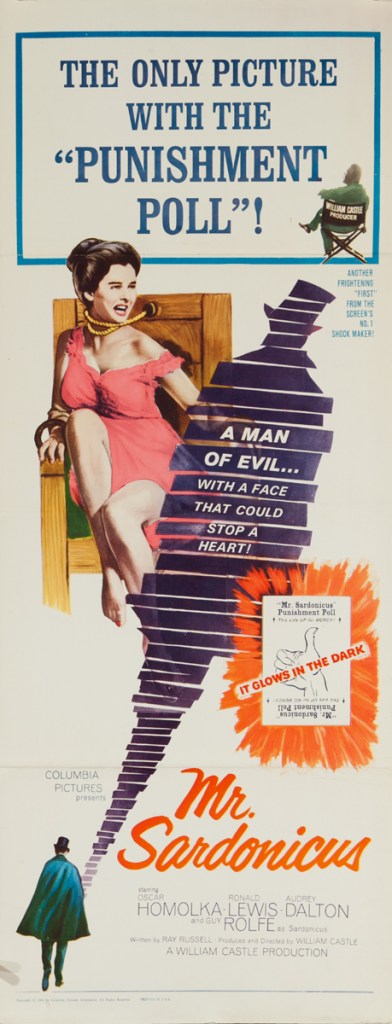
Horror Film Review: Mr. Sardonicus (dir by William Castle)


The next time that someone gives me a hard time for not being compassionate enough (and believe it or not, it does occasionally happen now that 90% of twitter has gone down the woke rabbit hole), I’m going to point out that I voted to show mercy to Mr. Sardonicus.

Played in villainous fashion by Guy Rolfe, Mr. Sardonicus was the title character of a 1961 film that was produced and directed by William Castle.  Castle was known for being the king of the gimmick.  His gimmick for Mr. Sardonicus was that, upon entering the theater, members of the audience were given two cards.  One card had a thumbs up.  One card had a thumbs down.  Towards the end of the film, the avuncular Mr. Castle appeared onscreen and announced that it was time for the audience to vote.  Should Mr. Sardonicus be punished for his sins or should he be shown mercy?  Thumbs up for mercy.  Thumbs down for punishment.  After taking the vote, Castle said, “Projectionist, play the reel.”

Now, of course, Castle only shot one ending and that was the ending where Mr. Sardonicus was punished.  To make sure the audience would vote the right way, Castle made Sardonicus into one of the most loathsome villains around.  Mr. Sardonicus — or Baron Sardonicus, as he preferred to be called — lived in a castle in the 1880s.  Not only did he torture his servants with leeches but he was also responsible for death of several dogs, all of which were killed as a part of his dastardly experiments.  To make it even worse, he wasn’t even a member of the nobility!  He stole his title!  It turned out that Mr. Sardonicus has once been a simple farmer who allowed his greed to get the better of him.  When his father was buried with a lottery ticket, Mr. Sardonicus dug up the old man to retrieve the ticket.  The shock of seeing his father’s skull caused Mr. Sardonicus’s face to freeze into a twisted grimace.  When the film begins, Mr. Sardonicus wears a mask and desperately wants to be cured of his affliction.

To try to convince Sir Robert Cargrave (Ronald Lewis) to cure his condition, Mr. Sardonicus is holding the woman that Sir Robert loves, Maude (Audrey Dalton), prisoner in a loveless marriage.  With the help of his evil servant, Krull (Oskar Homolka), Mr. Sardonicus torments the villagers and anyone else unlucky enough to come near the castle.

And yet, when I watched this movie last night with the Late Night Movie Gang, I voted to show compassion to Mr. Sardonicus because I’m a firm believer both in criminal justice reform and that almost anyone can be rehabilitated.  Perhaps Mr. Sardonicus just needed someone to say that they believed he could be a better man.  I was willing to do that.  However, the rest of the Late Night Movie Gang voted to punish him.  I think it was the dead dogs that sealed the deal.  So, sorry, Mr. Sardonicus.  I tried.

Even before William Castle tells everyone to vote, Mr. Sardonicus is enjoyably over-the-top and silly horror film.  It plays out like an extended episode of Twilight Zone, with every action that Mr. Sardonicus takes bringing him closer to karma’s judgment.  Guy Rolfe is properly evil and arrogant Sardonicus and Oskar Homolka gets many of the best lines as the servant who may not be as loyal as he seems.

Mr. Sardonicus is currently on YouTube.  Watch and vote for yourself!

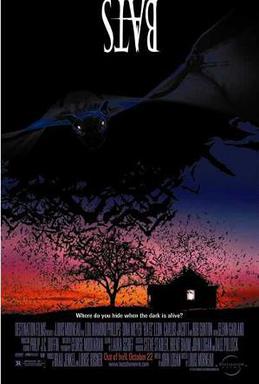
Bats (1999, directed by Louis Morneau)


A scientist (Bob Gunton!) has genetically engineered the local population of bats in order to make them super intelligent and aggressive.  Though he says that he just wanted to make sure that the bats never went extinct, the ultimate result of his experiment is that the bats are now killing all of the citizens of a small town in Texas.  With the National Guard threatening to blow up the town, it’s up to Sheriff Emmett Kimsey (Lou Diamond Phillips!), Dr. Alexandra McCabe (Dina Meyer!), and assistant Jimmy Sands (Leon, so cool that he only needs one name!) to figure out how destroy the bats without destroying everyone’s home.

Now, this is how you make a killer bat movie!  There’s a lot of stupid things about Bats but it’s still a thousand times better than Nightwing.  I liked the idea of superintelligent bats more than the idea of just angry bats.  The bats are too clever for the humans, often seeing straight though their plans.  Nightwing took itself very seriously.  Bats does not and is therefore, better in every regard.  The bats are always on the attack, the good guys are always running from one place to another, and the National Guard just wants to blow everything up.  It’s a fun B-move, with the B standings for Bats.

You have to love that cast, too.  Any movie with Lou Diamond Phillips and Leon is going to be cooler than any movie without them.  I wouldn’t be surprised to learn that the two of them hunt bats in their spare time because they really seemed to know what they were doing.  Dina Meyer was obviously cast more because she looks like Dina Meyer than because she’s really a credible scientist but she still handles all the bat talk without embarrassing herself.  Bob Gunton is a great bad guy, as always.

Bats is dumb, silly, and terrifically entertaining.

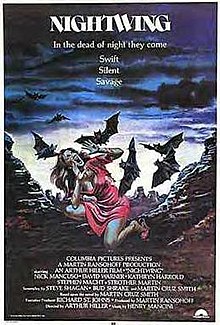
Nightwing (1979, directed by Arthur Hiller)


Cattle and humans are dying in New Mexico at an alarming rate.  Scientist Phillip Payne (David Warner) thinks that the local bat population has become infected with the plague.  Deputy Youngman Duran (Nick Mancuso) thinks that the bats may be attacking because of a curse that was cast by a Hopi medicine man.  Meanwhile, the corrupt tribal chief (Stephen Macht) just wants to sell the land to an evil land developer (Ben Piazza) and be done with it.  Dr. Anne Dillion (Kathryn Harrold) tries to spread the word about the bats but the authorities don’t want the bad publicity.  They’ve never seen Jaws.  And, finally, a group of missionaries camp in the desert with no idea what’s about to swoop down on them.

I don’t know about you but I would never think of missing an Arthur Hiller horror movie!  While many directors in the 70s proudly wore the auteur and rebel label, Arthur Hiller went the opposite route.  He oversw conventional, Hollywood productions, the best known of which was Love Story.  Arthur Hiller was so mainstream that he eventually served as President of the Academy.  This is all to say that Arthur Hiller directed some good films and he directed some bad films but, with his total lack of any sort of personal vision, he was absolutely the wrong director to do a horror movie.  Hiller’s direction is flat.  He’s not mean-spirited enough to enjoy the bat attacks and instead, he focuses on the debate over whether white developers should be buying native land, as if the people watching this movie are going to be watching for the human drama.  By the end of the film, the bats have almost been abandoned and the movie turns into an action film, with a group of survivors fighting off Stephen Macht’s security force.

The most interesting thing about Nightwing is catching Strother Martin, the veteran western actor who memorably talked about a failure to communicate in Cool Hand Luke, as an ex-missionary.  Otherwise, the film pales in comparison to The Birds and Wolfen, the two films which it must resembles in theme and action.

4 Shots From 4 Ed Wood Films


4 Shots From 4 Films is just what it says it is, 4 shots from 4 of our favorite films. As opposed to the reviews and recaps that we usually post, 4 Shots From 4 Films lets the visuals do the talking!

Today, we continue to pay tribute to the great Edward D. Wood, Jr. with….

4 Shots From From 4 Ed Wood Films

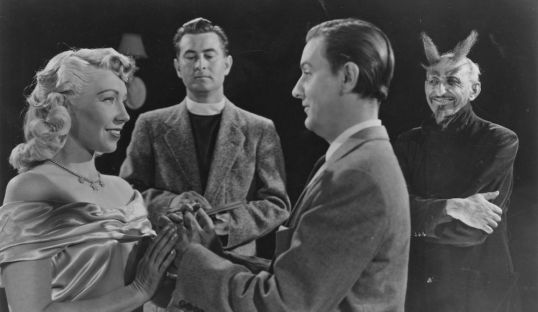
Glen or Glenda (1953, dir by Ed Wood, DP: William C. Thompson)

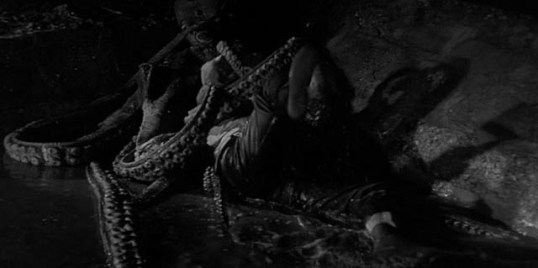
Bride of the Monster (1955, dir by Edward D. Wood, Jr., DP: Ted Allan and William C. Thompson)

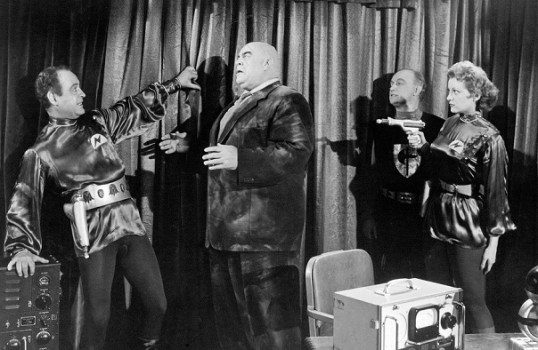
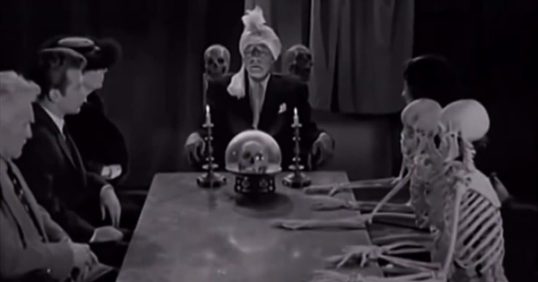
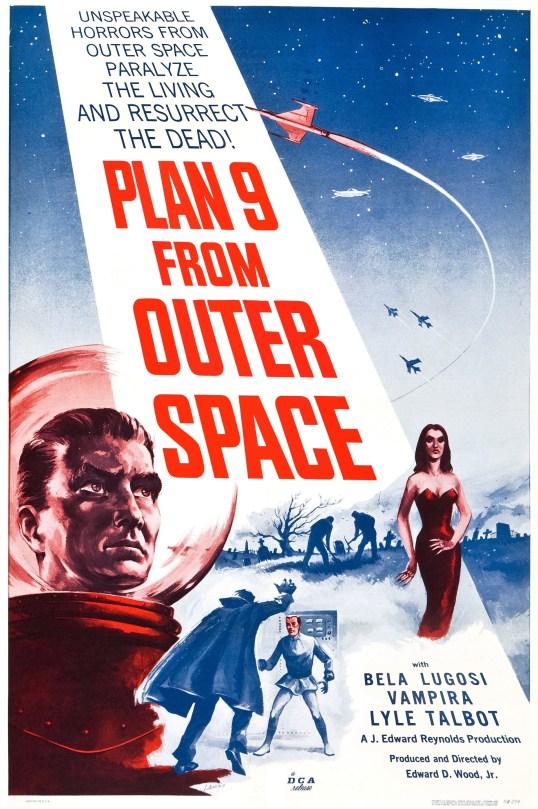
Plan 9 From Outer Space (1957, dir by Edward D. Wood, Jr., DP: William C. Thompson)

Night of the Ghouls (1959, dir by Ed Wood, DP: William C. Thompson)

Horror on the Lens: Plan 9 From Outer Space (dir by Edward D. Wood, Jr.)


Viewing Plan 9 From Outer Space during October is a bit of a tradition around these parts and here at the Shattered Lens, we’re all about tradition.  And since today is the 97th anniversary of the birth of Ed Wood, Jr., it just seems appropriate to watch his best-known film.

Speaking of tradition, this 1959 sci-fi/horror flick is traditionally cited as the worst film ever made but I don’t quite agree.  For one thing, the film is way too low-budget to be fairly judged against other big budget fiascoes.  If I have to watch a bad movie, I’ll always go for the low budget, independent feature as opposed to the big studio production.  To attack Ed Wood for making a bad film is to let every other bad filmmaker off the hook.  Ed Wood had his problems but he also had a lot of ambition and a lot of determination and, eventually, a lot of addictions.  One thing that is often forgotten by those who mock Ed Wood is that he drank himself to death and died living in squalor.  The least we can do is cut the tragic figure some slack.

Plan 9 From Outer Space is a ludicrous film but it’s also a surprisingly ambitious one and it’s got an anti-war, anti-military message so all of you folks who have hopped down the progressive rabbit hole over the past few years should have a new appreciation for this film.  I mean, do you want the government to blow up a Solarnite bomb?  DO YOU!?

Also, Gregory Walcott actually did a pretty good job in the lead role.  He was one of the few members of the cast to have a mainstream film career after Plan 9.

Finally, Plan 9 is a tribute to one man’s determination to bring his vision to life.  Ed Wood tried and refused to surrender and made a film with a message that he believed in and, for that, he deserves to be remembered.

Now, sit back, and enjoy a little Halloween tradition.  Take it away, Criswell!

Can you prove it didn’t happen?

WELL, CAN YOU!?