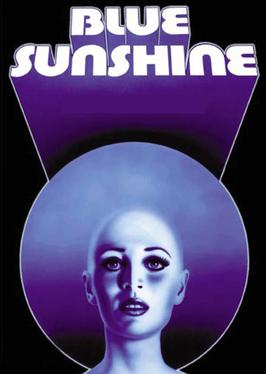
Today’s scene that I love comes from Jeff Lieberman’s 1978 film, Blue Sunshine.
If you haven’t seen the film, Blue Sunshine is the nickname for the acid that a group of characters dropped while in college during the 60s. Unfortunately, ten years later, all of them are losing their hair, suffering from extreme migraines, and turning into psycho killers. It’s the worst acid flashback of all time!
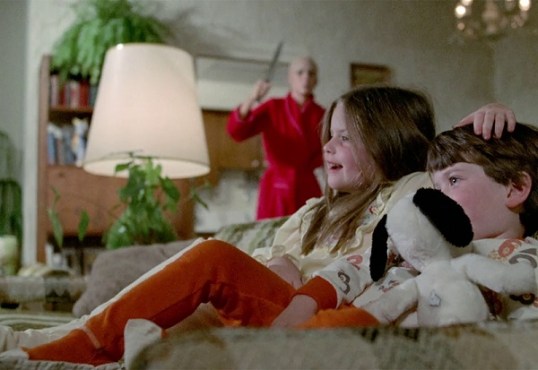
This is a pretty good film, one that uses the horror genre as a way to explore the contrast between the idealism of college and the realities of the real world. It’s also, as you can see in the scene below, quite suspenseful and more than a little frightening.
4 Shots From 4 Films is just what it says it is, 4 shots from 4 of our favorite films. As opposed to the reviews and recaps that we usually post, 4 Shots From 4 Films lets the visuals do the talking!
Yesterday was the birthday of the great director, Jeff Lieberman, who was responsible for some the best and most unusual horror thrillers of the 70s and the 80s! Today, TSL honors this talented filmmaker with….
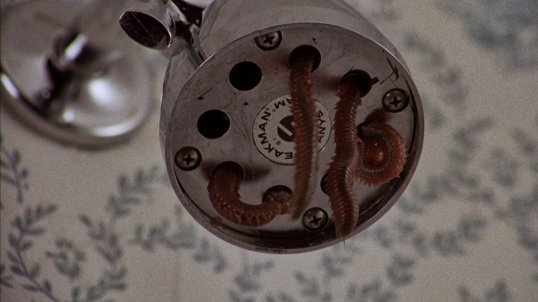
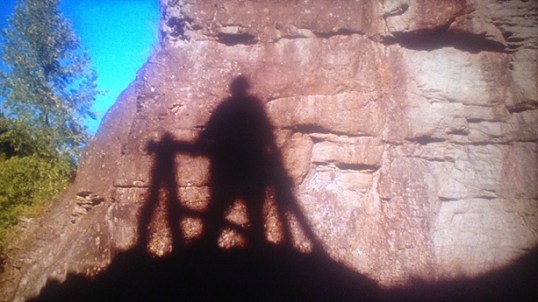
4 Shots From 4 Jeff Lieberman Films
Squirm (1976, dir by Jeff Lieberman, DP: Joseph Mangine)
Blue Sunshine (1978, dir by Jeff Lieberman, DP: Don Knight)
Just Before Dawn (1981, dir by Jeff Lieberman, DP: Joel King and Dean King)
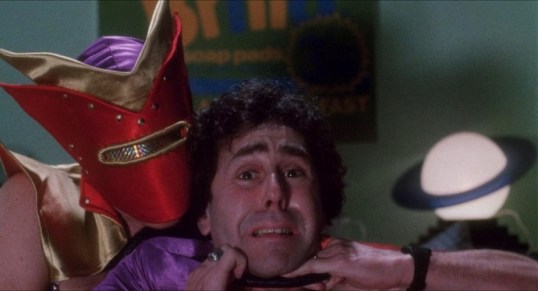
Remote Control (1988, dir by Jeff Lieberman, DP: Tim Suhrstedt)
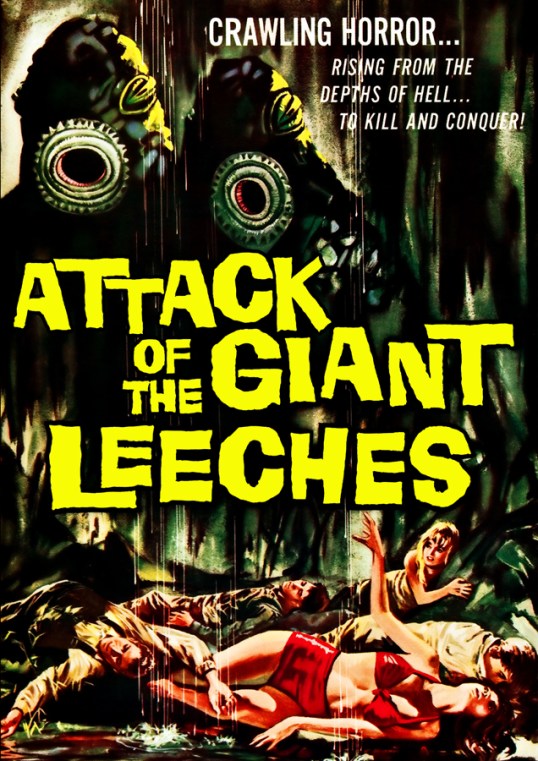
For today’s public domain horror film, I present to you 1959’s Attack of the Giant Leeches. This 60-minute film is a classic Drive-in film. While it has its slow spots, it also features an iconic performance from Yvette Vickers, who is like one of my favorites of the strong, confident, unapologetically sexy women who dominated the old B-movies. (Plus, she was only 5’3 and it’s not easy being brave when you’re having to look up at everyone. Trust me, I know.) This short little film is steamier than Louisiana in August and is full of bayou atmosphere.
I have to admit that I’m kinda freaked out by the scenes of people floating underwater in this film. And leeches … agck! Don’t even get me started on leeches. Especially giant leeches…
On tonight’s episode of Friday the 13th: The Series, Ryan discovers that his own father has been using a cursed pipe to get ahead in business!
This episode originally aired on July 16th, 1988. Ryan’s father is well-played by Michael Constantine, a familiar character actor (he was the father in My Big Fat Greek Wedding) who passed away on August 31st of this year.
In the 2013 film, Dead in Tombstone, Danny Trejo plays Guerrero De La Cruz, an old west outlaw who is loyal to his family, who has no problem robbing banks, but who also is not a fan of unnecessary bloodshed. Even though the film opens with Guerrero and his gang gunning down a posse of men, that’s just because they were saving the life of Red (Anthony Michael Hall), who just happens to be Guerrero’s half-brother. No sooner than you can say, “In what world could Danny Trejo and Anthony Michael Hall possibly be related?,” Red is asking Guerrero to help him pull off a daring robbery.
Guerrero helps Red because Guerrero is all about family. Unfortunately, Red is all about money and, not wanting to share the loot after the robbery, he promptly guns Guerrero down. Not only does Red shoot Guerrero but he insists that each member of the gang shoot him as well, implicating all of them in the crime.
Guerrero dies and promptly goes to Hell, where he’s met by Lucifer (Mickey Rourke). Guerrero doesn’t want to go to to Hell. He wants to get revenge. He offers to send a lot more souls down to Hell if Lucifer gives him a chance to return to the world of the living so that he can kill Red and the former members of his gang. Amused, Lucifer agrees but with a condition: Guerrero only has 24 hours to kill all six of his killers and Guerrero has to do all of the killing himself. He can’t hire someone else to do it or ask anyone for help. Guerrero agrees.
Unfortunately, as Guerrero soon discovers, he’s not the only one who wants Red dead. He’s going to have to move quickly if he’s going to kill all the members of the gang before Calathea (Dina Meyer), the wife of a sheriff killed by Red, gets a chance to do it herself!
Dead In Tombstone is one of those films that sounds a lot more interesting than it is. The concept behind the film is actually a pretty neat one and I like the idea of Guerrero actually having competition. This isn’t one of those westerns where everyone patiently waits their turn to go after the bad guys. The entire world wants these guys dead! Plus, who wouldn’t be excited about the idea of watching Danny Trejo and Mickey Rouke act opposite each other? With his weathered features and stoic demeanor, Danny Trejo is the perfect choice to play an outlaw and, for that matter, Rourke’s gravelly whisper and permanent smirk are put to good use in the role of the Devil. And while Anthony Michael Hall might seem like an odd choice to play Danny Trejo’s half-brother, he’s still properly villainous and loathsome in the role of Red.
And yet, the overall film itself is a bit uneven. The film looks good (especially for a straight-to-video project) but it never really seems to develop any sort of narrative momentum and there’s more than a few slow spots. At times, the film seems to be unsure of just how seiously it wants to take itself and, as a result, the story exists in a kind of limbo between being a straight western with supernatural elements and send-up of the whole genre. The end result is pretty uneven but the dream combination of Rourke and Trejo still makes it worth watching.
What do you get when a producer like Roger Corman notices that Jurassic Park was the most financially successful film of 1993?
Dinosaur Island!
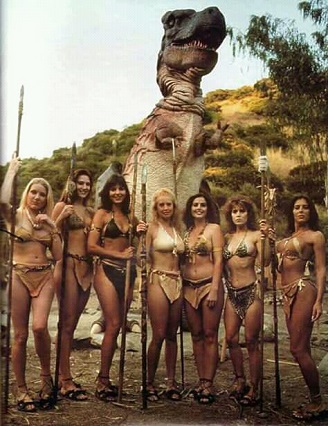
Directed by not just Fred Olen Ray but also Jim Wynorski (and if that combination isn’t enough to spark your interest, I don’t know what is), Dinosaur Island is about what happens when a cargo plane transporting three AWOL soldiers back to the United States crashes near an uncharted island. Led by no-nonsense Capt. Briggs (Ross Hagen), the soldiers make it to the island.
They discover that the island is full of beautiful cavewomen who spend much of their time topless. For the film’s intended audience of teenage boys, that’s good.
They discover that the women are ruled by a queen (Toni Naples) who hates men. That’s bad.
When the women notice that one of the men has a smiley face tattoo, they decide that he is the chosen one who has been prophesized about in the ancient scrolls. That’s good, I guess.
Chosen or not, the men still have to battle the Tyrannosaurs Rex that rules the island. That’s bad. Or is it good? I don’t know anymore.
To save money, Roger and the gang reused the dinosaur who appeared in Corman’s previous Jurassic hit, Carnosaur. They also reused a lot of stock footage from that film. The Carnosaur footage often doesn’t match with the footage that was shot for Dinosaur Island but I don’t know that anyone would expect anything less from Corman-produced rip-off of Jurassic Park. There are some films where the cheapness of it all become a selling point and this is one of them. The special effects are less important than marveling at how the movie got a dinosaur without spending any money.
Dinosaur Island is a bad movie with less than convincing special effects and a lot of overacting but it seems to be aware of its limitations so it’s hard not to like it. It’s obvious that Ray and Wynorski both understood that there was no way that they were gong to be able to make a serious film with the resources that they had available so instead, they shot a flat-out comedy that made fun of its own cheapness. It was the right approach to take, even though the film’s jokes are as often groan-worthy as they are funny. Among the cast, Ross Hagen seemed to have the best understanding of what was needed because he deadpans his way through the entire film, delivering his weird lines with a straight face and giving a performance that wouldn’t be out of place in Airplane! or one of the other ZAZ films.
Not surprisingly, this was a popular film on late night cable back on the day. It’s combination of boobs, jokes, and dinosaurs made it a Cinemax mainstay. Rewatching it, I knew how stupid it was but I couldn’t help but laugh at a few parts. I enjoyed viewing it again. Nostalgia is more powerful than any dinosaur.
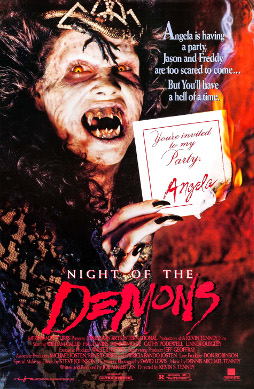
Last year, a group of friends and I watched 1988’s Night of the Demons for our weekly #ScarySocial live tweet. Not surprisingly, everyone loved the film. This scene below, featuring a possessed Angela dancing, was especially popular. Since today is director Kevin Tenney’s birthday, it only seems appropriate to celebrate by making it today’s horror scene that I love!
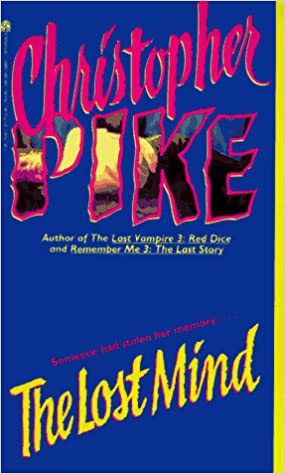
The book opens with our main character waking up in middle of the wilderness. She has no idea who she is or where she is. She doesn’t know why she’s covered in blood. What she does know is that there’s another girl lying a few feet away from her and she’s been stabbed to death! Did the living girl kill the other girl? She knows that she didn’t but, at the same time, she also knows that everyone will assume that she did.
It’s only after our main character stumbles across her car that she discovers that her name is Jenny. It’s only when she drives to a nearby town that she discovers that she lives with her overworked mom and her little brother. Apparently she goes to school and she has a job but Jenny can’t remember the specifics of any of it. Also, Jenny has a best friend named Crystal and they’re so extremely close that people are shocked whenever they see that Jenny is by herself. In fact, no one has seen Crystal for a while. Where could she be …. uh-oh.
Now, if this was an R.L. Stine novel, this is where you would expect some sort of cutesy twist to kick in. This is where you would look up from the book and says, “Ah-ha! I bet Jenny actually is Crystal and Jenny is just some imaginary character that she created to help her deal with a past trauma!” However, this is not an R.L. Stine novel. This is a Christopher Pike novel and Christopher Pike was always a hundred times darker than R.L. Stine ever was. If Stine always ended his books with a return to normalcy and maybe a joke or two, Pike’s novels took his characters to Hell and usually abandoned them there.
Even as she tries to figure out what type of life she’s led up until losing her memory, Jenny finds herself having dreams and visions where she’s in another person’s body, watching as they smoke hash, commit murders, and perform occult ceremonies. Soon, Jenny is investigating just what exactly it means to have a soul and whether or not a soul can move from one body to another. And, as she discovers more about the circumstances of Crystal’s death, she’s forced to consider just how far she’ll go to get revenge….
AGCK! Seriously, this is pretty dark stuff for a YA novel. I would have had nightmares if I had read this when I was a child. But that’s the thing with Christopher Pike. When he told a horrific story, he didn’t hold back. Instead, he created a world where happy endings often did not exist. The Lost Mind is dark and morbid and, even reading it now as an snarky and sarcastic adult, the book’s mystery was still intriguing. The book started out with a murder and it ended with a bang. Someone needs to turn this one into a Lifetime film.
That Argento is responsible for some of the greatest horror and suspense films of all time, everyone agrees. At the same time, there’s a tendency amongst critics to be unfairly dismissive of his post-Opera films. The claims that Argento either lost his touch or that he ceased to care about his films or that Asia Argento is somehow to blame for the uneveness of his later films have themselves become clichés, repeated by people who really should know better. Obviously, any director is going to struggle to follow-up the string of masterpieces that Argento directed early on in his career. And yet, the claim that Argento’s later films aren’t worth watching simply does not hold up under scrutiny. Unfortunately, these claims became even more widespread with the release of the unnecessary remake of Suspiria. When it become obvious that Luca Guadagnino’s film was a pretentious disaster, his online supporters responded by trying to destory the legacy of Argento’s masterpiece.
That’s why I’m grateful for Troy Howarth’s Murder By Design. Published in 2020, Murder By Design examines the life and the work of Dario Argento. It’s a combination of a biography and a critical analysis and it’s probably about as fair of an examination of Argento’s controversial legacy as I’ve ever read. Howarth, of course, writes about the films that everyone agrees are brilliant but, even more importantly, Howarth also gives the same amount of consideration to the films that are usually dismissed, like Phantom of the Opera and The Stendhal Syndrome. Though Howarth is hardly a blind Argento cheerleader — he’s critical of many of Argento’s later films — he also doesn’t give in to the temptation to lazily dismiss everything that Argento directed after 1985. He approaches Argento as both a fan and a scholar, critical but open-minded. As a result, he not only provides an interesting look at Argento but also a look at the development of post-World War II film industry and at the growth of horror as a genre.
Even better, Howarth explores all of Argento’s work. That includes the screenplays that he wrote before directing his first film. That includes the films that he produced and the television shows that he hosted. He makes the case for Argenton as an artist whose influence and vision goes far beyond just the films that he’s directed. Troy Howarth is one of the best writers about Italian cinema out there and Murder By Design is a must-read for anyone serious about Argento.



 Through the Shattered Lens