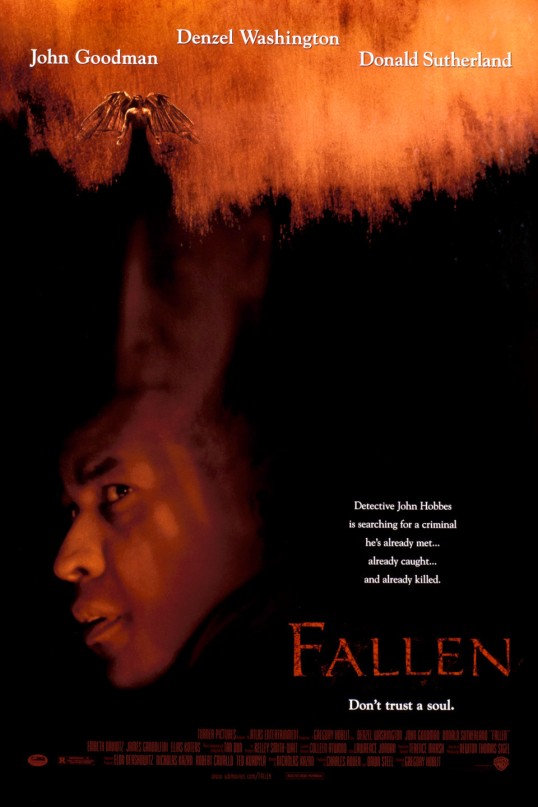
Horror Film Review: Fallen (dir by Gregory Hobilt)


“Time is on my side….” sings an ancient Sumerian demon, who is apparently a huge fan of the Rolling Stones.

“Do you like cream?” asks a possibly crooked detective who is played by a slightly less heavy than usual James Gandolfini.

Donald Sutherland walks through a shadowy police station and flashes his big smile.

A detective played by John Goodman talks on the phone and makes cheery jokes while investigating a brutal murder.

A demon jumps from person to person, possessing everyone for a matter of seconds, just so he can freak out one specific person.

“Beware my wrath,” a white-haired businessman says to Denzel Washington.

There’s no way to deny it.  1998’s Fallen is a film that’s full of strange moments.  Some of it works and some of its doesn’t but it’s never boring.  Denzel Washington plays John Hobbes, a Philadelphia detective who has achieved a small amount of fame as the result of capturing serial killer Edgar Reese (Elias Koteas).  Reese asks to see Hobbes before he’s executed and it turns out that, for a man about to pay the ultimate price for his crimes, he’s in a surprisingly good mood.  Before he goes in the gas chamber, Reese chants something in Aramaic.

Soon, new murders are being committed in Phladelphia.  Hobbes and his partner, Jonesey (John Goodman at his most Goodmanesque), suspect that the killer is a copycat, trying to capture some of Reese’s notoriety for himself.  Gretta Milano (Embeth Davidtz), the daughter of a detective who committed suicide after being accused of committing a series of murders, tells Hobbes that the new killings are actually being committed by a demon named Azazel.  Azazel can jump from body to body and can compel people to do terrible things.  Gretta asks Hobbes if he belives in God.  Hobbes says it’s hard to have faith when you deal with murder every day, a somewhat clichéd line that Washington makes work through the absolute conviction of his delivery,

Denzel Washington is the key to this film’s success.  Sure, there’s a lot of murders and a lot of twists and a lot of possessions and there’s a lot of scenes that are shot from the point of view of the demon but, in the end, Fallen works because Washington is absolutely convincing as a man who is facing an evil that is beyond human understanding.  Washington gives a very naturalistic and grounded performance, one that keeps an element of reality in Fallen regardless of how messy the story may get.  When it becomes apparent that the demon is going to try to harm his brother and his nephew, Washington’s fury feels real.  When Hobbes discovers that the demon has gotten to one of them, Washington’s underplayed reaction makes the scene even more poignant and painful.  It’s hard to imagine Fallen being anywhere near as effective with an actor other than Denzel Washington in the lead role.

Fallen is a twisty movie.  The demon moves quickly and it always seems to have a backup plan.  He manipulates Hobbes into doing some things that are so terrible that you’re not sure that Hobbes is every going to recover, even if he does somehow manage to defeat Azazel.  Hobbes and Azazel are worthy adversaries and, as a result, the film gets away with a lot of stuff that wouldn’t otherwise work.  Even the use of Time Is On My Side pays off, as the one character who you don’t want to hear sing the song suddenly starts doing a Mick Jagger impersonation and you’re just like, “Oh no, what’s going to happen now?”  The film’s high point is a lengthy sequence where Hobbes stands on a busy street and watches as Azazel jumps from body to body.  Everyone who passes Hobbe gives him a death glare.  It’s a frightening moment, one in which Fallen captures the intensity of a nightmare.

I watched Fallen earlier today.  I can’t really say that I was expecting much from it but I was surprised.  It’s actually one of the better horror films that I’ve watched for the first time this month.  It’s big and strange and creepy and it’s got Denzel Washington doing what he does best.  What more could you ask for?
The Terror Within II (1991, directed by Andrew Stevens)


Two years after ripping off Alien with The Terror Within, producer Roger Corman decided to rip it off a second time with The Terror Within II.  This time, star Andrew Stevens hopped into the director’s chair and, along with the sex-crazed monsters, a religious cult was also added.  A year after The Terror Within II was released, Alien 3 was released and it also featured a religious cult.  Was it a coincidence or was Roger Corman predicting the future?

Speaking of the future, The Terror Within II returns us to the crappy future that was predicted by the first film.  As the previous film’s only survivor, scientist Andrew Stevens is walking across Colorado to take a position at yet another lab.  Along the way, he meets a young woman named Ariel (Clare Hoak).  No sooner have they met than they’re doing their bit to repopulate the human race.  Meanwhile, a cult wants to kidnap Ariel and offer her up to the mutants.  (The mutants were called Gargoyles in the first film.  Now, they’re called Lusus.)

Meanwhile, at the other lab, the scientists, including Stella Stevens and R. Lee Ermey, are studying a mutated finger, which appears to be spontaneously regenerating into a Gargoyle or a Lusus or whatever its called now.  Does it occur to anyone at the lab that growing their own monster is a stupid idea?  No.  Humanity is doomed.

The Terror Within II was shot for even less money than the first film but it’s also a marked improvement.  That’s mostly due to Andrew Stevens being a far more competent filmmaker than the director who did the first film.  Stevens know how to shoot an action scene and, when the monsters inevitable do end up storming the lab, it’s more exciting in the second film than it was in the first.  Plus, whereas The Terror Within only had George Kennedy to lend it some class, The Terror Within II has both R. Lee Ermey and Stella Stevens!  It’s an improvement, all around.

Unfortunately, there was never a third film.  The Lusus probably would have won anyways.  There’s only so many underground labs that humanity can hide out in.

Game Review: The House on Highfield Lane (2021, Andy Joel)


The House on Highfield Lane is an entrant in 2021 Interactive Fiction competition.  Browse and experience all of the games by clicking here.

Mandy has always been frightened by the forboding house that sits on Highfield Lane but, when she’s walking home from school one day and comes across a letter that’s been addresses to the house’s owner, she decides to finally conquer her fear. What starts as a simple quest to deliver the mail turns into a long adventure as Mandy explores the house, solves puzzles, and even helps to reanimate the dead.

The author of this game described its genre as being “horror without the horror,” because, even though the game is about exploring a creepy old house, there aren’t any of the elements that usually come with a haunted house game. (There is a mad scientist but he’s not such a bad fellow.) This is actually kind of an old-fashioned game, where the emphasis is on exploring and solving puzzles. There’s a lot of puzzles. Solving puzzles has always been my weak spot when it comes to playing IF games. I’m the type of player who always ends up asking for hints or looking at a walk-through. The House on Highfield Lane does come with hints. It wasn’t long after I started playing that I started to use them but again, I’m terrible at puzzles. I think most experienced IF players will be able to solve the majority of the game’s puzzles without having to ask for help.

This is an enjoyable and engaging game. The descriptions of each room were so well-written that I could easily picture them in my head as I played, This game was partially designed to show off the new Quest 6 engine and it does a good job of doing just that. Content-wise, it feels like a throwback to the old text adventures that you would play for hours, experimenting with different verbs and seeing what you could do in each room of the house. If you like exploration-centered games and don’t mind having to figure out several puzzles, this is a game you should enjoy.

Play The House on Highfield Lane.

Scenes that I Love: Tor Johnson In The Unearthly


We continue to honor the memory of Tor Johnson with today’s scene of the day.

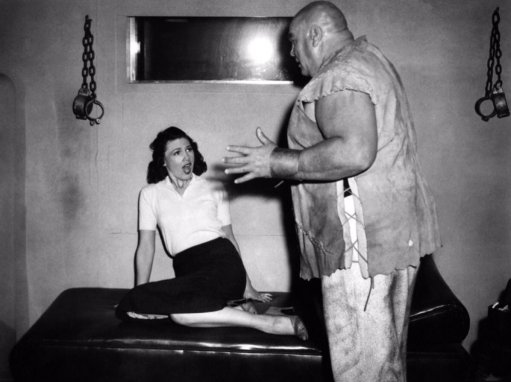
Even though Tor Johnson is playing a character named Lobo, today’s scene that I love isn’t from Ed Wood’s 1955 film, Bride of the Monster. Instead, it’s from 1957’s The Unearthly. In this film, Lobo is now John Carradine’s servant. (Lobo made quite a career out of working for mad scientists.) The Unearthly was directed by Boris Peftroff, a friend of Wood’s, so it’s not improbable that this film’s Lobo was meant to be the same Lobo as the one who appeared in Bride of the Monster and Night of the Ghouls.

Anyway, in this scene, Tor does his usual Lobo stuff while John Carradine plays the piano. “Time for go to bed,” Lobo says at one point, a much-mocked line but one that is delivered with a bit of gentleness by Tor Johnson. My point is that Tor did the best that he could and bless him for it.

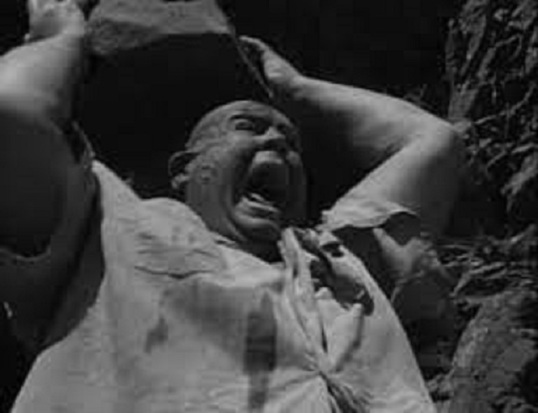
4 Shots From 4 Tor Johnson Films


4 Shots From 4 Films is just what it says it is, 4 shots from 4 of our favorite films. As opposed to the reviews and recaps that we usually post, 4 Shots From 4 Films lets the visuals do the talking.

Today is Tor Johnson’s birthday so it just seems appropriate to present….

4 Shots From 4 Tor Johnson Films

Bride of the Monster (1955, dir by Ed Wood, DP: Ted Allan and William C. Thompson)

Plan 9 From Outer Space (1957, dir by Ed Wood, DP: William C. Thompson)

The Unearthly (1957, dir by Boris Petroff, DP: W. Merle Connell)

The Best of Yucca Flats (1961, dir by Coleman Francis, DP: John Cagle and Lee Strosnider)

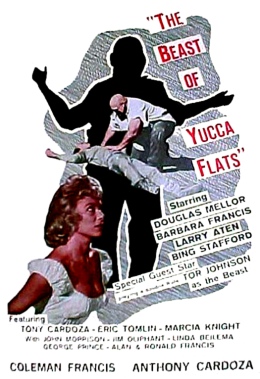
Horror On The Lens: The Beast of Yucca Flats (dir by Coleman Francis)


Beastyuccaflats

Since today is Tor Johnson’s birthday, it only seems appropriate that today’s Horror on the Lens should be one that he starred in, 1961’s The Best Of Yucca Flats.

My friend, the writer and chef Tammy Dowden, claims that this is the worst movie ever made.

Well, technically, she may be right.  The Beast of Yucca Flats is a thoroughly inept film that makes next to no sense and has massive continuity errors.  It’s a film that also features the legendary Tor Johnson as a Russian scientist who gets mutated by radiation and becomes a monster, but not before taking off almost all of his clothes while walking through the desert.  For that matter, it’s also a film about a family that comes together though adversity — namely, being shot at by the police after the family patriarch is somehow mistaken for Tor Johnson.  And finally, it’s the story of how a dying monster can find comfort from a rabbit and that’s actually kind of a sweet message.

Here’s the thing — yes, The Beast of Yucca Flats is bad but you still owe it to yourself to watch it because you will literally never see anything else like it.  Plus, maybe you’ll be able to figure out what the whole point of the opening scene is.

Because I’ve watched this film a few times and I still have no idea!

Enjoy!

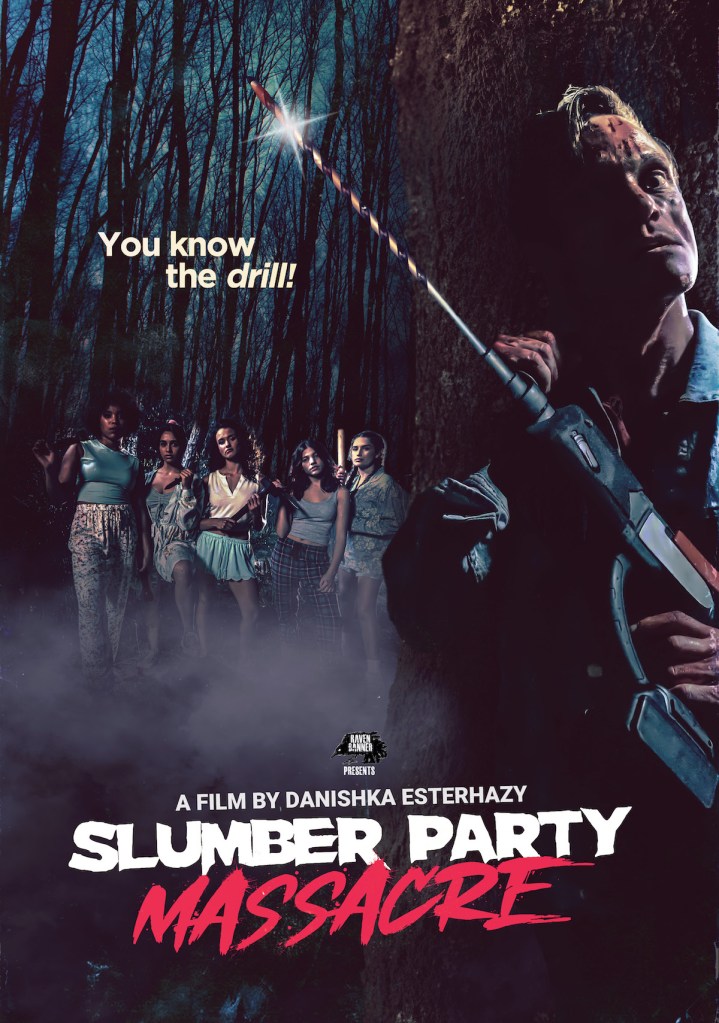
The TSL’s Grindhouse: Slumber Party Massacre (dir by Danishka Esterhazy)


This weekend, SyFy premiered Slumber Party Massacre, which was billed as being a re-imagining of the original film of the same name. The original film featured a creepy loser with a drill and the latest version features a creepy loser with a drill. The original film featured a group of friends being menaced at a slumber party and the latest version features not just one group of friends but three groups of friends, all being stalked. The original film was a sneakily subversive satire of the genre while this new version is a satire that’s neither sneaky nor particularly subversive.

This new version takes place at a lakehouse. Years ago, the drill killer attacked a slumber party and was apparently killed by the party’s sole survivor. Now, the location has become a hot spot for people who are obsessed with true crime podcasts. The daughter of the sole survivor of the last slumber party massacre goes to the house with a group of her friends, all of whom are looking forward to possibly being attacked by the drill killer so that they can kill him. Meanwhile, there’s a group of boys who are also at the lake because they love visiting murder houses. The boys are constantly screaming and having pillow fights. The girls are fully armed and they frequently comment on the absurdity of the film’s plot while pointing out all of the slasher movie clichés.

There are a few things that I liked about this new version of Slumber Party Massacre but, in the end, it’s hard not to feel that the movie just tries too hard. The film’s approach is a bit too heavy handed to really be effective. Perhaps if I had never seen a horror film that specifically poked fun at the conventions of the genre, I would have been more impressed with Slumber Party Massacre‘s attempt at humor. But the thing is …. I’ve seen Cabin In The Wood. I’ve seen Scream. I’ve seen Behind The Mask: The Rise of Leslie Vernon. I’ve seen countless Asylum mockbusters. Like most horror fans, I am beyond the point where I can simply be impressed by characters in a movie pointing out the conventions of the genre. The first Slumber Party Massacre was a satire that worked specifically because it played out its absurdity with a mock seriousness. The new version, though, is constantly pointing out its own cleverness. At times, the entire production feels a bit needy. Instead of trusting the audience to figure out what it’s saying, this new version continually tells us. This new version doesn’t trust its audience.

That’s not to say that the film itself doesn’t have a few good moments. For instance, I liked the character of Alix (Mila Ranye) and there is a nice bit where the group debates whether or not killers always come back to life. The murders are gruesome without being sadistic and, just as in the first movie, that drill leaves us with no doubt as to just what exactly the killer’s main issue is. (Slumber Party II also gets a shout out, as one potential victim, when told to get a weapon, grabs guitar.) Towards the end of the movie, there’s an effectively tense scene involving a nail gun and, for a few minutes, the film’s danger actually feels real.

The film has its moments but, for the most part, this re-imagining of the original Slumber Party Massacre was just to heavy handed to work for me.

Horror on TV: Friday the 13th: The Series 2.1 “Doorway to Hell” (dir by William Fruet)


Tonight, for our horror on the lens, we have the first episode of the 2nd season of Friday the 13th: The Series!

Guess what? Uncle Lewis is, once again, trying to reenter the world of the living! Can Micki and Ryan stop him!?

This episode originally aired on September 30th, 1988.

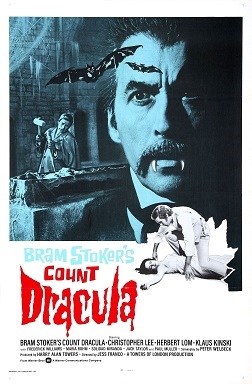
International Horror Review: Count Dracula (dir by Jess Franco)


Christopher Lee played Dracula in seven horror films and he often said that he hated almost every single one of them.

Christopher Lee, you have to understand, was a fan of Bram Stoker’s original novel and he always wanted to play Dracula the way that Stoker wrote him, as a member of the old nobility who got younger each time he drank blood.  As Lee often explained it, he spent years vainly trying to convince Hammer to do a Dracula film that was faithful to Stoker’s novel but Hammer instead preferred to use Dracula as an almost generic villain, one who was frequently plugged into equally generic films.

At some point, in the late 60s, producer Harry Alan Towers approached Christopher Lee and asked him to play Dracula in a non-Hammer film about the world’s most famous vampire.  At first, Lee refused.  If he was bored with playing Dracula for Hammer, why would he want to play him for someone else?  However, Towers then explained that his version of Dracula would be the first Dracula film to actually be faithful to Stoker’s book.  In fact, along with the presence of Christopher Lee, that would be the film’s major selling point!  Hearing this, Lee agreed.

The resulting film was 1970’s Count Dracula, a German-Spanish-British co-production that was directed by none other than Jess Franco.  Jess Franco, of course, is a beloved figure among many fans of Eurohorror and a bit of a controversial filmmaker.  Some people admired him for his ability to direct atmospheric films while spending very little money.  Others complained that Franco’s films were frequently amateurish and narratively incoherent.  When it comes to Franco, both camps can make a compelling argument.  Personally, I tend to come down on the pro-Franco side of things, particularly when it comes to the films that he made with Towers in the 70s.  For his part, Christopher Lee said he enjoyed working with Franco and they would go on to collaborate on several more films together.

So, what type of film is Jess Franco’s Count Dracula?  Well, Towers did not lie to Lee.  For the most part, Count Dracula remains faithful to plot of Bram Stoker’s Dracula.  There’s a few minor differences, of course.  A few characters are combined, which is understandable given that you sometimes need a scorecard to keep up with everyone in the novel.  The ending is a bit more abrupt in the film than it is in the book.  This probably has something to do with the fact that Franco ran out of money before he finished the film.  That was a fairly frequent occurrence on Franco’s films.

That said, film sticks close to the novel.  Jonathan Harker (Frederick Williams) goes to Transylvania and meets Dracula (Christopher Lee, with a mustache), an aging nobleman.  Harker soon finds himself being held prisoner in the castle, a victim of Dracula and his brides.  Though Harker does manage to escape (though not before finding Dracula asleep in his coffin), he ends up at a psychiatric hospital in London.  He meets Dr. Seward (Paul Muller) and Prof. Van Helsing (Herbert Lom).  Eventually, his fiancee Mina (Maria Rohm) and her best friend, Lucy (Soledad Miranda, who was Franco’s muse until he tragic death in a car accident) come to visit him.  Accompanying Lucy is Quincy Morris (Franco regular Jack Taylor), who, in the film, is a combination of two of the novel’s characters, Quincy and Arthur Holmwood.  Meanwhile, a madman named Renfield (Klaus Kinski) babbles about his master and eats bugs.

That said, while the story may stick close to Stoker, this is definitely a Franco film.  The action plays out at its own deliberate pace.  Depending on how much tolerance you have for Franco’s aesthetic, you’ll find this film to be either dream-like or slow.  Personally, I liked the amospheric images and the somewhat ragged editing style.  Whether it was Franco’s intention or not, they gave the film a hallucinatory feel, as if one was watching a nightmare being dreamt by Stoker himself.  At the same time, I can imagine others getting frustrated by the film and I can understand where they’re coming from.  Franco, with his habit of mixing the sensual with a deep sense of ennui, is not for everyone.

Still, it was interesting to see Lee giving a much a different performance as Dracula than he did in the Hammer films.  The Hammer films portrayed Dracula as being animalistic, driven by only his craving for blood.  In Count Dracula, Lee plays with the idea of Dracula being a relic of the old world, someone who has no choice but to watch as civilization changes around him.  While Dracula is undoubtedly evil, Lee plays him with hints of dignity.  Gone is the snarling and growling monster of the Hammer films and instead, this movie features a Dracula who takes an almost Calvinistic approach to his affliction.  He’s accepted his fate.  As he tells Harker, Harker can either choose to enter the castle or not.  In the end, it makes no difference because eventually, someone will enter.  The film also retains the idea of Dracula growing younger in appearance as he drinks blood, which adds a whole other dimension to Dracula’s cravings.  Blood is life and youth, two things that Dracula no longer possesses.

As for the rest of the cast, Klaus Kinski, not surprisingly, throws himself into the role of Renfield.  Reportedly, he ate real bugs for the role.  Herbert Lom seems a bit bored with the role of Van Helsing.  He doesn’t have any of the eccentric energy that we typically associate with the role.  Of course, some of that is due to the fact that, because of scheduling conflicts, Lom and Lee were never on set at the same time.  The scenes where Dracula and Van Helsing confront each other were created through some editing sleight-of-hand.  As is typical with Franco films, sometimes it works and sometimes, it’s extremely obvious that Lom wasn’t actually looking at Lee (or anyone other than the cameraman) when he delivered his lines.

Count Dracula is an interesting take on the story.  It’s a bit uneven, though that’s perhaps not a surprise considering that the production was apparently beset by budgetary problems from the start.  This film is Franco at his least lurid and it’s hard not to miss some Franco’s more sordid impulses.  Watching the film, you get the feeling that Franco was holding back.  But, the visuals are wonderfully dreamy, Kinski is compelling in his insane way, and Lee finally appears to be enjoying the role of Dracula.  It’s actually kind of nice to see.