Brother Cane’s And Fools Shine On is best-known for appearing on the soundtrack of Halloween: The Curse of Michael Myers. No matter what else people say about that movie, the general consensus seems to be that at least the music was good.
The video is slightly horror-themed, though Michael Myers doesn’t show up. Instead, the video feels like an homage to the expressionistic cinema of F.W. Munrau and Fritz Lang, as if someone tried to combine Nosferatu with Metropolis.
The Reluctant Vampire was the 7th episode of the 3rd season of HBO’s Tales From The Crypt! It stars Malcolm McDowell as a vampire who is a little bit too nice for his own good. Seriously, you can’t go wrong with Malcolm McDowell as a vampire.
The Reluctant Vampire originally aired on July 10th, 1991.
At the start of 1980’s The Day Time Ended, the Williams Family has relocated to the desert!
(Why the desert? I have no idea. I’ve been told that the hot air of the desert would be ideal for my asthma but then I’d have to live in the desert and, from what I’ve seen in the movies, bad things always happen in the desert. If it’s not aliens, it’s zombie cowboys.)
Grandpa (Jim Davis), Grandma (Dorothy Malone), Richard (Christopher Mitchum, looking a lot like his father, Robert), Beth (Marcy Lafferty), and their young daughter, Jenny (Natasha Ryan) have moved into a very nice ranch house that appears to be sitting in the middle of nowhere. The house comes with a barn, a few horses, and …. ALIENS!
At first, Jenny is the only one to notice the strange blue light that keeps glowing behind the barn. But soon, the rest of the family is seeing UFOs and weird (but kind of cute) creatures are knocking on the front door and saying hi. Lizard men appear in the distance and beckon for the family to follow them. Soon, the house itself is being zapped through time and space….
This is going to be a short review but, then again, The Day Time Ended is a short movie. With a running time of only 75 minutes (not including the end credits), The Day Time Ended feels less like a movie and more like an extended episode of The Twilight Zone. That said, if it was an extended episode of The Twilight Zone, it would be considered to be one of the more enjoyable episodes of the series. While none of the characters are particularly complex or deeply written, the cast is believable as a family and everyone does a good enough job that the viewer won’t want to see anything bad happen to any of them. (I’m also happy to say that all of those horses are really pretty and — fear not! — for once, no harm befalls any of the animals.) The motives of the aliens are kept ambiguous throughout the film, leaving the viewers as confused and intrigued as the family and the final shot is somehow both silly and tremendously satisfying at the same time. The Day Time Ended is a B-movie but it’s an entertaining B-movie.
Directed by B-movie specialist, John “Bud” Cardos, this is one of those movies where the cheapness of the special effects add to the film’s charm. Initially, the UFOs are represented by lights darting through the sky. (Residents of Texas will immediately think of our beloved and yet unexplained Marfa Lights.) When the UFOs are finally seen in close-up, they are obviously plastic models but, in this age of excessive CGI, there’s something undeniably charming about the idea of going to the trouble to build plastic models. The claymation aliens are adorable! Seriously, there are some films that you just can’t help but kind of love and, for me, The Day Time Ended is one of those films.
The Twine Fishing Simulator starts out like an old school fishing simulator. At first, everything about it, from the font to the simple directions, reminded me of the type of clunky but addictive text games that I used to play back in the early 90s. Back then, we didn’t need a lot of fancy graphics or even much descriptive text. We just needed our imagination.
You are fishing. You start at the Lake. If you catch enough different types of fish, new locations will be opened. Each new location gets bigger and there are new fish to catch at each place. There are also various rewards that you can get after you catch certain fish. There are NPCs who you can talk to. You can ask them questions about fishing. Some of them offer hints. Some offer side quests. Some ruminate on the nature of existence.
The further you get into the game, the stranger it gets. This is not a typical fishing simulator. It’s not just about catching the fish. It’s about why you’re catching the fish and why you’re moving from one location to another. It starts out as nostalgic fun and then gets increasingly surreal as the game progresses. I can’t reveal too much about it without spoiling the game’s puzzles but it’s ultimately one gigantic mindscrew disguised as a fishing simulator, and an entertaining one at that. Anyone can write a strange game but it takes talent and imagination to write a strange game that, like this one, is worth playing and even replaying.
It was only after I finished the game that I realized that I could have just stayed at the Lake and kept fishing.
What would you do if your friend confessed to committing a murder?
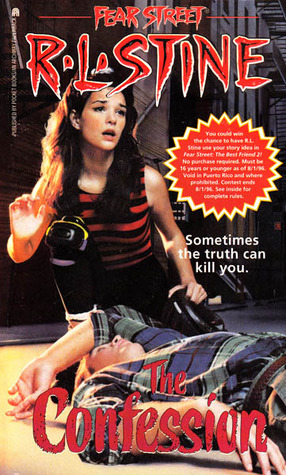
That’s the dilemma that is at the heart of R.L. Stine’s 1996 YA horror novel, The Confession.
No one at Shadyside High likes Al. He used to be kind of nice but, as of late, he’s been dressing in all black, drinking beer, and picking fights. Plus, he’s got a really bad habit of blackmailing his friends. Al is the type who will sell you the answers to a test and then threaten to tell everyone that you were cheating unless you keep him supplied with cash. (Fortunately, my sister was a year ahead of me so I could just go through her old tests if I needed the answers in advance.) Al is a real jerk and no one is that upset when he turns up dead and with a rollerblade stuffed in his mouth!
Who killed Al!? Well, nerdy Sandy tells his friends that he did it. At first, everyone’s okay with the idea of covering for Sandy because it’s not like Al was a nice guy and Sandy did promise not to kill anyone else. But then Julie (who also discovered Al’s body) starts to have nightmares about Sandy and she finds it difficult to keep covering for him every time that she speaks to the police. Julie also notices that Sandy has been acting a little bit differently since confessing to the murder. Sandy seems to be a little bit more aggressive now, almost as if he might want to try to kill someone again….
AGCK!
Listen, if I was in Julie’s shoes …. well, I don’t know what I’d do. On the one hand, I have always been against murder and violence in general. On the other hand, Al was a real jerk and it was kind of obvious that he would have eventually ended up killing someone if someone hadn’t gotten to him first. I would not want to be the person who sent a friend to death row. So, in this case, R.L. Stine came up with a plot that actually made me think. At the same time, he also added a last-minute twist that let almost all of the characters off the hook. I guess that’s to be expected. I mean, we’re talking R.L. Stine here, not Dostoevsky, Still, I was a bit disappointed with the final few pages of the book. Things worked out …. BUT AT WHAT COST?
Again, there was no cost. This is R.L. Stine. All the trauma in the world is worth it as long as you’re dating a cute guy and speaking in quips by the end of the book. That, after all, is the appeal of Fear Street.
Cregar was born in Philadelphia in 1913 and spent a good deal of his youth in England. That was where he first appeared, as a child actor, with the Stratford-Upon-Avon theatrical troupe and it was also where he developed the English accent that would serve him well later in life. Cregar once said that, from the age of eight, all he wanted to do was be on stage.
For most of the years that followed, Cregar never stopped performing. Cregar went from acting on stage to eventually making his way to Hollywood. He first appeared on the big screen in 1940 and he went on to appear in 16 films. He appeared in nearly every genre of film, from comedy to film noir to even a western. As frequent viewers of TCM can tell you, he played a surprisingly charming devil in 1943’s Heaven Can Wait. But he was probably best-known for playing a mysterious man who might be Jack the Ripper in 1944’s The Lodger and for his role as the possibly mad pianist, George Henry Bone, in Hangover Square, obsessively playing the piano while his room burned down around him. Sadly, that will be his final role.
Cregar was an actor who had the talent to be a leading man but, because he weighed over 300 pounds, he found himself used as a supporting player in Hollywood. He was a character actor who yearned to be a romantic star and who feared he would be forever typecast as a villain. Perhaps because Cregar disliked playing villains, his villains often seemed to be conflicted about their actions. (Indeed, there was a vulnerability to Cregar that made it difficult not to feel some sympathy for his characters.) Determined to change his image, Cregar embarked on a crash diet that was aided by amphetamines. He lost over a 100 pounds but he also put his health in jeopardy. On December 9th, 1944, Cregar died after suffering a heart attack. He was 31 years old. His friend Vincent Price delivered the eulogy at Cregar’s story. Cregar’s final film, Hangover Square, was released four months after he died.
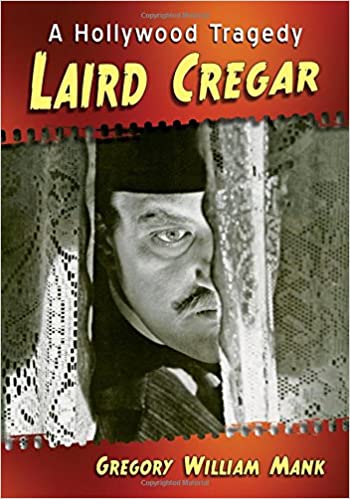
Gregory William Mank’s biography, Laird Cregar: A Hollywood Tragedy, not only tells the story of Cregar’s short life but it also examines how Cregar took his frustrations and his insecurities and used them in his performances. In Mank’s biography, Cregar comes across as being a kind and generous man who wanted so desperately to be a star that it destroyed him. The book serves as not only an examination Cregar and his talent but an indictment of a studio system that set very rigid rules for who could and who couldn’t be a star. The book also features details about Cregar’s extensive and successful stage career. If you’re a history nerd like me, you’ll appreciate all of the detail that Mank goes into while discussing who co-starred with Cregar and their subsequent careers. Mank explores Cregar’s childhood and his career. The resulting biography pays tribute to a star who deserved better.
It’s a double feature like none other! The majority of the trailer (understandably, in my opinion) is devoted to clips from I Drink Your Blood. What is I Drink Your Blood about? It’s about a little kid who gets rid of a bunch of annoying hippies by giving them food that has been infected with rabies!
2. Grizzly (1976)
Wow, I wonder where they got the idea for this movie from!
3. The Crater Lake Monster (1977)
Awwww! What a cute monster!
4. Cathy’s Curse (1977)
Beware of Cathy …. and her doll too!
5. Jennifer (1978)
A bullied teenage girl has psychic powers …. hmmmm, this sounds familiar….
6. The Children (1980)
“Something terrifying has happened to the Children!” This actually a pretty scary film but somehow, the trailer is even scarier.
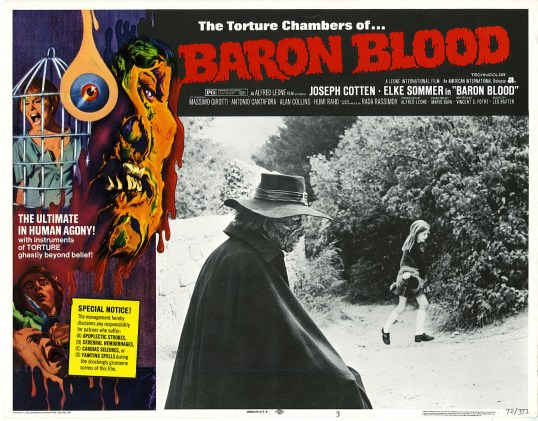
Directed by the great Mario Bava, the 1972 Italian film, Baron Blood, tells a story of gothic horror.
During the 19th century, there was no one as feared in Austria as Baron Otto Von Kleist. Much like the infamous Gilles de Rais, the Baron was a sadist who used his noble background as a cover for his macabre activities. In his castle, he murdered hundreds of villagers and, for that, he was nicknamed Baron Blood. He also had an accused witch burned at the stake. As she died, she cursed the Baron, saying that he would continually rise from the dead just so he could be killed again and again. When you think about it, that’s actually a pretty badass curse.
One hundred years later, the Baron’s American descendant, Peter Kleist (Antonio Cantafora), arrives in Austria to check out the family castle. The castle is being converted into a tacky hotel where tourists can stay in the same rooms where the Baron used to kill his victims. However, Peter is not particularly concerned with what’s about to happen to the castle. Instead, he’s in Austria because he’s discovered a parchment that contains an incantation that will bring the Baron back to life. He wants to give it a try, more for his own amusement than anything else. Neither her nor Eva (Elke Sommer), a college student who is studying the hotel’s architecture, really think that they are going to bring the Baron back to life by reading the incantation at midnight. Of course, they’re wrong.
It’s easy to make fun of Peter and Eva for being so naïve as to think that it wouldn’t be a big deal to cast a magic spell but it’s not like they realize that they’re characters in an Italian horror film. They don’t know that their lives are being directed by Mario Bava. To be honest, if I was there, I probably would have joined them in reading the spell. Sometimes, it can be fun to tempt fate.
That said, in the case, fate should not have been tempted. People are soon dying. When the man behind the hotel project is murdered, a wheelchair-bound millionaire named Alfred Becker (Joseph Cotten) shows up and purchases the castle for himself and announces plans to restore it. Will restoring the castle bring peace to the village or is the witch’s curse too powerful to defeat?
Baron Blood is often described as being one of Bava’s lesser films and is it true that it feels a bit conventional, particularly when compared to the subversive and satiric Bay of Blood and the surreal Lisa and the Devil.Baron Blood was a film that Bava himself was reportedly not enthused about making, one that he took on only because his last few films had struggled at the box office and he didn’t feel he would get any better offers. Perhaps that’s why a definite strain of melancholy and disillusionment runs through Baron Blood, a film in which a beautiful castle is destined to be turned into a tacky tourist trap by a businessman who could hardly care less about either history or aesthetics.
Though the story is a bit predictable (and you’ll have little trouble guessing which character is the Baron in disguise), I actually like Baron Blood. Not surprisingly, considering that it was a Bava film, Baron Blood is heavy on gothic atmosphere, so much so that it feels almost like an extra-bloody Hammer film. Both the castle and the village are full of shadows, from which anyone or anything could emerge at any moments and the cold grandeur of the castle is nicely contrasted with the garishness of 70s Europe. A visually striking scene where Eva flees from an attacker is especially well-directed and the film ends on a properly macabre note, one that once again feels as if it’s putting a distinctly Italian spin on a situation one would usually expect to find in a Hammer production.
Antonio Cantafora is a bit of a stiff but Elke Sommer gives an energetic and committed performance as someone who is torn between preserving the past and embracing the modern world. She doesn’t get to do as much in this film as she did in Lisa and the Devil but she’s still a sympathetic lead and someone to whom most viewers will be able to relate. We care about her character and, as a result, we care about discover just what exactly the Baron has in store for her.
Baron Blood may not have been a critical or a box office success when it was originally released but it has achieved a certain immortality. In a development that could have been lifted from one of Bava’s films, the sounds of the Baron’s victims screaming were later lifted from this film, remixed, and sold as being a recording that had apparently been made of sinners screaming from behind the gates of Hell. To this day, there are sites that insist that this recording is genuine. One hopes that Bava would have appreciated the admittedly dark humor of it all.
4 Or More Shots From 4 Or More Films is just what it says it is, 4 shots from 4 of our favorite films. As opposed to the reviews and recaps that we usually post, 4 Shots From 4 Films lets the visuals do the talking!
This October, I’m going to be doing something a little bit different with my contribution to 4 (or more) Shots From 4 (or more) Films. I’m going to be taking a little chronological tour of the history of horror cinema, moving from decade to decade.
Today, we take a look at 2008, 2009, and 2010!
6 Shots From 6 Horror Movies: 2008 — 2010
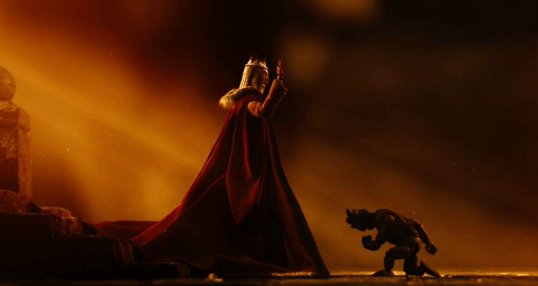
Hellboy II: The Golden Army (2008, dir by Guillermo del Toro, DP: Guillermo Navarro)
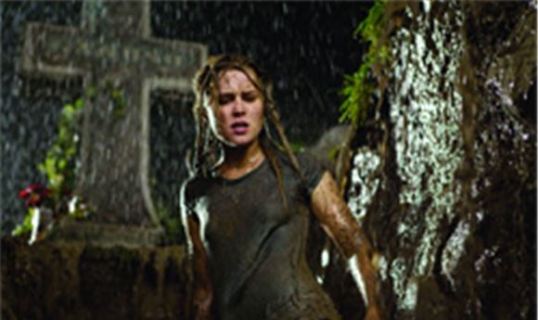
Drag Me To Hell (2009, dir by Sam Raimi, DP: Peter Deming)
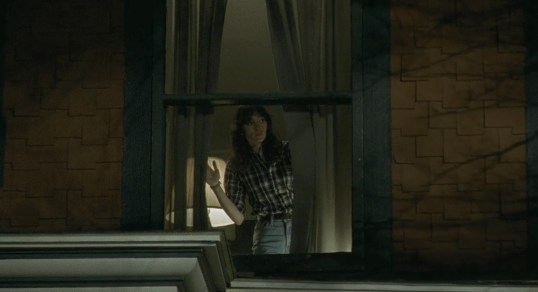
The House of the Devil (2009, dir by Ti West, DP: Eliot Rockett)
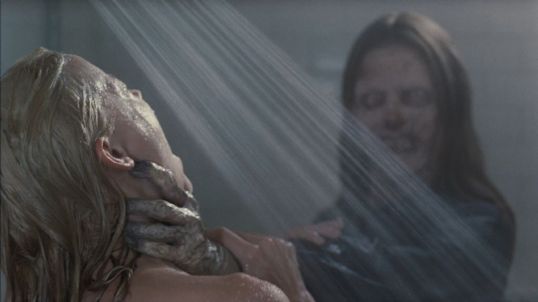
The Ward (2010, dir by John Carpenter, DP: Yaron Orbach)
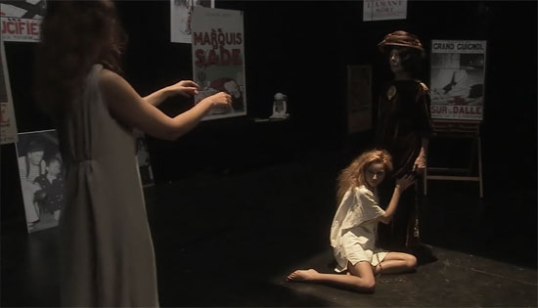
The Mask of Medusa (2010, dir by Jean Rollin)
Black Swan (2010, dir by Darren Aronosfky, DP: Matthew Libatique)



 Through the Shattered Lens