Horror On The Lens: Haunted House of Horror (dir by Michael Armstrong)


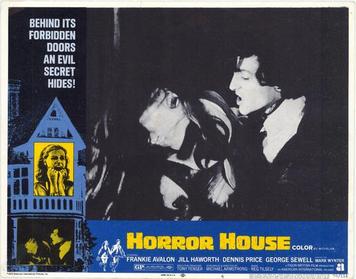
First released in 1969, The Haunted House of Horror features a group of 20-somethings who, bored with the usual parties, decide to that it might be a kick to hang out in a supposedly haunted mansion.  Once they’re in the mansion, they decide that it might be even more fun to hold a seance!

(Seriously, what is the deal with people holding séances in haunted mansions?  That really seems like the last place where you would want to mess with potentially malevolent spirits!)

The party becomes much less fun once someone starts killing off the group, one-by-one.

This film is notable for two reasons.  First off, it features Frankie Avalon in one of his attempts to break free of his Beach Party typecasting.  Secondly, the role of Richard, who is played by Julian Barnes, was originally offered to a young singer named David Bowie.  Reportedly, Bowie was quite excited about doing the film but, in the end, the producers worries that he and Frankie Avalon would not get along.  I’m not sure why.  David Bowie had a sense of humor and, judging from his Casino cameo, so does Frankie.

Music Video of the Day: Voyeur by Kim Carnes (1982, directed by Russell Mulcahy)


The music video for Kim Carnes’s Voyeur is another music video that was initially banned from MTV and other music shows because it was considered to be too suggestive.  The video features Kim Carnes watching and being watched in a red light district.

This was another video directed by Highlander’s Russell Mulcahy, who perhaps did more than anyone to perfect the early music video aesthetic.

Enjoy!

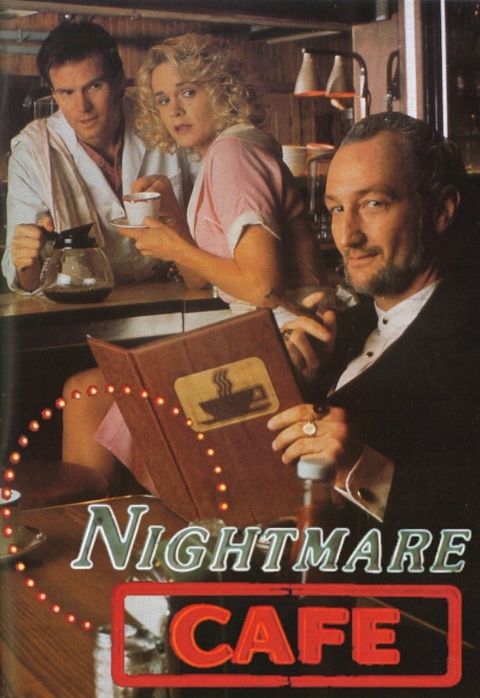
Late Night Retro Television Reviews: Nightmare Café 1.4 “The Heart of Mystery”


Welcome to Late Night Retro Television Reviews, a feature where we review some of our favorite and least favorite shows of the past!  On Mondays, I will be reviewing Nightmare Café, which ran on NBC from January to April of 1992.  The entire show is currently streaming on YouTube!

This week, a dying detective is allowed a chance to solve one last case.

Episode 1.4 “The Heart of Mystery”

(Dir by John Harrison, originally aired on March 20th, 1992)

This week’s episode of Nightmare Café is the first to largely focus on a guest star.  While Jack Coleman and Lindsay Frost do play roles in this week’s episode and Robert Englund’s Blackie actually gets to do more than usual, the majority of the episode is still dominated by Timothy Carhart as Detective Stan Gates.

One dark night, Stan chases a young thief (played by Alfonso Quijada) into a dark alley.  When the thief pulls a gun on him, Stan explains that he’s a police officer and he’s not trying to take the thief to jail.  He explains that he knows the young man is on drugs and is not in full control of his actions.  He asks the young man to give him the gun.

Meanwhile, in the nearby Nightmare Café, a bored Frank and Fay are playing a game of Clue.  (Colonel Mustard did it.)  Stan walks into the café and asks for a cup of coffee.  Robert Englund’s Blackie suddenly appears sitting in a booth and eating from a bag of popcorn.  He introduce himself to Stan and then leads Stan over to a window.  Looking through the window, Stan can see himself and the thief in the alley.  The thief has fired the gun and the bullet appears to be suspended in the air.  Blackie explains that the café has slowed down time to give Stan the chance to solve one last case before the bullet hits and kills him.

The case involves the death of Charlotte Bening (Laura Mae Tate), a wealthy woman with whom Stan was in love.  One night, when Stan was investigating a break-in at her mansion, Stan fired his weapon at what he believed to be the burglar.  Someone hit him from behind, knocking him out.  When Stan woke up, he discovered that the person who was actually shot was Charlotte!  While the police ruled it an accidental shooting, Stan was convinced that someone specifically set him up.  Could it have been Charlotte’s brother, a frustrated artist named Philip (Denis Forest, who also appeared in last week’s episode of Friday the 13th)?  Or could it have been …. well, there is no one else, actually.  The great Lochlyn Munro does make a brief appearance as one of Charlotte’s more aggressive suitors but he’s only onscreen for a few minutes.  There’s not much suspense to this mystery.

That said, I did enjoy this episode of Nightmare Café, which not only pays homage to film noir but which also features Robert Englund at his quippy best as he passive-aggressively pushes Stan into solving the case.  Fay does briefly leave the café so that she can pretend to be the producer of a true crime series and interview some of the people who knew Charlotte and Stan but, for the most part, this episode is centered around Timothy Carhart and Robert Englund and both of them carry things nicely.  Though the episode’s format probably confused those who, on the basis of the previous three episode, didn’t realize that Nightmare Café was originally envisioned as being an anthology series, The Heart of Mystery holds up very well.

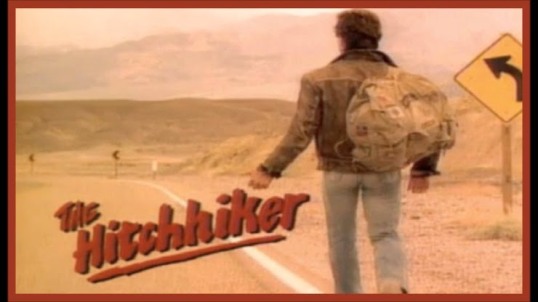
Horror on TV: The Hitchhiker 6.1 “Fading Away” (dir by Jerry Ciccoritti)


On tonight episode of The Hitchhiker, Nick Mancusco gives a strong performance as an ex-Marine who struggles to distinguish reality from his paranoid fantasy.  The Hitchhiker himself has a little bit more sympathy for the main character in this episode than he’s had for characters in previous episodes.

This episode originally aired on September 21st, 1990 and was the first episode of the show’s sixth season.


October Hacks: Sweet Sixteen (dir by Jim Sotos)


1983’s Sweet Sixteen takes place in a small town in Texas.

Sherriff Dan Burke (Bo Hopkins) does his best to try to maintain the peace but it’s not always easy.  Not when a good majority of the town is prejudiced against the Native Americans living on a nearby reservation.  There’s a major archeological dig happening on the reservation, headed up by Dr. John Morgan (Patrick Macnee), but the town doesn’t care about any of the artifacts that Dr. Morgan and his team might discover.  They’re too busy harassing local activist Jason Longshadow (Don Shanks) for stepping into the wrong bar.

However, a distraction from all of the casual racism has arrived in the form of Dr. Morgan’s daughter, Melissa (Aleisa Shirley).  Soon, it seems like every teenage boy and young man in town is lusting after Melissa.  Melissa, for her part, is only fifteen years old and is struggling to deal with all of the attention.  Sometimes, she enjoys the attention.  Sometimes, she just wants to be left alone.  (Believe me, as someone who had adults hitting on her when she was 13, I could relate.)  Melissa’s birthday is coming up and her mother (Susan Strasberg) is planning on throwing a big party and inviting the whole town to come over and celebrate.  Sheriff Burke thinks it’s a great idea.  “This town could use something to celebrate.”

The only problem is that any boy who so much as looks at Melissa ends up getting brutally murdered.  When an old Native American man named Greyfeather (Henry Wilcoxin) is spotted near the scene of one of the crimes, the local redneck blame him for the murders and tragedy ensues.  Sheriff Burke has to find the real murderer and, whether he likes it or not, he’s going to get some help from his kids, Hank (Steve Antin) and Marci (Dana Kimmel).

Hank and Marci really are this film’s secret weapons.  In the past, I’ve been pretty critical of Dana Kimmel’s performance in Friday the 13th Part 3 and her insistence that her character be re-written to reflect her own religious beliefs and desire to be a good role model.  However, Kimmel is really likable (and perhaps more appropriately cast) as the fiercely intelligent but still relatively innocent Marci, who reads murder mysteries and is totally excited about the prospect of getting to solve a real murder.  Hank is perhaps a bit less enthusiastic about about crime-solving than Marci but he still helps out his sister because she’s his sister.  Awwwwww!

Sweet Sixteen is a bit of an untraditional slasher film, one that is as concerned with social issues as is it was stalking and slashing teenagers.  Perhaps that explains why it has a slightly better cast than the typical 80s slasher, with veteran actors like Patrick McNee, Susan Stasberg, and Bo Hopkins acting opposite equally capable but younger actors like Kimmel, Antin, and Aleisa Shirley.  It’s also a surprisingly likable slasher film, due to the Dana Kimmel and Steve Antin’s engaging lead performances.  Honestly, I think it’s kind of a shame that there weren’t a series of films featuring Marci and Hank solving crimes.  Dana Kimmel and Steve Antin make quite a team in this above average slasher.

The TSL Horror Grindhouse: Blood Thirst (dir by Newt Arnold)


Filmed in 1965 but not released until 1971, Blood Thirst takes place in Manila.  Young women, many of whom work at or near the Bario Club, are turning up dead with all of their blood drained from their body.  Inspector Miguel Ramos (Vic Diaz) thinks that the crimes are the work of one homicidal maniac but there are whispers that the women are falling victim to a cult of devil worshippers.  Hoping to solve the case before a full-fledged panic breaks out, Ramos summons a friend of his from New York, Detective Adam Rourke (Robert Winston).

Detective Rourke, who is perhaps a bit too quick to smirk, thinks that it’s going to be easy to solve this case but it turns out the opposite is true.  He goes undercover as a visiting writer and starts to hang out at the Bario Club.  He gets to know the people who work there and he introduces himself to the club’s owner, Calderone (Vic Silayan).  Calderone is immediately suspicious of Rourke, something that he ascribes to his natural concern for his employees.  However, the club’s most popular dancer — the beautiful blonde Serena (Yvonne Nielsen) — informs Rourke that Calderone murdered his previous wife.

Both Detective Rourke and Miguel’s sister, Sylvia (Katherine Henryk), suspect that the killer is Calderone.  However, the viewers have a bit more information than Rourke and Sylvia.  We know that the killer is a horrifyingly disfigured monster who always seem to emerge from the shadows.  What is the monster and why is it obsessed with draining the blood of young, beautiful women?  That’s the mystery that Rourke will eventually have to solve.

Just from the plot description, Blood Thirst might not sound that impressive and I have to admit that I went into the film with low expectations.  But I was actually surprised to discover that the film was far more effective than I was expecting.  Visually, the stark black-and-white cinematography creates an appropriately ominous atmosphere and the scenes in the club feel like they could have been lifted from the best examples of film noir.  Characters literally emerge and occasionally disappear into the darkness, with shadows often obscuring half an actor’s face as if to remind us that any one of the characters could be the murderer (and, by that same token, any of them could actually be innocent).  When Serena performs in the club, her blonde hair and pale skin almost seem to glow in the darkness.  The monster itself is effectively frightening as it makes it way through the film, moving like a crazed animal that has found itself outside of its natural habitat.

Of course, it’s hardly a flawless film.  Rourke is a remarkably unlikable character, one who smirks his way through the entire film.  The scenes where he flirts with Sylvia are cringeworthy and redeemed only by Sylvia’s habit of both slapping him and kicking him out of her car.  There are a few moments of humor that don’t quite work.  The film is at its best when it focuses on atmosphere and shadows as opposed to the characters.  Blood Thirst works as a filmed dream, a vision of dark and disturbing things.

The Demolitionist (1995, directed by Robert Kurtzman)


In the future, America is overrun by crime.  Mad Dog Burne (Richard Grieco) and his brother, Little Henry (Randy Vasquez) escape from California death row.  Mayor Eleanor Grimbaum (Susan Tyrell) wants the Burne brothers captured and she wants to be able to show the voters that she’s tough on crime.  When brave police officer Alyssa Lloyd (Nicole Eggert) is killed by Mad Dog Burne’s gang, she is brought back to life in cyborg form by Prof. Crowley (Bruce Abbott) and, after a training montage, she is let loose on the streets as a police-backed vigiliante.

The Demolitionist owes an obvious debt to Robocop, with Nicole Eggert miscast as an expressionless cyborg who launches a one-woman/one-machine war on crime.  The main problem is that The Demolitionist has none of Robocop‘s wit or its subversive subtext.  Nicole Eggert is no substitute for Peter Weller and Richard Grieco is no Kurtwood Smith.  “Booker’s a good cop!” I said whenever Grieco showed up.

The only interesting this is about the cast, which is full of horror veterans.  Jack Nance plays the prison priest who counsels the Burne brothers before they escape their scheduled executions.  Reggie Bannister plays the warden.  Sarah Douglas plays  a surgeon.  Joseph Pilato is one of Mad Dog’s followers.  And playing Mad Dog’s second-in-command is none other than Tom Savini.  Finally, the city’s most popular journalist is played by Heather Langenkamp!

The Demolitionist demolishes almost the entire town but she still can’t come up with any way to make this stale Robocop rip-off feel fresh.


Horror Scenes That I Love: Daria Nicolodi in Deep Red


Born in Florence, the outspoken Daria Nicolodi had already appeared in a quite a few films before Dario Argento cast her as the female lead in 1975’s Deep Red.  Nicolodi would spend the rest of her career being closely associated with Argento, both as Dario’s partner and as the mother of Asia Argento.  Dario and Daria had a notoriously volatile relationship.  While one can sense Argento falling in love with Nicolodi while watching the way he films her in Deep Red, she is noticeable in her absence from Suspiria despite the fact that she is generally acknowledged as being the one who came up with the idea of the film.  (Angered that, despite the collaborative nature of their partnership, Argento did not offer her the lead role in Suspiria and instead offered a supporting role that Nicolodi felt was not particularly interesting, she instead accepted an offer from Mario Bava and gave what is generally considered to be her best performance in Shock.)  She appeared in Dario’s subsequent films, through Opera.  She eventually split with Argento and continued her film career, playing Asia’s mother in Scarlet Diva.  Daria Nicolodi also became a popular and witty interview subject, one who was always good for a few shocking quips.  While Daria could be very critical of Dario in those interviews, she was also often the quickest to defend his talent as a director.

Daria Nicolodi appeared in a lot of horrifying scene but today, I want share this rathe gentle scene from Deep Red, in which Daria’s journalist playfully challenges David Hemmings to a little arm-wrestling.  It is scenes like this that make Deep Red one of the greatest examples of the giallo genre.

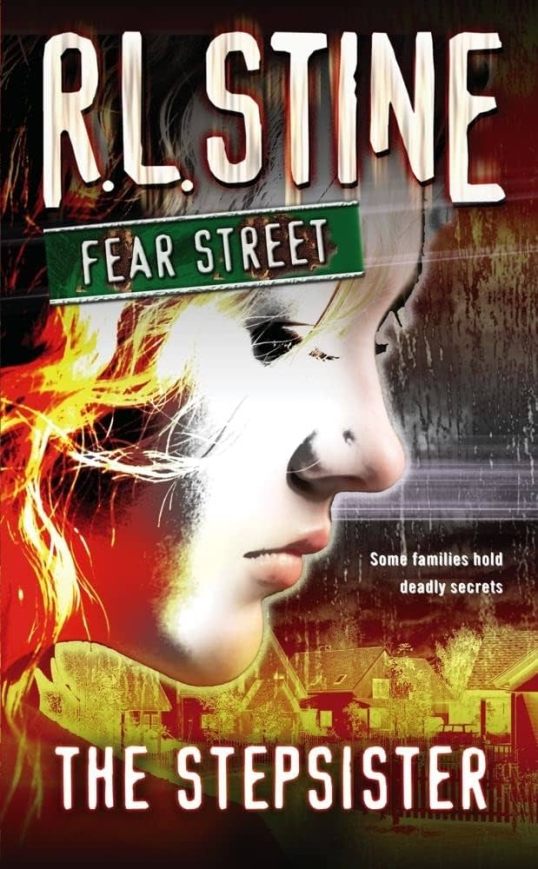
Horror Book Review: The Stepsister by R.L. Stine


Poor Emily!

The star of the 1990 novel, The Stepsister, Emily may live in a nice house on Fear Street and she may have a cool sister and a boyfriend who specifically dumped he sister so that he could date Emily (yikes!) but Emily has still had a lot of tragedy in her life.  When she was a little girl, she could only watch helplessly as her father drowned in Fear Lake.

Now, Emily is a teenager and her mother has married a guy named Hugh Wallen and everything sucks!  Hugh is a bit of a jerk, the type who brags about how happy he is to have two new stepdaughters who can help to clean the house and who refers to his family as being a harem because there’s so many women in it.  (DOUBLE YIKES!)  Hugh also gives his son, Rich, a hard time because Rich likes to read books.  In fact, Rich is a huge Stephen King fan.

Perhaps the most awkward thing about Emily’s mom marrying Hugh is that Emily now has a stepsister named Jessie.  Jessie is the type who complains about the house, complains about Emily’s dog, complains about how Emily’s biological sister has red hair (and trust me, that totally turned me against Jessie), and who will probably steal everyone’s boyfriend as soon as she gets a chance.

But is Jessie capable of murder?

That’s the question that Emily has to solve because there are strange things happening around the house, from fires getting set to innocent animals getting killed to peroxide being put in shampoo bottles.  Emily overhears Jessie on the phone, saying that “I really could kill her!’  Is Jessie being literal or is she just venting her frustrations?  When Emily reads in Jessie’s diary that she was once accused of being involved with a murder, does that….

Wait, wait, wait, WAIT!  Emily is reading Jessie’s diary?  Not cool, Emily!

Seriously, Jessie has her issues but it’s not as if Emily is the most accepting of stepsiblings.  I mean, it’s one thing to get upset because Jessie doesn’t like her dog or because Jessie makes fun of her room and her clothes.  That’s totally understandable.  Jessie seems to have issues with people with red hair so, as far as I’m concerned, Emily shouldn’t even say hello to her when they pass on the street.  But to then accuse someone of being a murderer just because you resent the fact that your mom was dumb enough enough to marry their father …. that’s going a bit too far!

Well, no worries.  Things do work out in the end.  The wannabe murderer is discovered and all of the siblings work through their issues and try to be nicer to each other.  Yay!

This book was interesting for me to read, just because after my mom and dad got divorced, I was always worried about what would happen if my mom remarried and I ended up with some stepsibling moving in with us and basically getting in the way.  I would be nice to them now but seriously, I was a brat when I was 13.

Anyway, this book was okay but it was also one of those Stine books where you could easily guess who the murderer was, just be eliminating all of the obvious red herrings.  There wasn’t really a lot of suspense to the book but I appreciated the somewhat realistic portrayal of a family trying to figure out how to adjust to their new situation.