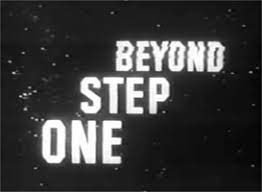
In this episode of One Step Beyond, which takes place over the course of several years, Lisa Garrick lives in fear of a chandelier in her family’s home. For her entire life, she has had a premonition that she is going to die when the chandelier comes crashing down. She refuses to stop into the room but eventually, both her father and her fiancé, insist that she conquer her fear and enter the room.
Seriously, if she doesn’t want to enter the room …. don’t make her enter the room! I love chandeliers but they do make me nervous. They always look like there about to come crashing down to me.
I like this episode because the main character is named Lisa.
This episode originally aired on March 10th, 1959.
Simon (Andrew Prine) is a bearded man who lives in a storm drain and who says that he is on a quest to become a god. He also says that he’s a warlock and he wants to make sure that everyone understands that there’s a huge difference between being a wizard and being a warlock. Don’t call Simon a wizard!
Simon’s quest for godhood hasn’t led to much success so he makes his living selling trinkets and charms to gullible people. One night, the police arrest him for vagrancy. While sitting in jail, Simon meets Turk (George Paulsin), a gay male prostitute who quickly becomes Simon’s first disciple. With the help of Turk, Simon is introduced to upper class society. It turns out that Turk’s clients include several very wealthy people. Simon is a hit on the party circuit. Slumming hippies view him as a potential guru. Wealthy people view him as a humorous oddity. Simon meets other occultists and starts to engage in bizarre rituals. He finds time to date Linda (Brenda Scott), the daughter of the totally square district attorney. Some people insist that Simon is a fake and some people say he is the real thing. For his part, Simon is soon getting revenge on all of his enemies and taking part in all sorts of freaky ceremonies as he continues his quest for supreme power.
Don’t let the supergroovy name fool you. Like a lot of films about the 60s and 70s counterculture, Simon, King of the Witches is remarkably dull. The action moves slowly. The plot never really makes that much sense. Andrew Prine gives a wonderfully over-the-top performance as Simon but the rest of the cast never really seems to wake up. The film’s most interesting moments are the ones where Simon effortlessly switches from upper class society to “street” society. Undoubtedly, this film’s portrait of jaded people looking for the new thing and getting taken advantage of by a sociopathic grifter felt very familiar in the 70s. And, actually, I guess it still does. There’s still a lot of wannabe gurus out there and a lot of people who have neither the willpower nor the intelligence to see through them. But the film itself just too boring to really be effective. Probably the most interesting thing about the film is that Simon seems to be a mix of Charles Manson and Rasputin. Like Manson, Simon knows how to take advantage of those who are lost and seeking a place where they can belong. And, like Rasputin, Simon turns his sordid lifestyle into an asset when he’s trying to thrill the stuffy old folks.
As I mentioned earlier, the film’s saving grace is Andrew Prine’s intense performance as Simon. Prine himself was an up-and-coming actor with a bright future ahead of him until his girlfriend, Kathryn Kupcinet, was murdered in 1963. As the boyfriend, Prine was immediately a suspect. Though the police quickly cleared him, the scandal still derailed his career and he ended up spending the rest of his career in films like The Town That Dreaded Sundown, Amityville II, and Simon, King of the Witches.
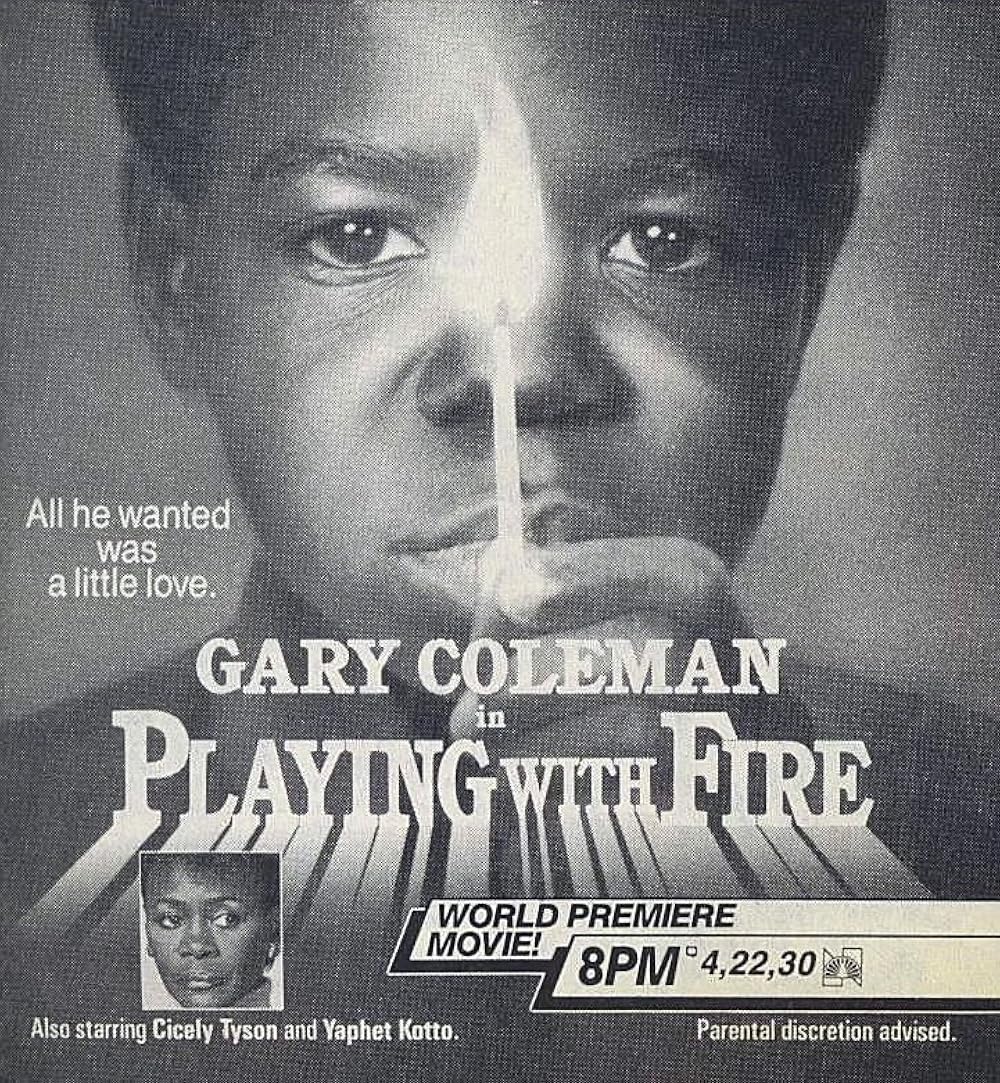
David Phillips (Gary Coleman) is a teenager who sets fires when he gets upset. He has many reasons to be upset. His parents (Ron O’Neal and Cicely Tyson) are getting divorced and are constantly fighting. His teachers at school are always getting on his back. He has to take care of his younger siblings and his dog. He can’t even get the bigger kids in school to let him play basketball with them. At first, David just plays with his lighter but, after he accidentally sets his mother’s coat on fire, David discovers that he likes to watch things burn. David and his mother both claim it’s just coincidence that David is always nearby whenever a fire breaks out but Fire Chief Walker (Yaphet Kotto) knows what’s really going on. After David nearly burns down his house, Walker tries to reach him before it’s too late.
This isn’t really meant to be a horror film but it’s shot like one, with plenty of scenes of Gary Coleman staring at a burning fire with a possessed-look in his eyes. The movie tries to make David sympathetic but the scene where he threatens his own dog with a lighter suggests that David has more problems than just his parents splitting up. This was Gary Coleman’s first dramatic role. I think it may have also been his only dramatic role. It’s not that he’s not convincing as a really angry kid. It’s just that he’s Gary Coleman so, no matter how much the movie tries, it still comes across as being a special episode of Diff’rent Strokes where Arnold becomes a pyromaniac. Coleman tries to play up the drama of the situation but it’s hard not to laugh whenever he looks shocked at one of the fires that he has just started. Every scene seems like it should end with Conrad Bain showing up with the cops.
For years, this movie was next to impossible to find but finally, someone found an old VHS tape in their garage and uploaded the movie to both YouTube and the Internet Archive, ensuring the world will never forget the time that Gary Coleman played with fire.
One final note: the director is better known for eventually becoming business partners with notorious Hollywood madam, Heidi Fleiss.
Yesterday was the 105th anniversary of the birth of the great actor Donald Pleasence.
(I know that may sound like a wordy way to say “birthday” but I always find it awkward to refer to those who are no longer with us as having a birthday.)
We can’t let October pass without paying tribute to Pleasence. Here is in 1978’s Halloween, playing the role for which he was best-known amongst horror fans.
Hi Horror and Case Lovers! So, I could not find a title card image for this short, but clowns scare the $#!% out of me so here we are. Just remember, that’s their real skin, not makeup. The oversized shoes and red nose are just to get you to let your guard down before they kill you! Now, you are able to face the world once again!
The short begins with a college student doing some cleaning at home. He checks the hallways and he sees…. yes a clown! Damn it! WHY?! WHY?!
Clowns, between you and me – why are you even a thing? I know what motivates you to make people mess their pants regardless of the season- you must feed, but why?! Can’t you just be anything else and still feast upon the living?
The Clown confronts the young man and…. he tries to kill him with a crowbar, but the would-be victim fights back with GUNS!!! Yes, GUNS ARE THE ANSWER! GUNS! They are Clown Repellent! They are Clown-Be-Gone! The Crowbar vs Clown is pretty effective too.
Now, is this short the result of two bored frat guys? Probably, but I’m ok because clowns are a menace! Yes, it ends with a gun solving the Clown Menace! This short worked for me!
4 Shots From 4 Films is just what it says it is, 4 shots from 4 of our favorite films. As opposed to the reviews and recaps that we usually post, 4 Shots From 4 Films is all about letting the visuals do the talking.
Today’s director: James Whale!
4 Shots From 4 James Whale Films
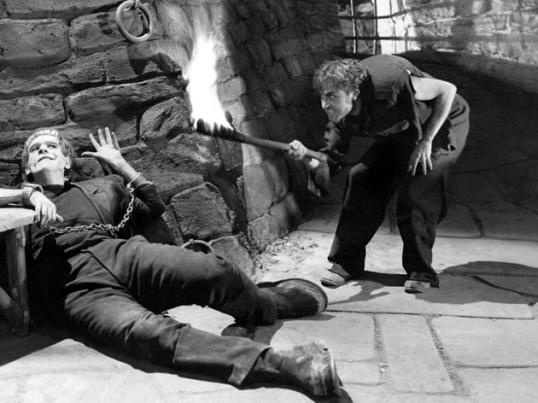
Frankenstein (1931, dir by James Whale, DP: Arthur Edeson)
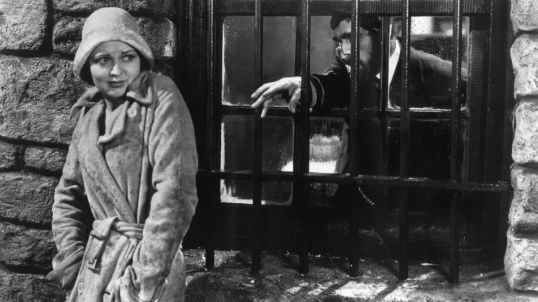
The Old Dark House (1932, dir by James Whale, DP: Arthur Edeson)
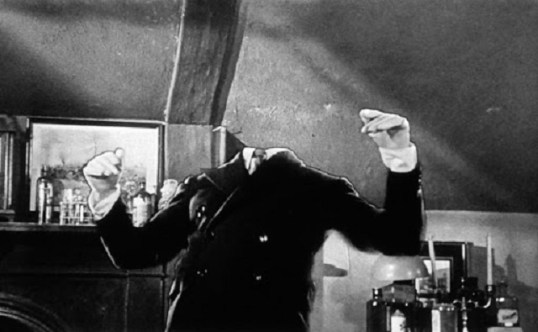
The Invisible Man (1933, dir by James Whale, DP: Arthur Edeson)
Bride of Frankenstein (1935, dir James Whale, DP: John J. Mescall)
The character at the center of the 1962 Edgar Allan Poe adaptation, The Premature Burial, Guy spends his days terrified of being buried alive. Like his father before him, Guy suffers from a disease that can make him appear to be dead despite actually being alive. Guy is convinced that his father was buried alive and swears that he could even hear his father crying for help inside of his tomb. Though his fiancée, Emily (Hazel Court), insists that Guy is driving himself mad with his fears, Guy continue to spend his time trying to invent a coffin from which one can easily escape. Even after Emily and Guy are married, Guy continues to obsess.
Finally, faced with the prospect of opening his father’s tomb to discover whether or not his father truly was buried alive, Guy appears to drop dead of a heart attack. But is he really dead or is he about to be buried alive!? And who is responsible for the series of mysterious events that apparently drove Guy to collapse of fright? Watch the film to find out! Or read the Edgar Allan Poe short story.
This was the third of Roger Corman’s Edgar Allan Poe adaptations and it’s the first one to not feature Vincent Price as the lead character. For the most part, the members of the small cast all do a good job with their roles. Ray Milland is both sympathetic and a little frightening as the obsessed Guy. Heather Angel is properly enigmatic as Guy’s overprotective sister and Hazel Court will keep you guessing as far as her character’s motivations are concerned. Dick Miller has a small but key role as a grave digger who seems to take just a little bit too much enjoyment from his work. The film’s atmosphere is properly gothic and, if the film isn’t as visually audacious as the first two Poe films, Corman still finds time to include a creepy and psychedelic dream sequence.
That said, Vincent Price is still very much missed. Corman reportedly wanted to use Price but, because Corman produced and financed the film himself, Corman’s former business partners at American International Pictures would not allow Price to appear in the film. (Price was under exclusive contract to AIP.) By the time Corman and AIP worked out their disagreements and again joined forces, Ray Milland had already been cast in the lead role.
While the actors all do a good job, it’s hard to deny that Guy Correll would have been an ideal role for Vincent Price, even if it would have meant essentially re-doing his performance from The Pit and the Pendulum. It’s not just that the film misses Price’s theatrical acting style. The film also misses the energy that Price brought to the previous two Poe films. ThePremature Burial moves at a stately pace and, in the end, it’s a bit too slow and respectable for its own good. Price would have jazzed things up and made a decent film into a truly memorable one. Fortunately, Price would return for the later Poe adaptations.
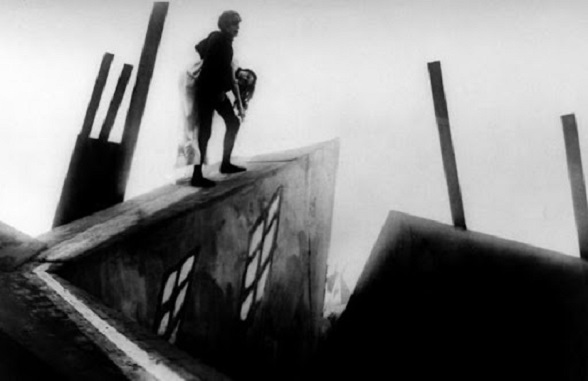
The Cabinet of Dr. Caligari (1920, dir by Robert Wiene, DP: Willy Hameister)
The Cabinet of Dr. Caligari is a film that I’ve shared many times previously on the Shattered Lens. The first time was in 2011 and then I shared it again in 2014, 2015, 2016, 2017, 2018, 2019, 2020, 2021, and 2022! Well, you know what? I’m sharing it again because it’s a classic, it’s Halloween, and everyone should see it! (And let’s face it — it’s entirely possible that some of the people reading this post right now didn’t even know this site existed in any of those previous years. Why should they be deprived of Caligari just because they only now arrived?)
Released in 1920, the German film The Cabinet of Dr. Caligari is one of those films that we’ve all heard about but far too few of us have actually seen. Like most silent films, it requires some patience and a willingess to adapt to the narrative convictions of an earlier time. However, for those of us who love horror cinema, The Cabinet of Dr. Caligari remains required viewing. Not only did it introduce the concept of the twist ending (M. Night Shyamalan owes his career to this film) but it also helped to introduce German expressionism to the cinematic world.
My initial reaction to The Cabinet of Dr. Caligari was that it simply wasn’t that scary. It was certainly interesting to watch and I was happy that I was finally experiencing this film that I had previously only read about. However, the film itself was obviously primitive and it was difficult for my mind (which takes CGI for granted) to adjust to watching a silent film. I didn’t regret watching the film but I’d be lying (much like a first-year film student) if I said that I truly appreciated it after my first viewing.
But you know what? Despite my dismissive initial reaction, the film stayed with me. Whereas most modern films fade from the memory about 30 minutes after the end credits,The Cabinet of Dr. Caligari has stuck with me and the night after I watched it, I even had a nightmare in which Dr. Caligari was trying to break into my apartment. Yes, Dr. Caligari looked a little bit silly staring through my bedroom window but it still caused me to wake up with my heart about to explode out of my chest.
In short, The Cabinet of Dr. Caligari passes the most important test that a horror film can pass. It sticks with you even after it’s over.
For the curious with an open mind to watch with, here is Robert Wiene’s The Cabinet of Dr. Caligari!
Carl Archer (Charles Aidman) is a recovering alcoholic who returns home after an extended stay in a rehab. His wife (Julie Adams, of Creature of the Black Lagoon and The Last Movie fame) is skeptical about whether or not Carl has really sobered up and is prepared to be a responsible father to their son, Steve (Charles Herbert). When Steve gets trapped in a cave, will Carl be able to use their psychic connection to find and rescue him?
Can you prove this didn’t happen!?
This episode originally aired on February 24th, 1959.


 Through the Shattered Lens