October True Crime: Killer’s Delight (dir by Jeremy Hoenack)


The 1978 film, Killer’s Delight, opens with the usual beautiful shots of San Francisco in the 70s.  It’s a lovely city, full of attractive people with their entire lives ahead of them.  The camera lingers on the Golden Gate Bridge.  If your movie doesn’t feature the Golden Gate Bridge, is it really set in San Francisco?

A van drives through the city and into the countryside.  My first instinct was to think, “Oh, that’s definitely a rape van,” and yes, it is.  (Seriously, don’t ever accept a ride from someone with a van.  Actually, you shouldn’t be hitchhiking to begin with!  Shame on you!)  The owner of the van, Danny (John Karlen), pulls over to the side of the road and tosses a naked woman’s body over the side of a cliff.

AGCK!

Now, I have to admit that Killer’s Delight (which is known by about a dozen other titles, including The Dark Ride) is a film that I’ve tried to watch several times but I’ve always struggled to make it all the way through.  That’s not because of the subject matter, though as a woman who once thought of herself as being invincible, I could certainly relate to many of the women who appeared in this film and made the fatal mistake of getting in that van.  No, the reason why I’ve always struggled with Killer’s Delight is because it’s a slow movie.  It’s not necessarily a bad film but it’s not one to watch if your eyelids are already starting to feel heavy.

This is an early serial killer film, made before it was decided that every killer should be portrayed as being an erudite and witty anti-hero.  Instead, the film’s killer is a loser named Danny (John Karlen) who has never gotten over his childhood and who, when he’s not killing, is busy sobbing.  It’s certainly a more realistic portrayal of a serial killer than anything that one might find in any of the films or books about Hannibal Lecter.  Danny has two skills.  He’s good at disguising himself and he’s fairly good at getting rid of bodies whenever there’s no one else around to see him.  Otherwise, he’s a total loser.  This realistic portrayal actually makes Danny into a very scary character.  You’re never going to meet Hannibal Lecter in real life.  That’s one reason why it’s so easy for some people to accept his crimes.  However, there are hundreds of people just like Danny out there.  There’s probably at least a few in your city right now.

The majority of the film is taken up with Sgt. Vince De Carlo (James Luisi) and his attempts to prove that Danny is the killer.  Vince is married and very protective of his daughters.  He’s also having an affair with a psychiatrist (Susan Sullivan) who runs the potential of becoming one of Danny’s victims.  Vince becomes obsessed with Danny but, much like Charles Bronson in Ten To Midnight, he knows that the justice system does not know what to do with a monster like Danny.

As I said, it’s a slow film but it is well-acted and, if you stick with it, it does cast an ever-growing atmosphere of doom.  It’s the type of film that will make you double-check the locks before you go to bed.

As for why this is a true crime film, it’s loosely based on the crimes of Edmund Kemper and Ted Bundy.  At the time the film was made, Bundy was still at large.  Killer’s Delight was the first film to be based on Bundy’s crimes, though Danny ultimately has more in common with Kemper than with Bundy.
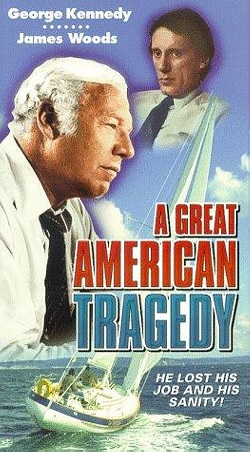
Retro Television Reviews: A Great American Tragedy (dir by J. Lee Thompson)


Welcome to Retro Television Reviews, a feature where we review some of our favorite and least favorite shows of the past!  On Sundays, I will be reviewing the made-for-television movies that used to be a primetime mainstay.  Today’s film is 1972’s A Great American Tragedy!  It  can be viewed on YouTube!

Brad Wilkes (George Kennedy) had a good career, working as an aerospace engineer.  He was able to buy a nice house.  With his wife, Gloria (Vera Miles), he was able to raise a good family.  He was even able to buy a sailboat, one that is the pride of the entire marina.  But then, one day, he’s told that the company is letting him go.

Returning to his home, Brad tells Gloria that he’s lost his job but that everything’s going to be okay because not only does he have a $10,000 pension but he’s sure he can find a new job.  “Of course, I might not be making $35,000 a year….” he says.

(Watching at home, I said, “Pfffft!  I make more than that!”  But, of course, Brad is talking about $35,000 in 1972 money, which would be the equivalent of a quarter of a million today.)

However, Brad soon discovers that getting a new job will not be as easy as he assumed.  It turns out that there are a lot of people out there looking for work and most of them are younger, cheaper, and better educated than Brad.  The bills start to pile up.  His former boss (Robert Mandan) informs Brad that his pension is going to be $7,000 less than he thought.  Brad forces himself to go down to the unemployment office so that he can collect $25 a week and then suffers the humiliation of being offered a loan by his well-meaning son-in-law (played by a youngish James Woods).  Gloria gets a job at the same clothing store where she used to shop and her lecherous boss (Kevin McCarthy) starts to hit on her.

For Brad, the final humiliation comes when he has to sell the boat.  A younger boat owner (Tony Dow, with a huge mustache) puts Brad in contact with a woman named Paula (Natalie Trundy).  Paula wants to buy the boat and, after they take it out on the water, Brad finds himself tempted to cheat on his wife.  It all gets to be too much for Brad and soon, he’s on a plane to Nevada where hopefully one good night at the craps table will be enough to pay his bills….

Watching this film, I found myself feeling very sorry for Brad while, at the same time, becoming very frustrated with him.  On the one hand, his company tossed him out after years of loyal service and then tried to screw him out of his pension.  On the other hand, Brad spent almost the entire movie in denial about how bad things actually were.  It’s one thing to be proud and it’s another to just be stubborn.  Knowing that he has next to no money, Brad still insists on throwing his annual 4th of July party and he even invites his former boss to come over and celebrate.  Brad simply cannot bring himself to admit that his old life is over but really, who can blame him?  He’s not the one who chose to be fired.

A Great American Tragedy was directed by J. Lee Thompson, who also did Cape Fear, The Guns of Navarone, the Planet of the Apes sequels, and several Charles Bronson films.  There are no fight scenes to be found in A Great American Tragedy but Thompson does get good performances from his cast and the film makes great use of George Kennedy’s likability.  The viewer remains sympathetic to Brad, even when he makes mistake after mistake.  A film about a formerly secure family suddenly discovering just how much the economy sucks, A Great American Tragedy remains just as a relevant today as when it was first made.

Retro Television Reviews: Fantasy Island 1.11 “Reunion/Anniversary”


Welcome to Retro Television Reviews, a feature where we review some of our favorite and least favorite shows of the past!  On Tuesdays, I will be reviewing the original Fantasy Island, which ran on ABC from 1977 to 1986.  The entire show is currently streaming on Tubi!

This week, Fantasy Island is all about confronting the mistakes of the past.

Episode 1.11 “Reunion/Anniversary”

(Dir by Allen Baron and John Newland, originally aired on April 29th, 1978)

Before I talk about the two fantasies in this episode, here’s a bit of trivia.  This episode was originally intended to be the first episode of the series.  That perhaps explains why it has a tone that is more similar to the original TV movie than to the more light-hearted episodes that followed.  Just as in the made-for-TV movie, Mr. Roarke is a bit of an enigma in this episode, one who has little trouble manipulating his guests in order to get the results that he wants.  This episode even ends with Tattoo saying, “Thank God,” and Mr. Roarke replying with a mysterious half-smile.  Roarke isn’t quite as sinister as he was in the TV movie but he’s also not quite the cheery host that he would become in later episodes.  Roarke, at one point, also mentions that he has people who research everyone’s fantasy before choosing whether to grant it.  That’s certainly different from later episodes, in which the fantasies are apparently available to anyone who can pay or who has been lucky enough to win Roarke’s sympathy.

Of course, when it came time to air the first season of Fantasy Island, this episode got pushed back and it aired as the eleventh episode.  As a result, it presents a bit of a change-of-pace from the episodes that aired the weeks before.  One can only imagine how someone who decided to start watching the show because of the fantasy where Don Knotts played a private eye reacted to this episode, in which four guests were stalked by a murderer who wore giallo-style black gloves.

The guests being stalked by the murderer are Agnes (Pamela Franklin), Hannah (Hilarie Thompson), Carol (Michele Lee), and Jill (Sue Loyon).  They are all members of the Honeybees, a group of former high school cheerleaders who are having a ten-year reunion.  Their fantasy is to spend the weekend at a recreation of the Beehive, a cabin where they used to hang out while in high school.  Of course, every one of them has a dark secret and, after one of the Honeybees is apparently blown up in a nearby barn, the three remaining Honeybees have to solve the mystery.  It all gets fairly dark and sordid but, fear not!  Mr. Roarke shows up and even takes part in some hand-to-hand combat before revealing the truth about what is going on at the Beehive.

(Again, this is not something that we would normally expect from Mr. Roarke.)

Meanwhile, troubled couple Toni (Lucie Arnaz) and Tom Elgin (Ronny Cox, looking slightly embarrassed) come to the island for their anniversary!  Toni wants to relive the weekend that they got married, when they were still happy and before Tom became a drunk.  All of their old friends are invited to the island and soon, Tom is flirting with another woman while Toni is flirting with another man.  Mr. Roarke even invites Rev. Allen (Stuart Nisbet), the man who performed the original wedding ceremony.  The reverend explains that, due to a mix-up at the licensing office, he wasn’t actually legally allowed to perform marriages when Toni and Tom get married so it turns out that Tom and Toni have been living in sin all this time!  Now, Tom and Toni have to decide whether to get married for real or to go their separate ways.

I vote for separate ways, just because they really do seem to be miserable together.  However, it turns out that Mr. Roarke has a plan to keep this awful couple together.

The decision to move this episode from the start of the season to the latter half was definitely a good one.  It was probably a bit too dark and dramatic to really work as the premiere episode but, as the 11th episode, it provides a nice change-of-pace.  After several comedic and somewhat shallow episodes, this episode emphasizes the dramatic side of Fantasy Island.  In this episode, the ultimate lesson appears to be that fantasies are fun but that it’s far more important to deal with the real world.  In other words, Fantasy Island is a nice place to visit but only Mr. Roarke and Tattoo should live there.