Scenes That I Love: The Cemetery Scene From It’s A Wonderful Life


I love It’s A Wonderful Life and I’m looking forward to watching it many times over the upcoming week. To me, it’s the rare example of a perfect film.

Below is one of the more somber but important scenes from It’s A Wonderful Life. George (James Stewart) and Clarence (Henry Travers) go to what would have been Bailey Park if George had been born. Instead, it’s now a cemetery and buried there is George’s brother, who would have died if George hadn’t been born. And, as Clarence explains, every man that George’s brother saved would have died as well. “Each man’s life touches so many other lives,” as Clarence puts it.

Here is a scene from a wonderful movie called It’s A Wonderful Life.

The Girl From Jones Beach (1949, directed by Peter Godfrey)


Painter Bob Randolph is famous for painting a beautiful woman who is known as “the Randolph Girl.”  Everyone wants to meet the model but they can’t because there is no one model.  Instead, there are a dozen models, each with a perfect feature that Bob uses in his paintings.  In need of money, Bob and his business partner, Chuck Donavon (Eddie Bracken) search for a woman who can be the real-life Randolph Girl.  Chuck thinks that he’s found her when he spots school teacher Ruth Wilson (Virginia Mayo) but Ruth has no interest in being a model.  She wants to be known for how she thinks and not how she looks.  Hoping to change her mind, Randolph pretends to be Czech immigrant and enrolls in Ruth’s citizenship class.

When a photograph of Ruth in a swimsuit is published without her prior knowledge, the school board decides that Ruth is not a good role model and they fire her.  With the support of Bob and Chuck, Ruth sues for reinstatement.  Bob ends up posing in the courtroom in his own swimsuit, the better to prove that there’s nothing wrong with  appearing in public in a swimsuit.

The role of Ruth was originally offered to Lauren Bacall, who turned it down because she didn’t think she could play a pin-up.  Not to knock Bacall but Virginia Mayo does seem like a better choice for the role of Ruth and she does a good job of bringing the role to life.  She proves to be a good match for Ronald Reagan, whose amiable nature allows him to get away with taking her class under a false pretext and speaking in a mangled approximation of a foreign accent.  The comedy is light and it fits well with Reagan’s affable screen presence.  The film is pleasant but ultimately lightweight and forgettable.  I can understand why, by this point in his career, Reagan was getting frustrated with the quality of scripts he was being sent.  The Girl From Jones Beach would be forgotten today if it didn’t star the future president of the United States.

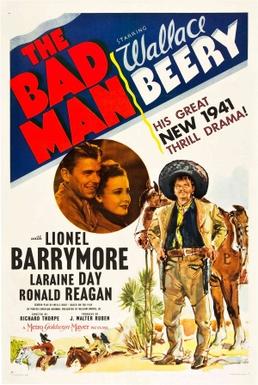
The Bad Man (1941, directed by Richard Thorpe)


Gil Jones (Ronald Reagan) lives on a ranch with his cantankerous uncle, Henry (Lionel Barrymore).  After their cattle are stolen by the notorious bandit Pancho Lopez (Wallace Beery), Gil and Henry are faced with the prospect of losing their ranch.  Banker Jasper Hardy (Henry Travers) wants to foreclose on Henry and take over the ranch but a businessman named Morgan Pell (Tom Conway) shows up and offers to pay the then-huge sum of $20,000 for the land.  Accompanying Morgan is his wife, Lucia (Laraine Day).  Lucia was Gil’s childhood love and Morgan fears that Lucia still loves Gil more than him.  Also in the mix is Gil’s comic relief best friend (Chill Wills), who has a crush on Hardy’s daughter (Nydia Westman).  Negotiations are interrupted when the flamboyant Lopez and his men return to the ranch and take everyone, but Gil, hostage.

This sepia-toned film is based on a stage play, one that had already been filmed twice.  It was Ronald Reagan’s first film for MGM and, when Reagan was running for President, he quipped that if he could survive acting opposite Wallace Beery and Lionel Barrymore than he could survive negotiating with Leonid Brezhnev.  The role of Gil is a typical Ronald Reagan role.  He’s good-natured and dependable and a little boring.  Because he once saved Lopez’s life, Lopez is willing to help him out with his problems.  Reagan is not bad in the role but he is overshadowed by Barrymore and Beery, two veteran actors who chew the scenery with gusto here.  Berry speaks in an exaggerated and not at all convincing Mexican accent while Barrymore bellows all of his lines.  Gil has so many different people yelling at him that it’s impossible not to feel sorry for him.  Morgan has ulterior motives for offering to buy the land and Tom Conway is a convincing villain.  Lopez helps out Gil and her uncle, saving not only their land but also plotting to bring Gil and Lucia back together.  It’s a stage bound mix of drama and comedy that doesn’t really work, though Beery and Barrymore are amusing and Ronald Reagan shows why he was cast in so many best friend roles.

Whether you’ll enjoy it will probably depend on how you feel about the cast because they’re really the only reason to watch.  If you’re a fan of Barrymore, Beery, or Reagan the film might work for you.  If you’re not, this stagey 70-minute western is probably not for you.

10 Oscar Snubs From the 1940s


Ah, the 40s! For most of the decade, the world was at war and the Academy’s nominations reflected that fact. The best picture lineups alternated between patriotic films that encouraged the battle against evil and darker films that contemplated both the mistakes of the past and what threats might be waiting in the future.  With the Academy being even more aware than usual that films and awards could be used to send a message, the snubs continued.

1940: John Carradine Is Not Nominated For The Grapes of Wrath

John Carradine’s first credited film appearance was in 1930 but Carradine himself claimed that he had appeared as an uncredited extra in over 70 films before getting that first credit.  Carradine would continue to work until his death 58 years later.  John Carradine did so many films that he was still appearing in new releases in the 90s, years after his death.  He appeared in over 234 films and in countless television shows.  He was a favorite of not only Fred Olen Ray’s but also John Ford’s.

Unfortunately, Carradine was never nominated for an Oscar, despite the fact that he did appear in some classic films.  (He also appeared in a lot of B-movies, which is perhaps one reason why the Academy was hesitant to honor him.)  Personally, I think Carradine most deserved a nomination for playing “Pastor” Jim Casy in John Ford’s The Grapes of Wrath.  Carradine is ideally cast as the former preacher turned labor activist.  When he’s alive, he gives the Joads hope.  When he dies, both the Joads and the audience start to realize how difficult things are truly going to be.
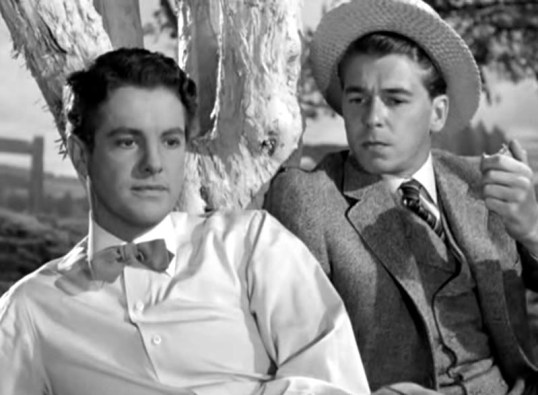
1942: Ronald Reagan Is Not Nominated For Best Supporting Actor For Kings Row

Kings Row is an enjoyably over-the-top small town melodrama and future President Ronald Reagan is fantastic in the film, with his natural optimism providing a nice contrast to the truly terrible things that happen to him and his loved ones over the course of the film.  Reagan was not nominated for this performance, the one that both he and the most of the critics agreed was his best, but he should have been.

1943: Hangmen Also Die Is Not Nominated For Best Picture

Fritz Lang’s anti-Nazi classic was not nominated for Best Picture and only received two nominations (for Sound and Score).  That year, the Best Picture winner was another anti-Nazi classic, Casablanca.

1943: Shadow Of A Doubt Is Ignored

Today, it is recognized as one of Hitchcock’s best but, in 1943, Shadow of a Doubt couldn’t even score a nomination for Joseph Cotten’s wonderfully diabolical turn as Uncle Charlie.  One gets the feeling that the film’s satirical jibes at small town America and its theme of evil hiding behind a normal façade were not what the Academy was looking for at the height of World War II.  It’s a shame because, in many ways, Cotten’s Uncle Charlie was the perfect symbol of the enemy that the Allies were fighting.

1944: Tallulah Bankhead In Not Nominated For Best Actress For Lifeboat

Unlike Shadow of a Doubt, Hitchcock’s Lifeboat received several Oscar nominations.  However, Tallulah Bankhead was not nominated for Best Actress.  Perhaps the Academy was scared of what she might say if she won.
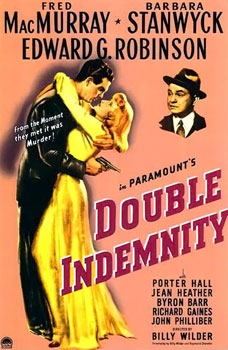
1944: Fred MacMurray and Edward G. Robinson Are Not Nominated For Double Indemnity

For all the nominations that this classic noir received, somehow neither Fred MacMurray nor Edward G. Robinson were nominated for their roles.  Both actors are brilliantly cast against type in this film.  MacMurray uses his trademark casual glibness to portray Walter Neff as being an arrogant man who is hardly as clever as he thinks that he is.  Meanwhile, Robinson’s more introspective performance leaves you with little doubt that, if anyone can solve this case, it’s him.  While Barbara Stanwyck was (rightfully) nominated, it’s had to believe that both MacMurray and Robinson were snubbed.

1946: Thomas Mitchell and Lionel Barrymore Are Not Nominated For Best Supporting Actor For It’s A Wonderful Life

As wonderful as James Stewart and Donna Reed are, it just wouldn’t be Bedford Falls without Uncle Billy and Mr. Potter!  Thomas Mitchell breaks your heart in the scene where he tries to remember what he did with the lost money.  And, for audiences who had just lived through the Great Depression, Lionel Barrymore represented every businessman who cared more about money than people.  It’s impossible to imagine the film without them …. or without Henry Travers, for that matter!  Seriously, very few films have received three best supporting actor nominations but It’s A Wonderful Life deserved to be one of them.
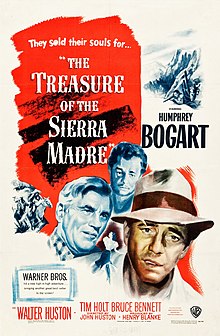
1948: Humphrey Bogart Is Not Nominated For Best Actor For The Treasure of the Sierra Madre

The Treasure of the Sierra Madre received four Oscar nominations.  Somehow, not one of those nominations was not for Humphrey Bogart.

1948 and 1949: Red River, Fort Apache, and She Wore A Yellow Ribbon Are Not Nominated For Best Picture

The public may have loved Westerns but the Academy largely shied away from them, with a few notable exceptions.  Howard Hawks’s Red River and John Ford’s Fort Apache and She Wore A Yellow Ribbon are today all recognized as being classic Hollywood films.  However, the Academy, then at the height of its bias towards “genre” films, didn’t honor any of them.

1949: James Cagney Is Not Nominated For Best Actor For White Heat

“Top of the world, ma!”  Maybe so, but not top of the Oscars.  The Academy was always more interested in honoring Cagney for being a song-and-dance man than for honoring him for his iconic gangster roles.

Agree?  Disagree?  Do you have an Oscar snub that you think is even worse than the 10 listed here?  Let us know in the comments!

Up next: Get ready to hate the commies and to love Ike because the 50s are coming!
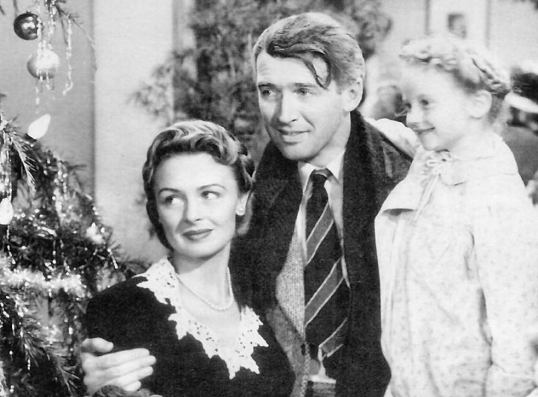
Scenes That I Love: The Cemetery Scene From It’s A Wonderful Life


Over the past 11 years, I’ve shared so many scenes from It’s A Wonderful Life that I’m a bit worried that I’m gong to run out of moments to share. It’s A Wonderful Life is one of my favorite films of all time, along with being a Christmas tradition. I watched it earlier this month and I’ll be watching it tonight with my family.

Below is one of the more somber but important scenes in It’s A Wonderful Life. George and Clarence go to what would have been Bailey Park if George had been born. Instead, it’s now a cemetery and buried there is George’s brother, who would have died if George hadn’t been born. And, as Clarence explains, every man that George’s brother saved would have died as well. “Each man’s life touches so many other lives,” as Clarence puts it.

Here is a scene from a wonderful movie called It’s A Wonderful Life.

Lisa Cleans Out Her DVR: Madame Curie (dir by Mervyn LeRoy)


(Lisa is currently in the process of cleaning out her DVR!  How long is it going to take her?  Probably about as long as it took scientists to discover radiation.  Still, she’s not giving up!  She recorded the 1943 best picture nominee, Madame Curie, off of TCM on February 16th.)

It would appear that if you wanted to produce a best picture nominee in the early 40s, the easiest way to do it was to cast Walter Pidgeon and Greer Garson as husband and wife.

Consider the evidence: In 1941, Blossoms in The Dust was nominated for best picture.  Greer Garson and Walter Pidgeon played wife and husband.

In 1942, Mrs. Miniver won best picture.  Greer Garson and Walter Pidgeon played husband and wife.  Interestingly enough, Garson actually starred in another best picture nominee that year, Random Harvest.  Random Harvest is a far better picture than Mrs. Miniver and actually featured a better performance from Garson but it did not include Walter Pidgeon.  Make of that what you will.

Then, in 1943, Greer Garson and Walter Pidgeon starred in Madame Curie.  Again, they played husband and wife and, again, their film was nominated for best picture.

As you can tell from the poster above, Madame Curie was advertised as being “Mr. and Mrs. Miniver together again.”  Actually, Garson and Pidgeon are playing characters far different from the stalwart and very British heroes of their previous film.  Instead, they are playing the Curies, Marie and Pierre.  The film opens with Pierre meeting Marie at a party and it juggles scenes of their romance with scenes of them discovering and playing with radiation.  Of course, it’s a struggle at times.  Their colleagues are dismissive of their efforts.  Both Pierre and Marie tend to get so caught up in their research that they close themselves off from the outside world.  Their efforts pay off when they isolate radium and win the 1903 Nobel Prize.  Of course, then Pierre gets run over by a horse while out buying his wife a pair of earrings.  Can Marie continue to do their research without him?

The unfortunate thing is that the movie pretty much ends with Marie winning her first Nobel Prize, which means that it leaves out some of the most interesting aspects of her life.  For instance, during World War I, she developed mobile X-ray units and worked in field hospitals.  She was also active in the struggle for Polish independence, even naming the first element that she ever discover polonium after her native country.  She spent almost her entire career working with radioactive material, often carrying radioactive isotopes in her pockets.  In 1934, Marie died of radiation poisoning.  Her research notes and other papers are so highly radioactive that they’re kept in a lead box and I assume that they probably glow whenever the lid is shut.  If you want to study Marie Curie’s notes, you have to put on a radiation suit.  Unfortunately, none of this is discussed in the resolutely positive movie.

Judging from what I’ve seen on TCM, Greer Garson appears to have been the Meryl Streep of her day, undeniably talented but a bit too obvious in her technique and just a little boring.  The same can be said of Madame Curie, which is a very well-made but not extremely memorable movie.  It’s like a lot of the films that were nominated for best picture in the 30s and the 40s — a big, prestige picture that never exactly comes to life.  The film is probably at its strongest in the beginning, when Walter Pidgeon does a pretty good job of playing Pierre as a brilliant introvert who is almost too shy to talk to Marie.  But, as the film progresses, it just becomes another slow-moving MGM biopic.

What movie beat Madame Curie for Best Picture?

None other than Casablanca.

Horror Film Review: The Invisible Man (dir by James Whale)


the-invisible-man

The 1933 Universal horror film, The Invisible Man, never seems to get as much attention as Frankenstein, Dracula, The Wolf Man, or The Mummy.  Perhaps it’s because the invisible man really isn’t a supernatural monster.  He’s just a scientist who has turned himself invisible and is now going mad as a result.  Or maybe it’s because there have been so many crappy films that have used invisibility as a plot point that the reputation of the original Invisible Man suffers by association.

For whatever reason, The Invisible Man never seems to get spoken about in the same breathless, gleeful manner as some of the other Universal monsters.  But I have to admit that, though I usually can’t stand movies about invisibility, I rather like The Invisible Man.

Based on a novel by H.G. Wells, The Invisible Man opens with a mysterious man (played by Claude Rains) arriving in a small English village.  He checks into a small inn and soon, everyone in the village is scared of him.  It’s not just his haughty attitude or his habit of ranting about his own superiority.  There’s also the fact that he is literally covered, from head to toe, in bandages.  He always wears gloves and dark glasses.  He insists that he’s doing important research and demands to be left alone.

The inn keeper (Forrester Harvey) and his histrionic wife (Una O’Connor) put up with the mysterious man until he falls behind on his rent.  However, once confronted, the mysterious man announces that he’s not going anywhere.  When the police and a mob of villagers arrives, the man starts to laugh like a maniac.  He unwraps the bandages around his head and…

THERE’S NOTHING UNDERNEATH!

Well, there is something there.  It’s just that the man is invisible so no one can see what’s underneath.  It turns out that the man is Dr. Jack Griffin, a chemist who has been missing for several days.  He’s created an invisibility serum but he can’t figure out how to reverse the effects.  Even worse, the serum is driving him insane.  Griffin’s fiancée, Flora (Gloria Stuart), and her father, Dr. Cranley (Henry Travers), are searching for Jack but Jack doesn’t particularly want to be found.  Jack is more interested in exploring how he might be able to use invisibility to conquer the world…

The Invisible Man is historically important because it was the film that brought Claude Rains to Hollywood.  Rains has previously made films in the UK but this was his first American film.  Think of how different film history would have turned out if The Invisible Man had, as originally planned, starred Boris Karloff.  Without Claude Rains coming to America, who would have played Louis in Casablanca?  Who would have played Sen. Paine in Mr. Smith Goes To Washington or Alex Sebastian in Notorious?  Of course, we don’t really see Claude Rains’s face until the very end of The Invisible Man.  Instead, we just hear his voice but what a voice Claude had!  He delivers his dialogue with just the right amount of malicious sarcasm.

I like The Invisible Man.  For modern audiences, it’s not particularly scary.  (Though I do find the idea of being unknowingly followed by an invisible person to be a little unnerving…)  However, unlike a lot of other old horror films, you can watch The Invisible Man and see why it would have been scary to an audience seeing it for the very first time.  In 1933, a time when film was still a relatively new medium and audiences had yet to become jaded by special effects, here was a man unwrapping his bandages to reveal that there was nothing underneath!  That had to have freaked people out!

The Invisible Man was directed by James Whale and the film features the same demented sense of humor that distinguished The Bride of Frankenstein.  The villagers are portrayed as being so hysterical that you can’t help but think that maybe Griffin has a point about being surrounded by fools.  By the time the local constable declares, “What’s all this then?,” you can’t help but start to sympathize with Jack Griffin.

There’s been a lot of  bad invisibility movies made but The Invisible Man is not one of them.  It may not be as well remembered as some of the other Universal horrors but it’s definitely one worth seeing.

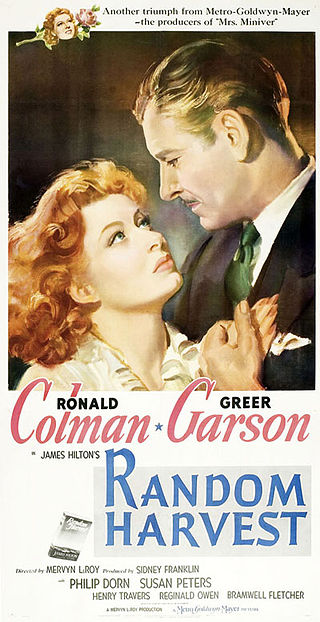
Cleaning Out The DVR #15: Random Harvest (dir by Mervyn LeRoy)


Random-harvest-1942

This morning, as a part of my continuing effort to watch 38 films by Friday and clean out the DVR, I watched Random Harvest, a romantic melodrama from 1942.

And when I say that Random Harvest is a melodrama, I’m not exaggerating.  During the first hour of the film, I found myself thinking that if Random Harvest were made today, it would probably be a Lifetime movie.  By the time the second hour started, I realized that it would actually probably be one of those heavily hyped miniseries that ends up being broadcast on A&E, Bravo, and Lifetime at the same time.  This is one of those big, epic stories where, every few minutes, a new plot twist emerges.

When the film opens during the first World War, John Smith (Ronald Colman) is a patient at a British asylum.  He knows that he was once a soldier.  He knows that he was gassed during a battle.  He knows that he’s recovering from extreme shell shock and it’s still a struggle for him to relate to other human beings. He knows that he will probably spend the rest of his life as a patient at the asylum.  He also knows that his name is not John Smith.  He’s not sure what his real name is because he suffers from amnesia.

One night, a message comes to the asylum.  The war has ended!  All of the doctor and orderlies go out to celebrate, leaving Smith unguarded.  Smith simply walks out of the asylum and eventually makes his way to a nearby town.  It’s there that he meets Paula (Greer Garson), a kind-hearted singer who invites Smith to join her traveling theatrical troupe.

Paula and Smith fall in love, end up getting married, and have a child together.  Paula encourages Smith to become a writer and eventually, a publisher in Liverpool asks to meet with him.  However, when Smith goes to Liverpool, he ends up getting hit by a car.  When he regains consciousness, he suddenly knows that his name is Charles Rainier and that he’s rich!  However, he no longer remembers that he was once named John Smith, that he’s married to Paula, or that he has a child.

The years pass.  Charles returns to his old life of servants, money, and political ambition.  His stepniece, Kitty (Susan Peters), falls in love with him but Charles, for his part, cannot stop wondering about what happened between getting gassed in World War I and getting hit by that car in Liverpool.

Meanwhile, Paula refuses to believe that Smith had abandoned her.  Even after she has him legally declared dead, she continue to believe that he’s out there.  And then one day, she sees a picture of Charles Rainier.  She also learns that Rainier needs an executive secretary, which just happens to be what Paula does when she’s not singing…

Just from reading that plot, you probably think that Random Harvest is an incredibly silly film, that type that, if it were made today, would star Katharine Heigl and maybe a British guy who had a minor role on Game of Thrones.  But, dammit, Random Harvest works!  Filmmakers in the 30s and 40s knew how to make this type of melodrama totally compelling and believable.  There’s not a hint of snarkiness or cynicism to be found in Random Harvest and, as a result, it feels almost churlish to criticize the plot for being implausible.  Sincerity saves this film.

Random Harvest was nominated for Best Picture but it lost to another film starring Greer Garson, Mrs. Miniver.  However, Garson gave a far better performance in Random Harvest than she did in Miniver.  When you watch most of her film today, Greer Garson always comes across as talented but a little boring and obvious in her technique.  (She was the Meryl Streep of her day.)  In Random Harvest, Garson actually gets to sing and danger and laugh and behave like a human being.  After seeing her in Blossoms In The Dust, Mrs. Miniver, and Sunrise at Campobello, watching her performance in Random Harvest is akin to an acting revelation.

Meanwhile, Ronald Colman also does a great work at both Smith and Charles (and they really are two separate characters).  Admittedly, Colman does come across as being a little bit too old for the role (and the age difference between him and Susan Peters does add a certain odd subtext to the scenes between Charles and Kitty) but, otherwise, he’s totally and completely credible as the character.  When he’s Smith, he speaks in a halting, uncertain tone and he walks like he’s still learning how to put one foot in front of the other.  When he becomes Charles, he’s definitely more confident but he still moves like a man who feels as if it’s his duty to carry the weight of the world on his shoulders.

(I have to admit that I’ve always found it strange that Margaret Mitchell apparently wanted Ronald Colman to play Rhett Butler in Gone With The Wind.  Watching his performance here, I still could not see Colman as Rhett but he would have made a great Ashley Wilkes.)

The beautiful Susan Peters was nominated for best supporting actress for her performance as Kitty.  Random Harvest was her first major role and she gives such a great and likable performance that it makes it all the more tragic that her career was cut short.  Just three years after appearing in Random Harvest, Susan was accidentally shot by her husband.  Though she survived, she would never walk again.  When she died, at the age of 31 in 1952, the official cause was pneumonia but it was also said that she had stopped eating and drinking and had literally lost the will to live.  Whether you love Random Harvest or you think it’s just a silly melodrama, you should watch it just to see Susan Peters’s great performance and to consider what could have been.

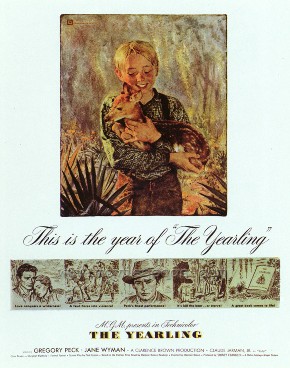
Cleaning Out The DVR #10: The Yearling (dir by Clarence Brown)


Original_movie_poster_for_the_film_The_Yearling

After I finished Abduction: The Jocelyn Shaker Story, I decided to watch a film that was shown on TCM as a part of the 31 Days Of Oscars.  When I started the 1946 film, The Yearling, I thought it was going to be a sweet and heartwarming little movie about a country boy raising a deer.  Instead, it turned out to be a rather dark movie about how much it sucks to grow up in the country.  I can only imagine how many childen, back in 1946, were scarred for life by this movie.

The movie is actually about two yearlings.  The main one is Jody (Claude Jarman, Jr.), who lives in the bayous of 1878 Florida.  His family is a farming and hunting family.  They live in a small shack and struggle to make ends meet.  His father, Penny Baxter (Gregory Peck) is … well, he’s Gregory Peck.  He’s stern but warm and speaks with that deep voice that lets you know that you better pay attention to everything he says.  While Penny is generally laid back and enjoys a good laugh, his wife, Ora (Jane Wyman), is far more serious and severe.  Ora has lost three children and, as a result, she is both overprotective and emotionally distant from Jody.

Jody desperately wants a pet but Ora says that they can’t afford to feed any animals.  However, one day, Penny is bitten by a snake.  Apparently, the organs of a deer can be used to draw out snake venom.  (Seriously, until I watched The Yearling, I had no idea this was the case.  I once nearly stepped on a rattlesnake in New Mexico and it totally freaked me out.  It’s good to know that if I ever do get attacked by a snake, all I have to do is kill a deer.)  Penny shoots a doe and has Jody cut out its heart and liver.  After doing so, Jody notices that the doe had a fawn.  He begs to be allowed to adopt it and, overruling Ora, Penny says that he can.

After getting his deer, Jody goes to visit his best friend, Fodderwing (Donn Gift) and ask him what he thinks a good name would be.  However, Fodderwing’s father informs Jody that his friend has just died.  And really, that scene pretty much epitomizes what The Yearling is about.  Because it’s told almost entirely from Jody’s point of view, the film may occasionally look like an old school Disney film.  But death and hardship are very real in the world of The Yearling.  People die, even children.  Having a pet may make the reality easier to take but it doesn’t change the reality.

Jody names the deer Flag.  As the film progresses, both Jody and Flag grow up.  Unfortunately, as Flag gets older and bigger, he causes more and more trouble for both his family and the neighbors.  He eats crops and he destroys fences.  After Penny is injured, Jody is the one who ends up replanting the corn and fixing all the damage.  But, even after all of Jody’s hard work, Flag still knocks down another fence.  That’s when Jody is told that he must shoot his beloved pet…

And that’s why I went, “Agck!  What type of movie is this!?”

Well, it’s a coming-of-age movie and, unfortunately, Jody is living at a time when growing up means giving up childish things.  (That’s always been my least favorite verse in the Bible, by the way.)  The Yearling itself is a pretty good film, though I do have one major problem with it.  The film looks great and both Jane Wyman and Gregory Peck are expertly cast.  If you keep an eye out, you’ll even spot Henry Travers — Clarence the Angel from It’s A Wonderful Life — in a small role.

That said, my main objection to The Yearling — the thing that keeps it from being quite as good as it could be — is the performance of Claude Jarman, Jr.  In the role of Jody, Jarman goes so totally over-the-top with his line readings and his facial expressions that it immediately takes the viewer out of the film’s reality.  Whenever anything happens — whether its Penny getting attack by a snake or his mother throwing a plate at his deer or Flag knocking over a fence — Jarman responds by standing there with his eyes and mouth wide open.  His lines are delivered with a rushed enthusiasm that can’t hide the complete lack of authentic emotion in his performance.  Claude Jarman tries really hard but it’s not surprising to discover that, after The Yearling, he only appeared in a few more films before joining the Navy and then subsequently moving behind the camera as a producer.

Then again, the Academy thought highly enough of Jarman’s performance to give him an honorary Oscar.  The Yearling itself was nominated for best picture but it lost to another sad film about giving up childish things, The Best Years of Our Lives.

Lisa Watches An Oscar Winner: Mrs. Miniver (dir by William Wyler)


Mrs_Miniver_poster

Mrs. Miniver, which won the Academy Award for Best Picture of 1942, is often treated somewhat dismissively by film historians.  The film tells the story of the Minivers, an upper middle class British family whose peaceful lives are changed forever by the start of World War II.  When the film initially went into production, the U.S. was still a neutral country.  As shooting commenced, the U.S. edged closer and closer to entering the war and, as a result, the script was continually rewritten to make Mrs. Miniver even more pro-British and anti-German than before.  The finished film was released four months after the attack on Pearl Harbor, by which point Mrs. Miniver had gone from being domestic drama to being both a celebration of British resilience and the Allied war effort.  “If the Minivers can do it,” the film told audiences, “why can’t you?”  As a result, Mrs. Miniver is often described as being merely effective propaganda.

Well, Mrs. Miniver may indeed be propaganda but it’s amazingly effective propaganda.  I recently DVRed it off of TCM and I have to admit that, as a result of those previously mentioned film historians, I wasn’t expecting much.  But I was in tears by the end of the film.  Yes, World War II has long since ended.  And yes, I could watch the movie and see all of the tricks and the heavy-handed manipulations that were employed to get the desired emotional response from the audience but it didn’t matter.  The film is so effective and so well-acted that you’re willing to be manipulated.

(Of course, it helps that there’s not much nuance to World War II.  As far as wars go, WWII was as close to a fight between good and evil as you can get.  If you can’t celebrate propaganda that was designed to defeat the Nazis, then what can you celebrate?)

As for the film itself, Greer Garson plays Kay Miniver, matriarch of the Miniver Family.  Her husband, Clem (Walter Pidgeon) is a successful architect.  When we first meet Kay and Clem, the only thing that they have to worry about is the annual village rose show.  (Henry Travers — who everyone should love because he played Clarence in It’s A Wonderful Life — plays the eccentric stationmaster who is determined to win with his rose.)  However, that all changes when they go to church and the vicar (Henry Wilcoxin) announces that Great Britain has declared war on Germany.

Life changes.  Soon, Kay must hold her family together while bombs are falling from the sky.  When Clem is away, helping out with the Dunkirk evacuation, Kay comes across a wounded German flyer (Helmut Dantine) in her garden.  The flyer demands that Kay give him food and when she does, he snarls that the Third Reich will be victorious.  He then passes out from his injuries, allowing Kay to take his gun and call the police.  (Reportedly, this scene was rewritten and reshot several times, with the German becoming progressively more hateful with each new version.)

Kay’s son, Vincent (Richard Ney), joins the Royal Air Force.  He also falls in love with Carol Beldon (Theresa Wright), the daughter of the aristocratic Lady Beldon (Dame May Whitty).  Over the concerns of Lady Beldon, Carol marries Vincent and she becomes the second Mrs. Miniver.  They do so, despite knowing that Vincent will probably be killed before the war ends.

Of course, there is tragedy.  People who we have come to love are lost, victims of the German onslaught.  Throughout it all, the Minivers (and, by extension, the rest of Great Britain) refuse to give into despair or to lose hope.  The film ends with them singing a hymn in a church that no longer has a roof and listening as the vicar tells them why they will continue to fight.

And yes, it’s all very manipulative but it’s also very effective.  I did cry and the film earned those tears.  In many ways, Mrs. Miniver is perhaps most valuable as a time capsule.  It’s a film about World War II that was actually made during the war and, as such, it provides a window into the attitudes and culture of the time.  But, if the film is valuable as history, it’s also just as valuable as a well-made melodrama.

I’m not sure if I would say that Mrs. Miniver deserved to defeat Kings Row for best picture of 1942.  But it’s still an undeniably good film.