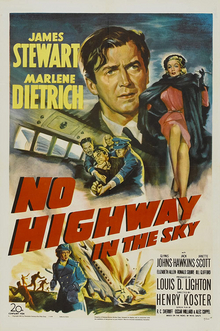
In 1951’s No Highway In The Sky, James Stewart stars as Dr. Theodore Honey.
In many ways, Theodore Honey is similar to the other roles that Stewart played after he returned from serving in World War II. Dr. Honey is intelligent, plain-spoken, and good-hearted. He’s eccentric and he sometimes has a difficult time relating to other people. He’s also deeply troubled. Dr. Honey is an engineer, one who specializes in determining how many hours an airplane can fly before it starts to fall apart. Dr. Honey is in England, working for an airline and testing his hypothesis that their newest model’s tail will fall off after the plane accumulates a specific number of hours. As is usually the case with these things, Dr. Honey’s employers are skeptical about his claims. There’s a lot of money to be made in air travel and the last thing they need is some eccentric American scaring everyone.
When Honey sets out to investigate a recent crash site, he finds himself on the same type of airplane that he’s been testing. After the plane takes off, Dr. Honey talks to the pilots and discovers, to his horror, that the plane is closing in on the time limit. While flight attendant Marjorie Corder (Glynis Johns) tries to keep him calm, Dr. Honey explains his theory to a film star named Monica Teasdale (Marlene Dietrich), who just happens to be a passenger on the flight. Both Marjorie and Monica find themselves falling in love with Dr. Honey and who can blame them? He may be an eccentric and it may be hard to follow what he’s talking about but he’s still Jimmy Stewart!
I’ve often thought that Stewart was “Jimmy” before World War II but he was definitely James afterwards. Stewart, unlike a lot of Hollywood stars who enlisted and were then used solely for PR purposes, actually flew several combat missions and saw firsthand the devastation of the war. He returned to America deeply disturbed by what he had seen and there’s a definite sense of melancholy to be found in all of Stewart’s post-war performances. That’s certainly the case here. Dr. Honey is a widower, his wife having been killed by a rocket attack during the war. He’s raising his 12 year-old daughter on his own and he deals with his sadness by throwing himself into his work. He’s someone who has seen and experienced great tragedy firsthand and it’s left him more than a little obsessed. There’s a very authentic sadness at the heart of Stewart’s performance and it elevates this film, making what could have been a by-the-book corporate thriller into a character study of a man standing at the dawning of a new age, the post-war era of commercial air travel, and saying, “Well, hold on one minute.”
Unfortunately, Honey’s obsessive nature makes it easy for some to dismiss him. When Dr. Honey purposefully sabotages the plane to keep it from flying again, he finds himself forced to defend his actions. Can he prove that his theory is true? And who will he end up falling in love with? You can probably guess the answers but it doesn’t matter if the latter half of the film is a bit predictable. James Stewart’s performance carries the film and keeps you watching.
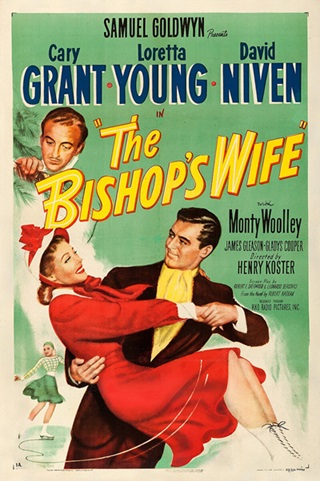
In 1947’s The Bishop’s Wife, Cary Grant stars as Dudley.
We first see Dudley walking down the snow-covered streets of a city that is preparing for Christmas. He watches Julia Broughman (Loretta Young), the wife of the local Anglican bishop. He stops to talk to Prof. Wutheridge (Monty Woolly), a secular humanist who is close to Julia and her husband, despite being irreligious himself. Dudley seems to know all about the professor, even though the professor is not sure who he is. The professor mentions that he was fired from a university because he was considered to be a “radical,” even though he has no interest in politics. The professor says that the town’s church has seen better days, especially since the Bishop is more interested in raising money from the rich to build a grand new cathedral than actually meeting with the poor who need help.
The last person that Dudley visits is Bishop Henry Broughman (David Niven). Dudley reveals to Henry that he’s angel and that he’s come in response to Henry’s prayers. Henry has been frustrated in his attempts to raise money for a new cathedral. Dudley has come to provide guidance.
With only the Bishop knowing the truth about Dudley, Dudley becomes a houseguest of the Broughmans. The Bishop has become so obsessed with his new cathedral that he’s not only been neglecting his diocese but also his family. While Dudley tries to show Henry what’s really important, he also helps Julia and her daughter Debby (Karolyn Grimes) to fit in with the neighborhood. (Bobby Anderson, who played the young George Bailey in It’s A Wonderful Life, makes an appearance as a boy having a snowball fight who says that Debby can’t play because no one wants to risk hitting a bishop’s daughter with a snowball.) The Bishop becomes jealous of Dudley and perhaps he should be as Dudley finds himself falling in love with Julia and considering not moving on to his next assignment.
(And now we know where Highway to Heaven got the inspiration for 75% of its episodes….)
The Bishop’s Wife is an enjoyable film, one that is full of not just Christmas imagery but also the Christmas spirit as well. The Bishop finally realizes that his planned cathedral is more of a gift to his ego than to the men and women who look to him for guidance and comfort in difficult times. David Niven is, as always, likable even when his character is acting like a jerk. That said, this is pretty much Cary Grant’s show from the start. Suave, charming, and gently humorous, Grant joins Claude Rains and Henry Travers in the ranks of great cinematic angels. Never mind that Grant’s character is a bit pushy and has his own crisis of faith. From the minute that Grant appears, we know that he’ll know exactly the right way to answer Henry’s prayers.
Cary Grant was not nominated for Best Actor for his performance here. Undoubtedly, this was another case of Grant making it all look so easy that the Academy failed to realize just how good of a performance he gave. Interestingly enough, The Bishop’s Wife was one of two Christmas films nominated for Best Picture that year, along with Miracle on 34th Street. Both films lost to Gentleman’s Agreement.
Occasionally, I’ll see a film like Crime of Passion or Bigger Than Life and I’ll say, “Wow, that’s really subversive for a movie that came out in the 1950s!”
And it’s true. We tend to think of the 1950s as being a time when conformity ruled all. It was a time of innocence and chastity, when cinema heroes all wanted to have a house in the suburbs and loving couples slept in separate beds and nobody ever questioned anything. Of course, the truth of the matter is that there were a lot of films released in the 50s that challenge that perception.
And then again, there were also films like 1955’s A Man Called Peter.
A Man Called Peter is a biopic about Peter Marshall (played by Richard Todd), a Scottish immigrant who came to the United States, became a Presbyterian minister, and then eventually became the Chaplain of the United States Senate. (That means that he would open each session of the Senate with a prayer and occasionally provide spiritual counsel to the senators.) I recently watched it on Netflix, specifically because I thought it might be appropriate for this series of political reviews.
And it is, but just barely.
It actually takes the film a while to get to the part where Peter Marshall becomes the Senate Chaplain. First, we watch him as a boy in Scotland, trying to stow away on a boat heading for America. Then, several years later, he’s out walking on a foggy night. He trips over a tree root and, as he lies on the ground, he announces that God has told him to 1) pursue a career as a minister and 2) to do so in America. (I have to admit that I was raised Catholic so I have no idea whether he was having a typical Presbyterian spiritual experience or not. But the film certainly takes it seriously.)
Peter ends up in America where he ministers to a church in Atlanta, marries Catherine (Jean Peters), and then eventually ends up at a church in Washington, D.C. When he eventually is asked to serve as Chaplain of the Senate, both he and the film go out of their way to avoid taking any definite position on any issue. Instead, Peter gives prayers that encourage the senators to put partisan bickering aside and work together to make the United States the best country in the world.
Having now watched all 120 minutes of A Man Called Peter, I can safely that this is a film that epitomizes everything that we always assume to be true about the 1950s. From the film’s view of marriage to religion to politics, A Man Called Peter is perhaps one of the most stereotypically 1950s movies ever made. This is such a 1950s movie that it’s even filmed in CinemaScope!
(And speaking of CinemaScope, A Man Called Peter looks great but it’s perhaps one of the least intimate biopics that I’ve ever seen. You can see every inch of the surrounding landscape but the human beings get lost.)
For me, the film’s most 1955 moment comes when Catherine first discovers that her husband has been reassigned to Washington, D.C. She and Peter are on their honeymoon when they get a telegram telling them that their new home in Washington is ready. Catherine is shocked. Peter says that he didn’t want to interrupt their honeymoon by telling her that they’re not going home to Atlanta. Instead, they’re going to an entirely new city and an entirely new life. (In other words, Peter has decided to say goodbye to Catherine’s family and friends.)
“Aren’t you pleased?” Peter asks her.
Cheerfully, Catherine replies, “Well, who wouldn’t be?”
As part of my mission to view every film — good or bad — ever nominated for best picture, I spent last night watching 1953’s The Robe (which was nominated for best picture but lost to From Here To Eternity.) The Robe is an old school biblical epic, the type of film that used to regularly get nominated for best picture but which you don’t see much of anymore. If you’re wondering why that genre hasn’t stood the test of time, I’d suggest watching The Robe.
Richard Burton stars as Marcellus, a womanizing Roman centurion who falls in love with young, pure noblewoman Diana (Jean Simmons). Unfortunately, Diana is set to marry the decadent Caligula (Jay Robinson). (Yes, that Caligula…) Burton’s rivalry with Caligula leads to him being reassigned to Jerusalem where he not only witnesses the crucifixion but also wins Jesus’ robe in a dice game. However, Marcellus soon finds himself being haunted by nightmares of the crucifixion and he discovers that he can’t even wear the robe without having a seizure. His slave, Demetrius (played by musclebound Victor Mature) has secretly become a Christian and steals The Robe before disappearing into the Holy Land. As Marcellus, who believes that only by destroying the robe can he free himself from his guilt, searches for Demetrius, he is reunited with Diana and, since this is an old school biblical epic, he also ends up converting as well. Unfortunately, he does all this around the same time that Caligula becomes Emperor and (in this film if not in actual history) begins to persecute the early Christians.
The Robe was the first film to made in “Cinemascope” and, while that may have been an amazing development back in 1953, when watched today, it’s obvious how much of the film is really just made up of filler designed to show off the new process. Again, it may have been amazing at the time but today, it just seems like a slow movie. Even more importantly, The Robe itself is so reverent and respectful of its subject that it’s just not that interesting. Speaking as a nonbeliever, I’ve still sometimes feel that a lot of contemporary films make it a point to ridicule Christians because they’re an easy target. Unlike a certain other world-wide religion, most Christians aren’t going to blow you up just because you featured an image of Jesus in your movie. However, movies like The Robe were not only extremely reverent and respectful but they went out their way to let you know how reverent and respectful they were being. The result is a film that lack any hint of nuance or anything that might actually challenge the audience. It’s like Avatar with Jesus.
Since he’s best known for being an alcoholic and marrying Elizabeth Taylor, Richard Burton might seem like an odd choice to play an idealistic Christian martyr. And, quite frankly, he is. Throughout the film, he’s visibly uncomfortable and, quite frankly, he didn’t have the legs necessary to pull off the ancient Roman look either. Jean Simmons is also stuck playing a stock character — the virtuous maiden. As with a lot of the old school biblical epics, the lead characters are so boring that you can’t help but feel they had more fun as pagans. Meanwhile, poor Victor Mature wanders through the film struggling to show anything resembling emotion. I mean, he tries so hard that its impossible not to like him. At the very least, The Robe proves that any film featuring Victor Mature will have some sort of camp value.
(As I watched The Robe, I kept thinking about a comment that Groucho Marx supposedly made. Apparently, he said he wouldn’t watch any movie starring Victor Mature because “I won’t watch any movie where the guy’s tits are bigger than the girl’s.”)
The Robe does feature some interesting supporting performances from several wonderful B-movie character actors. Jay Robinson is obviously having the time of his life playing the Emperor Caligula. Robinson’s version isn’t quite as effective as Malcolm McDowell’s but Robinson is a lot more fun to watch. Richard Boone is effectively slovenly in the role of Pilate and there’s a nice little throw-away scene where Pilate absent-mindedly washes his hands twice. Meanwhile Ernest Thesiger (who played Dr. Pretorious in the Bride of Frankenstein) is an oddly benevolent Emperor Tiberius while Michael Rennie, the alien from the original The Day the Earth Stood Still, plays none other than St. Peter. Even Jeff Morrow (from This Island Earth) has a small role.
Like most of the old school Hollywood biblical epics, The Robe seems pretty hokey when viewed today and I get the feeling it probably seemed hokey when it was first released back in 1953. Still, I remember that my Grandma Meehan used to love to watch these movies whenever they would show up on television. She would have deep theological debates with the images that flickered across the screen. I can still remember spending multiple Easters listening to her argue with The Ten Commandments. I don’t know if Grandma ever saw The Robe but I do know that she believed that the Holy Tunic was presently located in France and not at the Cathedral of Trier in Germany. Seriously, you did not want to question her on this point.
To be honest, watching this type of film is always an odd experience for me. Up until recently, I described myself as a “fallen Catholic” and I always felt so proud of myself afterward. I could spend hours telling you why I no longer believed in the faith of my childhood and I could get quite smug about it. I guess I still can but, as of late, I’ve discovered that humility goes well with a lack of faith. I’ve also been forced to admit that when you’re raised Catholic, you’re a Catholic for life regardless of whether you believe in the Holy Trinity or not. If pressed, I guess I’d call myself “an agnostic Catholic.” I’m the type of nonbeliever who still feels the need to go to confession after a long weekend. It’s not so much that I doubt my doubt as much as I wish that I could still go back to a time in my life when I actually could have faith without feeling like I was in denial. So, even as I openly scoff at these films, there’s always that small part of my heart that wants to embrace the film in all of its simplistic and hokey glory.
That said, it’s also true that The Robe is a lot easier to resist than a film like Pasolini’s The Gospel According to Saint Matthew or, for that matter, The Exorcist.

 Through the Shattered Lens