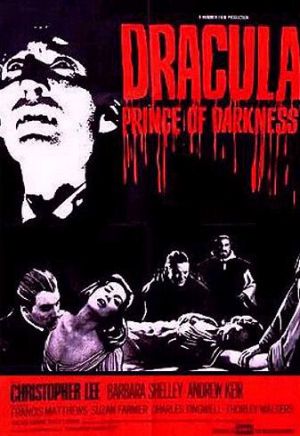
Christopher Lee often went on record about how much he disliked most of the Hammer films in which he played Dracula, feeling that Hammer didn’t really understand the character of Bram Stoker’s famous vampire. In fact, when Lee agreed to appear in 1966’s Dracula: Prince of Darkness, he did so with the requirement that he would not have any dialogue.
While it’s possible that Lee may have been hoping that his demand would force Hammer to release him from his contract, his requirement actually works to the film’s advantage. In the scene below, Lee shows that he didn’t need dialogue to make Dracula into a terrifying and malevolent force. Lee’s otherworldly and dangerous charisma and Dracula’s feral and vicious nature come through without him saying a word.
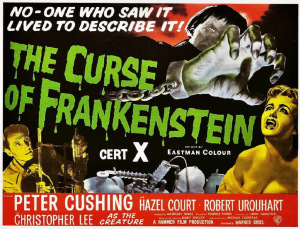
First released in 1957 and one of the films that put Britain’s Hammer Films on the map, The Curse of Frankenstein opens in Switzerland in the 19th century. It’s a time of superstitious villagers, judgmental priests, aristocrats who dabble in science, and lots of cleavage. It’s also a time when justice is harsh. That’s something that Baron Victor Frankenstein (Peter Cushing) has discovered as he sits in a cell in prison, awaiting his execution date.
Baron Frankenstein has been convicted of the murder of a maid named Justine and the public is eager to see this haughty and eccentric aristocrat put to death. Victor, however, claims that he is innocent of Justine’s murder. As Victor explains to a visiting priest (Alex Gallier), he is guilty of many things but he didn’t kill Justine.
The story that Frankenstein tells the priest is a familiar one. Victor inherited the Frankenstein estate when he was fifteen and, having always been interested in science, his hires a scientist named Paul Krempe (Robert Urquhart) to mentor him and ultimately collaborate with him on his experiments. Even as he falls in love with and become engaged to his cousin, Elizabeth (Hazel Court), Victor becomes obsessed with the idea of creating a human being from perfect parts collected from the dead.
Victor puts his creation together, piece by bloody piece. He has no trouble using a the body of a robber and the hands and eyes that purchases from the workers at the local morgue. But when it come time to pick a brain, he wants to use the mind of a distinguished scientist. Unfortunately, the scientist is still alive so Victor pushes him over a bannister. That kills the professor but the removal of the brain does not go quite as smoothly as Victor was hoping. The brain gets damaged when it’s removed. The Creature (an intimidating Christopher Lee) is eventually brought to life but, with that damaged brain, all it wants to do is destroy and kill. Victor isn’t happy about that but soon, he discovers that having a killer Creature has its uses.
As opposed to the well-meaning but obsessed version of the character that Colin Clive played in the original Frankenstein, The Curse of Frankenstein presents us with a Baron who is rather unstable from the start. It’s not just that the Baron is obsessed with bringing the dead back to life. It’s that he is fully willing to kill people for his experiment. Perhaps his only redeeming quality could have been his love for Elizabeth but he screws up even that by having an affair with the ill-fated Justine (Valerie Gaunt). From the start, the Baron’s main obsession is with his own power. Elizabeth is ultimately just another pawn for him to control.
Considering how evil this film’s version of Baron Frankenstein is, it’s a good thing that he’s played by Peter Cushing. Cushing gives an intense but charismatic performance as the Baron, capturing not only the character’s ruthlessness but also his fierce intelligence. The tragedy of the film’s version of the story is not that the Baron’s experiment goes wrong but that the Baron did actually have the potential to do a lot of good for the world. He’s smart and he’s determined but he’s lacking a conscience. If anything, the Creature he builds is a representation of his own dark thoughts and desires. The Baron is an aristocrat and the Creature is built out of common thieves and people who died in debt but they’re both different sides of the same coin.
Gory and fast-paced, The Curse of Frankenstein was a huge hit and it made stars out of both Cushing and Lee. I tend to prefer Hammer’s Dracula films to its Frankenstein film but The Curse of Frankenstein holds up well as a portrait of what happens when madness and science collide.
In December of 1872, a sailing ship called the Mary Celeste was found adrift and deserted in the Atlantic Ocean. When the ship left New York in October, it had a captain and a full crew. The captain’s wife was among the passengers sailing on the ship. When the Mary Celeste was discovered, not only was no one on board but there was no evidence as to where everyone had gone or what caused them to abandon the ship in the first place. The crew of the Mary Celeste appeared to have vanished into thin air and none of them were ever seen again.
As you might guess, this led to years of speculation about what happened. Some people blamed pirates. Some blamed food poisoning. Some blamed ghosts and sea monsters. More modern theorists have blamed UFOs.
First released in 1935 and originally entitled The Mystery of the Mary Celeste, Phantom Ship offers up a theory of its own. It speculates about what happened during the final voyage of the Mary Celeste and why its crew vanished. One of the members of the crew is played by Bela Lugosi. Lugosi was still riding high from his starring role in Draculawhen he starred in Phantom Ship and, playing a veteran sailor who appears to be a bit unstable, Lugosi gives an enjoyably over the top performance. Admittedly, PhantomShip has its slow spots and, at times, it threatens to get bogged down in a subplot about the love triangle involving the Captain, his wife, and the Captain’s best friend. But Lugosi makes the film worth watching and, towards the end, there are some wonderfully atmospheric shots of the nearly deserted ship.
Along with being one Lugosi’s non-Dracula horror films, Phantom Ship is also well-known for being one of the first films to be produced by the British film company that would eventually become known as Hammer Pictures.
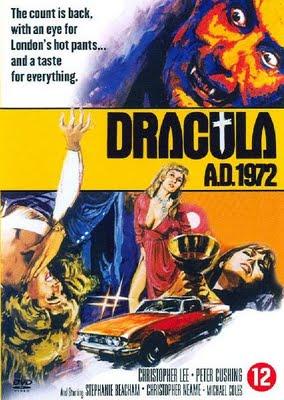
Even in the year 1972, Count Dracula (Christopher Lee) could not escape Prof. Van Helsing (Peter Cushing). Of course, the Van Helsing here was a descendant of the Van Helsing who gave Dracula such a hard time in the 19th century but still, Dracula was not thrilled to see him.
This scene is from Hammer’s Dracula A.D. 1972. It’s not generally considered to be one of the better Dracula films but I enjoy any chance to see Peter Cushing and Christopher Lee (who were the closest of friends off-screen) acting opposite each other.
Today is the 116th anniversary of the birth of the British director, Terence Fisher.
Though Fisher had a long career as both an editor and a director and he worked in almost every genre, he achieved immortality with the horror films that he directed for Hammer Films. Fisher’s horror films took the monsters that had previously been made famous by Universal Studios and resurrected them with a pop art spin. Regardless of whether the subject matter was Frankenstein, the Mummy, Dracula, or some other fearsome creature, Fisher brought a vibrant splash of color to their stories. (Often that color was blood red.) At a time when American horror films were still hobbled by the production code and tended to hide their themes under several heavy layers of subtext, Terence Fisher brought Hammer’s stories to life with explicit violence and unapologetic sexuality. When Christopher Lee’s Dracula stared at a victim with lustful eyes, there was little doubt about what was actually happening. Once Fisher started working for Hammer, he never left the horror genre. Personally, I would have liked to have seen what he could have done with a Bond film.
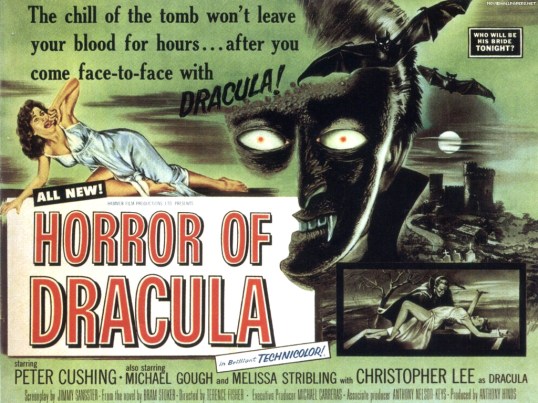
Today’s scene that I love comes from one of the first of the Fisher-directed Hammer horror films, 1958’s Horror of Dracula. (In the UK, it was simply know as Dracula.) Christopher Lee may not appear in this scene but it’s still one of the creepiest moments in the film. In this scene, Lucy (Carol Marsh) returns from the dead and, sporting a new set of fangs, attempts to get her former maid’s daughter, Tania, to come for a walk with her. Thanks to both Fisher’s direction and Marsh’s unforgettable performance, this is a scene that sticks with you even after the film ends. Whenever I see Lucy peeking out from behind that tree and calling out to little Tania, my mind flashes back to when I was in the 1st grade and a police officer stopped by the classroom to ask if we all knew what to do if an adult who we didn’t know tried to get us to go off with them. This scene definitely gives off stranger danger vibes and it’s all the more creepy as a result.
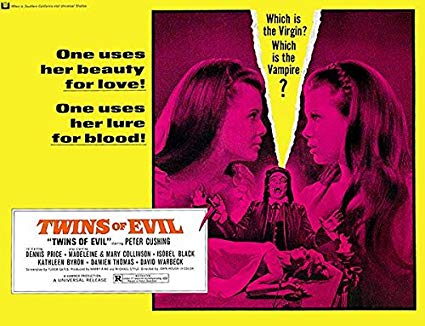
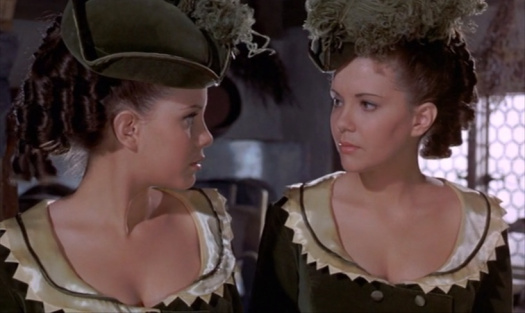
British babes Mary and Madeleine Collinson became the first set of twins to not only star as Playboy Twin Centerfolds (and we’ll get to that at the end of this post!!), but to star in a Hammer Horror film, 1971’s TWINS OF EVIL. Not only that, the lasses got to play opposite Hammer icon Peter Cushing as their puritanical, witch burning uncle. It’s the final chapter in Hammer’s Karnstein Trilogy (preceded by 1970’s THE VAMPIRE LOVERS and 1971’s LUST FOR A VAMPIRE), based on characters from Sheridan LeFanu’s 1872 novella , and it’s a sexy, blood-spattered scream!
As uncle Gustav Weil goes around the countryside burning young girls at the stake, his recently orphaned twin teenage nieces Maria and Frieda arrive from Venice. Prudish Uncle Gustav disapproves of the girls’ plunging decolletage (“What kind of plumage is this? The birds of paradise?”). While Maria is shy and demure, Frieda’s a…
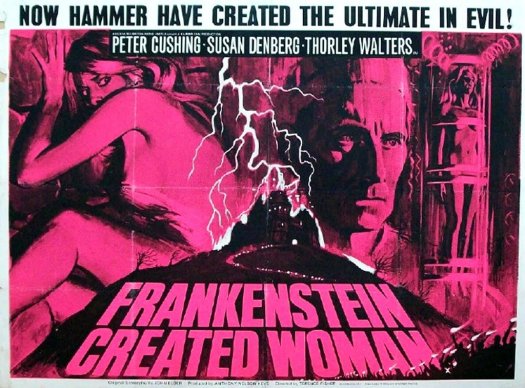
Hammer Horrors were a staple of Boston’s late, lamented “Creature Double Feature” (WLVI-TV 56), so today let’s take a look at a demonic duo of Frankenstein fright films starring the immortal Peter Cushing in his signature role as the villainous Baron Frankenstein.
FRANKENSTEIN CREATED WOMAN was the fourth in Hammer’s Frankenstein series, made three years after EVIL OF FRANKENSTEIN. The Baron is back (after having apparently been blown to smithereens last time around), this time tampering with immortal souls rather than mere brain transplants. The movie features some ahead-of-its-time gender-bending as well, with the soul of an unjustly executed man transmogrified into the body of his freshly dead (via suicide) girlfriend, now out for vengeance!
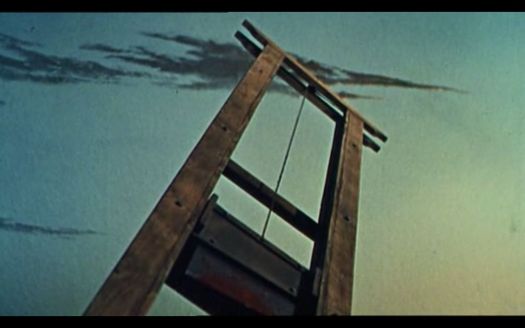
Young Hans (Robert Morris), who watched his father guillotined as a child, grows up to work for muddle-headed alcoholic Dr. Hertz (Thorley Walters , in an amusing performance), who revives the cryogenically frozen Baron…
One of the greatest Hammer vampire films didn’t even star Christopher Lee. In fact, it wasn’t even a Dracula film. Instead, it was the story of a circus.
1971’s Vampire Circus tells the dark story of a Serbian village called Stetl. Early in the 19th century, the children of Stetl are dying. The superstitious villagers believe that Count Mitterhaus (Robert Tayman) might be responsible. In fact, they suspect that Count Metterhaus might be a vampire! Why? Well, first off, he only seems to be around during the night. Secondly, he lives in a big spooky castle. Third, he’s a count and don’t all counts eventually become vampires?
Now, it would be nice to say that all this turned out to be a case of the villagers letting their imaginations get the better of them but nope. It turns out that they’re pretty much right. One night, the local teacher, Albert Muller (Laurence Payne), sees his own wife, Anna (Domini Blythe) leading a child towards the dark castle. It turns out that Anna has fallen under the spell of Count Mitterhaus. The villagers promptly drive a stake through the Count’s heart, though he manages to do two things before dying. First off, he curses the town and announces that the blood of their children will give him new life. Secondly, he tells Anna to escape and track down his brother.
Fifteen years later and, as one might expect, Stetl is a town under siege. However, the town is not being attacked by vampires. (Not yet anyway.) Instead, the town has been hit by the plague and, as a result, it’s been isolated from the outside world. Men with guns have surrounded the town and are under orders to kill anyone who tries to leave or enter. Some in the village believe that this is the result of the Count’s dying curse while others just see it as more evidence of man’s inhumanity to man. Regardless, it’s not good situation.
Fortunately, escape arrives in the form of the Circus of the Night! That’s right, a gypsy carnival suddenly appears in town. How did it manage to slip by the blockade? Who knows and who cares? What’s important is that the villagers, especially their children, need an escape from their grim existence and the Circus seems to offer something for everyone. There are dancers. There are acrobats. There’s the mysterious tiger woman. There’s a mirror that makes you see strange things. And, of course, the are vampires….
That’s not really a shock, of course. The name of the film is Vampire Circus, after all. What always takes me by surprise is just how ruthless and cruel the vampires are in this film. Even by the standards of a 1970s Hammer film, this is a blood-filled movie but, even beyond that, the vampires almost exclusively seem to target children. Fortunately, all of Stetl’s children tend to be a bit obnoxious but it’s still a shock to see two fresh-faced boys get lured into a mirror where they are both promptly attacked by a vampire. (And don’t even get me started on what happens when one of the vampires comes across a boarding school.) Make no mistake, this circus is not made up of the type of self-tortured, romanticized vampires that have dominated recent films. These vampire are utterly viscous and without conscience. In other words, these vampires are actually frightening.
The members of the circus are, themselves, a memorable bunch. David Prowse is the hulking strongman. Lalla Ward and Robin Sachs are the achingly pretty, innocent-faced twin acrobats who greedily drink the blood of anyone foolish enough to wander off with them. Some members of the circus can transform into animals. What’s interesting is that not all of the members of the circus are vampires. Some of them, I guess, are just groupies.
Featuring the reddest blood that you’re ever likely to see and a cast of memorably eccentric character actors, Vampire Circus often feels more like an extremely dark fairy tale than a typical Hammer vampire film. Clocking in at 87 minutes, Vampire Circus is a briskly paced dream of carnivals and monsters.
The 1961 Hammer film, The Curse of the Werewolf, is a good example of a film that could succeed on casting alone.
As you can probably guess from the title, this film is about a werewolf. And there was never an actor more perfect for the role of a werewolf than Oliver Reed. Set aside Reed’s legendary reputation for wild off-set behavior. Set aside the fact that Reed specialized in playing men who often seemed to have a beast lurking deep within them, a beast that was constantly bursting out. With his handsome but scarred face and his burly physique, Oliver Reed looked like a wolf. If I had to sit down and paint a picture of how I visualized a man who transformed into a beast, the picture would probably end up looking like Oliver Reed.
In fact, Reed is so perfectly cast in this film that it’s easy to overlook the fact that he doesn’t even show up until the last quarter or so of the film. Clocking in at a relatively leisurely-paced 91 minutes, The Curse of the Werewolf plays out more like an extremely grim fairy tale than a traditional horror film.
It begins in 18th century Spain, with a beggar stumbling across the wedding of a cruel nobleman. When the beggar asks for food, he’s mocked. He’s cruelly forced to beg and then, for his trouble, he’s thrown into jail. Isolated from the world, the beggar’s only human contact comes from his kindly jailer and the jailer’s mute daughter. When the nobleman tries to force himself on the daughter, he’s rejected. As a result, he throws the jailer’s daughter into the cell with the now animalistic beggar. When she’s eventually released, she promptly murders the nobleman but she’s now pregnant with the beggar’s child.
That child is named Leon Corledo and eventually, he’ll become Oliver Reed. But first, we watch as he grows up, the adopted son of the kindly Don Alfredo (Clifford Evans). Alfredo’s housekeeper considers Leon to be cursed because he was born on Christmas Day and his mother died in childbirth. Alfredo may dismiss that as a silly superstition but, as Leon grows up, strange things do happen. Goats are murdered and, even though a dog is blamed, we know that it has something to do with Leon.
Yes, Leon is a werewolf but interestingly enough, it’s not the full moon that transforms Leon into a beast. Instead, it’s stress and depression. When Leon grows up and goes to work in vineyard, he’s fine until he realizes that he’ll probably never be a rich man like his boss and he’ll never have enough money to marry Christina (Catherine Feller). That’s when he loses control and transformed.
The Curse of the Werewolf is a dark and moody film, directed in an appropriately atmospheric fashion by Terence Fisher. Leon is one of the more tragic Hammer monsters, having been born with an affliction that he can’t control and which no one else is capable of understanding. Oliver Reed gives a wonderful performance, revealing the tortured soul that lurks underneath the fearful exterior. This Hammer film may not be as well-known as the Dracula or Frankenstein films but it’s definitely one that deserves to be seen.
Today’s horror scene that I love comes from the 1957 classic, The Curse of Frankenstein!
In this scene, the Monster (Christopher Lee) reveals himself and then promptly attack his maker (Peter Cushing). My favorite thing about this scene is that zoom shot of the Monster’s face after the bandages have been removed. The look he’s giving Frankenstein leaves no doubt about how the Monster feels about being reanimated.
Knowing that Lee and Cushing were close friend in real life makes this scene all that more enjoyable.




 Through the Shattered Lens