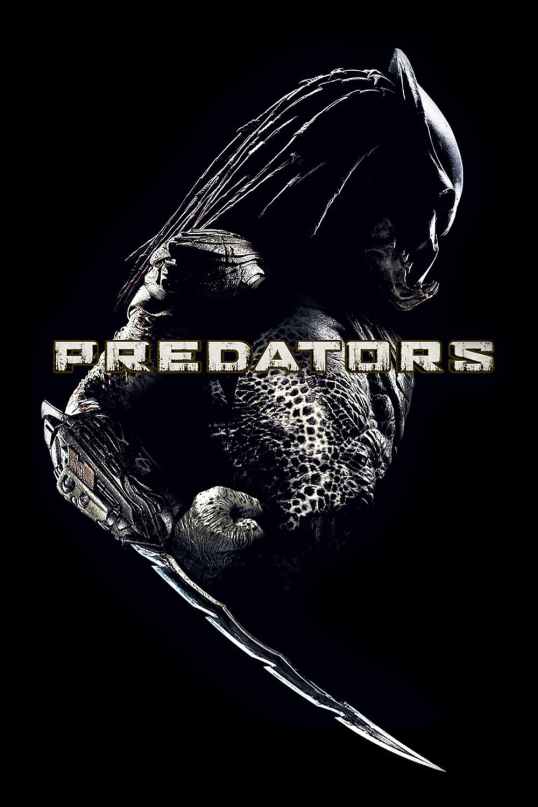
It would be twenty years before those space-faring hunters, the Predators, would return to the big screen. Sure, they appeared in the two Aliens vs. Predator films of the early 2000s, but I don’t count those as part of the Predator franchise—mostly because they weren’t the headliners. Plus, those two mash-up films were all kinds of awful.
2010’s Predators, directed by Nimród Antal and produced by Robert Rodriguez, set out to breathe new life into the sci-fi action franchise that the two AvP entries had drained of excitement. From the early 1990s until this film’s release, the Predator mythology had steadily expanded through novels, comics, and games, creating a world as rich as any in science fiction. Longtime fans came to understand the Predators’ culture, mindset, and technology.
For some, that world-building stripped away the mystery that made the Predator such an iconic monster. Others felt it helped establish consistent rules, allowing future stories to build on a solid foundation instead of endlessly one-upping what came before.
Predators embraced this expanded lore while adding a new wrinkle: the introduction of the so-called “Super Predators,” bigger, faster, and meaner than the classic hunters we’d seen over the decades. Another new element placed the story on an unnamed planet serving as an extraterrestrial game preserve, where Predators could hunt their chosen prey on familiar ground.
This setup lent a new dimension to the narrative. The humans being hunted had nowhere to run, and whatever advantage they might have enjoyed on Earth vanished instantly. They were now being hunted on Predator turf—a cruel inversion of game hunting, like a safari where the prey has no chance against its well-equipped pursuers.
Despite these new additions to the lore, the film mostly works as an action-thriller. We get the requisite band of misfits, murderers, and killers—the worst humanity has to offer, but the best at what they do. They range from black-ops mercenaries and elite snipers to cartel enforcers and even a serial killer.
Leading this reluctant ensemble is the enigmatic Royce, played by Oscar-winner Adrien Brody, who surprisingly pulls off the wiry, cold-hearted black-ops soldier. The film hinges on his performance. He’s not a team player, nor is he likable—he fits the antihero mold perfectly, willing to sacrifice anyone if it means surviving another hour. Yet he understands that his best chance lies in keeping others alive, if only as tools for his own survival. He’s the audience surrogate, the one who rolls his eyes as everyone else makes one bad decision after another.
Antal’s action direction recalls the McTiernan era. He favors long, sweeping takes that clearly define the geography of each battle—a quality too rare in modern action cinema, where quick cuts and shaky edits often stand in for real dynamism. Where the film falters is in its reliance on exposition-heavy dialogue. After nearly every action set piece, the momentum stalls as characters explain what’s happening. Laurence Fishburne even appears in a role that exists purely to deliver exposition.
Now, about those Super Predators: they’re an intriguing trio who expand the series’ creature variety, though at the cost of making the classic Predator seem almost obsolete. There’s the Tracker, who uses alien hunting dogs to flush out prey; the Falconer, who employs a cybernetic drone that feels straight out of the Marvel Cinematic Universe; and the Berserker, the biggest and most brutal of the three, relying on raw power rather than skill or strategy.
They look fantastic but slightly diminish the menace of the original Predator design. Against this new breed, the traditional hunters seem almost helpless.
Still, Predators stands several notches above what audiences got from the two AvP movies. Despite an exposition-heavy script and a bold but polarizing decision to downplay the classic Predator’s threat, Antal’s entry injects enough adrenaline and fresh lore to reenergize the series. It’s unfortunate that the AvP films’ lingering stench colored its reception, but over time, more fans have come to appreciate Predators for what it is: a fun, muscular, and engaging slice of sci-fi action.
 Through the Shattered Lens