That may seem like an obvious statement but I think it’s important to sometimes reiterate these things. That’s especially true with someone like Richard Ramirez. Ramirez murdered at least 15 people in California in 1984 and 1985 and, to this day, no one is sure why. The press gave Ramirez a cool nickname, christening him “The Night Stalker.” When he was captured, the press covered his claims of being a Satanist. Because he was a dark-haired bad boy with intense eyes, a large number of true crime groupies attended his trial and later claimed to be in love with him. (That will always be strange to me as Ramirez was also described as having rotten teeth and rancid breath. That would be a definite turn-off for me. Well, that and all of the raping and murdering.) Even when he was sent to Death Row, Ramirez’s admirers continued to send him money and gifts in the mail. For a select group of people, he was an icon.
That’s why I think it’s important to make a few things clear about Richard Ramirez.
He was a drug addict who reportedly struggled with impotence.
He was barely literate.
He specifically targeted women and the elderly because he knew he could overpower them.
He was captured because he was too much of a dumbass to realize that his picture was in every newspaper. He ended up getting his ass kicked by several angry citizens and he probably would have been killed by them if the police hadn’t shown up.
He was a Satanist, which is one of most boring things that you can be.
He said “See you in Disneyland,” after he was sentenced to death. He could have just gone to Disneyland on his own without killing people beforehand.
He had terrible personal hygiene. The long dark hair? There’s no way it wasn’t full of lice.
When he died, no one claimed his body so the prison just set him on fire and today, they probably use his ashes to help soak up spills.
In short, the dude was a loser and certainly not worthy of being played by Lou Diamond Phillips.
1989’s Manhunt: The Search For The Night Stalker deals with the search for the Night Stalker while not making the mistake of glamorizing him. We see Ramirez’s crimes but the film doesn’t waste much time trying to figure out what makes Ramirez tick. Instead, Ramirez remains a shadow of evil, descending on Los Angeles and reminding us all the lock our doors. The emphasis is instead on the two detectives (Richard Jordan and A Martinez) who are investigating the crimes and the journalists who often sensationalized the murders but who also played an important role in getting the uncaptured Ramirez’s face in front of everyone in California. The film itself delves into all of the true crime made-for-TV movie cliches but Jordan and Martinez both give good performances, the film does a good job of capturing the paranoia of a city under siege, and, most importantly, the film reminds us that Richard Ramirez was, above all else, a total and complete loser.
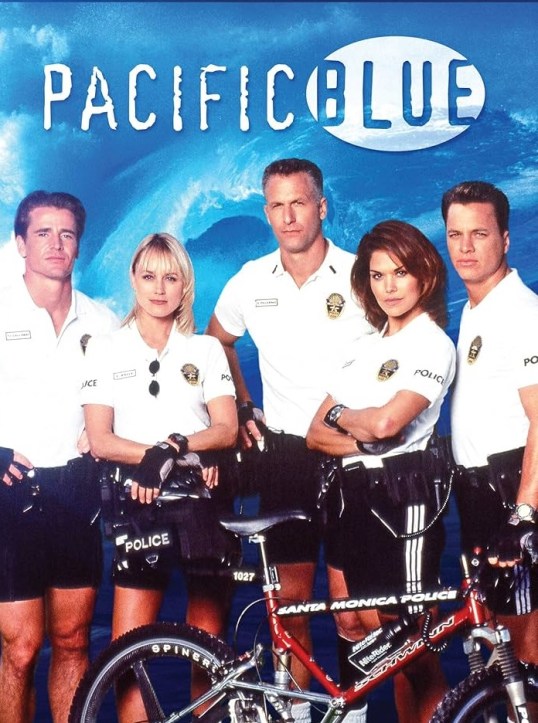
Welcome to Late Night Retro Television Reviews, a feature where we review some of our favorite and least favorite shows of the past! On Tuesdays, I will be reviewing Pacific Blue, a cop show that aired from 1996 to 2000 on the USA Network! It’s currently streaming everywhere, though I’m watching it on Tubi.
This week, Chris goes undercover.
Episode 2.8 “Undercover”
(Dir by Terrence H. Winkless, originally aired on October 13th, 1996)
A smarmy detective wants Chris to go undercover to help investigate a suspected money launderer, Tim Wakefield (Scott Plank). Palermo argues that Chris doesn’t have enough experience to work undercover but the detective asks Chris, “What do you want to do? You ready to get out of those bicycle shorts and do some real police work?”
I have to admit that line cracked me up. It really made the whole episode. Palermo got offended, as he always does whenever anyone points out that bike cops look silly with their shorts and their crisp white shirts. What was great about the line was that it was true. The detective may have been smarmy but he was right about Chris being invited to do “real police work” and he was right about bike cops not being real policemen. Everyone know it’s true! Seriously, if a bicycle cop ever tries to pull you over, just slam down on the accelerator. What are they going to do? Chase you when you’re going over 30 mph? I think not!
(Seriously, two seasons in and the show is still trying to convince us that bike cops are real cops. Sorry, Palermo, it’s not going to happen!)
That said, this episode’s main plot still ended up falling flat because Chris is not a very interesting character and her whole undercover thing wasn’t particularly credible. When she went undercover, she still came across as being just as stiff, humorless, and unlikable as when she’s riding her bike and threatening people with arrest. Tim Wakefield, of course, fell for her and Chris was supposed to be attracted to him and conflicted about her assignment and I never bought it for a second.
(As for Wakefield, he turned out to be not as bad of a guy as everyone assumed. He was arrested but his lawyer got him off and the episode ended with him sending Chris a postcard from some tropical beach. I think Chris was supposed to be wistful as she looked at the postcard but, since Darlene Vogel was apparently only capable of one facial expression, who knows for sure?)
Meanwhile, Cory dealt with being stalked by a mentally unstable ex-boyfriend, Wasn’t it just last week that Cory’s partner was being stalked by a mentally unstable woman? This show certainly does enjoy repeating itself. While Palermo worried about Chris, TC and Victor chased some roller-blading teens who were shooting random tourists with paintballs. The roller-blading scenes were kind of exciting but, unfortunately, they had to share space with all of the awkward bicycle scenes.
This episode had its moments. The roller-blading was cool. The detective making fun of Palermo was gratifying. Overall, though, the fact that the show centers around bicycles continues to be a flaw that simply cannot be overcome. There’s simply no way to make anyone riding a bicycle look impressive, I don’t care how serious they try to look.
Horizon: An American Saga: Chapter One is the rather unwieldy title of the first part of what Kevin Costner has said will be an epic four-part movie about the settling of the American frontier.
It’s very, very long.
It has a running time of three hours, during which time a lot of characters are introduced and a lot of plotlines are initiated but, because this is the only first chapter, none of them come to a close. In fact, as the film ends, it’s still a mystery as to how some of the characters are even related. I watched all three hours and I took my ADD meds this morning so you can be assured that I was actually paying attention. That said, I still struggled to keep track of who everyone was or even where they were in proximity to each other. Indeed, it was only towards the end of the film that I realized that several years were supposed to have passed over the course of the first chapter’s running time.
That’s not to say that the film is a disaster. While it’s not quite the nation-defining epic that Costner obviously envisioned it as being, it’s also not quite the cinematic atrocity that several critics made it out to be. It’s a throwback of sorts, to the epic westerns of old. As such, the film features taciturn gunslingers, a woman with a past, dangerous outlaw families, fierce Indian warriors, and a wise Indian chief who has dreamed of the coming of the white man. The film is full of actors — like Michael Rooker, Sienna Miller, Sam Worthington, Danny Huston, Will Patton, James Russo, Dale Dickey, and Kevin Costner himself — who feel as if they belong to a different era of filmmaking. Just about everyone in the film is heading to the settlement of Horizon, which sits in Apache territory. Despite the efforts of the Indians to kill every settler who shows up, they keep coming. As one army officer explains it, the Indians have made the mistake of thinking that the settlers will come to believe the land is cursed while the settlers, all of whom are full of American optimism, instead chose to believe that the previous settlers were unlucky but that the next wave of settlers will make it work. Costner has the right visual sensibility for a western. The film reveals a director who is obviously in love with the Western landscape and the film is at its best when it simply frames the characters against the beauty of the frontier. But when it comes to actually telling a compelling story, he struggles. There are a lot of moving parts to the first chapter of Horizon and the problem is not that they don’t automatically connect but instead that Costner never gives us any reason to believe that they’ll ever connect. There are no visual clues or bits of dialogue to assure the viewer that everything they’re watching is going to eventually pay off. Costner asks his audience to have faith in him and remember that he directed Open Range and Dances With Wolves while forgetting about The Postman.
The first hour, which features a brutal raid on the settlement by a group of Indians, is the strongest. It really drives home the brutality of what we now call the old west. In the style of Michael Cimino’s The Deer Hunter, Costner closely observes the individual customs of the film’s settlers and carefully introduces several appealing characters who leave the viewer feeling as if they’ve met a very special and very unique community of people. That makes it all the more devastating when the majority of those characters are subsequently wiped out with casual cruelty in a raid led by the Indian warrior Pionsenay (Owen Crow Shoe). (Later — much later — a tracker played by Jeff Fahey will show similar brutality while wiping out a group of Apaches.) The first hour establishes the frontier as being beautiful but also dangerous and it also drives home the mix of determination, desperation, and even madness that led so many to follow Horace Greeley’s advice and “Go west!” Though the film was shot in early 2023, the brutality of the raid brought to mind the terrible images of the October 7th attacks on Israel. The subsequent scenes in which Pionesenay and his followers ridiculed those in the tribe who wanted peace mirrored the current schism that’s driving apart the worldwide Left. The U.S. Army, for their part, arrives a day late and can only offer up not-so subtle condescension. The surviving settlers, however, remain determined to make a home for themselves.
The second hour focuses on Hayes (played by Costner), who rides into a mining town and gets involved with a family of outlaws who are looking for the woman who shot their father. The second hour is a bit more of a traditional western than the first hour, though some of the violence is still shockingly brutal. (Even being comedic relief won’t save you in this film.) Abbey Lee gives a good performance as the woman with a past and a baby and Kevin Costner is …. well, he’s Costner. He could play this type of role in his sleep.
The third hour is a mess, introducing a wagon train and featuring a miscast Luke Wilson as the leader of the settlers and Jeff Fahey giving a strong performance as a ruthless tracker. The third hour meandered as a whole new set of characters were introduced and I was left to wonder why the film needed new characters when the characters from the first two hours were perfectly adequate. It was during the third hour that I started to really get impatient with the film and its leisurely approach to storytelling.
The film ends with a montage of what we can expect from the next few chapters of Horizon and I will say that the montage actually looked pretty cool. That’s because the montage was almost totally made up of action scenes, with none of the padding that caused Chapter One to last an unwieldy three hours despite only having 90 minutes worth of story. Still, one has to wonder if we’ll actually get to see the next three chapters. The first chapter bombed at the box office and didn’t exactly excite critics. Costner is producing and financing the films himself and I doubt he’ll give up on them. The Horizon saga will be completed but will it made it to theaters or will it just end up on streaming? Personally, I think the whole thing would work best as a miniseries but who knows? (If Horizon was airing on Paramount, it would probably be a Yellowstone-style hit.) All I really do know is that Chapter Two has yet to be released. And that’s a shame because, for all of Chapter One‘s flaws, I’d still like to see how the story turns out.

 Through the Shattered Lens