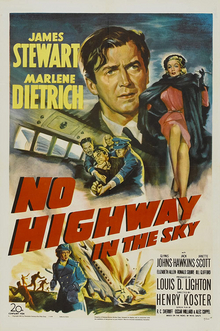
Film Review: No Highway In The Sky (dir by Henry Koster)


In 1951’s No Highway In The Sky, James Stewart stars as Dr. Theodore Honey.

In many ways, Theodore Honey is similar to the other roles that Stewart played after he returned from serving in World War II.  Dr. Honey is intelligent, plain-spoken, and good-hearted.  He’s eccentric and he sometimes has a difficult time relating to other people.  He’s also deeply troubled.  Dr. Honey is an engineer, one who specializes in determining how many hours an airplane can fly before it starts to fall apart.  Dr. Honey is in England, working for an airline and testing his hypothesis that their newest model’s tail will fall off after the plane accumulates a specific number of hours.  As is usually the case with these things, Dr. Honey’s employers are skeptical about his claims.  There’s a lot of money to be made in air travel and the last thing they need is some eccentric American scaring everyone.

When Honey sets out to investigate a recent crash site, he finds himself on the same type of airplane that he’s been testing.  After the plane takes off, Dr. Honey talks to the pilots and discovers, to his horror, that the plane is closing in on the time limit.  While flight attendant Marjorie Corder (Glynis Johns) tries to keep him calm, Dr. Honey explains his theory to a film star named Monica Teasdale (Marlene Dietrich), who just happens to be a passenger on the flight.  Both Marjorie and Monica find themselves falling in love with Dr. Honey and who can blame them?  He may be an eccentric and it may be hard to follow what he’s talking about but he’s still Jimmy Stewart!

I’ve often thought that Stewart was “Jimmy” before World War II but he was definitely James afterwards.  Stewart, unlike a lot of Hollywood stars who enlisted and were then used solely for PR purposes, actually flew several combat missions and saw firsthand the devastation of the war.  He returned to America deeply disturbed by what he had seen and there’s a definite sense of melancholy to be found in all of Stewart’s post-war performances.  That’s certainly the case here.  Dr. Honey is a widower, his wife having been killed by a rocket attack during the war.  He’s raising his 12 year-old daughter on his own and he deals with his sadness by throwing himself into his work.  He’s someone who has seen and experienced great tragedy firsthand and it’s left him more than a little obsessed. There’s a very authentic sadness at the heart of Stewart’s performance and it elevates this film, making what could have been a by-the-book corporate thriller into a character study of a man standing at the dawning of a new age, the post-war era of commercial air travel, and saying, “Well, hold on one minute.”

Unfortunately, Honey’s obsessive nature makes it easy for some to dismiss him.  When Dr. Honey purposefully sabotages the plane to keep it from flying again, he finds himself forced to defend his actions.  Can he prove that his theory is true?  And who will he end up falling in love with?  You can probably guess the answers but it doesn’t matter if the latter half of the film is a bit predictable.  James Stewart’s performance carries the film and keeps you watching.
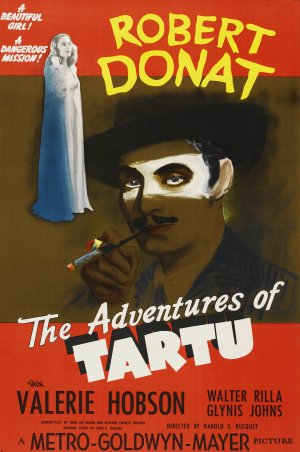
The Fabulous Forties #15: The Adventures of Tartu (dir by Harold S. Bucquet)


The_Adventures_of_Tartu_FilmPoster

The 15th film in Mill Creek’s Fabulous Forties box set was The Adventures of Tartu, a British film from 1943.

The Adventures of Tartu opens during the Blitz and follows Captain Terrence Stevenson (Robert Donat), a British explosives expert, as he defuses an unexploded German bomb in the ruins of London.  He does it without breaking a sweat or showing the least bit of hesitation.  With his clipped accent and his perfectly trimmed mustache, he’s a British hero through and through.  He’s so perfectly British that you expect him to start singing the entire score of H.M.S. Pinafore.  He’s the epitome of unflappable resilience.

And he’ll need all of that resilience to survive his next mission!  It turns out that, as British as he may seem, Captain Stevenson was originally born in Romania and is still fluent in both his native language and German.  Because of this, MI6 recruits him to parachute back into Romania, which is now under the control of the Nazis.  Stevenson will assume the identity of a recently assassinated Nazi chemist, Jan Tartu.  As Tartu, he will then make his way to Czechoslovakia where a member of the resistance will arrange for Stevenson to get a job at a secret Nazi chemical factory.  Stevenson will destroy the factory from within.

Unfortunately, Stevenson’s contact is arrested before he can arrange for job to be assigned to Stevenson.  When Stevenson (now pretending to be Tartu) arrives in Czechoslovakia, he is instead assigned to work in a munitions factory.  In order to eventually win assignment to the chemical factory, Stevenson now has to win the trust of the Nazis without losing the trust of the resistance.  That turns out to be more than a little difficult because, as Stevenson quickly discovers, he is now living in a world where no one can be trusted and everyone is paranoid.

(In one of the film’s best sequences, Stevenson is captured by a group of men and struggles to figure out whether he is now a prisoner of the resistance or a prisoner of the Gestapo.)

I’m not going to go into too many other details, beyond saying that The Adventures of Tartu is an effective and twist-filled work of wartime propaganda.  What’s interesting is that when the film starts, it almost feels a bit comedic.  Stevenson is so extremely British and the initial Nazis that he meets are so extremely buffoonish that it’s hard to take them seriously.  But, as the film progresses, it gets more and more serious.  In order to accomplish his mission, Stevenson is forced to make some difficult decisions and likable characters suffer as a result.  As Stevenson himself spends more time with the Nazis, both he and the viewer discover just how evil they truly are.  (Technically, the viewer should already know that the Nazis were evil but it must be remembered that The Adventures of Tartu was made during World War II, at a time when it was still difficult to get accurate information about what was happening in Nazi-occupied Europe.)  By the end of the movie, the Nazis are still buffoons but it’s impossible to laugh at them.

I imagine that wartime audiences left The Adventures of Tartu feeling even more committed to destroying the Nazi regime.  Meanwhile, modern audiences will watch The Adventures of Tartu and, once again, be reminded of how fortunate we are that the Allies won the war.

You can watch The Adventures of Tartu below!

http://www.youtube.com/watch?v=YhqNJCCTITs

Cleaning Out The DVR #5: Around The World In 80 Days (dir by Michael Anderson)


Last night, as a part of my effort to clean out my DVR by watching and reviewing 38 movies in 10 days, I watched the 1956 Best Picture winner, Around The World In 80 Days.

Based on a novel by Jules Verne, Around The World In 80 Days announces, from the start, that it’s going to be a spectacle.  Before it even begins telling its story, it gives us a lengthy prologue in which Edward R. Murrow discusses the importance of the movies and Jules Verne.  He also shows and narrates footage from Georges Méliès’s A Trip To The Moon.  Seen today, the most interesting thing about the prologue (outside of A Trip To The Moon) is the fact that Edward R. Murrow comes across as being such a pompous windbag.  Take that, Goodnight and Good Luck.

Once we finally get done with Murrow assuring us that we’re about to see something incredibly important, we get down to the actual film.  In 1872, an English gentleman named Phileas Fogg (played by David Niven) goes to London’s Reform Club and announces that he can circumnavigate the globe in 80 days.  Four other members of the club bet him 20,000 pounds that he cannot.  Fogg takes them up on their wager and soon, he and his valet, Passepartout (Cantinflas) are racing across the world.

Around The World in 80 Days is basically a travelogue, following Fogg and Passepartout as they stop in various countries and have various Technicolor adventures.  If you’re looking for a serious examination of different cultures, this is not the film to watch.  Despite the pompousness of Murrow’s introduction, this is a pure adventure film and not meant to be taken as much more than pure entertainment.  When Fogg and Passepartout land in Spain, it means flamenco dancing and bullfighting.  When they travel to the U.S., it means cowboys and Indians.  When they stop off in India, it means that they have to rescue Princess Aouda (Shirley MacClaine!!!) from being sacrificed.  Aouda ends up joining them for the rest of their journey.

Also following them is Insepctor Fix (Robert Newton), who is convinced that Fogg is a bank robber.  Fix follows them across the world, just waiting for his chance to arrest Fogg and disrupt his race across the globe.

But it’s not just Inspector Fix who is on the look out for the world travelers.  Around The World In 80 Days is full of cameos, with every valet, sailor, policeman, and innocent bystander played by a celebrity.  (If the movie were made today, Kim Kardashian and Chelsea Handler would show up at the bullfight.)  I watch a lot of old movies so I recognized some of the star cameos.  For instance, it was impossible not to notice Marlene Dietrich hanging out in the old west saloon, Frank Sinatra playing piano or Peter Lorre wandering around the cruise ship.  But I have to admit that I missed quite a few of the cameos, much as how a viewer 60 years in the future probably wouldn’t recognize Kim K or Chelsea Handler in our hypothetical 2016 remake.  However, I could tell whenever someone famous showed up on screen because the camera would often linger on them and the celeb would often look straight at the audience with a “It’s me!” look on their face.

Around The World in 80 Days is usually dismissed as one of the lesser best picture winners and it’s true that it is an extremely long movie, one which doesn’t necessarily add up to much beyond David Niven, Cantinflas, and the celeb cameos.  But, while it may not be Oscar worthy, it is a likable movie.  David Niven is always fun to watch and he and Cantinflas have a nice rapport.  Shirley MacClaine is not exactly believable as an Indian princess but it’s still interesting to see her when she was young and just starting her film career.

Add to that, Around The World In 80 Days features Jose Greco in this scene:

Around The World In 80 Days may not rank with the greatest films ever made but it’s still an entertaining artifact of its time.  Whenever you sit through one of today’s multi-billion dollar cinematic spectacles, remember that you’re watching one of the descendants of Around The World In 80 Days.